

Table of contents
- Executive Summary: The Hidden Costs of Bad Hiring
- Why Do Successful Hires Turn into Failures?
- How Can HR Prevent Employee Mismatch After Hiring?
- What Are the Biggest Recruitment Follow-up Issues?
- How Does Poor Onboarding Create Long-Term Problems?
- What Causes High Turnover in the First 90 Days?
- How Can We Measure and Improve the Quality of Hire?
- What Role Does Manager Training Play in Retention?
- How Can HR Leaders Implement a Strong Post-Hiring Strategy?
- Conclusion: Turning Good Hires into Great Employees
- Case Studies: Companies that Mastered the Transition
- Key Takeaways & Solutions (Post-Hiring Challenges)
- FAQs
Executive Summary: The Hidden Costs of Bad Hiring
Indeed, for CEOs and CHROs, the additional investment in the new hire goes well beyond the signing of the offer. This is when the real danger usually begins. Post-hiring challenges mostly create a cost to the tune of early turnover, which then negates the entire six-month exercise of recruiting. Most reasons for this are quite serious employee mismatch after hiring and subsequent recruitment follow-up issues that deter, mislead, or otherwise give wrong impressions to newly assigned employees about the work environment. This post outlines major failures right after signing the contract and proceeds to recommend strategic manager-led approaches to get a successful hire as a term, high-performing asset. Closing the gaps between pre-hire promises and post-hire reality will protect HR leaders’ talent investment.
Why Do Successful Hires Turn into Failures?
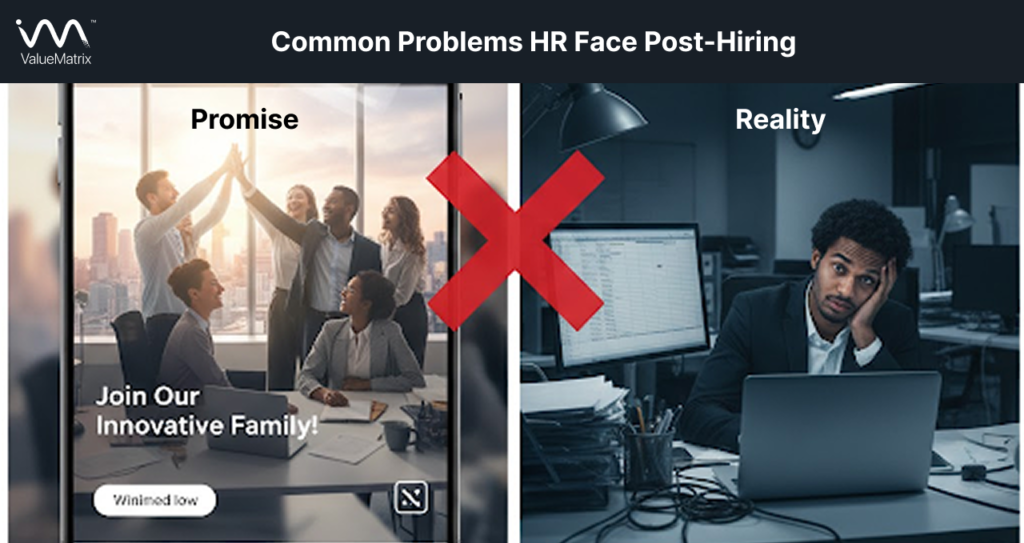
One of those really frustrating post-hiring challenges in HR is when that newly hired candidate leaves the organization merrily, sometimes as early as a few months into employment. Most of the time, that is due to the employee mismatch after hiring and the actual working realities that new hires face every day. In the absence of clear expectations being set, HR and the hiring manager will find themselves confronted with that confused new hire, and eventually, the disillusionment of that employee or voluntary turnover. Halving the related questions involves some genuine internal thinking on how we sell the job and transition the candidate.
Recruitment invariably talks about the positives of the role and overlooks what those difficult day-to-day realities might mean in the long run.
The Hidden Problem of Expectation vs. Reality
The recruiter spins stories about strategic, exciting work, and the new hire, once in, expects three months of getting onto the job without doing boring administrative stuff. On entering, therefore, they feel cheated. The hourly compromise on the gaps between the job description and real performance must be reduced.
Did We Misread the Candidate’s Motivation?
In some cases, the reason that a person took the job was purely financial, not for the sake of the mission. This poor justification causes problems for that individual, particularly once the work gets stressful. Among other things, pre-hire screening becomes much more effective in uncovering a candidate’s real drivers.
Lack of Clear Performance Goals
The new hires should know an explicit definition of success on the 30th, 60th, and 90th day. Without clear and measurable goals, the new hire feels adrift and worthless, assumes he or she must be failing, and thereafter, it is like an employee mismatch after hiring.
Ultimately, the failure post-hire truly stands for a failure of communication and integration. By addressing these very fundamental issues, HR stands to achieve great success in curbing unnecessary early turnover costs.
How Can HR Prevent Employee Mismatch After Hiring?
It is typically too late to address employee mismatch after the hiring process; it must begin well before the new hire ever steps through the door. Increasingly, this entails creating a hiring process that is more honest and transparent, and where the focus is on fit rather than mere skill. The CHRO needs to establish processes that actively seek evidence of cultural compatibility and present a genuinely realistic picture of the job environment and team dynamics to the candidate. The whole idea is to prevent post-hiring issues at the source.
A significant investment in time for screening tools and candid conversations minimizes the chances of having to repeat an expensive recruitment process very shortly after.
Improving the Interview for Cultural Fit
Interviews should include structured questions on handling conflict, receiving feedback, and collaboration alongside skill inquiries. These behavioral inquiries are far more accurate in predicting success than a test of required technical skills.
Conducting Structured Reference Checks
Reference checks should confirm more than just dates of employment; they should also include questions that objectively address the candidate. They should be concerned with work style and how they will address the problems of your role and company culture.
Using Realistic Job Previews
An important strategy to curb employee mismatch post-hire is to give the candidate an honest preview of the bad side of the job (e.g., “The team is facing a difficult deadline and needs 50-hour workweeks for the next quarter”), thus allowing the candidate to self-select out if the job is too much to handle.
Wherever the HR process predicts long-term fit as opposed to short-term skills acquisition, it considerably enhances the chances of building a successful and sustainable employment relationship.
What Are the Biggest Recruitment Follow-up Issues?
A major source of post-hiring challenges stems from recruitment follow-up issues on the operational failures that happen between the offer acceptance and the first day. This time should be a buildup to excitement and confidence, but it is more often than not shrouded in silence, mixed up at best with paperwork, and bad at coordination. A sense of this is what is said to the new hire; the company is a bit disorganized, and this casts doubt into the mind of the new hire, who may possibly even decide to ghost them before the start date. Rectifying this inter-staging period is quite crucial.
An administrative glitch indeed tests the organizational efficiency of your HR function. And failure on this occasion will place in jeopardy all the good work done within the recruitment arena.
Why Communication Drops After the Offer
Once the aspirant accepts the offer, the recruiter goes on to the next vacancy, leaving the new hire in a vacuum. A dedicated environment for pre-boarding with automated welcome messages and manual check-ins should be designed for engaging the new hire.
The Problem of “Pre-Boarding” Paperwork
A very obnoxious welcome to a new employee would be getting them to fill out endless paper forms on the first day. Getting all the necessary tax forms, contracts, and internal set-up requirements completed online before day one means using their first day to focus on people rather than paperwork.
Lack of Manager Readiness
If the desk, computer, and first week’s schedule for the new hire were not ready on behalf of the manager, a message would be sent across that the company is unprepared and unprofessional. Without serious enforcement from the HR team, a company’s checklist will fail to ensure that major recruitment follow-up problems have been avoided, and the hiring manager is fully ready for day one of the new employee.
If treated as a priority, the time between acceptance and start date will go a long way in calming any jitters and practically ensuring a great beginning.
How Does Poor Onboarding Create Long-Term Problems?
The directives and teachings of HR have put the onboarding into severe processes. It is not just an event; in fact, an entire strategic integration is ongoing for a period of about six months. These failures lead to an immediate increase in post-hire complications, as well as early exit. Most damaging, poor onboarding suggests to new hires they are not that important, slows productivity, and inhibits the critical relationship-building necessary for national success. Also, there is such a severe investment in hiring that any failure to integrate them with the new working environment is a waste.
A Good RETENTION SYSTEM CARVES ONBOARDING INTO ITS FOLD. Here, investment starts returning dividends in talent.
The Connection Between Onboarding and Retention
Formally put through onboarding, employees remain with the organisation at the end of the year; instead of a one-day orientation, which will be very expensive, especially in the long run.
The Danger of Information Overload
A new employee is overwhelmed on the first day book of 100 pages and six hours of HR presentations. This is too much. Information shall be delivered in small, manageable chunks over some weeks, prioritised according to what they need to know now.
Failing to Integrate the New Hire Socially
Most often, success is knowing who to ask in getting help. Onboarding must include intentional introductions to key cross-functional partners and team members. Assigning a social buddy helps break the ice and ensures they quickly build a supportive network.
HR leaders should redefine onboarding such that it will not merely be a one-time event, but a longitudinal, strategic, long-term process aimed at expediting productivity and creating a lifetime of loyalty in employees.
What Causes High Turnover in the First 90 Days?

In the first three months, high turnover rates usually serve as the strongest elicitors of post-hiring challenges. This condition, in nearly all cases, is attributable to either employee mismatch after hiring or important gaps in the support structure provided by the manager and co-HR staff. All costs in recruiting, hiring, and training a new employee are virtually wasted with the very early exit. Familiarity with the basic processes, however, is clearly essential for executive leaders.
Fixing the 90-day turnover: it is all about huge dedication to support and feedback while managing the initial shock of starting a new job.
The Impact of Unmet Expectations
As elaborated, newly appointed employees will quit once reality doesn’t match the recruitment promises. Disappointment becomes the subsequent phase when excitement yields to disappointment-such an efficient excuse for leaving a company.
Insufficient Manager Support
Check in, guide, socialise, mostly lead by example when trying at least: I am busy and may be unavailable. Such an employee feels abandoned and cannot succeed.
For example, manager engagement in the first 90 days is perhaps the largest factor in the retention outcome.
Lack of Early Wins and Feedback
Thus, the early win assignment and ongoing acknowledged feedback from topic-competent managers have to be via several ways. Ways by which HR ensures that the new employee perceives themselves as a very important contributor, while also earning some positive strokes in the process.
HR can save the company a great deal of money by replacing the recently hired employee, focusing support and clarity through this critical window.
How Can We Measure and Improve the Quality of Hire?
Data is the currency for CEOs. Unless HR measures the post-hiring challenges correctly, it cannot solve them. The ultimate measure of saying that recruitment worked is the long “Quality of Hire” focus far behind the usual time-to-hire timeline; this measure checks whether the new employee is succeeding after six or twelve months. With the help of examining success through tracking, HR would thereafter know which faults need to be rectified-whether it is in the first part (interview, onboarding, recruitment follow-up issues).
With outcome results being measured, HR further becomes proactive rather than just tending to issues after the fact or dealing with failures.
Tracking 90-Day Performance and Engagement
While tracking performance metrics and engagement levels within the first 30, 60, and 90 days, evaluations should be formal. This data would serve as the initial signal of a potential employee mismatch after hiring and would allow for immediate course correction.
Analyzing Source-of-Hire Success
HR should keep track of what sourcing channels (which may include referrals, job boards, and internal transfers) bring about those hires, and hiring successes and hires that remain retained. This is a good intervention to stop funneling money down the various sources that are never-endingly bringing in fast talent that just doesn’t cut it.
Using Exit Interviews for Process Improvement
When an employee leaves too soon, the exit interview should not center on the employee but rather on the failure of the system. Structure questions to assess how well the job matched the recruitment pitch used to recruit-and what recruitment follow-up issues influenced the departure.
Data turns HR into a strategic partner capable of diagnosing and fixing systemic problems.
What Role Does Manager Training Play in Retention?
The single most vital element in the success or failure of any new employee is truly this very manager. For a truly sustainable solution to the perils of post-hiring challenges, HR needs to shift its focus from training the new hire to training the manager. A poor manager will make a poor choice after an employee mismatch after hiring, or provide inconsistent guidance for the new hire. Manager readiness is therefore a per-second imperative in the talent strategy.
Training managers is an investment in the retention and productivity of all your human resources.
Coaching Managers on Early-Stage Mentorship
This should entail training them on new hire support specifics: how to set expectations, how to introduce the team, and how to balance training with work on something productive.
Ensuring Managers Deliver Consistent Feedback
A structure for feedback on the part of HR to managers must also include non-confrontational, time-bound, and consistent during the course of the trial period, the first 90 days. Ongoing feedback prevents small performance issues from snowballing into large, job-ending ones.
Holding Managers Accountable for New Hire Success
New hire turnover rates should be one of the indicators used to measure the performance of managers. This affirms retention as a leadership imperative and not only as an administrative concern for HR.
When equipped with the right skills, managers are transformed from passive observers into active retention agents.
How Can HR Leaders Implement a Strong Post-Hiring Strategy?
The successful resolution of the difficulties presented by the post-hiring stage requires an alignment along an evidently documented process; thereby, lessening extant nomenclature of the first year of employment into the recruitment interphase. It is not just a question of new tasks; rather, recruitment follow-up issues deservedly should be identified as processes to be structured, automated, and delivered consistently under contractual rights of predictability and professionalism, which are demanded by the most talented ones.
This means the process of making manual errors is futile by ensuring unwavering support for the new employee, from a new, fragile hire into an absolutely loyal and full-contributory team member.
Designing a “First 180 Days” Roadmap
Preparation of an endorsed roadmap in documented form, spelling out all mandatory check-ins, training modules, social introductions, and performance review activities that must happen over the first six months. HR and the manager become accountable together.
Automating Key Check-ins and Surveys
Utilise the HRIS system for the automation of manager reminders on 30/60/90-day reviews while automatically delivering to the new hire short anonymous surveys on the experience, flagging any potential employee mismatch post-hiring.
Treating Post-Hiring as the Start of the Employee Lifecycle
The integration is seen by HR leaders to be the first step toward employee development. A focused effort to ensure excellence in the first year furthers long-term engagement, training effectiveness, and leadership development.
Post-hiring phase formulation is the strategic cure for expensive early turnover
Conclusion: Turning Good Hires into Great Employees
Addressing post-hiring challenges requires executive buy-in to convert the process into a strategic one. By automating recruitment follow-up and removing employee mismatch after hiring through honest previews and manager training, HR adds value to the company’s talent investment. An emphasis on the seamlessly executed first 180 days turns a successful recruitment event into a foundation for the long-term success and competitive advantage that an organisation prospers upon.
Statistics: The Hard Facts of Post-Hiring Failure
- Turnover Cost: The cost of replacing an employee would be anywhere between 6 to 9 months of the salary of that employee; therefore, the turnover cost increases due to early turnover owing to poor post-hiring follow-up.
- Onboarding Impact: New hires who are inducted into well-structured programs hold on to their companies 82% more strongly than those inducted into weak programs and are over 70% productive.
- Manager Failure: Almost 60% of new hires with managers who do not contact them between the offer and start date are likely to resign within the first year.
Case Studies: Companies that Mastered the Transition
1: Google’s “Just-in-Time” Nudges
- The Fix: Google found manager preparedness was key. They created a simple automated email checklist sent to managers the day before a new hire started, listing five critical setup steps (e.g., “Have a welcoming conversation,” “Discuss the role’s network”).
- The Result: The simple recruitment follow-up issues were solved, leading to a 25% increase in new hire productivity within the first 9 months, proving manager readiness is not complex, just consistent.
2: Microsoft’s Employee Experience Platform
- The Fix: Microsoft implemented a digital platform that manages the pre-boarding process. It automates paperwork, sends personalised welcome videos, and introduces the new hire to their team and mentor before Day One.
- The Result: By solving potential employee mismatch after hiring through transparency and eliminating administrative friction, Microsoft ensured new employees arrived feeling valued, connected, and ready to contribute immediately.
Key Takeaways & Solutions (Post-Hiring Challenges)
| Problem Faced (Post-Hiring Challenges) | Key Risk/Symptom | Strategic Solution for HR |
| Employee Mismatch After Hiring | New hires leave after their first 90 days; they were found to be ‘disinterested’. | Introduce RJPs and structured behavior-focused interviews with respect to the cultural fit. |
| Recruitment Follow-up Issues | ‘Ghosting’ employees before their first day; post-appointment administrative chaos on the first day. | Establish a pre-boarding process with programmed checks and an entirely paperless system before baseline. |
| Poor Onboarding | Long time-to-productivity; subdued social integration and support. | Draw up an all-encompassing First 180 Days Roadmap, detailing mandatory executive supervision and peer buddying. |
| Lack of Manager Accountability | Leads to abandonment by new employees towards the end of inconsistent support. | Include newcomer retention as a direct metric that is measurable on the performance review for any hiring manager. |
FAQs
An RJP is a recruiting method whereby one provides a complete picture of the job with clear advantages as well as disadvantages to the candidates. It prevents employee mismatch after hiring because candidates who are sensitive enough to the challenges can self-select out and leave behind only those more genuinely prepared for the reality of the role.
Quality of Hire. It requires tracking the career success of the employee in time (usually deployed 6 or 12 months after hiring) as judged through performance reviews, retention rate, and manager feedback, thereby revealing the true importance of the recruitment process itself.
This period of silence following the offer and before the start date is really optimal for risk. Bad recruitment follow-up issues indicate disorganisation and neglect, which may cause candidates to “accept competing offers or doubt their choice”, leading to the cost of “candidate ghosting.”
should also be included as one of the metrics to weigh the manager’s annual performance review. That way, the manager’s compensation and advancement in career progress will be dependent on assuring that newly hired team members are absorbed and retained.