
Table of contents
When an employee leaves, the loss is rarely limited to a resignation letter. It’s a slow unraveling — of momentum, of morale, of time that can’t be billed or quantified. Most leaders can calculate a replacement salary. Fewer can measure the cost of disengagement that begins long before someone decides to walk away.
High turnover has long been viewed as an HR problem. In reality, it’s an organizational blind spot — one that bleeds into finance, operations, and even customer experience. The Society for Human Resource Management (SHRM) estimates that replacing a single employee can cost up to 50–200% of their annual salary, depending on their role and tenure. However, the hidden costs — the ones embedded in interrupted workflows, postponed projects, and employee burnout — frequently exceed that amount significantly.
What makes these costs truly dangerous is their invisibility. Attrition erodes value quietly. A top performer’s departure can set off a chain reaction — colleagues shoulder extra work, quality slips, and morale takes a hit. Each of these outcomes carries a financial implication that most organizations fail to link back to turnover.
In an age where data defines every other business decision, talent loss remains oddly anecdotal. This gap exists not due to apathy from companies — rather, it stems from their inability to quantify what isn’t readily visible. The hidden costs of attrition lie in the ambiguous aspects of human conduct: engagement, culture, trust, and exhaustion.
Progressive organizations are beginning to acknowledge this discrepancy. Employing AI-powered talent intelligence tools like ValueMatrix, certain organizations are starting to identify early signs of attrition — ranging from falling engagement metrics to subtle changes in communication trends. Because the real question isn’t how much turnover costs, but how much of it could have been prevented if the warning signs had been seen sooner.
What Turnover Really Costs
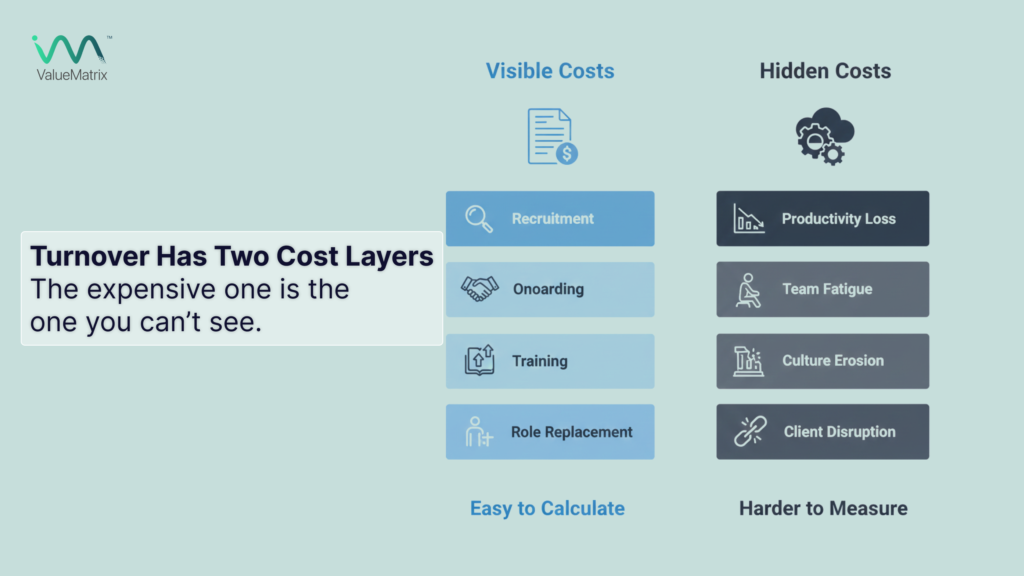
When organizations talk about turnover, the conversation usually starts with recruitment budgets and ends with onboarding costs. These are tangible, easy to document, and simple to explain in a quarterly report. But the true cost of employee turnover doesn’t end when a new hire signs an offer letter — it begins there.
Direct costs consist solely of visible elements: job advertisements, recruiting expenses, interview durations, moving costs, and training sessions. The Center for American Progress discovered that the cost of replacing a salaried worker averages 20 % of their annual pay, and this figure can significantly rise for leadership or specialized positions. However, that estimate fails to capture what occurs in the weeks and months that follow.
Each new employee creates a productivity gap — the time between training and complete competence. In that period, current team members compensate, frequently at the expense of their own productivity. Managers split focus between training and delivery, deadlines stretch, and client satisfaction subtly dips. These are rarely captured in spreadsheets, but they directly affect revenue.
Then there’s the cultural cost. Each departure resets team chemistry. Projects lose continuity, institutional knowledge walks out the door, and informal networks — the invisible systems that keep work flowing — collapse and must be rebuilt. The impact compounds when turnover becomes habitual; retention then shifts from a challenge to a crisis.
From a financial standpoint, employee retention cost — investing in engagement, learning, and wellbeing — is almost always lower than the ongoing churn cycle. A single strong retention program can offset multiple departures. But most organizations still allocate more budget to replacement than to prevention.
Modern HR analytics are starting to expose this imbalance. By tracking turnover-related KPIs — time-to-fill, early attrition rate, and training ROI — leaders can begin to see how much they’re losing to reaction instead of investing in stability. AI-driven systems such as ValueMatrix go further, identifying which teams face rising attrition risk before it turns into a resignation.
Turnover isn’t merely a cost center; it’s a signal. And grasping its message is the first step to preventing the leak from evolving into a structural issue.
The Hidden Costs That Hurt Growth
For most organizations, the financial cost of replacing an employee is visible. What stays hidden is the extended series of implications that occur quietly — diminished productivity, declining morale, and the breakdown of trust. These effects are not isolated; they create a pattern that can subtly weaken growth.
1. The Productivity Black Hole
Productivity doesn’t merely fall when an individual departs — it begins to decrease well in advance of the resignation. Gallup reports that actively disengaged workers result in organizations losing 18% of their yearly salary due to decreased productivity. When disengagement permeates a team, it can hinder deliverables, postpone launches, and diminish quality.
Each departure creates a vacuum. Workloads are reassigned among teams, deadlines are adjusted, and the adjustment period for new hires contributes to prolonged inefficiencies. Institutional knowledge — methods for quicker problem-solving, who to approach for immediate solutions, and which clients favor what — disappears suddenly. In specialized positions, the effect is amplified; a single departure can disrupt entire project schedules or client outputs.
This loss is seldom quantified in monetary terms, but it directly affects HR metrics, employee turnover and overall business performance. Businesses that see turnover solely as a recruitment expense fail to recognize its significant impact on daily operations.
New tools in talent intelligence, such as ValueMatrix, are assisting organizations in measuring this productivity gap. By analyzing patterns such as declining collaboration frequency or reduced engagement in team communications, these systems surface early indicators of performance slowdowns long before resignations occur.
2. Engagement Decay and Emotional Fatigue
Turnover doesn’t just remove people; it drains energy. Each departure chips away at the collective sense of purpose. The other employees are tasked with managing new responsibilities, dealing with unpredictability, and doubting their own security.
A study by MIT Sloan Management Review indicates that a toxic workplace culture is 10 times more indicative of employee turnover than salary. This underscores a fact that numerous organizations fail to recognize: retention involves more than just compensation or benefits; it’s about emotional balance.
As engagement decreases, innovation diminishes as well. Employees cease to offer suggestions, communication turns transactional, and collaboration across functions diminishes. Ultimately, even dedicated team members begin to lose motivation—not due to a desire to depart, but because it appears that no one is staying.
Employee engagement and turnover are connected in a cyclical relationship. Limited involvement leads to exits, and exits subsequently reduce involvement. To break this cycle, it’s essential to move past HR initiatives; it requires a thorough grasp of employees’ feelings, interactions, and connections within the work environment.
By analyzing sentiment trends on communication platforms, AI-driven systems can detect indicators of disengagement — like decreased feedback involvement and slower reply rates — enabling swift action.
3. Brand and Client Fallout
Every exit sends ripples beyond internal walls. When client-facing employees leave, customer relationships weaken. A project delayed by a transition can erode years of trust.
In sectors such as consulting, SaaS, and creative services, consistency is valuable. Clients frequently remain due to connections, not contracts. Repeated turnover in essential teams may give a company an impression of instability, despite maintaining high service quality. Eventually, this viewpoint influences renewals, referrals, and brand image — an expense that no financial statement captures.
4. Leadership Opportunity Cost
Leaders fail to recognize the extent of time that turnover takes away. Every resignation leads to more interviews, additional onboarding, and diminished strategic focus. When senior management is drawn repeatedly into firefighting retention issues, long-term planning suffers.
The opportunity cost here is massive. Instead of innovating, leaders are reacquiring talent they already paid to develop. A cycle of constant rehiring blurs priorities and burns leadership energy that should fuel growth.
AI-driven predictive workforce analytics can assist in redirecting leadership focus towards strategy. By pinpointing departments at high risk for turnover, predicting role-specific risks, and correlating engagement declines with business results, these systems enable leaders to intervene before attrition worsens.
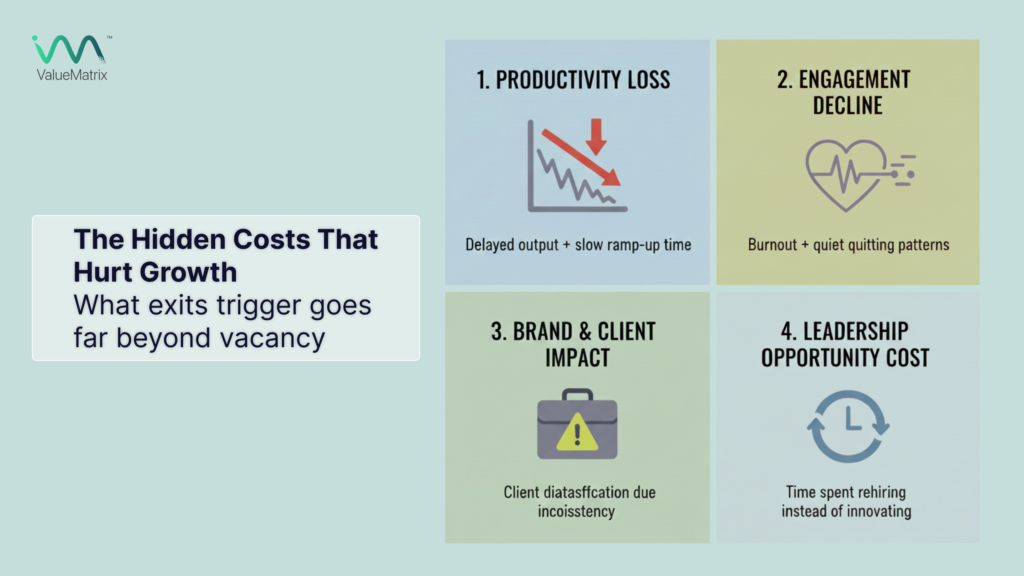
The hidden costs of turnover don’t appear on financial statements, but they manifest everywhere: in missed deadlines, rising stress, and fading trust. Over time, these invisible losses compound into measurable stagnation. Organizations that learn to identify these early – through data, empathy, and foresight – are the ones that sustain growth long after others start counting their losses.
Measuring the True Cost: Data Is the New Compass
For years, the conversation around turnover has been driven by intuition rather than intelligence. HR teams have tracked resignation counts and exit interview notes, but not the complete financial, operational, and emotional footprint that follows each departure. The challenge isn’t a lack of data — it’s a lack of synthesis.
Assessing the cost of employee turnover begins with quantifiable indicators:
- Direct costs: hiring, orientation, training, and temporary productivity decline.
- Indirect costs: diminished morale, lost chances, leadership time, and eroded client confidence.
The Society for Human Resource Management (SHRM) suggests that when these factors are combined, the total cost of turnover can reach three to four times the departing employee’s annual salary. However, only a few organizations evaluate this in depth. They see turnover only as a percentage instead of a performance measure affecting revenue, customer experience, and long-term growth.
To bridge this gap, innovative HR leaders are reinterpreting turnover evaluation as an element of their workforceintelligence strategy. Instead of viewing exits as isolated events, they are connecting retention data with insights on performance, engagement, and culture
This is where technology quietly redefines the game.AI-driven systems, like those integrated into ValueMatrix, consolidate engagement metrics, behavioral trends, and performance signals to identify where attrition is most likely to occur. These insights go beyond numbers — they explain the “why.” For example, a consistent decline in project involvement or interdepartmental cooperation can signal early signs of disengagement that foreshadows turnover.
Possessing this data doesn’t eradicate attrition; it places it in context. It enables leaders to identify trends — which teams lose talent most quickly, which positions demonstrate ongoing dissatisfaction, and which supervisors foster lasting loyalty. Through this perspective, turnover shifts from being a reactive concern to a more anticipatory matter.
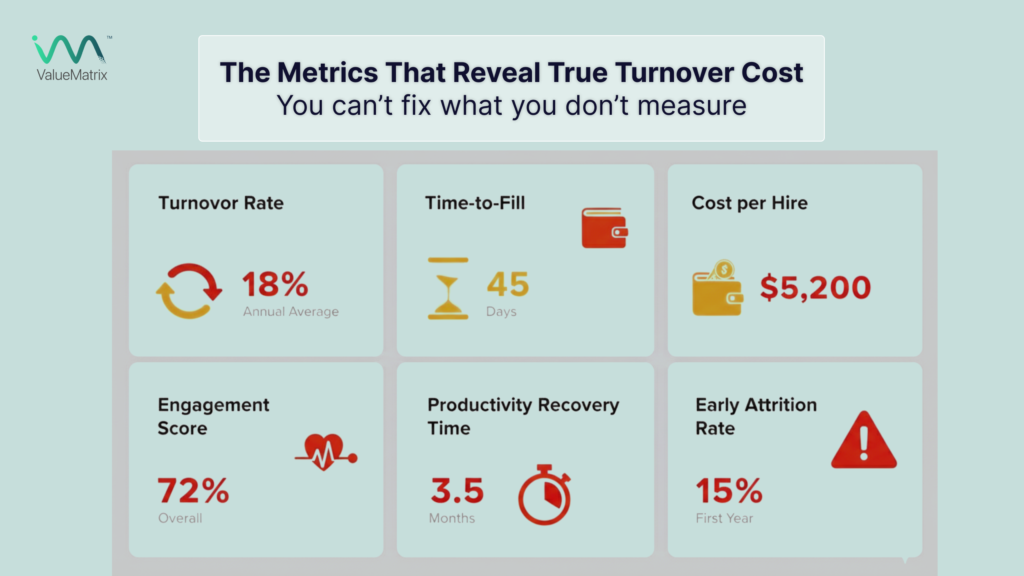
When organizations assess what is important, they cease to mistake activity for advancement. When considered as strategic indicators instead of mere afterthoughts, retention metrics serve as a compass that highlights the health of culture, the clarity of leadership, and the sustainability of growth.
Cultural Debt: The Long-Term Price of Ignoring Turnover
Every organization carries a certain level of cultural debt — the invisible backlog of neglected engagement, strained communication, and unspoken fatigue. Like financial debt, it compounds over time, quietly shaping the organization’s future. High turnover accelerates this process, forcing teams to constantly rebuild identity faster than they can sustain it.
Culture is often described as “how things get done when no one’s watching.”As turnover increases, that quiet tempo starts to break apart. Teams lose their unofficial leaders — those who boost morale, resolve conflicts, or remind everyone about the importance of their work. Without them, anxiety fills the space. What was once collaboration becomes coordination; what was once trust becomes tolerance.
A study by MIT Sloan Management Review found that toxic culture was the single largest predictor of attrition during the Great Resignation — over 10 times more influential than compensation. Yet toxicity rarely begins as overt behavior; it starts subtly, through unaddressed stress, unclear communication, and leadership fatigue. Left unchecked, these become normalized, eroding the very foundation of belonging.
This is where turnover becomes more than a symptom — it becomes a signal. High attrition doesn’t only reflect dissatisfaction; it reflects an identity crisis. Employees don’t just leave companies; they leave cultures that stop reflecting their values. And when culture becomes transactional, so does loyalty.
The long-term consequence of this is harder to quantify but deeply felt. Innovation slows because psychological safety diminishes. Knowledge-sharing becomes guarded. New hires sense instability before they find belonging. Over time, even strong employer brands begin to fade — not through bad press, but through word-of-mouth from those who quietly left.
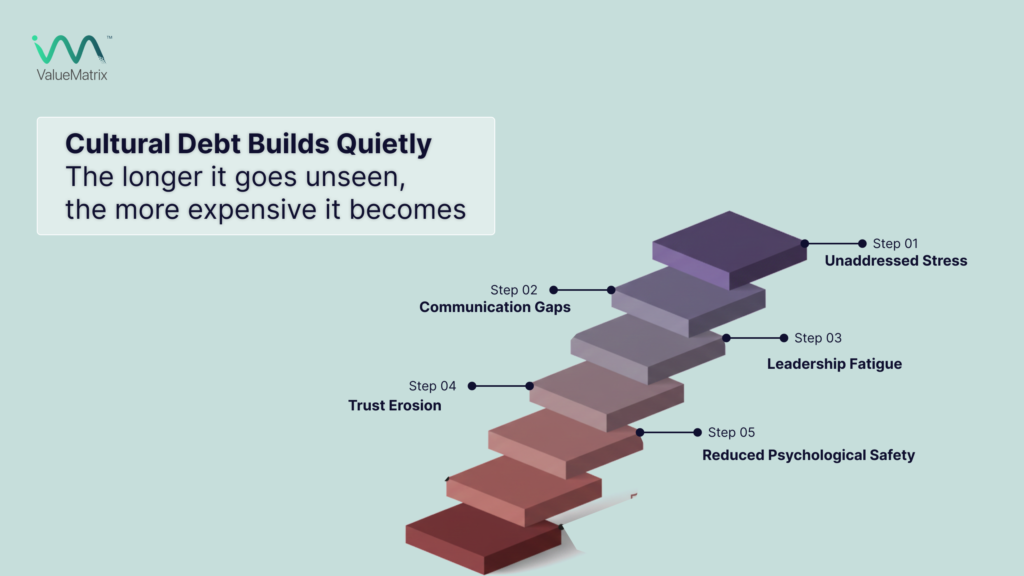
Technology can help illuminate what intuition alone can’t.AI-powered talent analytics can map sentiment trends, measure engagement pulses, and reveal cultural drift before it becomes visible. Tools like ValueMatrix are being used by forward-thinking organizations to translate culture into data — not to replace empathy, but to enhance awareness.
The cost of ignoring turnover isn’t only financial; it’s philosophical. Culture is an organism that either evolves or decays. When signs of warning are ignored, the costs of recovery become significantly higher than those of prevention.
From Attrition to Advantage: Using Talent Intelligence to Reduce Churn
Turnover, at its core, is a feedback loop. It reveals what an organization values, overlooks, and tolerates. While it’s impossible to eliminate completely, the difference between reactive companies and resilient ones lies in how quickly they recognize its patterns. With the right insights, attrition can become an advantage — a diagnostic tool for culture and leadership.
1. Diagnose Before You Retain
The natural reaction to turnover is to address it once it occurs — through exit interviews, salary changes, or fresh engagement initiatives. However, at that point, it’s already too late. The wiser strategy is to identify risk early, when disengagement can still be reversed.
This is made possible bypredictive analytics. AI-driven systems can aggregate subtle signals – attendance dips, reduced peer interaction, slower project participation – and translate them into retention risk models. Tools like ValueMatrix use behavioral and performance data to highlight at-risk teams or individuals before formal disengagement occurs.
This proactive view changes everything. Instead of asking why people left, leaders start asking what might make them stay.
2. Personalize Retention at Scale
No two employees leave for the same reason. Some seek growth; others desire acknowledgment, adaptability, or purpose. The difficulty lies in recognizing these patterns without making retention a uniform process for everyone.
Talent intelligence aids in closing this divide. Through the integration of engagement metrics and role-specific data, AI can categorize employees into distinct “retention personas.” For instance, technical talent may prefer learning opportunities, whereas creative teams appreciate autonomy and meaning.
When these patterns become apparent, HR can create initiatives that truly connect — mentorship for leaders, clarity in career paths, adaptable policies, or recognition programs linked to contributions rather than length of service. In summary, personalization eliminates uncertainty.
3. Leadership and Listening
Data can reveal risk, but only leadership can tackle it. The Gallup State of the Global Workplace report consistently reveals that managers contribute to at least 70% of the differences in team engagement. To put it differently, individuals don’t leave jobs — they abandon managers who lack clarity or compassion in their leadership.
This is why data must inform, not replace, human connection. When engagement dips, leaders need to listen, not just analyze. AI insights are most powerful when paired with authentic dialogue — performance conversations that focus on purpose, not punishment.
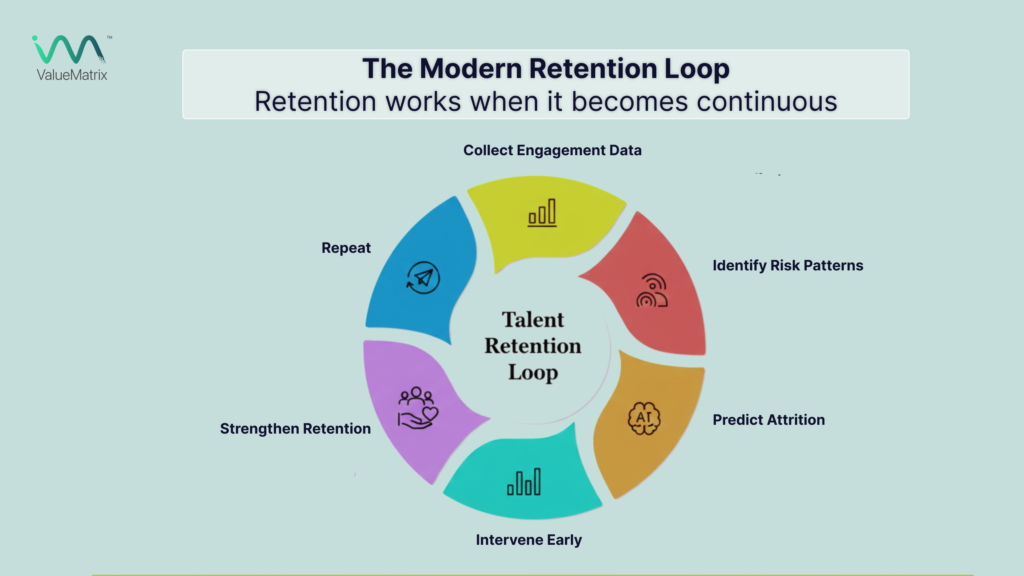
4. Build a Continuous Retention Loop
Traditional HR models treat turnover as an event; modern talent systems treat it as a signal in motion. The goal isn’t to stop exits altogether, but to understand them faster and prevent avoidable churn.
Continuous feedback systems – pulse surveys, performance analytics, sentiment mapping – feed this loop. Platforms like ValueMatrix integrate these inputs to identify where culture, leadership, and engagement intersect most effectively. This allows organizations to move from “tracking attrition” to actively predicting and reducing it.
When retention is constant, organizations cease to react and begin to prepare for the future. They shift from responding to exits to creating spaces where individuals prefer to remain – not out of necessity, but by choice.
Conclusion
Turnover is frequently viewed as an inescapable expense of conducting business – a logistical setback that is accommodated in yearly budgets. Yet beneath each resignation lies a narrative regarding people’s work experiences: if they feel recognized, appreciated, or merely disposable. The hidden costs of attrition are, in numerous respects, human expenses masquerading as monetary ones.
As organizations grow more digital, their understanding of people must grow more human. AI-driven analytics can now identify patterns that intuition alone cannot – who is likely to withdraw, which teams are feeling pressure, and where leadership exhaustion is subtly growing. Platforms such as ValueMatrix illustrate how technology can reveal these insights with accuracy and compassion, transforming workforce data into foresight instead of merely hindsight.
Yet the goal isn’t to mechanize people’s decisions. It’s to view them with greater clarity. The future of retention isn’t solely focused on stopping exits, but on fostering environments where individuals choose to remain due to a sense of purpose in their work, visible progress in their development, and safeguarded well-being.
When businesses view data as a perspective for understanding – rather than a replacement for it – they start to assess what is genuinely important. Reduced churn, higher engagement, and stronger culture aren’t just HR outcomes; they’re business advantages.
In the end, staying human is the smartest strategy a data-driven organization can adopt. Because the greatest return on investment doesn’t come from replacing people — it comes from never having to.
FAQs
The cost of employee turnover includes both direct and hidden expenses. Direct costs cover recruitment, onboarding, and training — typically estimated at 20–200% of an employee’s annual salary, depending on their role. Hidden costs, however, extend to lost productivity, reduced morale, and disruption in client relationships. When combined, research from SHRM suggests turnover can cost up to three to four times the departing employee’s annual pay.
Because they don’t appear on a financial statement, metrics like time-to-fill or cost-per-hire are easy to measure, but engagement decline, cultural erosion, and opportunity loss are harder to quantify. Many organizations also lack integrated HR analytics systems that connect people data to performance outcomes — making the true cost of attrition easy to underestimate.
Turnover creates a productivity lag as remaining employees absorb additional work while new hires ramp up. According to Gallup, disengaged employees cost organizations 18% of their annual salary in lost productivity. Repeated exits also lower morale, triggering a cycle where declining engagement leads to more turnover, and more turnover deepens disengagement.
Essential HR metrics for turnover analysis include:
Turnover rate (voluntary and involuntary)
Cost per hire and time-to-fill
Early attrition rate (within the first year)
Engagement and satisfaction scores
Productivity recovery time post-exit
When combined, these data points reveal how attrition impacts business performance beyond headcount changes.
AI and talent intelligence platforms such as ValueMatrix can analyze behavioral, engagement, and communication trends to predict attrition risks before they result in resignations. These systems identify early warning signs — like declining collaboration or reduced feedback participation — allowing leaders to act early with targeted engagement or development initiatives.
Sustainability in retention comes from balance, not control. Investing in leadership quality, transparent communication, and employee well-being builds long-term stability. Data can highlight patterns, but culture must close the loop — by ensuring that employees stay not because they must, but because they want to.
About Us
ValueMatrix is an AI-powered talent intelligence platform that helps companies hire better, faster, and without bias. We go beyond resumes to assess skills, behavioral traits, and cultural fit using advanced AI and proven psychological frameworks. Our platform delivers data-driven insights that improve hiring accuracy, reduce time-to-hire, and elevate candidate quality.
ValueMatrix AI enables hiring teams to make confident hiring decisions and build high-performing teams at scale.