
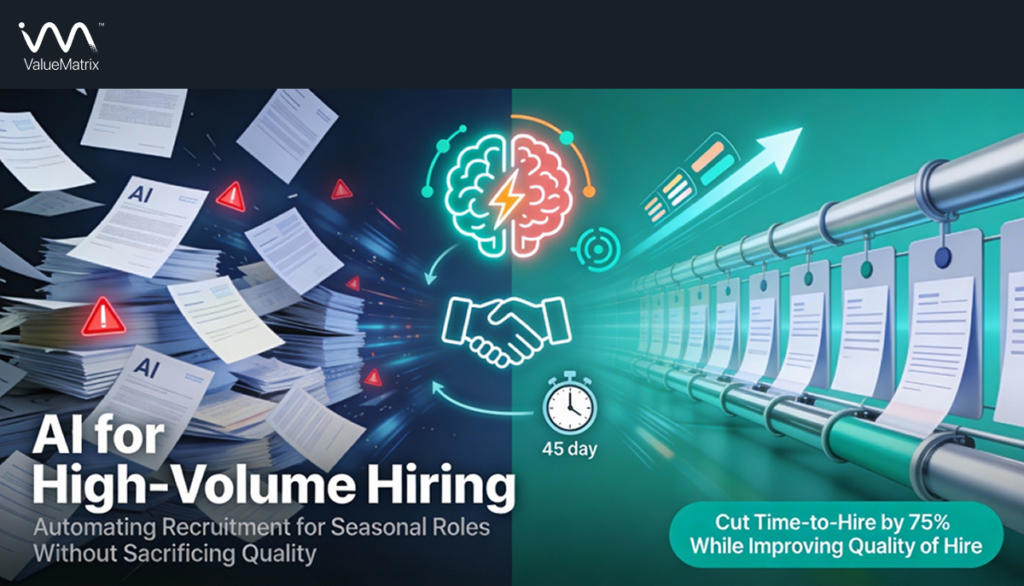
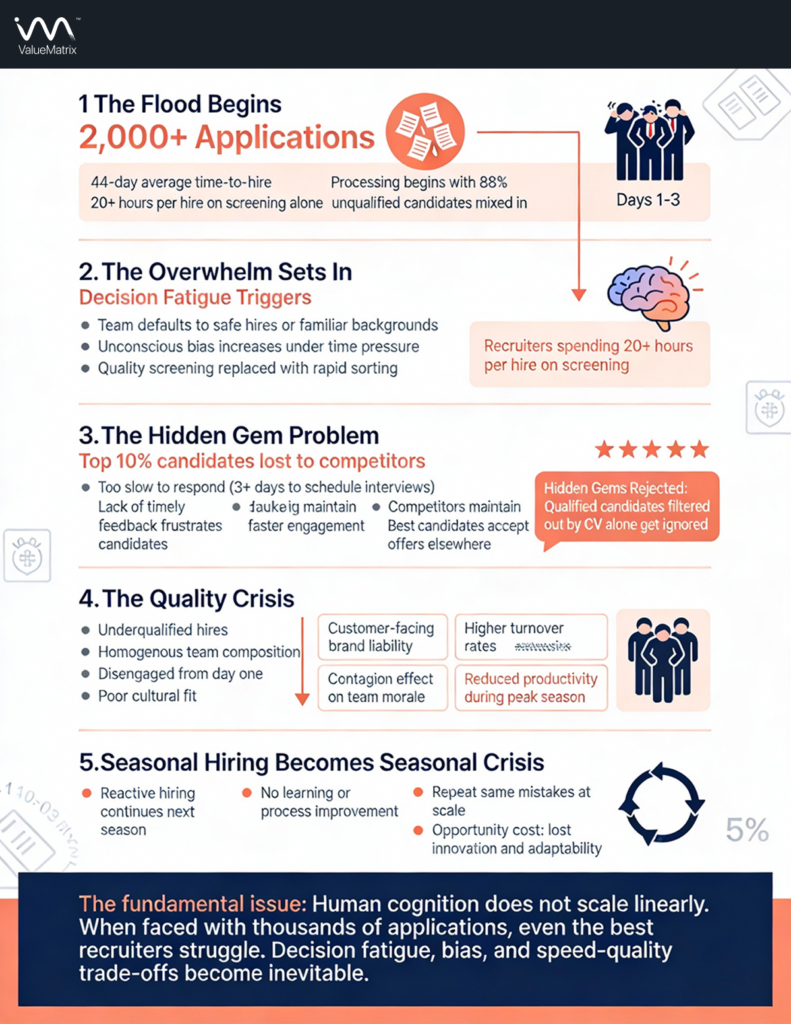
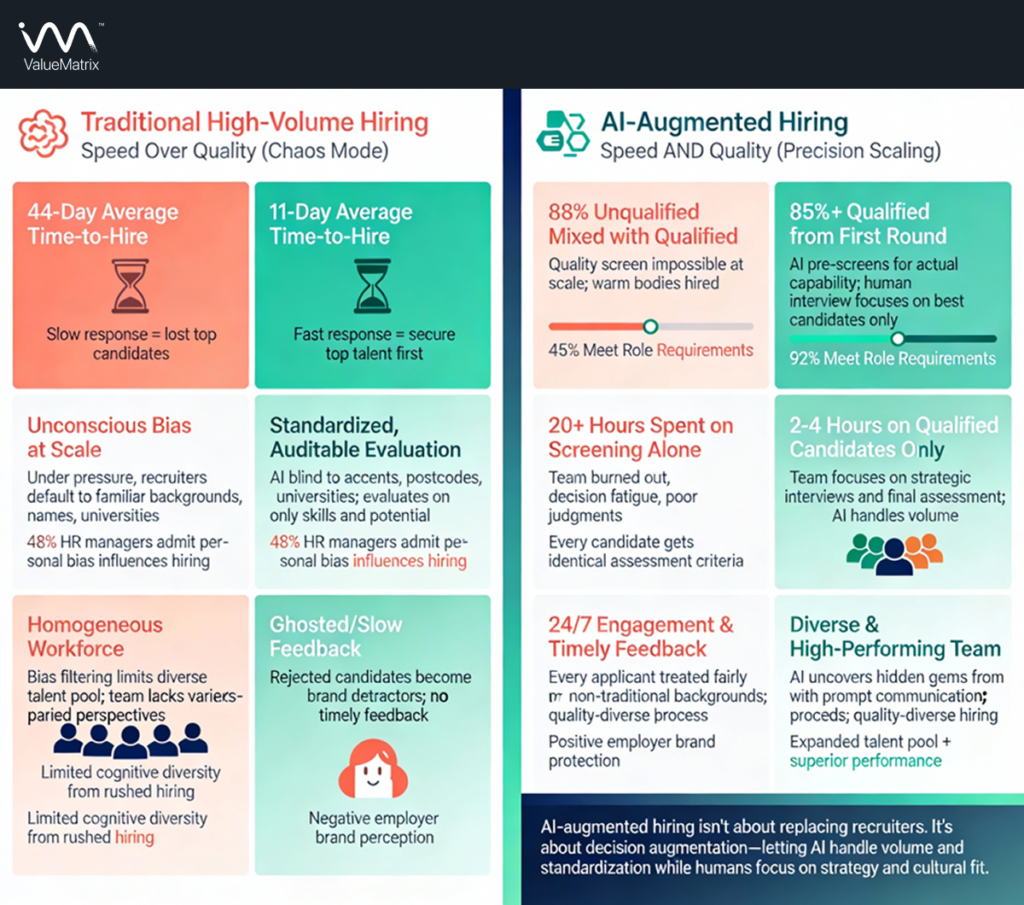
It is the middle of September, and you have just 45 days left until the peak hiring season starts. You have over 2,000 seasonal positions available for hire and have posted the vacancy notification. The expectation is that you will have a steady flow of candidates coming in. What happens? There’s a flood of CVs and reference letters in your inbox. It’s just too overwhelming. Within the next 2 days, your inbox is filled with these applications, and your recruitment team is spending over 20 hours behind one hire – just on screening and scheduling. They are giving everything they have to handle this workload – scan the CVs, call, leave notes, and voicemail messages. But the numbers are just too much to handle.
Weeks bleed by. By the time your team draws the list of the top 10% of applicants, they are gone.
Why? You and your team were simply too slow to respond. They got a better offer from the competitor, who ironically kept in touch with them from Day 1. And just like that, you lost a great hire. Moreover, in this frantic rush to fill up the vacancies, an unconscious bias can creep in. Your team, bruised and battered with workload, defaults to “safe” hires or familiar backgrounds. This bypasses the diverse talent pool you particularly said you wanted, and finally, you are left with a workforce that is now underqualified, disengaged, and homogenous.
You are not alone in this chaotic scramble. A lot of modern-day recruitment teams are feeling this heat. The numbers underline the struggle. 88% of applications in the system may be unqualified. In the process of high-volume hiring, you may lose the hidden gems because the global average time-to-hire has moved up to 44 days.
Here’s where the conversation starts to shift. As companies struggle to identify the best AI-driven solutions for such high-volume hiring, they understand that just having speed alone is not enough. Management that prefers cost-effective solutions for high-volume hiring quickly finds out that automated hiring for seasonal vacancies is not a luxury anymore. It is the need of the hour. You will need AI for high-volume hiring, and it’s not about having a shiny new tool to play with. Rather, it is about reimagining how you can engage with talent when sheer numbers can overwhelm and undermine the quality of hire.
1. The Seasonal Hiring Paradox: Why “Warm Bodies” Is a Failing Strategy
For decades, the “seasonal surge,” whether the Q4 retail peak, the summer hospitality rebound, or the logistics rush, has been treated as a distinct, chaotic sprint. The requirement is pretty straightforward. Get as many people in as possible, and that too as quickly as possible. However, modern CHROs are stuck in a paradox: their companies are hiring people at a great pace, but the workforce quality is not up to the mark. And so is not the fairness in terms of hiring as well as the retention numbers.
The problem isn’t that HR teams lack effort; it’s that human cognition does not scale linearly. When recruiters face thousands of applications in a week, decision fatigue sets in. What begins as a strategic selection process devolves into rapid sorting. This manual failure point creates immense risk. A bad seasonal hire isn’t just a sunk cost; they are a customer-facing brand liability and a driver of contagion for team morale.
AI changes this equation by functioning as a decision-augmentation system rather than a simple filter. It allows organizations to move from “survival mode” hiring to precision scaling. AI done right doesn’t just fill roles faster; it stabilizes workforce quality, preserves culture, and protects employer brand during periods of extreme volatility. For the modern CHRO, this is not a conversation about operational efficiency; it is about risk management and business continuity.
2. Diagnosing the Breakdown: Why Conventional Models Are Not Well Suited to Scale
Your conventional models of recruitment are standing on the base of “assumed” stability. And that stability is nothing but a manageable flow of candidates coming in at a predictable rate. Your team will have ample time to review and can also focus on long-term retentions. Seasonal hiring inverts every one of these variables, breaking the standard “CV-screen-interview” model.
From an Industrial-Organizational (I-O) psychology perspective, high-volume hiring triggers screening fatigue. Research shows that the quality of human decision-making deteriorates significantly after repetitive tasks. A recruiter reviewing their 50th CV of the day simply cannot apply the same cognitive rigour as they did to the first. To cope, the brain relies on heuristics—mental shortcuts that manifest as bias. We see the similarity bias (favouring candidates who “feel” like us) and the halo effect (letting one trait, like a specific previous employer, overshadow all others).
In the seasonal rush, line managers often bypass the process entirely, reverting to “good enough” hiring just to fill shifts. What it does is create a blind spot where your efficiency metrics, such as Time-to-Hire, simply overshadow the dwindling Quality-at-Scale. On the Excel sheet, it’s nice to see 500 people getting hired in 10 days. But if 20% of them leave within the first 45 days, the operational cost is very high. The reality for CHROs is that you cannot solve a volatility problem with stability tools. You need a system designed for high-velocity filtering that doesn’t sacrifice rigour.
3. Redefining AI: Infrastructure, Not Automation
There is a lot of buzz around using AI in recruitment. And this buzz constantly fluctuates between hiring on autopilot and fear of black box algorithms. For CHROs, it is quite important to ignore the top-layer noise and define what AI-driven solutions for high-volume context actually look like. It is more of an infrastructural change.
AI is not a magic wand that replaces human judgment; it is a pattern recognition engine that scales consistency. In a manual process, “fairness” depends on which recruiter picks up the file and how tired they are. In an AI-augmented process, screening logic is applied identically to the first candidate and the ten-thousandth.
Companies exemplify this shift by moving beyond keyword matching. Instead of asking “Does this CV have the word ‘retail’?”, advanced AI asks, “Does this candidate exhibit the reliability and stress tolerance required for this role?” This is a fundamental reframe:
- From “Automation”: Replacing admin tasks.
- To “Augmentation”: Providing recruiters with richer data to make better final decisions.
- From “Speed Tool”: Just going faster.
- To “Consistency Engine”: Ensuring every applicant gets the same level of consideration.
By removing the administrative drag of sorting and scheduling, AI allows human recruiters to focus on the high-value “sell” conversations and final judgment calls. It transforms the recruitment function from a funnel of rejection into a pipeline of verified potential.
4. Operationalizing the Funnel: Where AI Creates Value
To operationalize AI effectively, we must look at the recruitment funnel not as a single event, but as a series of staged filters where technology outperforms human effort.
4.1 Sourcing & Reach
Seasonal hiring often runs into a simple problem. Employers keep going back to the same local talent pools. Over time, these networks dry up. AI-driven programmatic advertising helps break this cycle. It identifies nearby and overlooked groups like students, gig workers, and retirees. Job ads are then placed where these people are most active. Research shows that 72% of recruiters feel AI improves sourcing by quickly matching passive candidates to role needs. This leads to a seasonal workforce that mirrors real customer diversity, not just one job board.
4.2 Application Screening
This is the highest-volume choke point. Manual screening is slow and inconsistent. AI tools can parse thousands of applications instantly, but the best systems go further, ranking candidates based on “fit” rather than just credentials. This prevents the “resume black hole” and ensures that the top 10% of candidates are surfaced immediately, not buried in day 3 of a recruiter’s inbox. It shifts the recruiter’s morning routine from “who applied yesterday?” to “who is the best match today?”
4.3 Assessments at Scale
For seasonal roles, a CV is a poor predictor of success. What matters is work readiness. AI-enabled assessments, often gamified or mobile-first, measure traits like cognitive agility and situational judgment in minutes. Platforms using Digital Twin technology can even model the attributes of your top performers and screen applicants against that benchmark, predicting success with far higher accuracy than a resume scan. This moves the screening criteria from “what you have done” to “what you can do.”
4.4 Interview Scheduling & Coordination
The drop-off rate in seasonal hiring often comes down to friction. If your team is taking over 3 days to set up an interview, the applicant is bound to be frustrated and would happily take an offer from your competitor. With AI scheduling agents, you can automate this workflow and set up calls 24/7. You can reduce your time to hire by nearly 75%.
5. Psychometrics Without the Jargon: Hiring for Fit
In high-volume seasonal hiring, “experience” is often a red herring. A candidate with two years of retail experience who is unreliable is far less valuable than a novice with high conscientiousness. This is where psychometrics democratized by AI becomes a strategic weapon.
We are not talking about hour-long personality tests that kill conversion rates. Instead, we are talking about micro-assessments that can measure specific predictors of seasonal hiring success: Tolerance to stress: Can your team handle the big time rush without snapping at the incoming customers?
- Reliability: Are you reliable? Will they show up for their work on time, every single time?
- Adaptability: How adaptable is your team? Can they quickly gel in with different team members to become a high-functioning team?
Traditional screening relies on proxies for these traits (e.g., “Did they stay at their last job long?”). AI measures the traits directly. For instance, companies utilize “Neuroscience Interview” techniques and psycholinguistics to analyze not just what a candidate says, but how they approach problems. By analyzing micro-behaviors and communication patterns, the system identifies “Digital Twins” candidates who mirror the psychological profile of your best existing employees.
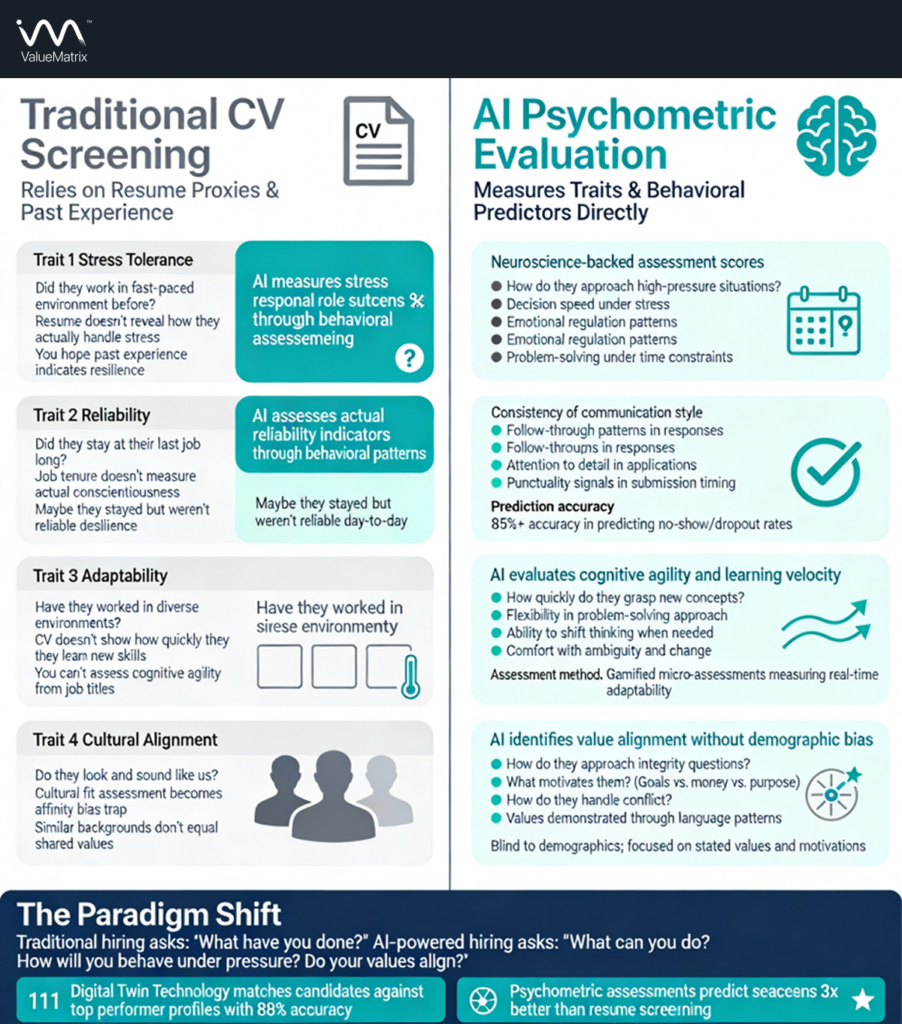
This approach reduces the guesswork. Instead of hoping a candidate is resilient because they worked at a fast-food chain, you have data points validating their adaptability. Crucially, this happens before a human interview, ensuring your managers spend time only on candidates who are psychologically equipped for the friction of the role.
6. Bias, Fairness, and Trust: Engineering Equity
One of the most persistent fears CHROs hold is that AI will institutionalize bias. It is a valid concern, but it ignores a critical reality: human hiring is already deeply biased.
48% of HR managers admit that personal bias influences their hiring decisions. In high-pressure seasonal hiring, this worsens. Recruiters rush, favouring candidates with familiar names, local addresses, or “safe” backgrounds. This unconscious filtering limits the talent pool and exposes the organization to homogeneity.
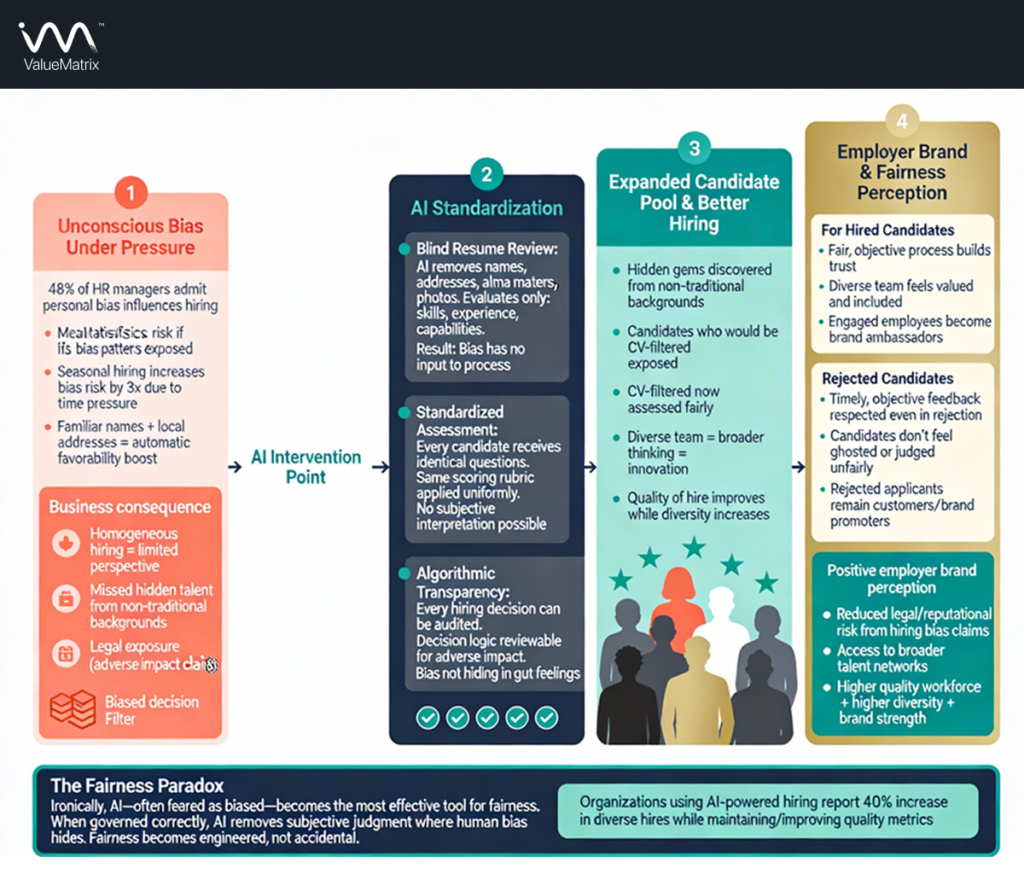
AI, when governed correctly, is an engine for equity. It is blind to accents, postcodes, and universities. It evaluates a candidate based strictly on the skills and potential defined in the algorithm.
- Standardization: Every candidate gets the exact same set of questions and assessment criteria.
- Auditability: Unlike a recruiter’s “gut feeling,” an AI’s decision logic can be reviewed and audited for adverse impact.
- Access: AI screening often uncovers “hidden gems”—candidates from non-traditional backgrounds who would be rejected by a CV screen but possess high aptitude.
Furthermore, fairness is a brand issue. Seasonal workers are often your customers. A rejected candidate who feels they were treated fairly remains a customer. One who feels ghosted or judged unfairly becomes a detractor. By ensuring every applicant receives a timely, objective response, AI protects the employer brand at a scale human teams cannot match. Fairness isn’t accidental; it must be engineered.
7. Culture Still Matters in Temporary Workforces
There is a dangerous misconception that culture is only for permanent employees. In reality, seasonal workers experience your organization at its most stressed and vulnerable. They are the face of your brand during your busiest periods. If you hire mercenaries, you get a mercenary culture transactional, low-effort, and high-risk. If you hire for cultural alignment, you get brand ambassadors.
AI supports cultural consistency by embedding your values into the screening process.
- Pre-Hire Alignment: Tools that assess “cultural fit” ensure candidates understand the pace and expectations before they join.
- Expectation Management: Realistic job previews (often delivered via AI chatbots) filter out those who aren’t aligned with the role’s reality, reducing early shock and attrition.
- Cohesion: By hiring candidates who score high on “team orientation,” you accelerate the bonding process—critical when teams have only days to form and perform.
Your seasonal workforce is not separate from your culture; they are a stress test of it. AI ensures that even temporary entrants align with the core DNA of the business, preventing the dilution of service standards during peak periods.
8. Metrics That Matter: Moving Beyond Speed
The traditional dashboard for seasonal hiring is obsolete. Obsessing over Time-to-Hire (TTH) and Cost-per-Hire (CPH) in isolation incentivizes the wrong behaviors, specifically, cutting corners.
With AI, CHROs can measure what actually matters: Quality of Hire.
- Early Attrition (30-60 days): This is the truest metric of hiring success. Did the AI predict retention accurately?
- Performance Stability: Are seasonal hires in Region A performing as well as Region B? AI standardizes the input, making performance gaps easier to diagnose (usually a management issue, not a hiring one).
- Candidate Experience (NPS): Are rejected candidates still promoters of the brand?
- Rehire Rates: The “Holy Grail” of seasonal hiring is building a pool of alumni who return next year. High rehire rates indicate a successful fit and a positive experience.
Organizations using advanced talent intelligence see up to 82% improvement in quality of hire. By shifting the conversation from “How fast?” to “How good?”, CHROs align recruitment with business outcomes like revenue protection and customer satisfaction.
9. Implementation Without Disruption: A CHRO-Led Playbook
If you are looking for AI-driven solutions for high-volume hiring, it is not just a rip-and-replace model. You need a measured and strategic integration that will help your team smoothen their operations and not spook them in the process.
- Start with the Friction: Do not try to automate the entire end-to-end process immediately. Identify the biggest bottleneck, usually screening or scheduling—and apply AI there first.
- Position as Support, Not Surveillance: Recruiters will fear displacement. Frame AI as a tool that removes the “drudge work” (CV sorting) so they can focus on the “detective work” (assessing potential).
- Governance is Key: Establish clear human-in-the-loop protocols. AI makes the recommendation; humans make the offer. Ensure there is an escalation path for candidates who feel misinterpreted.
- Calibrate to Reality: Ensure your AI is trained on your high performers, not generic industry data. Use your “Digital Twins” (your best current seasonal staff) to set the benchmark.
Be confident but pragmatic. This is an evolution of the recruitment function, not a demolition of it.
10. The Strategic Payoff: From Chaos to Resilience
Seasonal hiring has long been the “wild west” of HR, tolerated chaos accepted as the cost of doing business. It doesn’t have to be.
With a well-thought-out use of AI for high-volume hiring, you can turn this weakness into your advantage. You will thus be in a position to hire 100s or 1000s of candidates without breaking your recruitment team. Moreover, you will be able to cut down on the churn and burn of the seasonal hire by making the right reliability calls. And finally, you will achieve the diversity and culture goals even when your company is moving at a great pace.
The question for leadership is no longer whether to automate high-volume hiring, but how quickly you can transition from manual filtering to intelligent decisioning. Those who design their hiring systems for volatility today will outperform on stability tomorrow.
Q&A:
Q1: Won’t candidates feel dehumanized if their first interaction is with a bot, especially for a people-centric role?
A: Surprisingly, the data suggests the opposite. Candidates for seasonal roles usually value speed and transparency much more than a delayed human interaction. A “human” process that leaves them in the dark for two weeks is actually more frustrating than an AI that engages them instantly, answers their questions at 2 a.m., and schedules an interview within minutes. The key here is honesty. When you label the AI clearly—letting them know it is a digital assistant there to speed up their application—candidates appreciate the respect for their time. The frustration only really arises when bots pretend to be people or when the conversation leads to a dead end.
Q2: How do we prevent AI bias from simply replicating the poor hiring patterns we already have in our historical data?
A: This is the most critical question for any leader. It is true that if you train a model on your last five years of hiring data—which might be full of unconscious bias—the AI will simply replicate those flaws. The solution is using Ethical AI frameworks that are audited rather than just trained. Leading platforms now use explainable AI, which flags why a decision was made. Instead of relying purely on historical “success profiles,” modern tools are calibrated against objective performance metrics, like shift reliability or sales data, and are regularly stress-tested for adverse impact against protected groups before they ever go live.
Q3: Can AI actually predict soft skills like reliability, or is it just keyword matching on steroids?
A: Today’s AI does much more than just matching keywords. It has integrated psycholinguistic analysis and has gamified assessments. With this approach, it can now find out traits like the emotional stability of the candidate or their cognitive processing speed. For instance, when testing their situational judgement, AI can identify patterns in how they prioritize tasks and how it will translate into real-life reliability. Such an assessment is much better than just a written statement on a CV that says “I am reliable.”
Q4: If we automate screening, how do we ensure we don’t accidentally reject a wildcard candidate who would have been a star?
A: This fear of the “false negative” is very common. However, manual screening creates far more false negatives simply because recruiters don’t have time to read every application thoroughly. AI ensures every single candidate gets a fair shot at the same criteria. Furthermore, you can configure safety nets in the system. For instance, you can flag candidates who fall just below the cut-off score but have high potential in specific outlier traits, routing them to a human for a second look. The goal isn’t to remove human judgment, but to ensure humans spend their time on the edge cases rather than the obvious rejections.
Q5: Is the ROI of these platforms real for seasonal hiring, given that we only use them intensively for a few months a year?
A: The ROI isn’t just in the hiring phase; it is found in the cost of early attrition. The most expensive part of seasonal hiring is the churn cycle—hiring someone, training them for two days, and having them quit on day four. If AI improves your quality of hire enough to reduce that early attrition by even 10% or 15%, the system pays for itself in training hours and lost productivity alone. Additionally, these platforms build a warm bench of silver-medalist candidates that you can re-engage instantly next season, drastically lowering your marketing spend for the following year.