

Table of contents
- What exactly is People Analytics? 🤔
- Why are businesses investing in People Analytics? 🚀
- What are the key areas where People Analytics is applied? 🎯
- What are the necessary skills for a People Analytics specialist? 💡
- What is the typical process of a People Analytics project? ⚙️
- What are some real-world examples of People Analytics success? 🌐
- What are the biggest challenges and ethical considerations? ⚠️
- What tools and platforms are used in People Analytics? 🛠️
- What is the future of People Analytics? 🔮
- Data Ethics and Privacy in People Analytics
- The Evolution of Analytics: From What Happened to What Should We Do
- 📊 People Analytics: Vital Statistics
- 💡 Fun Facts in People Analytics
- Conclusion
- FAQs
For decades, human resources relied on gut instinct and legacy practices for decision-making. With people analytics, a new era dawns today. People analytics is the application of HR data science to workforce problems. It enables the transformation of the HR department into a strategic function. In fact, it creates a really data-driven HR through measurable and actionable insights.
What exactly is People Analytics? 🤔
People analytics systematically collects employee data and uses that data to enhance business performance and improve talent management. More than just reporting, it forecasts outcomes. It answers crucial questions on performance, retention, and engagement.
Definition and Scope
People analytics is the application of statistical techniques to people-related data-in-scope compensation-related data, into training hours for employee lifecycle coverage, and data-backed HR strategic formulation.
Evolution (Pre-2010 vs. Post-2010)
Before 2010, HR metrics comprised predominantly standard metrics such as headcount, turnover rate, and time-to-hire. After 2010, however, the evolution was monumental as there were now advances in big data tools enabling deeper and predictive analysis. This marked the real beginning of HR data science.
Differentiation from Traditional HR Reporting
It is purely a descriptive tradition for HR reporting. It only tells what happened in the past (e.g., “Turnover was 10%”). People Analytics is prescriptive and predictive regarding why such situations arose and what actions would be necessary in the future. This enables proactive data-driven HR decision-making.
In summary, People Analytics is the scientific methodology that HR uses to achieve measurable return on investment and herald into the world of talent management the true arrival of data science.
Why are businesses investing in People Analytics? 🚀
Moreover, companies understand that their best investments are human capital. Such investments gets better by people Analytics to realize maximum returns. It provides an objective way to improve employee performance and the health of the organization.
Strategic Value (Moving beyond administrative tasks)
However, People Analytics raises HR from the position of administrator to that of a strategic partner. Such HR executives are then ready to hold discussions with boards of directors concerning workforce risk. Direct alignment of talent strategies to corporate financial goals is possible. This becomes imperative for the organization’s long-term growth.
Quantifiable ROI (Reduced turnover costs, improved productivity)
However, the most potent reason is the in-your-face calculable return on the investment (ROI). These predictive models then save huge costs from the unwanted turnover of employees. They optimally configure staffing models to increase productivity per employee and illustrate these savings as directly trackable.
Competitive Advantage (Optimizing talent strategy)
One of the benefits that People analytics provides to companies is that they can optimize their talent strategy. Therefore, businesses recruit faster, retain their talent longer, and better staff their projects. They know how training relates to performance, and such insights give them a huge edge in market leadership.
People Analytics is fast changing, a necessity for the organization to help it gain measurable value in an economy increasingly dependent on talent.
What are the key areas where People Analytics is applied? 🎯
People Analytics nigh-on touches every function within human capital management. It proffers evidence-based solutions to common organizational bottlenecks.
Recruitment/Talent Acquisition (Predictive hiring)
Analysts set up predictive models to ascertain new hire success. They arrive at these decisions by unearthing the candidate traits that correlate with performance and longevity. To this effect, sourcing channels and interview processes are optimized to enhance the prospects of cultural fit and performance from day one.
Performance Management (Drivers of high performance)
Drawing from data reveals the organizational drivers of performance, such as team composition, manager quality, or tool availability. Here, performance management shifts away from focusing on outputs and towards creating conditions for success.
Compensation and Benefits (Equity and competitive analysis)
The analytics address the need for checks and balances in the good and fair work-prevailing wage structure. Once it has identified internal pay gaps (for example, gender discrimination in pay and race discrimination), it will offer ways to correct them. It will predict the effects of change in the benefits plan upon retention and engagement.
Employee Retention and Turnover (Predictive models)
This stands to be one of the more popular uses of People analytics. Machine learning predicts which high-value employees are at risk of leaving. It allows the managers to intervene in time with raises, mentoring, or new opportunities.
What are the necessary skills for a People Analytics specialist? 💡
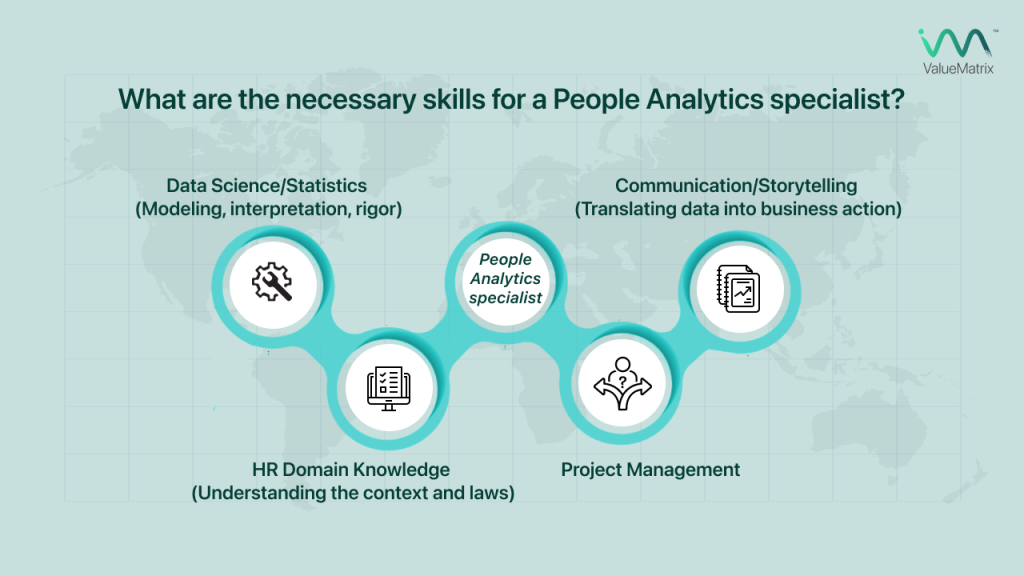
A successful People Analytics specialist needs a multi-faceted skill set. The specialist should know how to clean data, build models, and test hypotheses. Typically, some basic knowledge of either Python or R as a programming language is a must for deep analysis into HR data science.
HR Domain Knowledge (Understanding Context and Laws)
A clear understanding of HR functions will provide context for the data itself. The analyst must be aware of performance review norms and compensation law, depending on the model considered, so that his/her model can remain relevant and above board.
Communication/Storytelling (Translating data to business action)
You should communicate data-driven results in an easy-to-digest and persuasive narrative. In addition to that, the analysts must guide the stakeholders on the recommendations, more from a business perspective and with little statistical jargon.
The actual strength of the People Analytics specialist lies in his/her competence in interlinking the complicated world of data with the ruthless complexity of actual business strategy.
What is the typical process of a People Analytics project? ⚙️
An organized, iterative life cycle is one of the hallmarks of successful People Analytics projects-and ensures the validity, alignment, and usefulness of their findings.
Frame the Problem (Ask a Clear Business Question)
The project begins with a direct business impact type question. Examples would be “Why is voluntary turnover highest in the engineering department?” The scope must be clear, along with the outcomes.
Collect and Clean Data (For Quality and Integration)
Most HR data sits in multiple systems. Hence, the analyst must first integrate and clean this siloed data. Data quality is paramount-a “garbage in, garbage out”-is particularly applicable to predictive modeling.
Analyze and Model (Statistical analysis and prediction)
This stage entails the application of statistical techniques and machine learning. Analysts seek correlations, develop predictive models, and identify root causes. This is where the core of HR data science is applied.
Implement and Evaluate (Measure the business impact)
Insights derived must lead to the implementation of some action (such as new manager training) whose results are subsequently measured and compared against the baseline to close the loop in validating the value of the analysis.
This systematic approach gives strong assurance that findings are robust and lead directly to meaningful organizational change.
What are some real-world examples of People Analytics success? 🌐
Big corporations can demonstrate the enormous strategic and financial payoffs of People analytics. These case studies provide clear evidence of the strength of a data-driven HR function.
Google (Project Oxygen)
Google has gained fame for using data to challenge managers from its own point of view. Project Oxygen investigated performance reviews and survey data. It identified eight behaviors that define highly effective managers. Training managers on these behaviors has led to significant improvement in their quality score. This was correlated with improvement in team performance and lower regrettable turnover rate.
IBM (Predictive Attrition)
IBM developed a patented predictive attrition program. Their model predicts whether employees will leave within a given timeframe with accuracy. It takes more than 20 data points into consideration, including compensation, job role, and manager quality. This ensures that managers can start retention discussions before the employee actively starts looking elsewhere.
Johnson & Johnson (J&J)
J&J was able to prove the business value of certain programs using their wellness and health data. Their health programs, including an “Energy for Performance” course, were analyzed for their long-term impact. J&J found a strong correlation that indicated the more people took up wellness programs, the better their retention rate became. The increased retention could potentially save the company roughly $200 million by cutting turnover costs.
These examples, beyond argument, demonstrate that People Analytics is not an imaginary concept but a very real and potent engine for strategic human capital management.
What are the biggest challenges and ethical considerations? ⚠️
For its value to be realized, ethical and practical challenges stand in the way of dealing with People Analytics with responsibility and conscience.
Data Privacy and Security (Compliance and trust)
Sensitive personal employee data must be secured against unauthorized access and usage in accordance with security protocols. Due diligence should be exercised in this regard when adhering to the laws of legislation, such as GDPR. The organization should, on the road to securing trust, ensure proper transparency with employees on how their data is treated.
Bias in Algorithms (Ensuring fairness and equity)
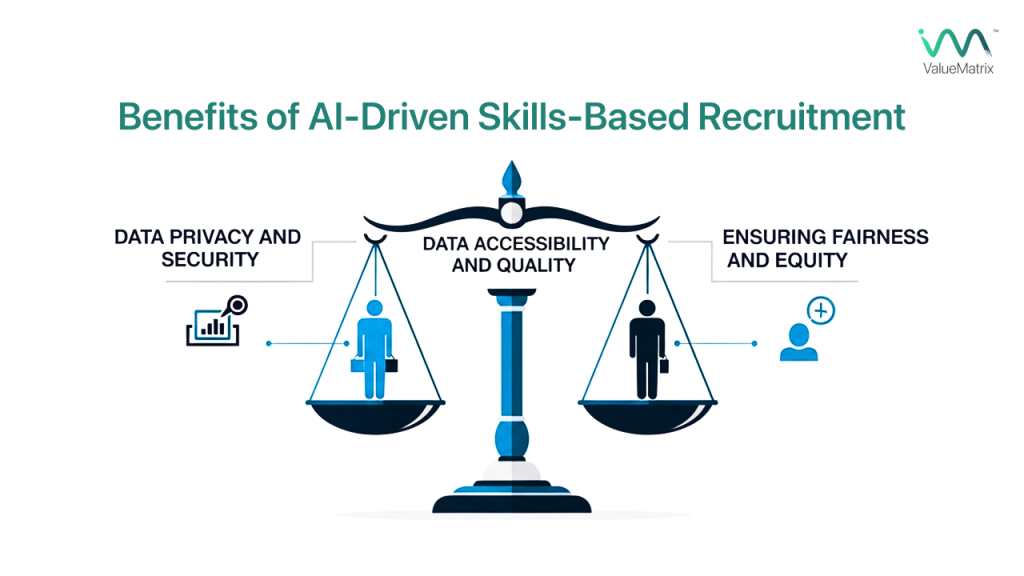
Predictive modelling works as per the training. A historical data set containing various biases (e.g., discriminating against male promotions) will perpetuate such discriminatory practices in its use. For this reason, analyses conducted by employees must embrace an active auditing of model designs so as to eliminate discriminatory outcomes from the design.
Data Accessibility and Quality (Overcoming siloed and inconsistent data)
Many companies struggle to maintain consistency in data entry owing to multiple HR systems that keep the data fragmented. Even the non-standard input of data directly contributes to the inconsistency. Investing in data governance is necessary before applying advanced HR data science.
To make People Analytics truly powerful and fair demands a concerted effort to deal with these ethical and operational challenges.
What tools and platforms are used in People Analytics? 🛠️
Contemporary People Analytics functions click into action through the nexus of multiple specialized tools employed in collecting, processing, and presenting data.
HRIS (Workday, SAP SuccessFactors, etc.)
The Human Resource Information System (HRIS) is the primary source of data. The HRIS stores core employee records, payroll, and benefits information. Data extraction and integration from here continues to other systems.
Spreadsheets (Initial data manipulation and quick insights)
Although strictly limited in modeling, Excel and the like are vital for initial data exposure. Quick calculations, data cleaning, and the preparation of preliminary summaries of limited datasets are often done using Excel.
Business Intelligence (BI) Tools (Visualization and dashboarding)
Finding visualization through BI tools (Tableau, Power BI) may find more applicability through turns and interactive dashboards. This unveils the complex data to HR generalists and senior leaders to monitor the key metrics.
Statistical Programming Languages (R, Python for advanced modeling)
Finding visualization through BI tools (Tableau, Power BI) may find more applicability through turns and interactive dashboards. This unveils the complex data to HR generalists and senior leaders to monitor the key metrics.
Python and R: these second languages underpin advanced data science in the HR field. Both are for machine learning and regression, as well as developing predictive attrition algorithms.
What is the future of People Analytics? 🔮
The future of People analytics points toward deeper integration, greater automation, and a more employee-centric focus.
AI and Machine Learning (Hyper-personalized and predictive models)
AI will grow beyond only attrition prediction. Hyper-personalizing recommendations regarding career and development paths will be offered. Machine learning will largely automate data preparation and streamline organizational design.
Focus on Well-being and Employee Experience (Beyond engagement scores)
Future analytics will largely use sentiment and stress data. The focus will shift to optimizing the “Experience” of work, not just measuring engagement. Mental health and burnout risk will play a pivotal role in metrics.
Integration with Business Strategy (Analytics embedded in all business decisions)
People Analytics shall no longer be confined to HR. The insights therein will actively drive sales targets, R&D spending, and capital allocations. Hereby establishing themselves as a true discipline with financial and operational aptitude.
People Analytics shall secure a firm place amongst the basic pillars of corporate strategy. This shall be, on account of the profound influence it wields on human capital management, thus driving corporate value.
Data Ethics and Privacy in People Analytics
An organization conducts more and more data-driven business activities. An even clearer organizational commitment should guarantee ethical and secure intelligence management of the employee information. Building employee trust through a solid ethical framework is essential for any analytics program to be sustained. Organizations need to be very much aware of data access, transparency, and bias while working to ensure that analytics are still considered useful and maintain a sense of responsibility.
The very essence of ethical people analytics is to achieve equally just and commendable outcomes for the company and its employees. Shortcomings or deficiencies in terms of cemented trust and transparency can easily brand analytics insights as what really constitute intrusive monitoring, thus counter-productive to engendering the actual culture to be improved.
The Evolution of Analytics: From What Happened to What Should We Do

People Analytics is not static; it has a clear maturity curve that determines how deeply it is insightful for an organization. Simple reporting will not bring true strategic business value. That understanding of the various maturity levels-from simple reporting on what has happened to predicting what might happen-makes for a compelling People Analytics roadmap.
- Descriptive Analytics: The “What Happened”
- Predictive Analytics: The “What Is Going to Happen”
- Prescriptive Analytics: The “What Should We Do”
As people move through the stages, HR changes from counting employees to using data as a lever to build the workforce of the future. It is in the prescriptive stage where the greatest opportunity lies-the point at which analytics moves from prediction to recommending and even automatically executing the best course of action.
📊 People Analytics: Vital Statistics
The Magnitude of Data in HR
The fundamental role of People Analytics, which happens to be translating HR activities to finance, translates into a profit-making frenzy. 79% of such organizations support proper decision-making compared to those without advanced People Analytics capabilities. Companies involving data-driven HR carry out 30% less employee turnover in their workplaces. So, analytics concerns people not only, but also business gains and profits out of it as well.
The Bottom Line on Attrition
An effective cost for a single high-performing employee leaving the organization might vary between 1.5 and up to two times an annual payroll for that particular employee to cater for recruitment, onboarding, and productivity loss. IBM’s predictive attrition module creates a perfect match for capturing at-risk employees with about 90% accuracy, thus bringing HR actions before incurring those costs.
💡 Fun Facts in People Analytics
The Desk Distance Insight
A very seminal study posits that the distances between desks correlate positively with team performance. More narrowly, employees situated closer to each other tend to have more frequent and effective exchanges of information, resulting in enhanced cooperation and productivity. This suggests that the layout of the office is a fairly subtle and powerful lever for optimizing People’s Analytics.
The ‘Overtime Paradox’
“In most cases, long hours of work produce a surprising outcome; after working for many weeks of long hours, productivity does not seem to be better than that of the other employees, and in many times, productivity nosedives.” To manage the “overtime paradox,” People Analytics should be programmed to direct managers toward enforcing shorter, sharper working hours to sustain output and prevention from burnout conditions.
Conclusion
People Analytics transcends being a mere technological upgrade; it stands as the strategic imperative for modern business success. Through the conscious outlay of data-driven HR, companies leave the world of reactive management behind. HR data sciences are utilized to shape the future workforce proactively, ensuring that every talent decision made is an informed strategic advantage.
FAQs
It points out the exact training and experience elements that predict future high performance. Therefore, it enables companies to spend training dollars wisely, customizing career paths to achieve closure of critical skill gaps.
One major query here is whether models can lead to algorithmic bias, whereby predictive models inherit from past forms of bias in employment or promotion data that can then be contain unfairly or discriminatory applications.
According to the chief of human resources, he must lead the unit with such priority in data governance and ensure that every key talent decision is made with People Analytics data in the background.
Analytics utilizes many sources of data beyond basic surveys for finding actual engagement drivers. These include communicating data and path clarity for careers. This helps HR devise focused interventions with real impact on employee experience.
It maps formal and informal communication and collaboration among teams. ONA reveals the hidden structure of an organization and identifies where the influential knowledge brokers are working, as well as those with little or no connections. ONA is vital in improving team collaboration, enabling fast change management, and ensuring all the crucial knowledge is shared.
Data integrity ensures that all employee data remains accurate, complete, and valid. The best human resource data science models are deemed useless and bias-laden if the original data is faulty. High data integrity brings about a degree of assurance in analysis for decision-makers.
About Us
ValueMatrix is an AI-powered talent intelligence platform that helps companies hire better, faster, and without bias. We go beyond resumes to assess skills, behavioral traits, and cultural fit using advanced AI and proven psychological frameworks. Our platform delivers data-driven insights that improve hiring accuracy, reduce time-to-hire, and elevate candidate quality.
ValueMatrix AI enables hiring teams to make confident hiring decisions and build high-performing teams at scale.