
Table of contents
How is AI revolutionizing Hiring?
When was the last time you printed your resume, stacked it neatly in your folder alongside your other certificates, and formed a beeline outside an employer’s office?
Those “good ole’ days” are a thing of the past now, and will only serve as bedtime stories to the younger generation born in the age of AI, especially with the changes that have happened with AI in hiring strategies in the past couple of years.
Things are moving so fast that many recently adopted practices have already become obsolete. For instance, remember asynchronous video interviews? Where the candidate would sit and talk to a blank screen with a ticking timer? Well, that’s already losing relevance fast, as an increasing number of companies are ditching it for more advanced forms of AI in hiring strategies.
Think about it, a very recent hiring tool is already obsolete. In the coming years, it’ll be harder to put a finger on what will stick and what will whoosh past us because AI is changing things at a breakneck speed.
But currently, more and more companies are hedging their bets on more advanced interviewing modules like psychometric tests, gamified assessments, and predictive analytics.
How are new technologies being replaced by newer technologies?
Gamified Assessments/Psychometrics- These are games based on behavioral science where you sit in front of a screen and play time-restricted games that assess you on human qualities like greed, decision-making, and risk-taking under pressure. These games put you in tough spots and judge how well you can wiggle out of them.
Predictive Analytics algorithms scan your previous records, like performance reviews, KPIs, and project completion rates, etc., and predict their future success in the company. It runs their past data through ML algorithms like Decision trees, Random forests, and Neural networks to accurately forecast a candidate’s future performance in the company.
Their accuracy can vary company to company, but IBM has been their biggest success story yet. Predictive Analytics in HR was 95% accurate in predicting the bounce rate of the candidates.
Interview Scheduling
Natural Language Processing – It is a branch of Artificial General Intelligence that enables machines to understand and interpret human languages. NLP models utilize semantic analysis, Syntax Analysis, Intent Recognition, and Language Translation to sense the emotions behind the words. Some advanced models can even detect nuanced emotions like sarcasm.
NLP-based models can scan public profiles of a candidate, like LinkedIn, Instagram, and X, using sophisticated text mining, and evaluate whether the candidate will be a good cultural fit or not.
The future for NLP-based hiring models looks promising; this report suggests that the NLP market will gross over $68 billion in 2028.
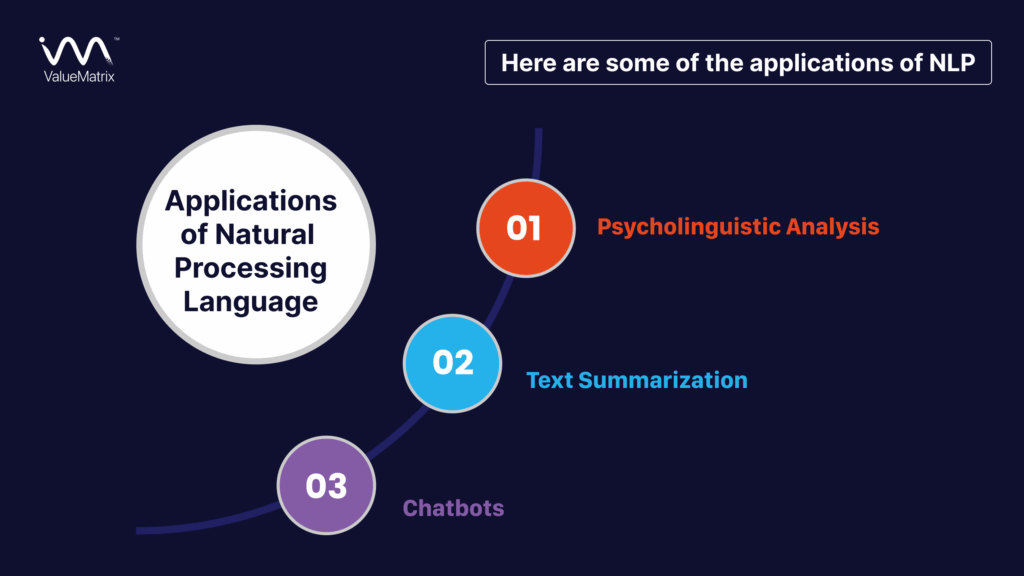
Here are some of the applications of NLP
NLP, with its varied scope of usage, is quickly becoming the staple in the AI hiring space.
Chatbots
Chatbots are the most widespread application of NLP. These are commonplace in the customer care domain, but they are expanding in the recruiting space as well. There are virtual recruiting assistants that handle the queries from the candidates and give real-time responses using the language interpretation and response generation elements of NLP.
Text Summarization
It’s an application commonly used for quickly screening reams of resumes. This application can parse important sentences and condense them into bulleted key points for faster viewing.
Psycholinguistic Analysis
Psycholinguistic AI is your virtual psychologist. It can examine word choice, sentence structure, and communication patterns of the candidate, and infer their psychological traits and core competencies.
For example, it can predict whether a candidate exhibits high conscientiousness based on their detailed and organized writing style.
What does the future look like?
The AI hiring strategy game is moving beyond fast-paced resume screening or even psychometric assessments. We are staring at an end-to-end automation of the complete hiring process.
Here are some of the futuristic technologies that will speed up your AI hiring strategy
Autonomous Screening
It is a revolutionary leap in recruitment. It’s an emerging AI technology that can analyze market trends, bounce rate probability, and skill gaps in the market to predict when new employees will be required to fill the vacant positions.
It then writes a market-optimized job description and posts the vacancy on job sites autonomously.
To summarize, sensing the market need for new vacancies, writing a job description for it, and posting it online on job portals happen without any human intervention.
Internal Talent Identification and Backfill Recommendations
Leverage advanced AI to scan vast amounts of employee data and predict which positions will be vacant soon and identify high-potential employees who are eligible to fill them.
These advanced AI models mine an employee’s performance reviews, project completion rates, and learning records to create a detailed virtual profile.
These advanced models even account for unstructured data like emails, career trajectory, and skill relevance to fill in that role.
When an employee vacates his role, the system automatically triggers a chain response and starts identifying high-potential candidates who can fill that role within the organisation.
The technology extracts data from HRIS systems and finds employees who are best suited to fill the vacant role.
Real-Time Offer Optimization
It is an AI-powered system that reads live market data, candidate behavior, and negotiation patterns, and tweaks compensation packages to increase acceptance rates during negotiations.
The technology monitors salary standards across multiple sources, analyzes competitor offers, tracks candidate engagement levels during the interview process, and uses predictive models to figure out the best arrangement of base salary, bonuses, equity, and benefits for each candidate.
AI can sense if a candidate displays hesitation at accepting the offer and can instantly rework some of the provisions of the offer, like signing bonuses, work hours, or other forms of remuneration, like stock options.

Pre-Start Immersive Experiences
A Virtual Reality-based onboarding process adds an extra layer of sophistication to the AI hiring strategy. Virtual Reality onboarding can greatly reduce the onboarding time and assimilation process. Instead of reading about the company from a brochure, they can take virtual office tours, meet their colleagues, and get a feel of the environment.
Virtual reality can also be used in the training modules. Employees can undergo virtual training, where they can practice their newly learned skills in a workplace simulation.
This makes learning immersive and practice-based as opposed to employees doing rote memorization from a manual.
Some of the benefits of VR onboarding.
- Faster learning curve. Newbies have a better understanding of complex tasks and systems from the very beginning.
- Increased engagement. The learning process is fascinating, fun, and efficient.
- Safe environment for practice. With VR, you maintain a risk-free environment in which to practice tasks.
- Better information retention. Interactivity helps employees memorize information more effectively.
- Customizable learning experiences. Easily tailor training modules to fit everyone’s learning pace and style.
- Instant feedback from newcomers. You can better understand the progress of new employees and adjust the onboarding process.
- Reduced costs. Over time, digital solutions reduce the need for physical materials, trainers, and space.
- Easier remote onboarding. AR and VR bridge the gap for remote employees. They can closely replicate being in the office or on the job site.
The Common Pain Points in Traditional Onboarding
Traditional onboarding faces several critical challenges that affect both employees and companies. Companies give just 43% of their employees more than a simple one-day orientation program. 48% of new hires say they didn’t get enough training after onboarding. This leads to job dissatisfaction, and this results in 3 in 10 employees applying for new jobs within three months.
The biggest problems in traditional onboarding include:
- Too many documents and messy paperwork
- Rushed training because of productivity pressure
- Different experiences in different departments
- Unclear communication about job roles
- Too much information in the first few days
VR onboarding can change all that.
AI employee onboarding tools have shown strong promise in fixing these problems
According to a study, companies that incorporate VR/AR in their onboarding process have reported a 40% increase in employee retention and a 30% decrease in training costs.
The promising results VR has delivered could be the catalyst for its rapid rise in the hiring realm.. It will be a different normal.
AI-Driven People Matching and Introductions
Walking into an office for the first time and seeing new faces could be a daunting experience for most of us. You might have read about the culture, but you are uncertain how much of what they say in their induction actually translates in the workspace. This is where AI-driven people matching comes in handy. AI creates your personality chart based on skills assessments, career goals, personality profiles, and past collaboration success, and connects you with people who mirror those same traits.
People matching AI can identify people with whom you can have a meaningful and fruitful workplace relationship, and send them personalised messages on your behalf.
It can even schedule informal coffee chats or virtual meetings, and identify future collaboration opportunities. People matching AI acts as your personalised matchmaker who helps you break the ice, climb out of your silos, and create relationships that might not have formed organically.
New Hire Engagement
AI can also become a new employee’s mentor for the first 90-day period, which is a challenge for most employees. This is when most people bounce off if they feel friction in assimilating with the company culture. Hire Engagement technology can hand-hold you through this period.
This technology identifies early signs of employee dissatisfaction by reading online behavior patterns such as email response time, training completion rates, and even subtle language changes in communication that can indicate declining morale of the employee.
The automated AI chatbots automatically check with the new employee via email and ask them how they are feeling. It can also correspond with the other party and arrange a meeting between the two so they can hash out their differences.
Does it mean the end of the road for human HR?
This is a fork in the road moment for Hr professionals all around the world. Although these end-to-end automations do reduce a lot of grunt work for the HR professionals and make their lives convenient, it is also true that this ruthless automation will render many Hr positions redundant.
Senior professionals with a lot of experience will be irreplaceable for their experience alone, but middle to junior-level HR could find themselves in a rocky boat. If you are a young professional, it will not hurt your chances to become more AI savvy and get yourself up to speed with all the major advancements that are happening in the AI hiring space. Think about ways you would integrate AI in your work to make onboarding more seamless, and figure out what valuable human insights you could provide that’d make you indispensable to your employer.
What’s in it for the job seekers?
Does all this AI bruhaha actually help them, or are they at the mercy of an algorithm?
For job seekers, AI is a double-edged transformation that brings them both opportunity and disruption. AI speeds up the hiring process, which means their waiting time for the call is significantly reduced. AI will not only get them skill-relevant jobs but will also track their career trajectory to push them into bigger roles in the future. This removes the pressure of “ballroom-dancing” with their bosses for promotions or better opportunities.
AI is great news for candidates who don’t come from privilege. People who don’t have a highly credentialed university to boast of or are backed by powerful references. AI algorithms ensure an unbiased hiring funnel where such identifiers of class and privilege are removed.
However, this AI also presents its own set of challenges; a mid-career pivot or a long hiatus can be viewed as a potential red flag. More neurodivergent candidates may not perform well in some psychometric assessments. Shrinking human contact in the hiring funnel leaves a very slim chance for nuance.
The bottom line is that AI presents great opportunities for job seekers, but it also brings its own sunset of challenges. So job seekers will have to adapt, learn the love language of AI: learn how to create SEO-optimised resumes, learning about ATS, social media cleaning, learning AI-adjacent skills.
Conclusion
“It was the best of times, it was the worst of times.”
From parsing resumes and decoding personality traits through psycholinguistics to negotiating contracts in real-time, revolution seems like an apt word to describe the complete takeover of AI in the hiring domain.
The future has already come. And there is no going back,the data suggests that 87% of the companies have onboarded AI in their hiring process. Although end-to-end automation is still a distant reality, we are rapidly moving towards it.
So the companies seem to be on board with the AI revolution, as far as the workforce is concerned, it’s just like the 90s, when computers replaced paperwork in the workplace. The workforce had to adapt to working with a mouse and a keypad for the first time, something which is second nature to us now.
Some experts believe that the AI revolution might be an even bigger paradigm shift than computers, but the workforce has been quick to adapt to this change; all of us have integrated tools like ChatGPT, Gemini, and Claude into our work, and we know how to optimize our resumes for ATS.
So, we may be adapting to this paradigm shift far more seamlessly than we give ourselves credit for.
About Us
ValueMatrix is an AI-powered talent intelligence platform that helps companies hire better, faster, and without bias. We go beyond resumes to assess skills, behavioral traits, and cultural fit using advanced AI and proven psychological frameworks. Our platform delivers data-driven insights that improve hiring accuracy, reduce time-to-hire, and elevate candidate quality.
ValueMatrix AI enables hiring teams to make confident hiring decisions and build high-performing teams at scale.