
Recruitment these days is a game of high stakes and high pressure. A majority of industries suffer from a deficit of competent talent, and the volume of resumes applied for available vacancies continues to increase. Using AI to screen candidates is not a fancy gimmick anymore. It’s the need of the hour!
Simultaneously, with pressure on costs, recruitment teams are also under pressure to perform more with less and faster while maintaining quality. For Chief Human Resources Officers, it is not only an operational issue anymore but also a strategic one.
Today’s HR leaders are strategic partners, shaping not just workforce policies but the future direction of the business. Technology is at the centre of that shift, and few innovations have been as transformative as artificial intelligence.
AI is more than another automation platform designed to speed administrative work. It is also a layer of baseline infrastructure within the recruitment process that can assist organizations in reaching the proper candidates more effectively, assessing them more objectively, and making recruitment decisions nimbler. By implementing AI into candidate screening and interviews, recruitment becomes a proactive, data-based strength and not a reactive, lengthy chore. The outcome is not only faster hiring but also more equitable and intelligent hiring that changes how you attract, assess, and hire talent.
Is AI a Choice or a Strategic Imperative?
Over the years, recruitment systems and processes have been built on labor-intensive work. These processes are relics of the past in today’s modern corporate world. Traditionally, recruiters labor through heaps of CVs, set up calls and interviews, and coordinate with managers as well as candidates. The result – recruitment is slow, painful, and, quite essentially, a drag. And such delays hamper business growth. You cannot find the right candidate and hence cannot take up the critical project. Business doesn’t wait for anybody.
Expenses pile up, too, from prolonged vacancies to greater use of contract labour. And even with the best of intentions, human-driven processes are prone to subconscious bias, causing missed chances at diverse, high-potential talent.
Talent acquisition has become a business-critical function and not an HR side activity. The hiring speed, quality, and inclusiveness of hiring decisions of the CHRO have a direct impact on profitability, innovation potential, and reputational effects of the brands of organizations. In an economy of skills and globalization, the talent competition is unrelenting.
Firms are competing no longer only with their industry counterparts but with the same data scientists, engineers, marketeers, and leaders as organizations across industries and geographies. You can no longer sit back and wait for talent to come to you.
This landscape requires a data-driven, proactive response. AI delivers just that. It drives time-to-fill forward while keeping business momentum going. AI eliminates much of the labor of hand-sifting by freeing recruiters to concentrate on engaging candidates and workforce planning strategy.
AI technology can identify transferable skills, determine cultural fit, and bring to light the best-of-the-best candidates from a worldwide talent pool in a matter of days, a tiny fraction of the time taken by a human team. This isn’t an efficiency play – this is business resilience and competitive advantage.
In the current market, the organizations that are best at finding and recruiting the best people quickest will innovate and outperform slower, more reactive recruitment cycles. For CHROs, going AI-enabled in recruitment is no longer an optional experiment. It’s a business imperative that lines up talent acquisition with and propels overall business goals.
How Does AI-powered Sourcing and Outreach Work?
Unlocking Passive Talent
One of the most dramatic shifts is how AI disrupts traditional recruitment methods by no longer waiting for applications to come through, but instead, actively seeking talent where they are. Rather than waiting passively for resumes to come through, AI-powered sourcing software can search through extensive digital footprints – professional networks, portfolios, articles, and even speaker lists from conferences – for candidates who possess qualifications that match role needs, even if not actively looking for jobs. Algorithms, through the use of natural language processing (NLP), decipher skills and experience in context, as opposed to only matching keywords, which makes it far easier to recognize hidden fits.
Expanding Diversity Pipelines
If you are looking to add diversity in your organization, AI can be the right answer. AI tools can look beyond the traditional recruitment networks and find candidates from underrepresented niches. The new machine learning models are more than capable of identifying inherent or potential biases and can recommend unique strategies to achieve the required diversification. For example, you can ask AI to look for inclusive language in job descriptions or ask for a new sourcing channel to reach a wider and diverse audience.
The true benefit is customization.
AI-driven outreach strategies can create communications as per the candidate’s career trajectory, their passions, and abilities. This makes the messaging and subsequent interaction more personal, relevant, and insightful. It will also allow you to create a more proactive outreach strategy, which is candidate-centric. You bypass the old passive recruitment methods and reservoirs and create fresh and broader talent pipelines.
What is Intelligent Screening and Parsing?
1. Context-driven Resume Analysis
AI is changing candidate filtering from a blunt process to an accurate, context-aware evaluation. Your traditional resume screening focused on keyword matches that often rewarded candidates who knew how to “game” the system with buzzwords.
These new AI tools use NLP and semantic analysis to read a CV. And these tools can read a CV just like you can. These tools now understand the context of a candidate’s experience. They can figure out the candidate’s skill depth and the suitable role. For instance, for a person with experience in managing projects in multiple programming languages, the AI can highlight the versatility as well as their leadership skill. It will look beyond the technical terms from the CV and generate a more nuanced and contextual screening report.
2. Skills-Based Matching
AI is also driving hiring toward skills-based matching. It can compare job descriptions with a candidate’s work history, portfolio, and even public data like GitHub contributions or research papers. This approach helps you look past what’s on paper, like job titles or degrees, which often unfairly screens out great candidates. Instead, it focuses on what people can actually do. For example, you can now find a fantastic cloud engineering candidate who might not have a computer science degree but has a proven track record of success in cloud architecture. It’s all about valuing real skills over formal credentials.
By pairing automated parsing with skills-based matching, AI moves past buzzwords and uncovers unconventional high-potential candidates in minutes. For CHROs, this means cleaner pipelines, stronger alignment between roles and skills, and a hiring process that values real-world ability over credentials – leading to fairer, higher-quality hires.
Is AI The New Frontier of Interviewing?
1. Asynchronous Video Interviews
Let’s be honest, interviews can be a bit of a lottery depending on the interviewer you get. AI is bringing much-needed consistency and scalability to this stage. One growing method is asynchronous video interviewing. Candidates record answers to set questions when it suits them. AI then reviews these recordings in detail.
It then processes the depth and relevance of the answers using natural language processing. Moreover, it can also decode the non-verbal cues, such as facial expressions. Thus, while generating the end report, it factors both verbal and non-verbal engagement and gives a clearer picture. And it does this consistently across the candidate pipeline. So, this consistency removes the “inconsistencies” that may creep in due to different interviewing styles and personnel. Moreover, it also uncovers some strengths that are not immediately visible on the CV.
2. Conversational AI and Chatbots
Another significant development is conversational AI chatbots for early interview stages. These tools can run initial screening conversations live or asynchronously, asking set questions about skills, experience, and availability. Using NLP and dialogue management, they interpret responses and flag candidates who meet baseline requirements.
They do more than screening. Chatbots can book interviews and send instant updates on applications.
By taking over repetitive tasks and giving fast, tailored replies, conversational AI makes the candidate experience better. It keeps people engaged and helps prevent drop-offs.
For leaders, this means quicker progress from application to interview. It allows for more consistent candidate comparisons and a smoother hiring process. Human recruiters are then free to focus on real conversations that AI cannot replace.
From Gut Feel to Predictive Analytics
Let’s be honest. Over the years, our recruitment process has been dominated by the “gut”. It’s more of an “I feel this person has the X factor that I am looking for” rather than “His data and metrics satisfy my underlying requirements”. Even reading the latter sentence makes us yawn. But in reality, we might be fueling inconsistency and bias. AI is changing this by bringing predictive analytics into the process. Hiring choices are now backed by data and statistical models instead of gut feel.
AI can study past hiring data, performance reviews, promotion records, and retention trends. Machine learning models can look for specific traits and experiences that may have a higher long-term success ratio for some roles.
For example, AI can put a candidate’s career path, skillset, and projects on one side and compare them directly to those of your top performers. The language models can find out contextual nuances from CVs, transcripts, or even written tests.
Clustering algorithms can group candidates with similar success profiles. AI can also use retention signals such as the average tenure of similar employees to predict how long a candidate might stay.
It can even add more structure to cultural fit assessments. AI can match the candidates’ values and strengths to those of your company and figure out if they are a right cultural fit for your company.
For CHROs, such predictive analytics makes the hiring process more evidence-driven instead of intuitive. Moreover, the selected candidates are a notch above the rest, and hence, it cuts down the turnover risk. Your hiring is personal, but not biased. It is data-driven, not “I feel”-driven. And more importantly, it’s tied to your business requirements.
The Business Case for AI: Measuring ROI and Impact
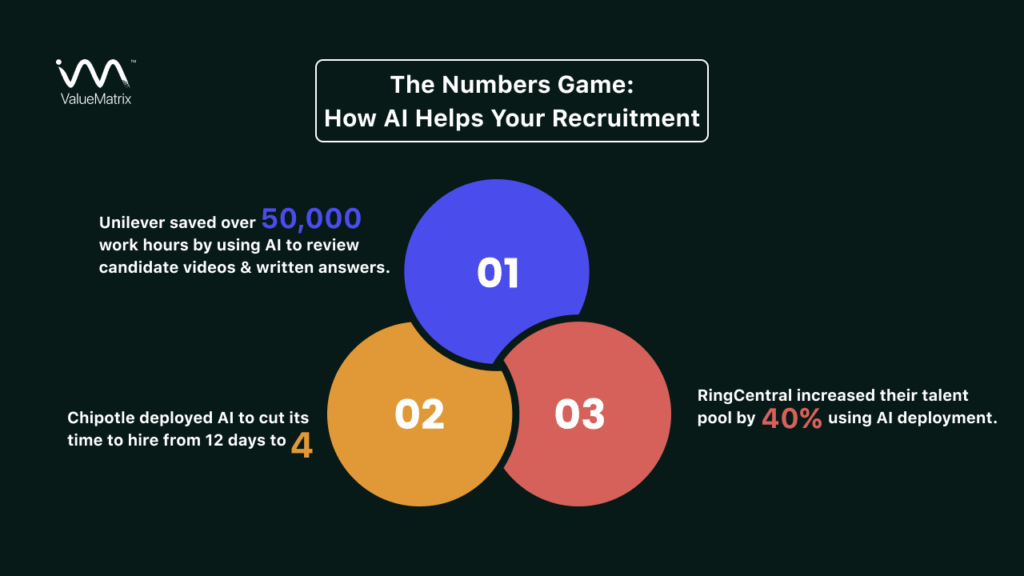
Bringing AI into recruitment is not about chasing trends. It is about getting measurable results. Companies worldwide are seeing clear gains in time cost and productivity.
1. Uniliver Reduced Time-to-Hire
Unilever faced the challenge of reviewing over a million job applications annually. Using AI to review candidate videos and written answers, the company cut its time to hire by 75%. They cut their hiring cycle from four months to four weeks. This saved 50,000 hours of work. Candidate diversity also improved. This showed that automation can speed decisions and make hiring more inclusive.
Another standout isthe Chipotle restaurant chain. They used an AI assistant to cut its time-to-hire from 12 days to 4. Application completion rates rose from 50% to over 85%. This was almost a 75% drop in hiring time.
2. Manipal Health Enterprises – Lower Cost-per-Hire
AI’s efficiencies directly translate into cost savings. A mid-sized tech firm reported cutting initial screening time from40 hours to just 10. In another instance,Manipal Health Enterprises brought in a virtual assistant to manage common employee questions—like those about leave, salaries, and HR policies. It saved them over 60,000 work hours. New hire turnover also dropped by 5% every year. The result? Less strain on the HR team and noticeable cost savings.
ROI projections say that you can cut down the overall hiring costs by up to 30% with the help of AI. The AI will do all the legwork – from CV parsing, optimizing ad spend, and reducing dependency on external agencies. This will free up your recruiters to invest their time in the original “human resourcing” tasks like building relationships with candidates and strategic planning.
3. RingCentral used Advancing Diversity and Inclusion
RingCentral used AI to improve how it finds and connects with potential hires. It pulled insights from their own data and from external sources. As a result, their talent pool grew by 40%. The quality of candidates also went up by 22%. Even better, interest from underrepresented groups rose by 40%. That’s how you make hiring fairer and more inclusive.
Using AI tools definitely has its ROI merits. It helps you cut down recruitment time and hiring costs. It helps you bring diversity to your organization and frees your HR team to do the “human” work. AI makes your recruitment smart, strategic, and agile – ready to fuel the company’s growth.
When AI Guides Who Gets Hired, Can Fairness Survive?
The promise of AI is exciting, but it comes with serious pitfalls. As CHROs push for adoption, the question isn’t just “What can AI do for us?” It’s also “What risks are we willing to take?”
1. Algorithmic Bias and Fairness
AI learns from past data. But what if that data carries years of biased hiring decisions? A system trained on old resumes and choices could end up favouring certain genders, ethnicities, or schools. In trying to hire faster, we could strengthen the very inequities and biases we want to remove.
Mitigation starts with governance. Regular checks on AI models can spot bias before it causes harm. Training data must be diverse and truly representative. This is essential, not optional. Explainable AI (XAI) is just as important. It should be able to show why it made a decision. Transparency is more than a rule to follow. It is what builds trust with candidates and stakeholders.
2. Data Governance and Compliance
Recruitment AI works with sensitive information. This can include career history assessments and even video recordings. CHROs must follow strict laws such as GDPR in Europe or CCPA in California. How sure are you that every vendor you use meets these rules?
A privacy-first approach means encrypting data and setting limits on how long it is stored. It means getting clear consent at every stage. But compliance is only part of the job. Candidates should know how their data is used. They should know how long it is kept and how AI influences their evaluation. If we keep this information vague or buried in fine print, can we honestly claim to be running a fair process?
AI in recruitment has huge potential. But it is only as ethical and legal as the rules that guide it. The best leaders will treat governance as the foundation for AI. It is what makes adoption both sustainable and strong over time.
Implementation Roadmap for CHROs
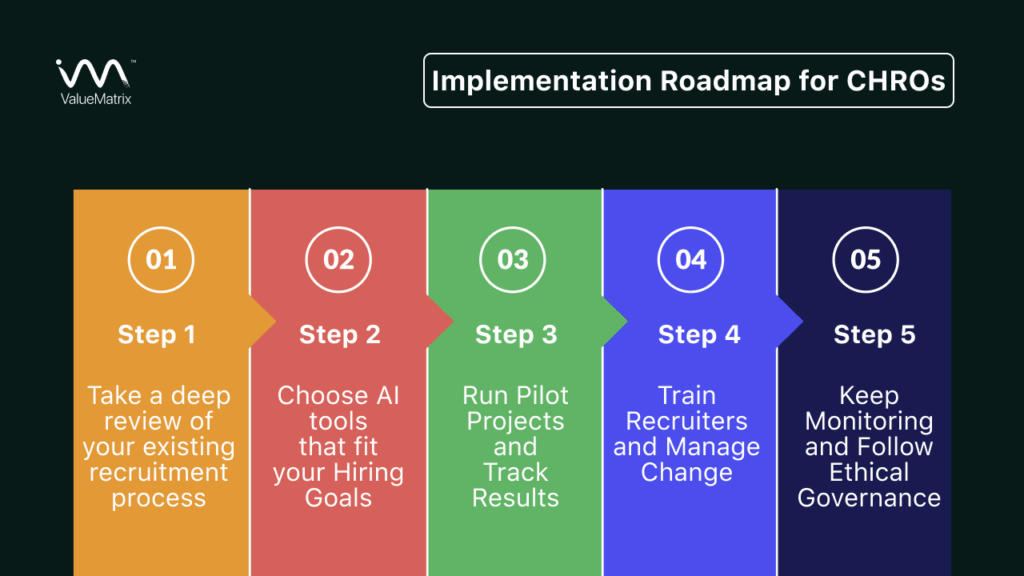
Addressing ethics and compliance of artificial intelligence tools is just the beginning. You need to turn that AI tool into a resource that offers value. That needs a clear plan.
| Step 1 | Review Existing Recruitment Process | – Map out each stage (sourcing → onboarding) – Identify delays and repetitive tasks – Spot areas where bias may arise |
| Step 2 | Choose AI Tools Aligned with Goals | – Define clear hiring objectives – Select tools based on needs: – Speed focus: Use scanning & scheduling automation – Diversity focus: Use bias-reducing tools – Prefer vendors with proven industry expertise |
| Step 3 | Run Pilot Projects & Track Results | – Start small (e.g., screening phase) – Measure metrics: time saved, candidate quality, drop-off rates – Use insights to refine before full roll-out |
| Step 4 | Train Recruiters & Manage Change | – Train teams to interpret AI insights – Emphasize human connection and candidate experience – Support adaptation to new workflows |
| Step 5 | Monitor & Ensure Ethical Governance | – Regularly check AI systems for fairness, accuracy, compliance – Keep ethical governance active and practical – Treat it as an ongoing responsibility |
The Power Couple: Human Judgment, Amplified by AI
To make AI in recruitment work, CHROs must invest in people as much as in technology. Recruiters need to move from admin work to strategic partnerships. They must read AI insights and guide hiring managers. They must shape workforce plans. This means building new skills. It starts with data literacy and requires advanced ways of engaging candidates.
Keeping humans in the loop is essential. AI can find candidates. It can see patterns. It can forecast outcomes. But real people, humans, must make the final call. Cultural fit and deeper motivations often appear only in real conversations. The strongest recruitment teams will be those where AI is the co-pilot and not the one in control.
In this vision, recruiters are not replaced—they’re elevated.AI takes care of filtering bookings and pattern matching, and Recruiters focus on what matters most. They build relationships and promote diversity. They help new hires succeed in the culture of the company.
AI also creates new chances for people to move within the company. It can find hidden talent and match them to new roles. It can open career paths that keep people longer.
Conclusion
The future for HR leaders is clear: weave AI strategically into every stage of the talent lifecycle, from hiring to growth, to build a future-ready “Human + AI” workforce. It is not about replacing people; it’s about unlocking their highest potential.
What once relied on slow, manual processes is now transforming into a faster, data-driven system that cuts hiring time and costs while improving diversity and aligning talent with business goals. But while technology makes hiring smarter and fairer, it also demands strong ethical safeguards to prevent bias and protect candidate privacy. The most effective model is a “Human + AI” partnership: AI takes care of repetitive tasks, while recruiters focus on judgment, relationships, and culture fit.
With ValueMatrix, CHROs can turn these ideas into reality—using our AI-driven, psychology-backed instruments to screen candidates faster, remove bias, and build teams that not only perform but truly fit the organization’s culture.
About Us
ValueMatrix is an AI-powered talent intelligence platform that helps companies hire better, faster, and without bias. We go beyond resumes to assess skills, behavioral traits, and cultural fit using advanced AI and proven psychological frameworks. Our platform delivers data-driven insights that improve hiring accuracy, reduce time-to-hire, and elevate candidate quality.
ValueMatrix AI enables hiring teams to make confident hiring decisions and build high-performing teams at scale.
FAQs
1. How does AI improve candidate screening compared to traditional methods?
AI automates resume parsing, skill matching, and background analysis, reducing human bias and saving recruiters hours of manual work. It ensures only the most relevant candidates move forward.
2. Can AI interviewing tools really assess soft skills and cultural fit?
Yes. Modern AI-powered video interview platforms analyze speech, tone, facial cues, and behavioral patterns to provide insights on communication, adaptability, and team fit, which are hard to capture through resumes alone.
3. Will AI replace human recruiters in the hiring process?
No. AI is a support system—it handles repetitive tasks like screening and scheduling, while recruiters still make the final judgment calls and build human connections with candidates.
4. How do AI-driven tools ensure fairness and reduce bias in hiring?
AI, when designed responsibly, minimizes unconscious bias by focusing on skills and performance indicators rather than gender, age, or background. Regular audits and ethical frameworks are essential to keep the process fair.
5. What benefits do companies gain by using AI for recruitment?
Organizations experience faster hiring cycles, improved quality of hires, better candidate experiences through instant feedback, and significant cost savings by automating routine recruitment tasks.