
Introduction
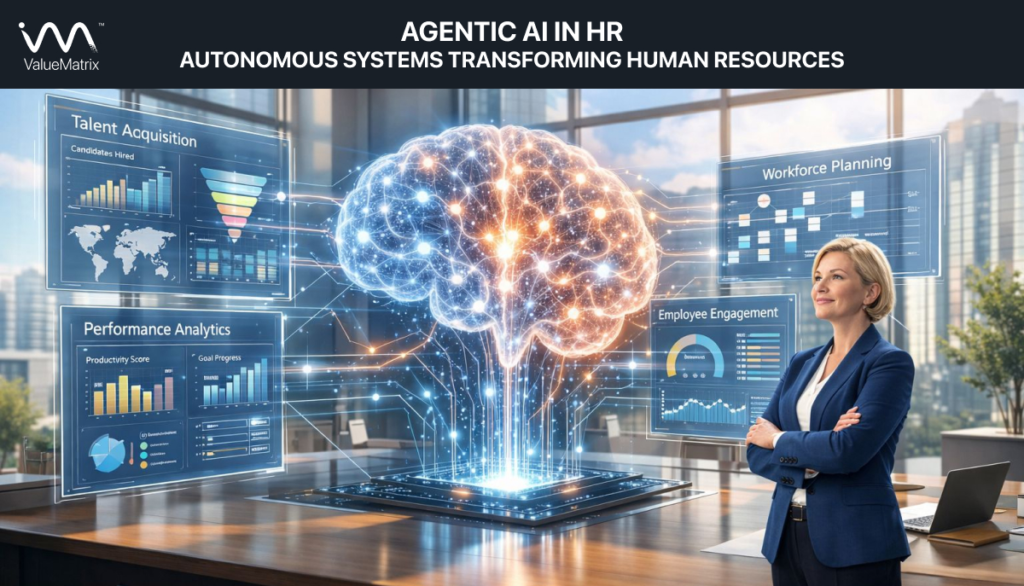
Artificial Intelligence has steadily become embedded in HR functions through automation, predictive analytics, and conversational tools. From resume screening platforms to chatbots that handle employee queries and dashboards that deliver workforce insights, AI is now a standard component of modern HR operations. However, most of these tools function within predefined workflows. They analyze information, generate reports, or trigger responses, but they remain dependent on human approvals and structured rules.
The emergence of agentic AI in HR signals a major transformation. Instead of operating only as assistants, AI agents in HR are designed to pursue defined objectives with limited supervision. These systems can interpret context, make decisions, and initiate actions across interconnected HR functions. Whether it involves coordinating hiring workflows, identifying retention risks, or adjusting workforce plans, they move beyond simple automation into intelligent, goal-oriented execution.
The growing uses of agentic AI in HR extend far beyond efficiency. Organizations are now exploring agentic AI applications in HR that enable proactive decision-making and adaptive processes. As businesses scale and talent ecosystems become more complex, implementing AI agents in HR processes is shifting from experimentation to a strategic priority. Forward-thinking leaders are embedding agentic AI in HR tech strategy to build scalable HR operations with agentic AI, positioning it as a cornerstone of next-generation HR AI.
https://valuematrix.ai/blog/ai-powered-talent-intelligence-platform-to-transform-human-resources/
Defining Agentic AI
At its core, agentic AI in HR refers to intelligent systems built with autonomy, goal orientation, and decision-making capabilities. Traditional AI models in HR primarily focus on prediction, classification, or pattern recognition. They might recommend candidates, flag attrition risks, or generate reports. However, they stop at the stage of generating insights. Human teams still interpret the output and decide what action to take.
Agentic AI goes a step further. It is designed to act. These systems can identify a problem, determine the next best course of action, execute tasks across multiple platforms, and learn from outcomes without requiring repeated instructions. Instead of functioning as a tool, the AI operates as a digital agent with a defined objective.
In practical terms, this means AI agents in HR can independently source candidates, screen applications, schedule interviews, coordinate with hiring managers, update records in applicant tracking systems, and trigger onboarding workflows. They can connect data across HRIS platforms, learning systems, and performance tools to inform decisions aligned with organizational goals. This shift transforms HR technology from passive automation into an active, decision-executing capability.
Autonomy and Proactivity as Core Capabilities
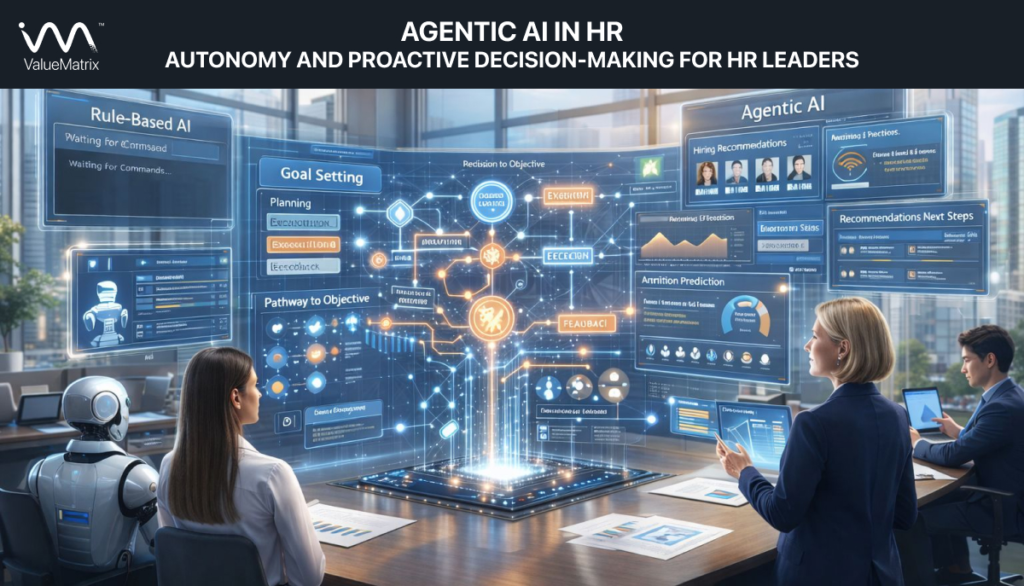
The defining characteristic of agentic systems is autonomy. Unlike rule-based automation that reacts to predefined triggers, these systems continuously monitor data environments and dynamically adjust their behavior. They do not wait for manual prompts. They detect patterns, anticipate needs, and initiate actions in real time.
For HR teams, this significantly changes the operating model. Instead of managing every microtask, professionals focus on outcomes and strategic objectives. For example, within the broader use of agentic AI in HR, a system might detect a sudden spike in candidate drop-off rates, analyze potential causes, redesign communication workflows, and automatically deploy improved engagement sequences.
This proactive capability also supports AI agents for recruitment automation, enabling faster hiring cycles and better candidate experiences. Over time, these systems refine their strategies through feedback loops, creating smarter and more adaptive HR processes that evolve alongside business needs. (The image below is just a representation will be formatted post you approve the blog)
https://valuematrix.ai/blog/ai-driven-hr-market-trends-for-2026-and-beyond/
How Agentic AI Differs from Other Forms of AI
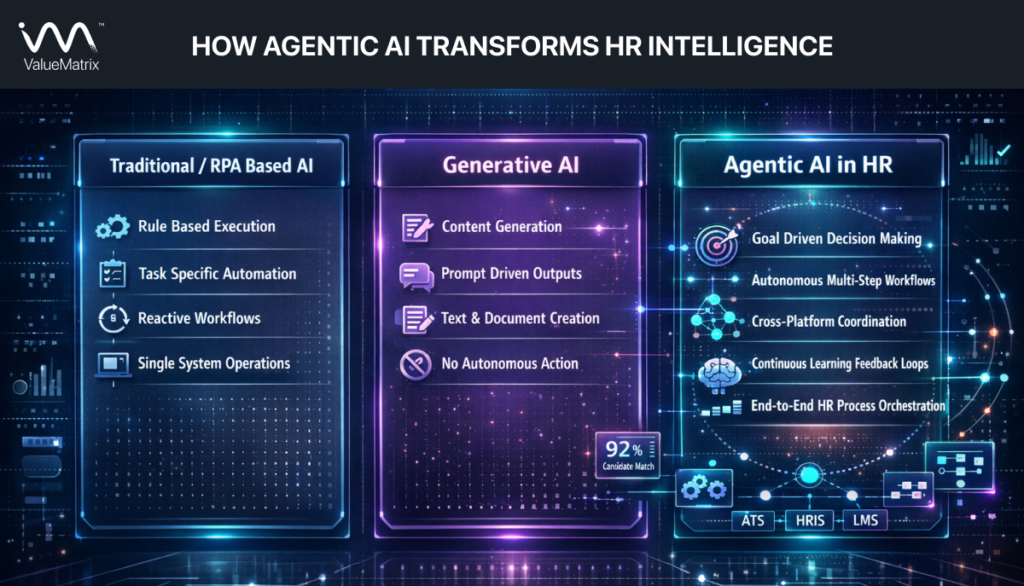
Agentic AI vs Traditional and RPA Based AI
Traditional AI systems and robotic process automation tools are largely rule based and task specific. They are effective for repetitive activities such as resume screening, payroll updates, or compliance documentation. However, they operate within predefined logic and cannot independently reason across interconnected workflows. They execute instructions but do not evaluate broader objectives or adjust dynamically.
By contrast, agentic AI in HR integrates reasoning, decision making, and execution. These systems coordinate activities across multiple platforms, analyze outcomes, and refine strategies without repeated human input. For organizations exploring advanced uses of agentic AI in HR, this means moving from isolated automation toward intelligent orchestration. Instead of automating one task at a time, AI agents in HR can manage entire talent workflows, making agentic AI applications in HR significantly more impactful and aligned with business outcomes.
Unlike task-specific automation, agentic AI in HR can reason across multiple steps and coordinate HR workflows. Traditional AI and RPA handle isolated tasks, but agentic systems proactively optimize processes across recruitment, employee support, and workforce planning.
Agentic AI vs Generative AI
Generative AI focuses primarily on producing content such as job descriptions, interview questions, onboarding guides, or policy summaries. While useful, it remains output oriented and dependent on prompts. It does not independently decide when content should be created or how it should influence broader HR objectives.
In comparison, agentic ai in HR tech strategy positions AI as a goal driven system. Agentic models determine when to generate content, where to deploy it, and how to act on resulting insights. For example, within AI agents for recruitment automation, the system may create a job description, publish it across channels, screen applicants, schedule interviews, and adjust sourcing strategy based on response rates. This level of coordination enables scalable HR operations with agentic AI, transforming automation into autonomous execution.
While generative AI focuses on content creation, AI agents in HR determine when and how to act on HR processes. They autonomously trigger actions, adjust strategies, and improve outcomes without human prompts, making them suitable for end-to-end HR workflows.
https://valuematrix.ai/blog/balancing-ai-automation-and-ethical-hr-decision-making/
Why HR Is Rapidly Adopting Agentic AI
Managing Scale and Complexity
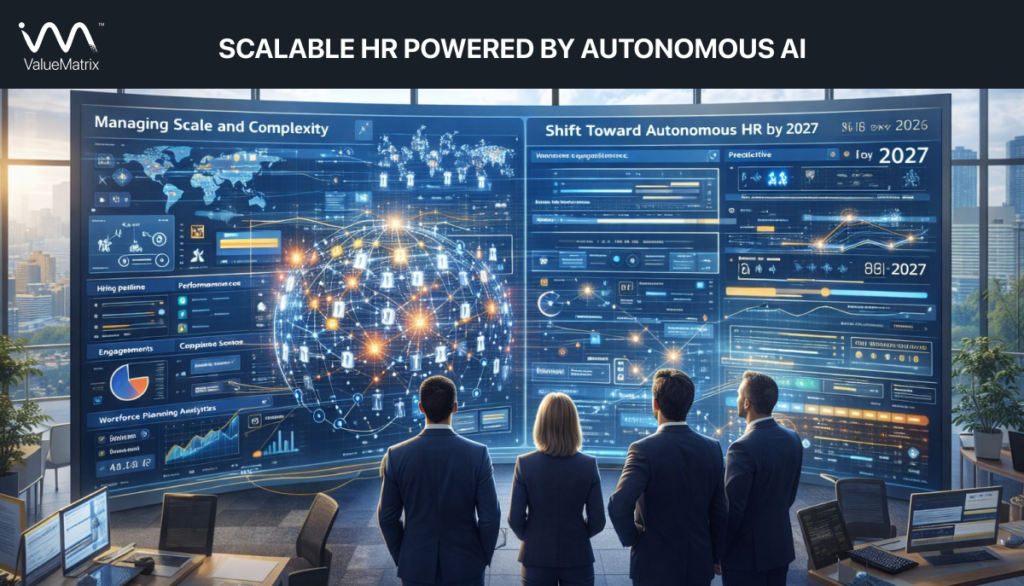
Modern HR functions are responsible for managing increasingly large, global, and distributed workforces. From recruitment and onboarding to compliance, performance management, and learning, the volume of interconnected tasks has grown exponentially. Manual coordination across systems often leads to delays, inconsistencies, and fragmented employee experiences. This is where agentic AI in HR is becoming a strategic necessity rather than a technological upgrade.
By leveraging AI agents in HR, organizations can orchestrate multi step workflows across applicant tracking systems, HRIS platforms, payroll tools, and learning environments. The expanding uses of agentic AI in HR include automating hiring pipelines, proactively resolving employee queries, and optimizing workforce allocation. These agentic AI applications in HR enable truly scalable HR operations with agentic AI, allowing HR teams to focus on strategic oversight instead of operational bottlenecks.
Global organizations use AI agents in HR processes to manage large, distributed workforces. Autonomous HR systems streamline recruitment, onboarding, employee queries, and compliance, allowing teams to focus on strategic initiatives.
Shift Toward Autonomous HR by 2027
Forward thinking enterprises are embedding agentic AI in HR tech strategy to future proof their people operations. As organizations move toward 2027, implementing AI agents in HR processes is expected to accelerate across talent acquisition, employee support, and workforce planning. The measurable benefits of agentic AI in HR management include faster decision cycles, improved consistency, and data driven adaptability, positioning it as a core pillar of next-generation HR AI.
Leading enterprises are embedding uses of agentic AI in HR to improve hiring speed, retention, and workforce planning. Early adopters show measurable gains in efficiency, consistency, and employee satisfaction, signalling a clear trend toward fully autonomous HR operations.
https://valuematrix.ai/blog/reinventing-talent-management-with-ai-hire-engage-inspire/
Key HR Use Cases of Agentic AI
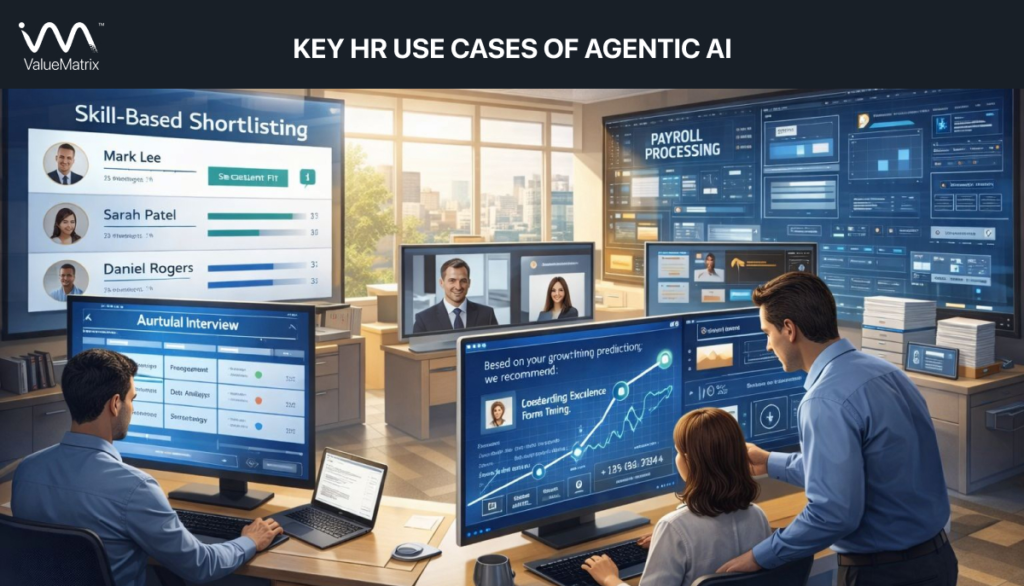
The growing uses of agentic AI in HR demonstrate how autonomous systems are reshaping the entire employee lifecycle. Unlike traditional automation, agentic AI in HR enables intelligent, goal driven orchestration across recruitment, engagement, development, and operations.
Talent Acquisition and Recruitment Enablement
One of the most powerful agentic AI applications in HR is within hiring. Through advanced AI agents for recruitment automation, organizations can autonomously scan talent markets, source candidates, match skills to job requirements, and screen profiles across multiple platforms. These agents continuously optimize pipelines by analyzing conversion rates, candidate drop offs, and skill gaps.
By implementing AI agents in HR processes related to hiring, companies reduce time to hire, improve quality of hire, and minimize bias in job descriptions and evaluations. Recruiters shift into a strategic oversight role, focusing on relationship building and final decision making rather than repetitive coordination tasks.
Organizations implementing agentic AI in HR are already seeing measurable hiring impact. Companies like BrightSpring Health, T-Mobile, and Chipotle have deployed autonomous AI assistants as part of broader AI agents for recruitment automation, improving sourcing accuracy, DEI outcomes, and reducing time-to-hire.
Employee Experience and Onboarding
Modern AI agents in HR provide personalized, real time support throughout onboarding and beyond. Conversational systems offer 24/7 assistance for benefits enrolment, leave management, payroll queries, and policy clarification. Within a broader agentic AI in HR tech strategy, these systems proactively guide employees through onboarding checklists, training schedules, and documentation requirements. The result is improved experience alongside scalable HR operations with agentic AI that reduce service desk workload.
Botpress’ HR support assistant demonstrates practical implementing AI agents in HR processes by autonomously managing employee queries, onboarding guidance, and policy clarification workflows. This reduces HR workload while maintaining 24/7 support.
Internal Mobility and Career Development
By analyzing skills data, certifications, performance history, and career aspirations, next-generation HR AI can identify internal candidates for open roles before external recruitment begins. This strengthens workforce agility and retention. These advanced agentic AI applications in HR align talent supply with evolving business needs while reducing dependency on external hiring.
Proactive Talent Management
Another critical area within the benefits of agentic AI in HR management is predictive retention. Agentic systems monitor engagement signals, performance trends, and learning activity to flag potential turnover risks. Instead of reacting to resignations, HR can intervene early with personalized development pathways.
Administrative Efficiency and HR Operations
From payroll processing to compliance tracking, agentic AI in HR streamlines administrative workflows. By fully implementing AI agents in HR processes, organizations eliminate bottlenecks and unlock time for strategic workforce planning, leadership development, and culture building.
As organizations scale, autonomous systems enable scalable HR operations with agentic AI. Databricks’ AI assistants in Slack reduced HR ticket volumes while supporting rapid workforce expansion, showing real-world efficiency gains.
https://valuematrix.ai/blog/from-data-to-decisions-predictive-analytics-in-hr-talent-management/
Benefits of Agentic AI for HR Teams
The growing adoption of agentic AI in HR is not only about automation. It is about redefining how HR teams create value at scale. The measurable benefits of agentic AI in HR management extend across strategy, analytics, and operational efficiency.
Focus on Strategic and Human Centric Work
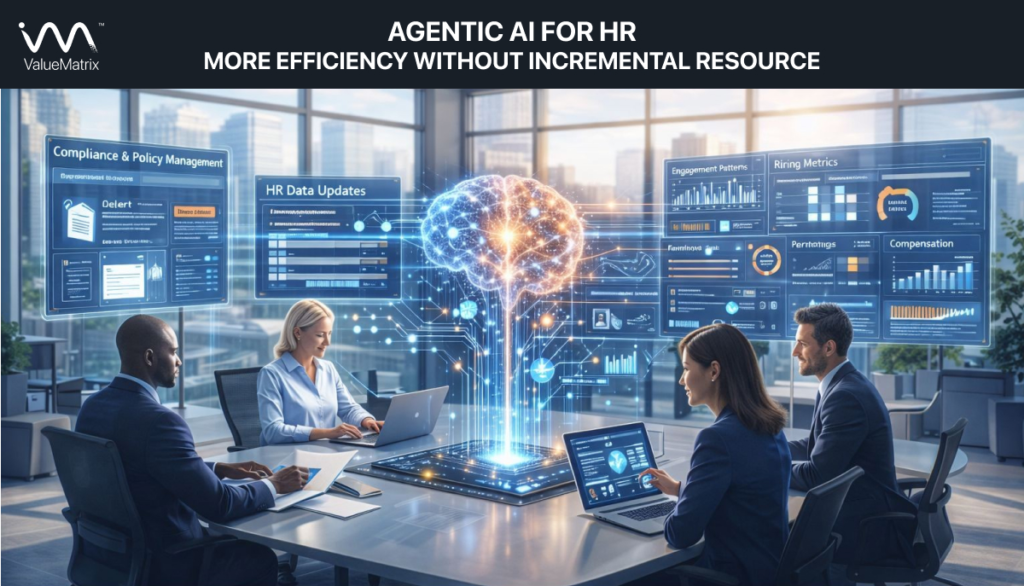
By implementing AI agents in HR processes, organizations reduce the burden of high volume, repetitive tasks such as interview coordination, policy responses, compliance documentation, and data updates. This allows HR professionals to redirect their time toward complex employee relations, leadership coaching, culture building, and long-term workforce strategy. Instead of managing transactions, teams oversee outcomes enabled by intelligent AI agents in HR.
Data Driven Decision Making
Through advanced analytics and continuous learning models, agentic AI applications in HR transform workforce data into actionable insights. These systems analyze engagement patterns, hiring metrics, performance data, and compensation benchmarks in real time. Embedded within a broader agentic AI in HR tech strategy, they enable faster and more consistent decisions related to workforce planning, talent forecasting, and rewards optimization.
Companies such as HP and Google showcase the benefits of agentic AI in HR management by using predictive workforce intelligence to reduce attrition and improve hiring success rates.
Scalability Without Increasing Headcount
One of the most compelling advantages of scalable HR operations with agentic AI is the ability to support growth without proportional increases in HR staffing. This makes next-generation HR AI especially valuable for rapidly expanding and globally distributed organizations.
Deployments like AMD’s agentic HR assistant demonstrate how agentic AI in HR can reduce ticket volumes, provide consistent 24/7 employee support, and maintain service levels without increasing HR headcount.
https://valuematrix.ai/blog/optimizing-talent-with-ai-workforce-planning/
Risks and Governance Considerations
Ethics, Trust, and Transparency
As organizations scale agentic AI in HR, governance becomes a foundational requirement rather than a compliance afterthought. Autonomous decision-making in hiring, promotions, and workforce planning raises legitimate concerns about bias, explainability, and accountability. The long-term benefits of agentic AI in HR management depend on transparent algorithms, traceable decision logs, and clear communication with employees about how systems operate.
A well-documented governance lesson emerged when Amazon discontinued its experimental AI recruiting system after detecting gender bias in training data. This case demonstrates the real risks associated with poorly monitored AI agents used for recruitment automation and reinforces the need for continuous fairness testing rather than reactive testing.
Human Oversight and Control
Even as enterprises adopt AI agents in HR, human oversight remains essential. Autonomous systems should operate within defined guardrails that reflect legal, ethical, and cultural expectations. Structured review mechanisms ensure responsible implementation of AI agents in HR processes without exposing the organization to compliance risks.
Governance as Part of HR Tech Strategy
Forward-thinking organizations embed oversight into their broader agentic AI in HR tech strategy, establishing ethics boards, audit committees, and bias detection models. This structured approach ensures innovation remains aligned with trust, transparency, and long-term workforce credibility.
https://valuematrix.ai/blog/ethical-ai-framework-a-simple-checklist-for-fair-hiring
The Future of Agentic AI in HR
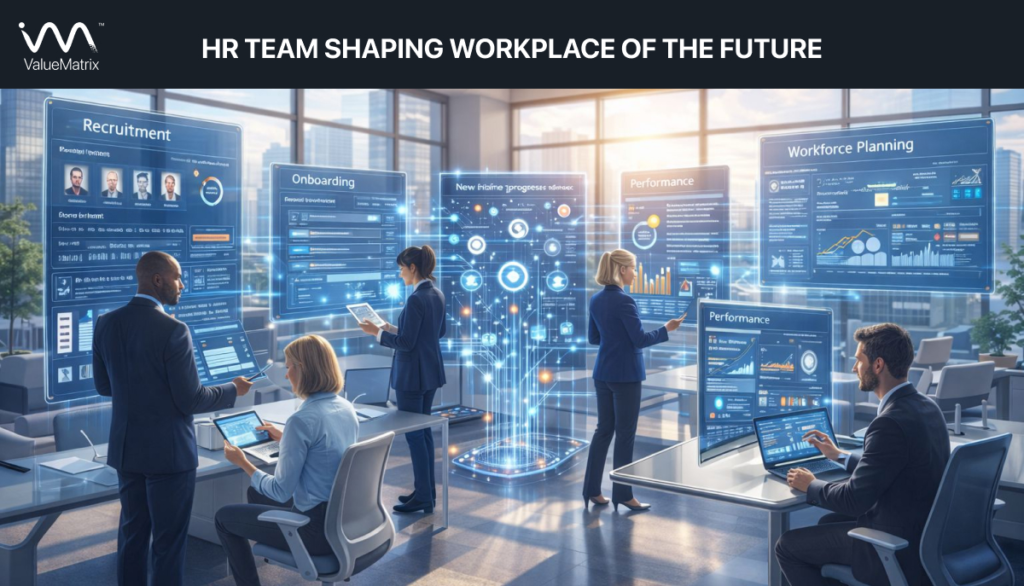
The future of agentic AI in HR lies in its evolution from an operational assistant to a true digital HR partner. Instead of functioning in isolated workflows, next-generation systems will unify recruitment, onboarding, performance management, learning, and workforce planning into a connected talent ecosystem. This integration will enable real-time decision-making across the employee lifecycle, supported by continuous data feedback loops.
As organizations mature in implementing AI agents in HR processes, autonomy will increase while manual intervention decreases. HR teams will no longer focus on task execution but on strategy design, culture strengthening, and ethical alignment. The expansion of AI agents in HR will also accelerate scalable HR operations with agentic AI, allowing enterprises to manage global workforces with precision and consistency.
Ultimately, the future positions HR leaders not as process managers, but as architects of intelligent, human-centred workforce strategy.
Conclusion
Agentic AI in HR signals a decisive shift from reactive automation to autonomous workforce orchestration. Unlike traditional systems, it combines reasoning, proactivity, and execution to transform recruitment, onboarding, internal mobility, talent management, and HR operations. The expanding uses of agentic AI in HR demonstrate how organizations can unify hiring, employee experience, learning, and workforce planning into a connected ecosystem powered by intelligent decision-making.
From AI agents for recruitment automation to personalized lifecycle support and predictive workforce analytics, the real agentic AI applications in HR are already reshaping enterprise HR models. When organizations focus on responsibly implementing AI agents in HR processes, they unlock the measurable benefits of agentic AI in HR management, including improved agility, consistency, and scalability.
As part of a forward-looking, agentic AI in HR tech strategy, these systems enable scalable HR operations while reinforcing governance, transparency, and human oversight. Ultimately, next-generation HR AI empowers leaders to move beyond administration and build resilient, future-ready talent strategies grounded in intelligence and trust.
Frequently Asked Questions (FAQs)
1. What is agentic AI in HR?
Agentic AI in HR refers to autonomous AI systems that can reason, make decisions, and execute actions across HR workflows without constant human prompting. Unlike traditional automation, these systems proactively manage recruitment, employee experience, workforce planning, and HR operations while continuously learning from outcomes.
2. How is agentic AI different from traditional HR automation?
Traditional automation and RPA follow predefined rules and handle isolated tasks. In contrast, AI agents in HR coordinate multi-step workflows, evaluate results, and adjust actions in real time. This makes agentic systems suitable for end-to-end HR transformation rather than task-level efficiency.
3. What are the main uses of agentic AI in HR?
The primary uses of agentic AI in HR include recruitment automation, employee onboarding, internal mobility matching, predictive workforce planning, and HR service management. These systems integrate multiple tools and data sources to optimize outcomes across the employee lifecycle.
4. How does agentic AI improve recruitment?
Through AI agents for recruitment automation, organizations can autonomously source candidates, match skills to job requirements, screen applications, and schedule interviews. This reduces time-to-hire, improves hiring quality, and minimizes bias when properly governed.
5. What are the benefits of agentic AI in HR management?
The key benefits of agentic AI in HR management include increased efficiency, better data-driven decision-making, scalable HR operations, improved employee experience, and proactive talent risk identification. HR teams can focus more on strategy and human-centred initiatives.
6. Is agentic AI safe and compliant for HR use?
Yes, but only with strong governance. Responsible implementation of AI agents in HR processes requires ethical frameworks, bias audits, human oversight, and transparent decision logic to ensure compliance and fairness in autonomous HR systems.
7. How does agentic AI support HR tech strategy?
An effective agentic AI in HR tech strategy integrates recruitment, performance, learning, and analytics into a unified talent ecosystem. This enables connected decision-making and supports long-term workforce agility.
8. What is the future of agentic AI in HR?
The future lies in scalable HR operations powered by agentic AI, where next-generation HR AI serves as a digital partner rather than a support tool. As autonomy increases, HR leaders will focus more on ethics, culture, and strategic workforce design while intelligent systems handle operational execution.