
Key Takeaways
- AI recruitment screening refers to the use of artificial intelligence to automate and speed up the initial stages of the hiring process.
- It extracts information from candidates’ resumes and matches with job descriptions.
- Unlike traditional screening, AI can parse hundreds of resumes in minutes.
- ValueMatrix AI ensures more consistent screening and enables data-driven hiring decisions.
- Human oversight, regular audits, and implementation of a governance policy are essential for effective AI screening.
What Is AI Recruitment Screening?
AI recruitment screening refers to the use of artificial intelligence to shortlist applicants in the first rounds of the hiring process. The system compares candidates’ qualifications against predefined job descriptions to identify the most suitable candidates.
The AI tools can quickly analyze resumes and cover letters, thereby screening high volumes of job applications within a short time. Advanced tools can communicate with candidates through online questionnaires, AI agents, or video interviews.
- Natural language processing (NLP) understands the job requirements and assesses the applications to match with job descriptions.
- Predictive analytics enable recruiters to make an informed estimate of candidates’ talent and quality.
- Human intervention is not needed to engage with candidates in the initial stages as AI can interact with them to answer their queries and schedule interviews.
- Through machine learning, AI updates itself from past experiences and improves over time.
How Does AI Screening Work?
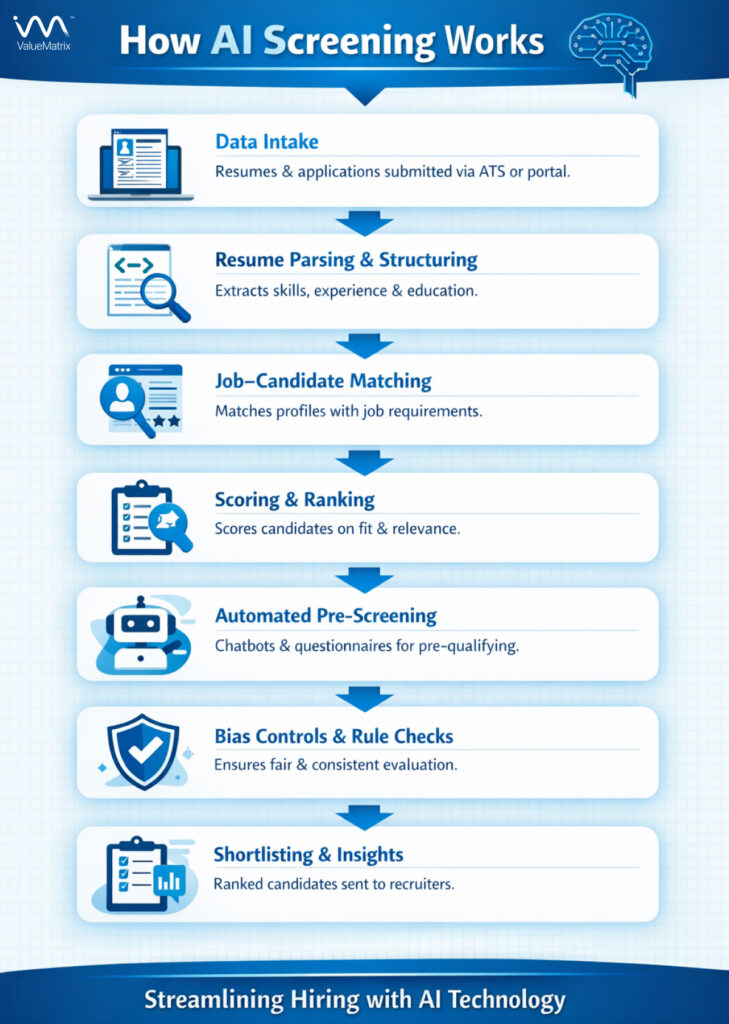
Recruitment screening with AI involves collecting the resumes, parsing candidate information from them, comparing it with the job description, and shortlisting the applicants who match the role requirements.
- Candidates are asked to submit applications through an ATS or career portal. AI collects information, such as their qualification, skills, and past jobs, from the application.
- The collected data is matched to the standardized criteria as per the role and scores are assigned as per the predefined weightages.
- Any basic information, such as availability and expectations, is collected from candidates, using chatbots or questionnaires.
- Recruiters receive a list of shortlisted candidates along with insights and reports.
How Is AI Screening Different From Traditional Manual Screening?
Traditionally, application screening involved manual review of resumes by HR teams or hiring managers. This process was time-consuming and inconsistent. AI screening offers consistency while ensuring scalability.
| Aspect | Traditional Manual Screening | AI Recruitment Screening |
| Speed | Time-consuming; resumes reviewed one by one | Processes thousands of applications in minutes |
| Scalability | Limited by recruiter capacity | Highly scalable with minimal additional effort |
| Consistency | Varies by recruiter judgment and fatigue | Applies uniform criteria to all candidates |
| Data analysis | Focuses on visible experience and keywords | Analyzes structured and unstructured data and identifies patterns |
| Bias risk | Higher risk of unconscious bias | Can reduce bias when properly configured and audited |
| Decision support | Relies on intuition and manual shortlisting | Provides ranked candidates and actionable insights |
| Candidate experience | Slower responses and limited feedback | Faster screening and automated communication |
| Recruiter effort | High administrative workload | Recruiters have time to focus on human-centric tasks |
| Contextual understanding | AI systems like ValueMatrix offer strong contextual judgment | Limited nuance recognition |
| Cultural fit assessment | ValueMatrix AI makes personal evaluation possible through computational psycholinguistics | Cannot assess intuitively |
What Are The Benefits Of AI Screening For Recruiters?
AI in hiring is driven by its substantial benefits of time and cost efficiencies, improved accuracy, scalability, consistency, and mitigation of bias. According to a study by Atomik Research and Insight Global, 98% of hiring managers have seen significant improvements in hiring efficiency with AI, and 95% plan to invest more in AI hiring processes.
Time and Cost Efficiency
One of the most significant uses of AI in hiring process is the reduction in time and cost of recruitment. Resumes move faster without human intervention. Organizations can reduce their recruitment costs and time, especially where the volumes are high.
Improved Accuracy In Screening
AI doesn’t just make the process faster than manual screening, it increases accuracy and consistency as the entire process is data-driven. The risk of overlooking qualified candidates is mitigated as resume screening is based on a uniform pre-set criteria. This can result in better skill and role matching, as well as a quicker closure of the position.
Scalability For Growing Hiring Needs
Enterprise and fast-scaling teams can expand their ability to handle large applicant volumes while maintaining a compact HR team. Hiring spikes can be successfully met with minimal additional effort.
Reduced Workload For Recruiters
Automation of a mechanical, repetitive task of screening resumes saves hours of recruiter time, which can be utilized for more productive tasks. Recruiters can focus on enhancing the quality of interviews and candidate experience.
Data-Driven Hiring Decisions
AI screening provides scores and insights on each candidate, for recruiters to make data-driven decisions rather than intuition-based ones. Moreover, there is visibility into pipeline quality and bottlenecks that can be addressed for the next hiring cycle.
Fairer and More Consistent Screening
AI screens applications based on a standardized screening logic. If this logic is driven by proper governance, organizations can reduce the influence of unconscious bias. Transparent, auditable screening processes eliminate questionable shortlisting of applications and enable improvements in future hiring cycles.
Enhanced Candidate Experience
Faster responses and timely closure of applications enhance candidate experience. Candidates have more time to prepare for further rounds if their application is shortlisted or they can move on with other opportunities when they get timely communication. Efficient initial processes centered around candidates’ convenience strengthen employer brand perception.
Know how ValueMatrix can help your organization with faster and more accurate screening outcomes. Request a demo.
What Are The Challenges And Limitations Of AI Screening?
The efficiency of an AI system relies on the input data and the company’s governance policy. Poor datasets can lead to overreliance on keywords and continuation of historical biases. Moreover, a weak or no governance policy raises several questions on the transparency and efficiency of the process.
A review of peer-reviewed studies published in 2025 by Silesian University of Technology observes that AI in hiring has brought in a significant reduction in recruitment time, operational cost, and unconscious bias, but that is ‘contingent upon data quality and system integration.’
Over-Reliance On Keywords
AI screening may favor resumes optimized for AI over those with higher quality. Candidates who insert relevant keywords smartly in their application may have a better chance of being shortlisted than qualified candidates who don’t. The system may also ignore synonyms and equivalent experiences. This not only deprives deserving candidates of an opportunity but also makes organizations lose better talent.
Risk of Embedded Bias
AI screening is an opportunity for organizations to avoid bias in hiring. But if the data is wrought with historical biases, AI will continue to reject candidates on grounds of their color, gender, age, and race. A study by the University of Washington Information School has shown that resumes with White-associated names were selected 85% of the time, but those with Black-associated names were selected only 9% of the time. Similarly, resumes of male names were shortlisted 52% of the time, as against those of female names, even for posts in HR and teaching, which have been traditionally seen as female-dominated.
Technical Limitations
AI tools may not be accurate in parsing unconventional resumes with unique formatting or extensions. Candidates who take care to make their resumes creative might lose out despite being suitable for the job. Similarly, AI might overlook multilingual resumes or specific terminology that is not included in its instructions.
Issues With Transparency
Why was a candidate rejected? Why was one preferred to the other? HR might find it difficult to explain the reasons for rejection to the candidates. Decisions based on algorithms may be right but convincing the candidates about the transparency of the process can be tricky.
Despite challenges, automation brings in efficiency to candidate screening. The key is to plan an implementation roadmap that addresses any foreseeable limitations.
Want to implement AI screening without the complicated challenges? See how ValueMatrix helps. Book a demo.
What Are The Best Practices In AI Screening Implementation?
The Silesian University review observes that successful AI screening implementation involves four ‘socio-technical’ conditions: “robust data governance, adequate IT infrastructure and interoperability with existing HR systems, upskilling of HR teams and proactive change management, and stakeholder trust built on transparency and ethical oversight”. A systematic approach to implementation typically involves the following steps.
Roadmap Planning
Do market research to understand the viability of automating the screening process in your industry. Compare your current hiring outcomes with your planned standards to understand the need to automate. Estimate the investments needed to modernize your existing HR systems and calculate the RoI.
Vendor Evaluation and Selection
The quality of the vendor is paramount for an effective screening system. Contact multiple vendors and call for bids. Compare their features and offers, know about the quality of their client service, go through the reviews, and negotiate with them for a better price and additional features.
Data Quality Assessment
Standardize formats for applications and ensure resumes have sufficient candidate details. Remove outdated and unnecessary information. Make sure the datasets reflect the current market trends and comply with the latest data privacy laws.
Customization and Configuration
Define the skills, experience, and qualifications for each role, with weightage for each of them. Set limits within which AI can shortlist or reject candidates. Include keywords, their synonyms, and emerging skills related to the role. Set rules for filtering the candidates, such as their location, experience, and pay scale. Align the tone of communication with your brand’s tone.
Bias Testing and Mitigation
Bias reduction is one of the key features of AI screening systems. But that is possible only with a conscious effort to filter out the historical biases through a thorough audit. Establish fairness metrics and implement bias detection tools for better results.
Human Oversight Protocol
Avoid fully depending on AI decisions. Identify areas that need human reviewers. Validate AI generated scores and ratings and check for any anomalies. Create a system where humans can override AI decisions. Maintain logs for accountability and use human feedback to train the AI tools.
System Integration
Integrate the AI screening system with existing HR and hiring platforms (HRIS, ATS) so that there is a smooth data flow between the systems. Avoid duplication in data entry and make the workflow seamless for the successful implementation of the AI tools.
Staff Training and Change Management
Training the HR team is a prerequisite for the success of the AI system. Take up orientation sessions for them and address their concerns, reassure them about their job security and how AI training can help them to upskill. Create training material and user guides for the HR members to use as a reference.
Pilot Testing
Start with limited roles or a few teams to test the efficacy of the system. Run parallel manual and AI screening to compare results and test its accuracy. Gather feedback from recruiters, identify issues before full rollout, and make the necessary changes.
Continuous Monitoring
The screening systems must stay aligned to company objectives. For this, measure the RoI based on the improvements in the reduction of time and costs involved in hiring. Collect feedback from candidates and review it. Update algorithms with new data and refine criteria.
Legal Compliance
To adhere to fair hiring practices, keep track of audit trails and the algorithmic modifications made to the system. When processing a candidate’s data, get their express consent as required by law. To find possible legal risks, conduct adverse impact analyses on a regular basis.
How Are Organizations Using AI Recruitment Screening?
IBM, US
The challenge
Identify high-quality and relevant candidates from thousands of applications. Also, attract qualified candidates to apply for suitable positions across IBM.
The solution
IBM developed an AI solution called Watson Candidate Assistant, which engages potential candidates and attracts them to apply for various roles. It matches their skills to available job openings and makes recommendations based on the analysis.
The impact
Carrie Altieri, Vice President HR Communications, IBM, says, “IBM gets 7,000 resumes per day and surfacing the right candidate in a reasonable time is like finding a needle in a haystack. Since implementing WCA, we have dramatically cut time-to-hire, doubled NPS (net promoter score), and vastly improved the matching of candidates to jobs.”
PricewaterhouseCoopers (PwC), UK
The challenge
A large volume of resumes for various roles across regions needed a more efficient process that reduced manual interventions and accelerated the screening process. PwC wanted a system that enhanced operational productivity while maintaining high levels of accuracy.
The solution
PwC implemented resume screening systems that evaluated candidates against predefined job requirements. The system was integrated into their existing ATS.
The impact
The conversion rate of candidates improved the accuracy of resume screening with automated screening and assessments. There was a 54% reduction in the overall time-to-hire with AI interventions at various stages of the recruitment pipeline. Moreover, there was a significant reduction in manual effort hours in resume screening and shortlisting.
Why Choose ValueMatrix?
ValueMatrix enables recruiters to make data-driven decisions with predictive analytics and optimal human-AI integration. Its AI systems follow a fair and unbiased approach towards candidates through diverse datasets, while a gamified approach ensures a reduced risk of unconscious bias.
- ValueMatrix goes beyond resume screening to include cultural fitment and team dynamics assessment of candidates.
- The AI uses cognitive gamification for bias-free, skills-based assessment.
- Computational psycholinguistics embedded in the AI systems enable the detection of AI-generated candidate profiles.
Book a demo to have a first-hand experience of how ValueMatrix systems work.
AI screening of candidates can bring in significant time and cost efficiencies. Additionally, it helps reduce unconscious bias in hiring. However, inaccurate or irrelevant datasets can negatively impact the very objective of automation. This can be avoided through constant monitoring of data and regular course correction.
FAQs
- How does AI work to analyze resumes?
AI uses ML and NLP to analyze resumes. The tools take information from resumes and compare them with job descriptions to determine how well a candidate fits the position.
- Are AI screening systems more accurate than human recruiters?
AI tools can be considered more accurate than human recruiters as they are programmed to be consistent, while maintaining speed. However, accuracy depends on the quality of the datasets and the screening criteria provided to the system.
- Can AI screening be used as a substitute for human recruiters?
AI cannot replace humans. It is just a tool that helps recruiters to speed up their work and be more efficient than before. HR can move away from mechanical tasks to focus on other productive areas. However, a recruiter’s judgment is essential for assessing more humane attributes of a candidate, which cannot be done by AI.
- Can AI reduce hiring bias?
Standardized criteria can make AI avoid biases. Care should be taken to remove any historical biases in the datasets. Responsible configuration and regular audits are necessary to ensure unbiased results.
- How can we stop AI from rejecting qualified candidates?
Improved configuration, high-quality data, and human supervision can prevent the tools from turning away competent applicants. When configuring, avoid relying too much on keywords and use a variety of training data. Include human checkpoints and test for false negatives on a regular basis.
- How can I pick the best AI recruitment screening tool?
Consider your hiring volume and frequency before opting an AI screening tool. Give preference to tools with clear algorithms, simple configuration, and track record of success in your sector.
- How is AI screening useful for startups?
Startups can speed up their hiring with minimal HR resources. AI can help them make their hiring more accurate and avoid mistakes during their growth phase, when quick decision making matters.
- How can SaaS and tech companies benefit from AI recruitment screening?
SaaS and tech companies can make use of AI screening to evaluate candidates based on their skills. It also enables them to close hiring cycles for niche roles faster.
- Can AI screening work for all types of roles?
AI screening works best for high volumes and roles that have clearly defined requirements. It is more suitable for technical, entry-level, and standardized positions than roles that require rare skills. Human evaluation is needed for executive positions and roles requiring significant judgment.
- Should candidates know they are being screened by AI?
Yes, candidates should know when AI is used in screening to maintain transparency. It builds trust and meets ethical and regulatory expectations.
Transform your hiring with faster and fairer recruitment screening. Request a demo today.