
Speed as a Competitive Advantage
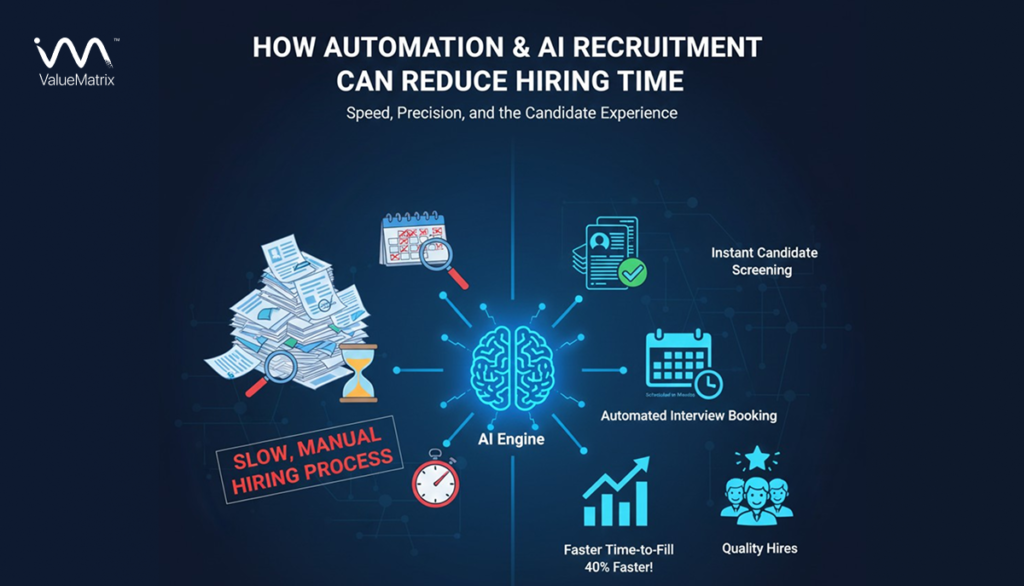
The 2025 talent economy will render “wait and see” – a typical attitude in recruitment – much more of a liability. If the top-tier talent is not engaged within the first 48 hours, such talent is generally stolen by more agile competitors. It will be described how AI recruitment automation becomes not simply about improving efficiency, but a real strategic engine of growth. By reducing time to hire with AI in recruitment, the leadership can transform a painfully slow manual process into a highly high-velocity talent funnel. We will have a look at the new tools, such as agentic AI and sentiment analysis, which enable a company to enhance the recruitment automation time-to-fill while preserving the human aspect of a world-class employer brand.
The Urgency of the Shift: From HR Manager to Growth Manager
To say the new talentscape demands more than traditional HR management seems an understatement. Organizations are navigating some previously unseen turbulence in keeping the talent they attract. The expectations among the employees now stretch almost non-existent, with each one believing that personal growth is their just due. All of this calls on the leadership to fundamentally shift: the drift away from the reactive HR manager, whose main focus is on administrative tasks, compliance checks, and periodic performance reviews, toward the proactive Growth Manager.
A Growth Manager is a strategic talent steward who uses advanced talent intelligence for managers to sculpt, develop, and motivate their teams, essentially improving AI for employee retention. This is not a mere matter of rhetoric; it answers to the immediate need of escalating costs of turnover and developing a resilient and future-ready workforce. A workforce where every employee feels really taken care of and supported.
1. Why Is the Traditional Candidate Journey Broken?
Traditional candidate journeys are often marred by broken steps and confusing processes that work in a sequential way and do not converge toward the end, since it remains a manual process that cannot support today’s application volumes. This futile “black hole” of sorts confuses candidates who are then unable to make quick decisions, thus taking all the time for everyone involved in the application process to recognize a superior fit; AI recruitment automation in time-to-fill could help.
In the outdated system, manual screening absorbs almost 23 hours of a recruiter’s week. This opens the door for systemic breaks that slow down the whole organization.
The communication gap
Without automation, candidates have to wait for initial acknowledgment up to a few dreary weeks, which, in over 30% of cases, leads to the drop-off of candidates.
Recruiter burnout
Managing high-volume roles manually might lead to a condition known as “resume fatigue,” a.k.a., when the overworking, tired human mind fails to recognize the right candidate.
High opportunity costs
When a post remains vacant for a day following the recruitment of high potentials-e.g., in the fields of sales or technology-then the productivity and revenue of the concerned day are lost.
To sum up, the old recruitment model is just too slow for the contemporary markets and thereby necessitates moving to an automated solution to survive.
2. The Foundation: What Is AI Recruitment Automation?
AI recruitment automation is the strategic application of AI to manage high-volume, repetitive tasks across the employment lifecycle. These AI systems relieve responsible, oversensitive tasks, decrease time-to-hire with AI, and enable organizations to gain the best hire without expecting any trade-offs.
Full-scale automation surpasses the rudimentary realm of keyword matching. This is where, in 2025, Large Language Models (LLMs) with a state-of-the-art grasp of workplace jargon are involved.
Intelligent task delegation
Data entry to scheduling goes to AI, allowing the recruiters a higher concentration on interviews.
Data-driven insights
Automation supports a dashboard view of their funnel to help them identify where candidates are dropping.
Scalable outreach
AI can personalize messages, keeping thousands of potential candidates updated.
AI recruitment automation emerges as the distribution system of a modern talent acquisition strategy.
3. How Does AI Automate Initial Screening and Sourcing?
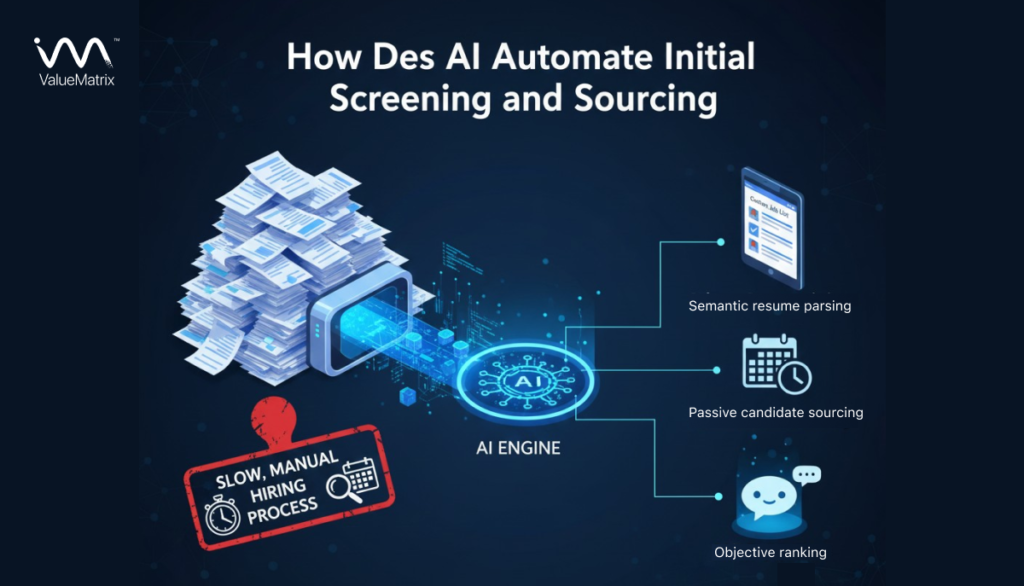
AI drastically minimizes the amount of time spent during initial screening by utilizing semantic analysis to understand what the resume “means” rather than just looking for keywords. This way, reducing time to hire with AI in recruitment begins at the start of the funnel.
Manual screening is the biggest hurdle in recognition in recruitment. AI can accomplish in minutes what a human team would take weeks to do.
Semantic resume parsing
AI does not need to find the word “Python”; instead, it can identify if the applicant has any experience with subjects like “Deep Learning” or “Flask.”
Passive candidate sourcing
At all hours of the day and night, AI agents in professional networks think this: “Here’s someone you might want to meet.” This way, the pipeline is pre-warmed even before the individual has a chance to apply for a job.
Objective ranking
Candidates are rated based on their skill and potential, and the candidate considered most fit would rise instantaneously to the top.
Organizations could reduce the initial processing time by up to 75% by automating phase one screening.
4. Strategies to Reduce Time-to-Hire with AI in Interview Scheduling
The best way to reduce time-to-hire with Artificail Intelligence comes through the elimination of interview scheduling inefficiencies. Automated tools now enable candidates to choose available slots based on the real-time availability of their recruiter.
Scheduling delays for another 3 to 5 days in the possibly quick hiring process. AI shakes off the emotion of delay by ushering in self-service formats.
Real-time calendar syncing
The AI checks that every interviewer whose presence is required is available before offering slots that suit everyone.
Automated reminders
System-generated messages and emails cut down on more than 20% of no-shows in interviews.
Instant rescheduling
In case any of the candidates is disapproved, and the hiring manager has a lot of outstanding work, they may not be available to juggle their crowded schedules. One automatic rescheduling—even if it maintains the expectation of an impersonal response—is possible without engaging humans.
In conclusion, automated scheduling brings a “quick win” that gives an immediate uplift to your recruitment automation time-to-fill metrics.
5. How Does Recruitment Automation Time-to-Fill Benefit Employers and Candidates?
In fact, a shorter recruitment automation time-to-fill directly correlates with a higher candidate acceptance rate and lower operational costs. When the process is fast, candidates feel valued, and the organization can return to full productivity sooner.
Speed, clearly signifying respect, is an element in the hiring process. Fast processes tell very alert candidates that the company possesses high discretion and decision-making firmly within its walls.
For the employer
Reducing time-to-fill saves an average of 500 dollars per day in lost productivity for every open role.
For the candidate
Fast processes build less anxiety around searching for jobs and make it difficult for the “counter-offer” stage to become a hurdle.
For the recruiter
Less chasing candidates means more time for strategic talent advising.
Thus, optimizing for speed creates a virtuous cycle that strengthens the employer brand and the bottom line.
6. Beyond Speed: Improving Quality of Hire While Reducing Time to Hire with AI in Recruitment
Speed is not all, but also reducing time to hire with AI in hiring, with the increase in the quality of the hire at the end of it, because it provides for more objective data points. AI looks for competencies and potential, which lead to better long-term retention.
Speed has always been coupled with the reduction of quality, a huge myth. What AI sped was actually built on higher, much deeper, more uniform data analyses.
Bias mitigation
Employers can strip out identifiers and thus focus solely on the skills; as a result, the resource pool will be much more diverse and skilled.
Predictive performance matching
With the system comparing candidate profiles to the organization’s best performers, predictions can be made on who might academically and socially thrive in the culture.
Holistic evaluation
Analyzes AI portfolios, GitHub repositories, and past projects so much faster than it could be done by a human, and an almost 360-degree view of the talent is now achieved.
Speed is all that is, and it makes you employ the right person earlier rather than just filling a gap with whoever gets there first.
7. How Predictive Analytics Foresees and Prevents Hiring Bottlenecks
Growth Managers tap into predictive analytics to assess trends from previous years on hiring, so as to identify potential bottlenecks before they occur. In this sense, using AI recruitment automation would enable future hires to be used in accurate predictions of possible delays; thus, resource shifting would occur to the most critical stages.
Data is worth little if it is not going to make the future different. Predictive AI moves TA from the descriptive function to the prescriptive.
Seasonal trend analysis
AI notes which months generally tend to generate more candidates and serves to improve workforce planning.
Recruiter workload balancing
Should a particular recruiter fill too many of his active roles, the AI might alert to a potential bottleneck in the speed of screening.
Candidate flow forecasting
This system will predict how many applicants in the funnel are needed to achieve one specific hire for niche roles.
In conclusion, predictive analytics keeps your recruitment automation time-to-fill in a stable state irrespective of market changes.
8. Can Automated Assessments Accelerate the Evaluation Phase
Automated assessments speed up the evaluation phase-it give instant feedback for both technical and soft skills of a candidate. This is an essential way of reducing time to hire using AI in recruitment, as evaluation is shifted early on in the journey.
The traditional “technical interview” is usually the longest hold-up. AI testing gives candidates the potential to demonstrate their skills asynchronously.
Gamified neuroscience tests
In this context, candidates take small games measuring characteristics such as risk-taking and problem-solving, with results instantly generated.
Real-time coding simulations
AI environments evaluate the technical problems described by candidates while they are being written by candidates and produce recruiter scores within a few seconds.
Soft skill benchmarking
The communications clarity and empathy levels of a candidate are analysed through their written responses to NLP.
In conclusion, moving the evaluation to the funnel top increases the chances that the recruiters get to spend time with candidates who will have proven themselves first.
9. How Does AI-Driven Rediscovery Optimize Recruitment Automation Time-to-Fill?
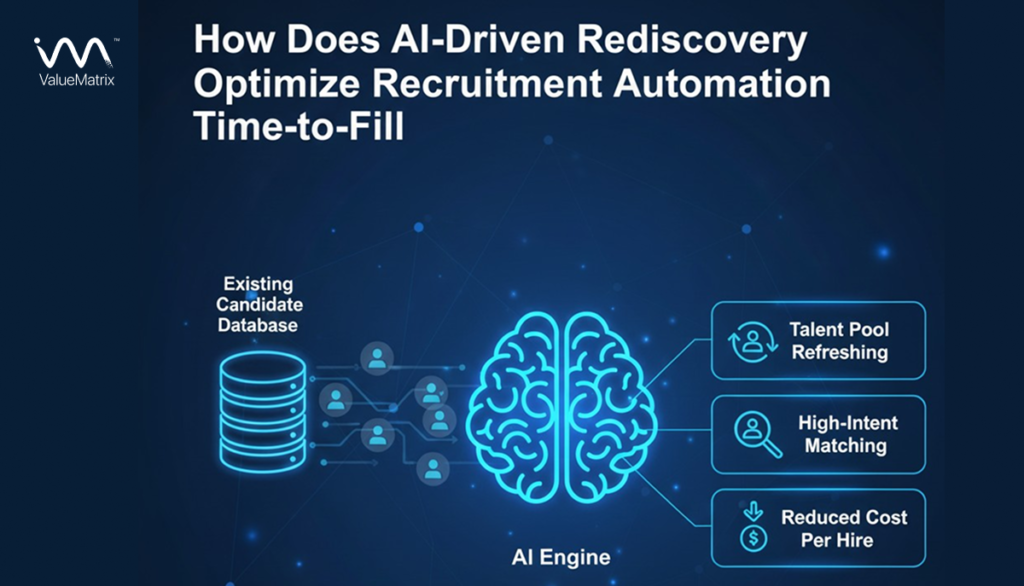
AI-powered rediscovery optimises by scanning your recruitment automation database for all of the silver medalists in previous roles. This frequently avoids needing an expensive, slow new sourcing cycle.
There is quite literally a goldmine of great talent in an applicant tracking system- that great talent had previously expressed an interest in your company. AI is the tool that will dig it out.
Talent pool refreshing
AI consistently adds fresh skills to candidate profiles since their last application.
High intent matching
The system identifies “number two” contenders for past roles and then considers them for current openings.
Reduced cost per hire
By getting someone already in your system, you are not spending on job board fees and long sourcing times.
Essentially, candidate rediscovery is the quickest way to improve your speed-to-hire, leveraging existing assets.
10. What Is the Role of Agentic Workflows in Reducing Time to Hire with AI in Recruitment?
By allowing AI agents to take independent, autonomous actions, agentic workflows reduce time to hire by allowing AI to reach the lowest achievable level through. AI agents may nudge managers, send documents, or manage logistics with no human intervention required.
Agentic AI isn’t about waiting for a command either, but actually understanding what “hiring a candidate” means, and then taking action to realise that.
Autonomous manager nudges
If a hiring manager does not communicate with the AI for 48 hours, it sends an intelligent reminder to do so to push forward the candidate.
Document collection agents
AI independently pursues references, background checks, and certifications, so the paperwork is ready when an offer is made.
Self-driving interview loops
The agent will detect a situation where the interviewer is out of the office and will swap with a qualified alternative automatically.
In brief, agentic AI frees the hiring process from the “human lag” that normally hinders great hires and keeps the speed at a machine’s level.
11. How Does Sentiment Analysis Personalize the Candidate Experience?
Detecting emotions in written and verbal communication is made possible through sentiment analysis. These AI in recruitment candidate experience modifications now enable recruitment intervention where a particular candidate appears beleaguered, ensuring that speed does not equal empathy deprivation.
Any automation will lead to a process being perceived as cold, even at top speed. On the other hand, sentiment analysis will provide “EQ” to AI’s “IQ.”
Real-time frustration alerts
Some revelation that draws clarity about a candidate’s strong emotional reactions when communicated through a chatbot will notify a human recruiter to run the conversation.
Brand sentiment monitoring
AI will hold onto all candidates’ feedback surveys to find which part of the hiring procedure is perceived as having more positive or negative emotions.
Tone matching
The correspondence of the automated emails to the communication style of the candidate will also be adjusted by the AI, making it feel much more personal.
In short, sentiment analysis keeps your automated human-centric and supportive.
12. Integration with the Modern HR Tech Stack for Maximum Velocity
The effectiveness of AI recruitment automation lies in its seamless integration into your existing infrastructure of HCM technology. With an unobstructed flow of data between ATS, CRM, and payroll systems, there is no “human effort” to move a candidate.
An uncoordinated tech stack is an open invitation to delays. The velocity ecosystem requires unified real-time updates across all platforms regarding information.
API first architecture
The new age AI tools connect instantly with Workday, Greenhouse, or Lever to ensure only one source of truth for a candidate’s data.
Automated offer generation
The necessary data on compensation will be pulled, and legal documents will be generated in seconds after the candidate is moved to the “Offer” stage.
Seamless onboarding handoff
Immediately after an offer has been signed, the AI initiates its onboarding sequence, ensuring the new employee feels welcome instantaneously.
In conclusion, a well-integrated technology stack forms the operational foundation for any strategy of reducing time to hire through AI in recruitment.
13. The Psychology of Hiring Speed: Impact on Retention and Trust
The speed at which you hire has very significant psychological effects on a candidate’s future commitment level to the organisation. Instant trust is forged by a fast, smooth process; this translates into higher retention rates once the hire is made.
Slow hiring equals stagnation in candidates’ minds. Conversely, speed symbolises burgeoning, agile, and highly interested organisations.
First impressions as a predictor
The treatment of candidates as applicants is indicative of treatment as employees.
Reducing “Offer fatigue.”
Because of the quickness of the process, the candidate is excited as the process is ongoing and, thus, has a higher probability of accepting the final offer.
Building a high-performance culture
Faster-paced companies perceive time as precious, with high performers thus naturally pulled toward them.
Thus, speed in hiring is an HR metric, but a very effective tool in shaping the internal culture of your organisation.
14. Measuring the Long-Term ROI of Shorter Hiring Cycle
Measuring ROI from AI recruitment automation goes beyond just time to fill. It also impacts the cost per hire and quality of hire. These organisations often have a 30% drop in overall recruitment costs with the implementation of tools like these.
For a Growth Manager, the ROI is when the organization can scale without having an increase in recruiter headcount.
Direct cost savings
Immediate financial gains result from less dependence on external headhunters and job boards.
Productivity gains
It clears up the main business case for AI investment by performing a revenue calculation generated by filling a role 15 days faster.
Reduced turnover costs
As a result of improved candidate matching, “bad hire” costs are significantly reduced in the long term.
In summary, ROI from reducing time to hire by AI in recruitment is thus measurable, great, and crucial for sustainable growth in business. Conclusion: The Future of Fast, Fair, and Effective Hiring
With AI recruitment automation, the talent acquisition landscape is transforming itself with instant speed in recruitment processes, and those processes are now also fairer and more effective. Starting from the initial screening and sourcing stages, the ability to use predictive analytics and agentic workflows is now provided to reduce time-to-hire with AI for many orders that improve the recruitment automation time-to-fill. Growth managers embracing these technologies position their organisations well into the future, keeping their firm competitive, attracting the best talent, and building strong, high-performing teams. The future of hiring is here, and it is powered by intelligent automation.
Solutions Table: Scaling the Candidate Experience
| Feature | AI Action | Benefit to Candidate |
| Chatbots | 24/7 FAQ support and status updates. | Immediate answers, no waiting in the “black hole.” |
| Agentic AI | Autonomously reschedules interviews and nudges managers. | Zero-friction coordination and faster decision-making. |
| Sentiment Analysis | Detects frustration or excitement in chat and email. | Triggers human help when the candidate needs it most. |
| Skills Engine | Matches true potential rather than just job titles. | Candidates found for roles they might have missed otherwise. |
| Predictive ROI | Forecasts hiring bottlenecks before they happen. | Ensures a consistent, reliable hiring timeline for all. |
Statistics: The 2025 Data Behind AI in Hiring
| Source | Insight | Key Figure |
| Phenom Report 2025 | Conversational AI impact on application completion. | 3x higher completion rates. |
| Gartner Research | Reduction in time-to-hire through strategic AI. | 30% faster hiring cycles. |
| Siemens Case Study | Reduction in time-to-fill for executive-level roles. | 40% faster fulfillment. |
| LinkedIn Future of Work | Improving quality of hire through AI-driven matching. | 14% better performance. |
| Universum Global | Percentage of job seekers preferring AI for early screening. | 61% of modern candidates. |
FAQs
This is, ironically enough, quite the opposite. With the results of some tedious administrative tasks taken off their hands, recruiters can engage in more in-depth and meaningful conversations with candidates who are truly a good fit for the role.
The contemporary composition of AI candidate recommendation capabilities and experience engines measures skills rather than degrees and titles, meaning those candidates with “transferable skills” are much more likely to be forwarded.
Yes. Most likely, the quality can only improve, as the AI is using objective data to match the candidates against the precise requirements of the role, thereby limiting any scope for human bias.
The use of a legitimate AI-powered recruitment automation platform, which is compliant with all the global data privacy legislations, including GDPR and CCPA, will safeguard your candidate data.