
Table of contents
- Executive Summary: AI: The Engine That Drives Scale in High-Volume Recruiting
- What Are the Challenges of High-Volume Hiring?
- How Do Information-Based AI-Powered Tools for Volume Hiring Solve These Challenges?
- What are the Best Automated Recruiting Platforms focused on Volume Hiring?
- What Is the Measurable Impact of AI for High-Volume Hiring?
- How Can HR Leaders Implement AI Ethically for High-Volume Hiring ?
- FAQs
Executive Summary: AI: The Engine That Drives Scale in High-Volume Recruiting
High-volume hiring, in the opinion of executive leaders in retail, logistics, and customer service, is not only an HR matter but a strategic bottleneck. Recruiters who manually sift through thousands of applications for similar roles face burnout due to prolonged time-to-hire and varying hiring quality. Artificial Intelligence is the smart application technology for high-volume recruitment. Organisations can automate 75 per cent of the early-stage hiring process by leveraging AI-enabled tools for volume hiring and selecting the best automated recruiting platforms. The remainder is hiring recruiters for strategic engagement, massively reducing recruitment costs while increasing speed and quality for every hire.
What Are the Challenges of High-Volume Hiring?
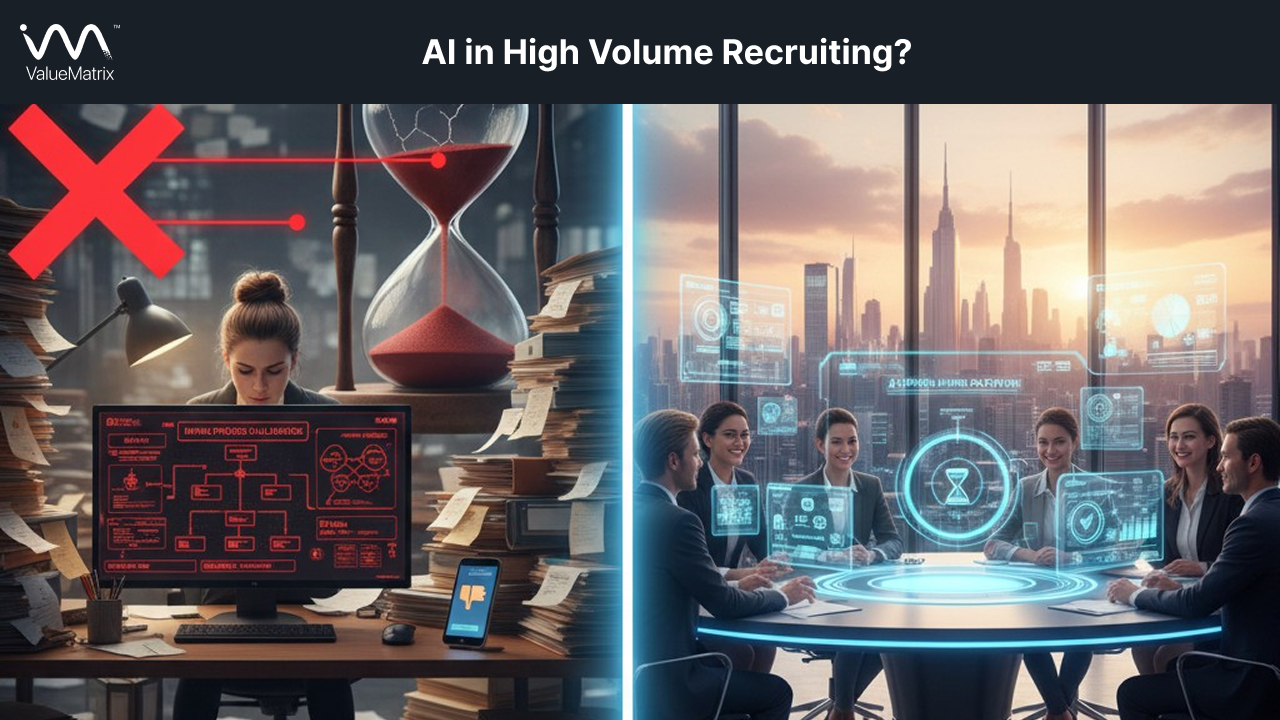
The distinctive needs of high-volume hiring, filling hundreds or even thousands of similar roles in a short time frame, culminate in a real perfect storm of operational challenges. For instance, the recruiters are constantly engaged in countering cognitive fatigue; there is pressure mounted by various hiring managers who do not seem to care about the final assessment; added to these are the administrative quicksand inherent in managing a vast pool of talent. This working environment is certainly one that endures endless cycles of repetitive tasks that take forever to complete, fall prey to human error, or outright lacks any uniformity in process. Absent any intervention, scaling operations would naturally lead to the compromise of quality.
It is precisely overcoming these core challenges that can lead to the need for a shift/time-lock mechanism for interruption to be put in place, providing well-considered automation mechanisms.
The Problem of Speed vs. Quality
Faced with expediting the recruitment process, time restricts an array of recruiters from spending even seconds on a single résumé; such quick scanning results in the hiring of mismatched ones, as many good candidates will be written off in the process. The wrong hire often leads to employee turnover. Speed takes precedence over having a good hire.
The Burden of Administrative Overload
Administrative tasks consume a significant portion of a high-volume recruiter’s day: resume screening, scheduling interviews, sending basic communication updates, and answering FAQs. This administrative burden leads directly to recruiter burnout and prevents them from engaging strategically with the best candidates.
The Issues of Inconsistency and Bias
Human reviewers under fatigue and stress subconsciously go for the quickest way out. This ends up giving rise to inconsistent standards for screening that increase unfavourable unconscious bias against certain applicants from minority groups, whom they see as unsuitable. Thus, preventing fit candidates from ever prospering in view of the organisation’s goals regarding increased diversity is simply too attainable.
AI for high-volume hiring conversion from manual systems is a must for retaining quality and fairness in a scalable manner.
How Do Information-Based AI-Powered Tools for Volume Hiring Solve These Challenges?
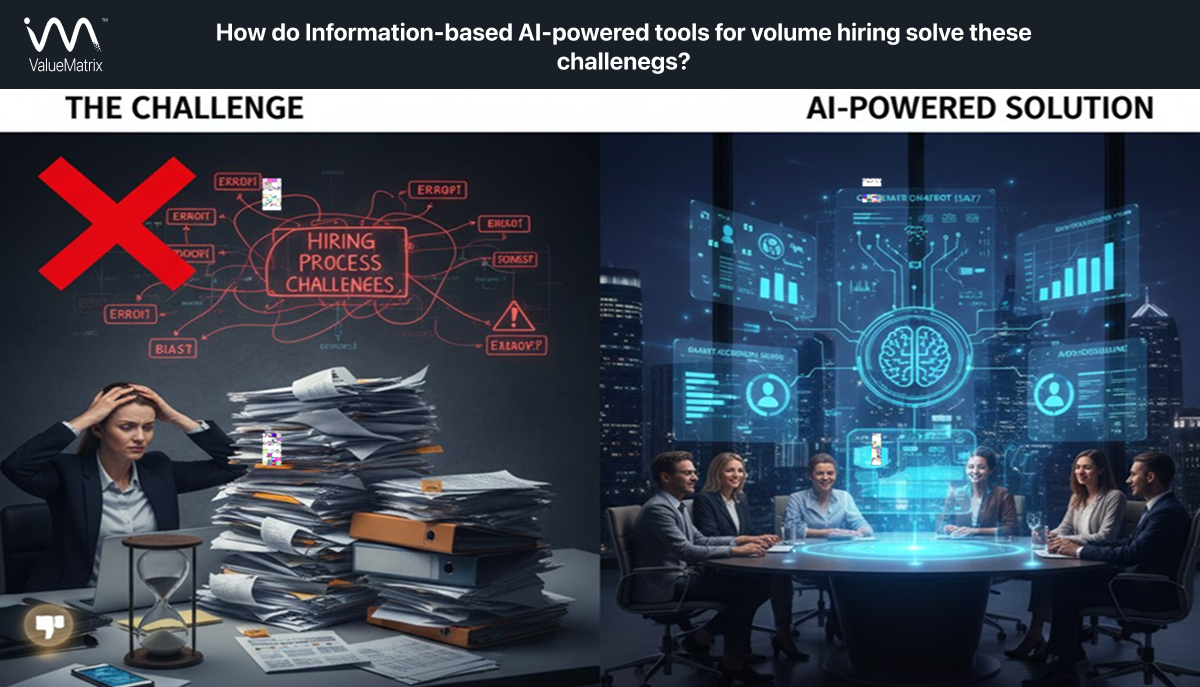
An information technology-enabled AI-powered tool for volume hiring is an application featuring data gathering, data processing, and data presentation with respect to the candidates in well-organised, structured data that transmutes subjective opinion into objective scores. Such tools are also excellent in carrying out high-volume repetitive tasks, which tire and reduce recruiter speed, such as filtering, matching, and communication.
These tools do not replace the human decision-maker but act as the always-on objective assistant, collecting and structuring the data needed for the final strategic decision.
Converting Data into Predictive Insights
AI-based resume screeners using Natural Language Processing (NLP) go beyond low-tech keyword matching. They look at context, proximity of skills, and past hiring data to come up with some form of a predictive score, allowing recruiters to finally put their thumb on the relative worth of the candidates most likely to succeed is light-years ahead of traditional ATS, which relied purely on keywords.
Streamlining Candidate-Facing Communication
AI chatbots and messaging systems essentially operate on the clock and provide an answer to all the queries that a candidate may have regarding role-related information, culture, and process. They have a 75% accuracy rate in replying to candidates’ concerns, thus significantly enhancing the candidate experience via speedy feedback critical factor in avoiding drop-offs during high-volume hiring.
Automating Candidate Pre-Screening and Skill Matching
AI is set to autonomously escort candidates through personalised screening workflows, and depending on their feedback, could do so with speed. If a candidate ticks off that they have a required license, the AI could upgrade them instantaneously to the next stage, skipping the useless manual eligibility check and significantly speeding up and increasing the flow in the pipeline.
Informational AI-powered tools for volume hiring throw down the necessary data foundation for the most efficient recruitment process possible.
What are the Best Automated Recruiting Platforms focused on Volume Hiring?
The best automated recruiting platforms that could meet volume hiring requirements should go beyond mere ATS functionality towards integrated solutions capturing conversational AI, structured assessments, and data analytics. These solutions will primarily focus on maximising candidate throughput while ensuring a structured and unbiased evaluation process.
The most powerful solutions promise 100% end-to-end automation tailored to especially friction-prone stages of the funnel.
Conversational AI Assistants (e.g., Paradox, Humanly)
These applications are also sometimes referred to as chatbots. They operate by themselves from the very first screening, handling FAQs, and even scheduling interviews all by themselves. From the point of engaging texts or mobile chat, the applicant can directly move to the first interview stage at the time of screening for high-volume hiring.
Structured Video Interviewing Platforms (e.g., HireVue, VidCruiter)
New video platforms install AI by standardizing all interviews: each candidate receives the same validated questions; then the AI computes structured scoring of the answers using a language, tone, and competence analysis of the candidates. That standardization also reduces biases by objectivity and consistency.
AI-Driven Sourcing and Matching Tools (e.g., Eightfold, Phenom)
Those platforms, where AI is used for high-volume recruitment, nearly always resource every talent pool, whether it is internal or external. They do not stop at mere searches; they assess and predict which candidate is best suited for the position. Thereby ensuring that recruiters only reach out to those candidates that meet minimum requirements and are ultimately predicted to have a greater likelihood of succeeding in this particular job.
Using the best in automated recruiting platforms to be used for volume hiring means that HR can manage a tenfold increase in application flow without needing a tenfold increase in recruiters in staffing.
What Is the Measurable Impact of AI for High-Volume Hiring?
Adopting AI for high-volume hiring does not just change a process; rather, it is a major financial and strategic lever-one that can be measured in ROI terms coming directly from the automation of very expensive, time-consuming manual steps. The business operations of well-known organisations worldwide have already demonstrated how this technology impacts their entire talent acquisition pipeline.
ROI from this investment is visible primarily in speed, efficiency, and, yes, improvement in quality of hire.
Dramatic Reductions in Time-to-Hire (TTH)
Most often, companies experience at least a 50% reduction in their TTH for high-volume roles through automating screening and scheduling. For instance, Unilever showed a 75% decrease in time-to-hire for their early-career programs thanks to AI adoption, much faster than before filling candidate roles.
Measurable Cost Savings and ROI
Time-saving converts to hard dollar value cuts in cost. Reducing repetitive tasks for recruiters means an organisation saves thousands of hours each year in manual labour. According to L’Oréal, 70-75% of early-stage recruitment tasks are automated, thus freeing recruiters to spend more time on the quality of candidates.
Improving Quality-of-Hire and Diversity
By assessing candidates objectively and consistently purely on skills and job requirements, the aspect of human biases is mitigated, resulting in a more diverse talent pool being interviewed. This supports the well-known finding that diverse workforce talents outperform those of less diverse ones.
Scale without losing value is the clear strategic positioning of AI for high-volume hiring.
How Can HR Leaders Implement AI Ethically for High-Volume Hiring?
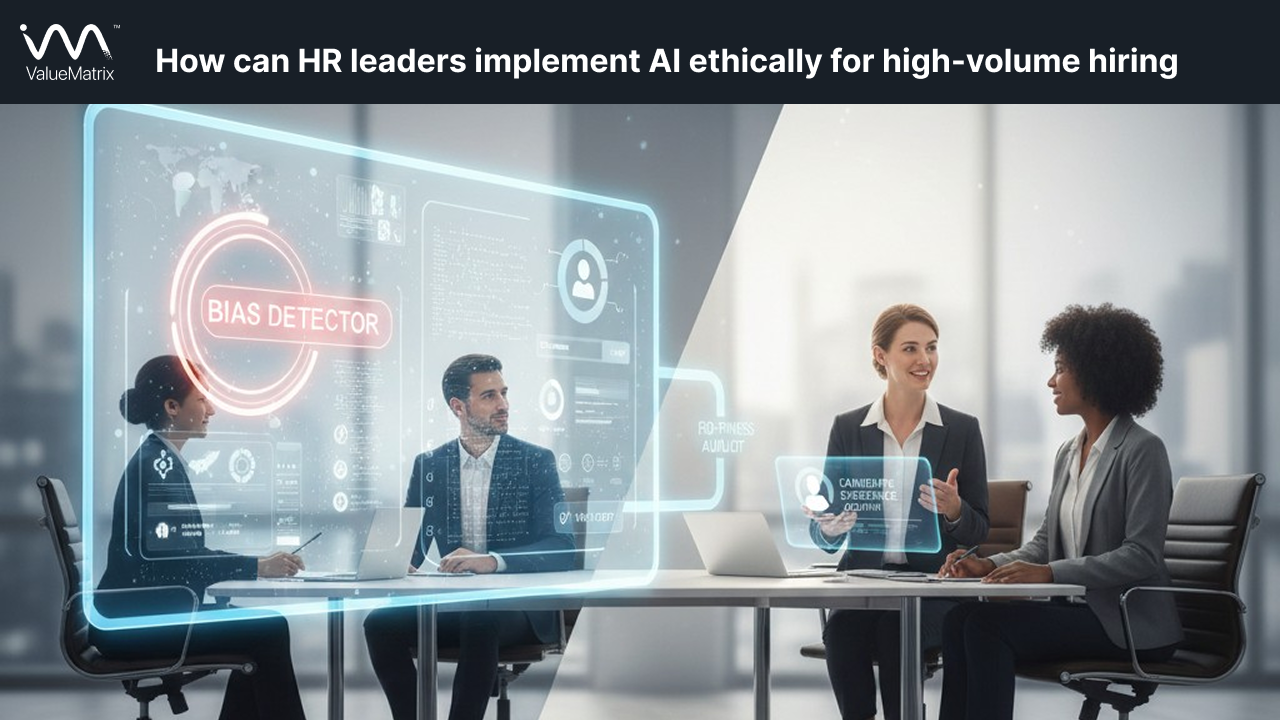
AI is important in high-volume recruiting, energizing all HR leaders to use technology impartially and transparently, building candidates’ and employees’ faith. If misused, AI can aggravate the issues of bias as they exist and expose companies to regulatory concerns with reputational risk.
Ethical governance goes beyond audit; it requires action, openness, and humanistic consideration.
Prioritising Human Oversight and Explainability
Recruiters would themselves be trained to understand exactly how the AI tool scores a candidate. AI implementation should assist and explain a decision, with the ultimate choice of who to hire remaining with a human. AI is not a decision-maker; it is meant to offer recommendations only.
Conducting Rigorous Bias Audits
General long-term audits should ensure that employees with hiring authority are using AI applications and best automated recruiting platforms for volume hiring that are free of bias. This is increasingly becoming a requirement under law in places such as New York City, doing away with faster but fairer systems.
Maintaining a Positive Candidate Experience
Automated or otherwise, every communication has to be humanized and respectful. Informational AI-powered tools for volume hiring should carry feedback and queries in real-time, such that they do not cause frustration. At all times, every candidate must know when to expect that AI will participate in this interaction.
Socially acceptable utilization will ensure that, whatever benefits may arise from the usage of the said AI application for high-volume recruiting, they would not come at the cost of possible damage to trust or fairness.
Conclusion: The Future of High-Volume Hiring is Intelligent, Consistent, and Quick
The future of high-volume hiring is irrevocably bound to the intelligent use of AI. By replacing manual screening with AI-powered tools for volume hiring and equipping themselves with the best automated recruiting platforms for volume hiring, organisations blur the lines between a recruiter as a clerical administrator and a recruiter as a strategic relationship builder. This strategic use of AI for high-volume hiring is the one way to collectively satisfy the demand for talent as it skyrockets, improve on quality, enhance diversity, and slash operational costs in a revolutionary manner.
🔑 Key Takeaways & Solutions (AI in High Volume Recruiting)
| Challenge in High Volume Hiring | AI Solution Category | Key Business Outcome (Benefit) |
| Administrative Overload (Screening/Scheduling) | Conversational AI / Automation | 75% reduction in recruiter time spent on manual tasks; 50% faster Time-to-Hire. |
| Inconsistency & Bias in Initial Screening | Structured AI Matching / Assessments | Increased shortlist diversity and a more objective, skills-based evaluation process. |
| Candidate Drop-off (Slow Communication) | Informational AI-Powered Tools (Chatbots) | 24/7 instant candidate service dramatically improves experience and completion rates. |
| Low Quality-of-Hire (Rushed Decisions) | Predictive Scoring / Video Interviews | Higher quality of hire through data-driven decision-making and standardised scoring. |
📊 Statistics: The Data Behind AI-Driven Scale
| Statistic/Source Cited | Key Fact/Figure | Direct URL |
| Gartner | 70% of large organizations are predicted to use AI for at least one segment of the recruiting lifecycle by 2026. | Gartner Says AI Revolution and Cost Pressures Are Two Forces Driving the Top Four Trends for Talent Acquisition in 2026 |
| Unilever Case Study | AI adoption led to a 75% reduction in time-to-hire for their early-career roles. | Next Gen AI in Action: Unilever’s AI-Powered Recruitment Revolution |
| Harvard Business Review | Algorithm-based decisions were found to be ~25% more accurate than human judgments in predicting job performance. | Algorithm Appreciation: People Prefer Algorithmic To Human Judgment |
| L’Oréal Case Study | Automated 70–75% of early-stage hiring tasks, saving recruiters significant time per candidate. | Top 4 AI Recruitment Case Studies |
Case Studies: Global Brands Redefining Volume Hiring
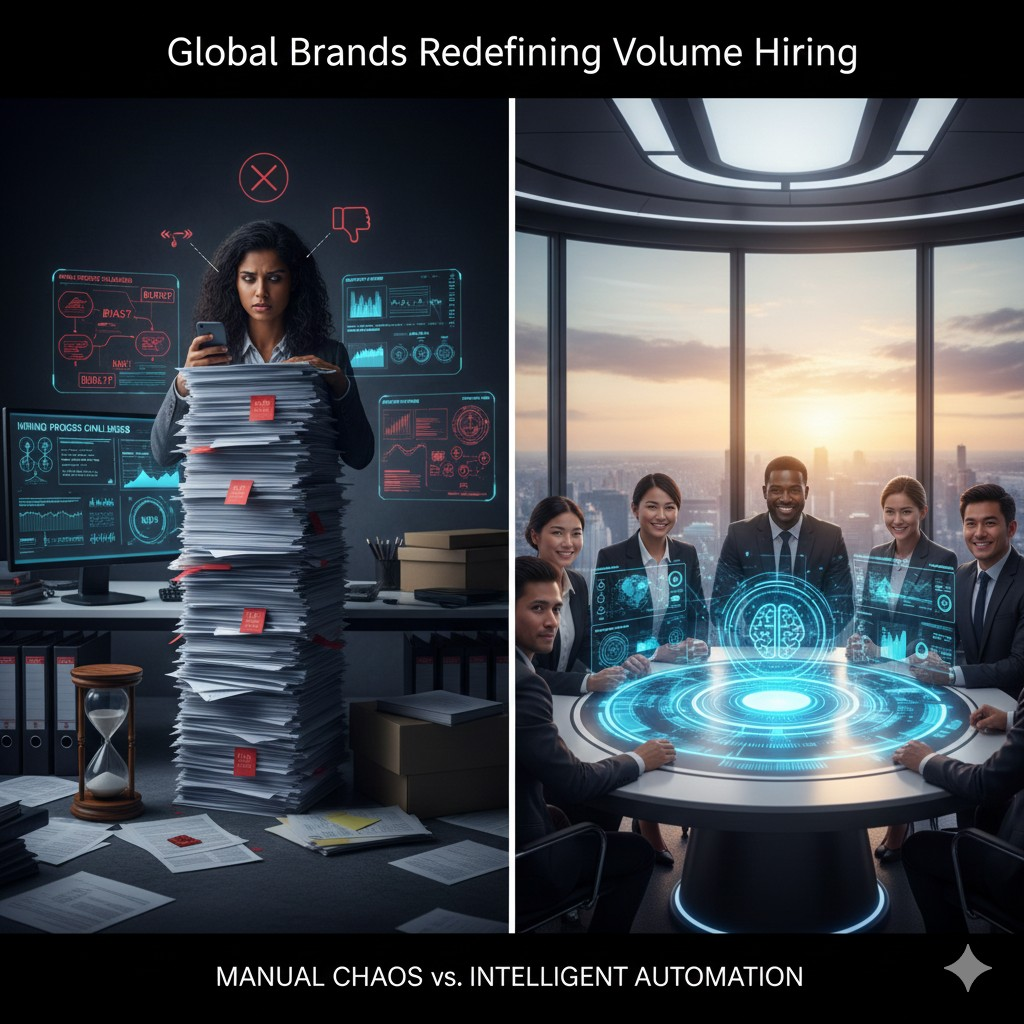
1: Unilever’s AI-Powered Global Graduate Program
- The Challenge: In the last 18 months, the real problem was that all of these applicants, who were 250,000+ in numbers, were vying for just under 1,000 graduate jobs globally.
- The AI Fix: Created a new online game, video interviewing, and analytical platforms in AI for an objective assessment of a candidate’s soft skills and cognitive abilities.
- The Result: It will cut hiring time by 75% while improving the same process of diversifying candidates within the shortlists.
2: L’Oréal’s Conversational Automation
- The Challenge: Applications really pour in from both corporate and retail applications, clogging up the valuable time of the applicant in the initial stages of screening and communication.
- The AI Fix: Initially, this screening takes place through an AI chatbot consisting of questions, eligibility verifications, 24/7 answering of FAQs, and autocalling interviews.
- The Result: It ensured to automate a good deal–70-75 percent–of initial stages in the hiring process. This improved candidate experience with instant feedback over inquiries and allowed recruiters to invest their time mainly in higher-value assessments of candidates.
FAQs
Whereas traditional ATS is purely a system of record that manages flow and captures data, an AI application is nothing less than a system of intelligence using machine learning and algorithms to predict success, score fit, and automate communications, as well as transforming raw data into actionable insights for the recruiter.
Industries like retail, logistics, call center, hospitality, and manufacturing are highly reliant on entry-level or standard staffing or staffing large numbers. Healthcare also falls under such industries, but only the less critical jobs, such as registrars.
In some aspects, yes. AI eliminates all those repetitive and boring tasks like screening, scheduling, and FAQ management so that the recruiter can really focus on the human side-building relationships, conducting deeper interviews, and hiring top candidates- making it even more strategic and impactful.
About Us
ValueMatrix is an AI-powered talent intelligence platform that helps companies hire better, faster, and without bias. We go beyond resumes to assess skills, behavioral traits, and cultural fit using advanced AI and proven psychological frameworks. Our platform delivers data-driven insights that improve hiring accuracy, reduce time-to-hire, and elevate candidate quality.
ValueMatrix AI enables hiring teams to make confident hiring decisions and build high-performing teams at scale.