
Table of contents
- Navigating the Intersection of Innovation and Accountability
- The Urgency of the Shift: From HR Manager to Growth Manager
- 1. What Is an Ethical AI Framework in Modern Recruitment?
- 2. Why Is an Ethical AI Framework Essential for Regulatory Compliance?
- 3. How Does an Ethical AI Framework Mitigate AI Recruitment Ethics Risks?
- 5. Building Your Custom AI Ethics Framework
- FAQs
Navigating the Intersection of Innovation and Accountability
The Ethical AI Framework is vital for organizations seeking growth; it has been made both a legal and moral necessity. For those firms venturing into high-volume hiring, it will bring with it the rising challenge of automated bias, which surfaces exponentially as candidates swell. Creating a comprehensive framework of AI ethics for high-volume recruitment makes your AI fair, transparent, and compliant with evolving standards such as the U.S. EEOC and the OECD AI Principles. This hands-on checklist in the guide will mean you never run afoul of AI recruitment ethics in the course of using the best automated recruiting platforms for volume hiring without sacrificing quality in the process.
The Urgency of the Shift: From HR Manager to Growth Manager
Today, high talent demands more than conventional HR management. Organizations are facing the most difficult challenges ever to attract and retain them; top talent has increased their demands for career advancement and personalized growth, now more than ever. In such an environment, the leadership will have to undergo some crucial transformation: from reactive “HR Manager”— typically for administrative functions, compliance, and performance evaluations—to proactive “Growth Manager.” A Growth Manager is a strategic talent steward who leverages advanced talent intelligence for managers to coach, develop, and inspire their teams, fundamentally improving AI for employee retention. More than a change in nomenclature, this has become a crucial response to increasing turnover costs and an urgent need to build a more adaptable workforce, prepared for future challenges, where every employee actually feels invested in and supported.
1. What Is an Ethical AI Framework in Modern Recruitment?
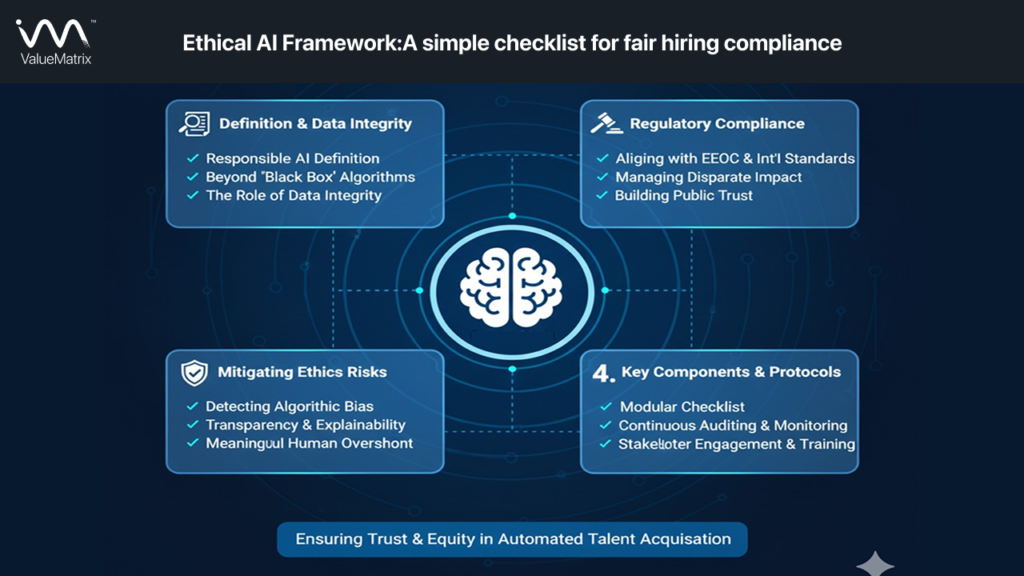
An ethical AI framework constitutes a declarative and technical architecture of principles intended to manifest fairness, transparency, and accountability in an AI system. In recruitment, it provides a framework for ethical AI recruitment to avoid discrimination and base hiring decisions on merit and job relevance only.
While establishing ethical AI frameworks, organizations would move from dubious decision-making into verifiability-in-every-automated-step mode. This is critical, especially in high-level AI-powered tools for volume hiring, where minute data inaccuracies result in large-scale exclusion.
The Definition of Responsible AI
Responsible AI means the practice of designing, building, and deploying AI that is directed toward achieving what it is intended for: delivering positive impacts on society while limiting the damage done. Within AI recruitment ethics, this adds a requirement to the system’s design that would expect it to be robust enough to handle a diversity of datasets without performing in favor of specific groups.
Moving Beyond “Black Box” Algorithms
A significant challenge of developing a new AI ethics framework is the “black box” nature of the decision, where the logic behind a decision remains obscured. But, it puts on top of the ethical AI framework the need for “Explainable AI” (XAI), and enables understanding and justification by a human recruiter as to why a candidate was ranked as he or she was.
The Role of Data Integrity
AI at its best, however, does not mean that total dependence on data for technological advancement will be completely taken away. Thus, the ethical AI frameworks would always challenge and prioritize data hygiene, that is, the training sets need to be audited for historical prejudices, such as a preference for particular universities or zip codes, before being provided for the use of high-volume hiring tools.
Ultimately, clear lines in the above AI ethics framework can ensure the alignment and the path of technological development within the core human values.
2. Why Is an Ethical AI Framework Essential for Regulatory Compliance?
For compliance purposes, ethical AI frameworks make hiring practices consistent with legally mandated bodies like the EEOC in the USA and the EU AI Act, among others. This is because these ethical AI frameworks come with the required documentation and anything required as evidence for bias testing to prove that an organization does not practice disparate impact or discrimination in hiring.
The regulatory landscape is moving quite rapidly. 2025 was the year in which the EEOC issued its new guidance that placed the responsibility for the discriminatory results of its AI vendors on employers. Without solid AI ethics frameworks, companies are, therefore, open to huge risks, whether legal or financial.
Aligning with EEOC and International Standards
The U.S. Equal Employment Opportunity Commission (EEOC) and international coalitions such as the OECD are setting clear expectations for AI recruitment ethics. One of their requirements is that AI tools are validated for violations of the “Four-Fifths Rule”, which ascertains that the selection rate of one group isn’t considerably lower than that of another.
Managing Disparate Impact and Legal Liability
Disparate impact occurs when a seemingly neutral policy has a disproportionately negative impact on a protected class. An AI ethics framework serves to act as a protective shield, thus requiring regular auditing to catch these trends early before they lead to costly litigation or regulatory fines.
Building Public and Candidate Trust
Transparency is a competitive advantage. According to recent Pew Research, 71% of U.S. adults oppose using AI to finalize hiring decisions. By making a public commitment to an AI recruitment ethics policy, organizations can fill this trust gap for all talent attracted to them who value fairness.
Ultimately, an ethical AI framework turns compliance from a “check-the-box” activity into a strategic pillar of corporate governance.
3. How Does an Ethical AI Framework Mitigate AI Recruitment Ethics Risks?
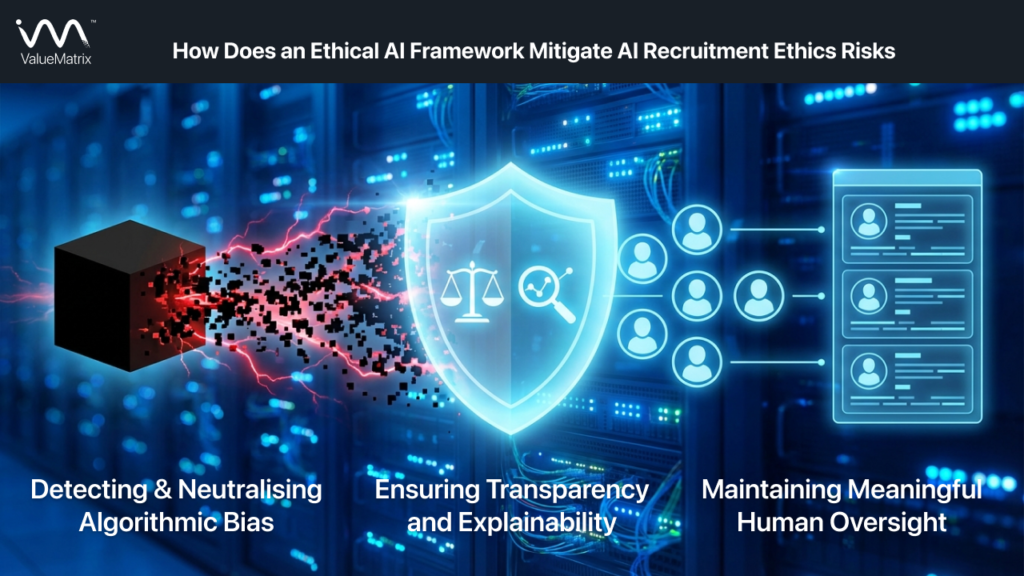
An ethical AI framework should mitigate any risk in AI recruitment ethics by creating various “Human-in-the-Loop” checkpoints along with automated bias-detection audits. Such an ethical AI framework will ensure that priority is always given to fairness and not just speed, with the aid of computational psycholinguistics to substantiate that such automated screenings are inferences about skill and not about biased proxies like age or gender.
Through AI for high-volume hiring, the processing with an underlying error would remain hidden. The AI ethics framework introduces the needed friction whereby at no point must speed be prioritized over equity.
Detecting and Neutralizing Algorithmic Bias
Bias could enter these parameters within AI ethics frameworks by means of skewed training data. For example, if a model has been trained considering the male bias of engineers, it could learn to discriminate against female names. Ethical instruments actively de-bias such datasets by stripping them of sensitive attributes before those datasets undergo processing.
Ensuring Transparency and Explainability
Candidates deserve to know how they are being evaluated. An ethical AI framework requires that any AI-powered information tool for volume hiring present a plain-language explanation of its recommendations. Transparency is among the core tenets of AI recruitment ethics by the calendar year 2025.
Maintaining Meaningful Human Oversight
An AI system should never be the sole decision-maker in a hiring process. Ethical AI frameworks state that recruiters vet the recommendations made by the AI, allowing a rhythm check that ensures that the system conclusively does not shoot itself in the foot and make decisions on the basis of objectionable influence or technical glitches.
An AI ethics framework neutralizes all such risks, giving organizations the confidence to adopt the best automated recruiting platforms for volume hiring without any doubts.
4. What Are the Key Components of an Ethical AI Framework?

Some essential components of an ethical AI framework include testing for bias, data privacy protections, requirements for transparency and explanation, and regular third-party auditing. Within an ethical AI framework, these components work together to create a “trust system” that reconciles the efficiency of AI recruitment ethics with the need for objective fairness.
An active document, an AI ethics framework, has to be embedded into daily workflows for every Growth Manager and recruiter.
The Modular Checklist for Fair Hiring
Perhaps the most effective way of action would be an AI ethics framework, covering everything from vendor vetting to the “explainability” of scores awarded to individual candidates. This will ensure that no link in the AI recruitment ethics chain is overlooked.
Continuous Auditing and Monitoring Protocols
With time, the performance of an AI model may “drift.” To ensure that, as new data is layered on, the ethical AI framework includes quarterly bias audits to ensure that the system remains fair. This is a key opportunity to apply the best automated recruiting platforms for volume hiring.
Stakeholder Engagement and Training
Ethics are often considered social rather than individual. The very notion of an AI ethics framework presumes providing such training to recruiters on how to interpret the AI insight and to identify automation bias, which is the reluctance to question the major call by a machine.
Putting these elements into practice means having your AI recruitment ethics standards materialize in every hire you make and ensuring they go beyond meaning.
5. Building Your Custom AI Ethics Framework
The initial step in establishing a domain-specific AI ethics framework is defining what the organisation values while recruiting and understanding the legal exigencies pertinent to that industry. This will involve keeping tabs on the current tech stack, defining fairness criteria, and conducting a check on the vendors themselves, whose AI recruitment ethics-reporting culture forms part of the organisation’s own culture.
With its own ethical AI framework, one can develop a talent-sourcing strategy customised to the interests of the specific organisation. It is so oriented to find those most culturally suited for the company while keeping full compliance with local and international laws.
Setting Fairness Criteria: Specify whether it is cognitive diversity, gender equity, or socio-economic diversity.
Vendor Selection: Limit yourself to vendors who are willing to issue a certificate attesting to the absence of bias in their algorithms.
Policy Integration: Have the AI recruitment ethics policy page available to all stakeholders and candidates in the organisation.
6. What Is the Long-Term Return on Investment for Maintaining Ethical AI Frameworks?

Long-term ROI benefits of ethical AI frameworks include reduced attrition, huge savings from avoiding potential legal penalties, and a better brand for the company in the eyes of both candidates and existing employees. An ethical AI framework ensures that talent eventually hired is based on merit; this directly increases productivity while supporting AI ethics in recruitment goals.
An ethical AI framework is the best investment for business development beyond simple compliance. Better accuracy in judgment eliminates nuggets and bias, thereby capturing high-quality candidates, ignoring the standard recruitment process, which in turn creates a more innovative and resilient workforce.
Reduced Vacancy Cost: An effective approach to conduct quick, accurate hiring roles with the right people in the first place.
Brand Credibility: Today, applicant corporations known for adopting an AI ethics framework are viewed in a different light by modern socially responsible candidates.
Futureproofing: You are typically securing a better future without the need to repackaging your systems to meet future legislation
Conclusion: Compliance as a Competitive Advantage
Choose an ethical AI framework; it’s a challenge for leaders in the automated era. When organizations have accepted an AI ethics framework and moved beyond the simple keyword matching for which the automated system has become almost synonymous, they will be able to drive their high-volume hiring with an emphasis not on volume but on human-centred values of long-term retention. In 2025 and beyond, the companies that will have real success will be those that treat AI recruitment ethics as an opportunity, and not as a challenge, to create diversity, capability, and loyalty amongst their workforces.
🔑 Key Takeaways & Solutions: The Fair Hiring Checklist
| Ethical Pillar | Checklist Action Item | Strategic Benefit |
| Transparency | Disclose AI use to all candidates in plain language. | Builds trust and meets AI recruitment ethics disclosure laws. |
| Fairness | Conduct “Four-Fifths Rule” bias audits every quarter. | Ensures compliance with EEOC and prevents disparate impact. |
| Explainability | Use “White Box” models that explain candidate scores. | Allows managers to justify decisions with talent intelligence. |
| Accountability | Assign a specific human “Ethics Owner” to oversee AI. | Ensures there is a clear line of responsibility for all AI outputs. |
| Privacy | Implement data minimization and encryption standards. | Protects candidate data and complies with international privacy laws. |
Statistics: The Cost of Bias and the Value of Ethics
| Statistic / Source | Key Insight | Reference Link |
| Gartner (2025) | Only 26% of candidates trust AI to evaluate them fairly. | Gartner AI trust in hiring 2025 |
| Pew Research | 71% of Americans oppose AI making the final hiring decision. | Pew Research AI hiring bias statistics |
| EEOC (2024) | Employers are legally liable for discriminatory AI vendor tools. | EEOC Official Guidance |
| Harvard Research | AI-picked candidates are 14% more likely to pass interviews when monitored for bias. | Search: Harvard AI hiring accuracy vs bias |
FAQs
No single jurisdiction has an “AI Law,” but civil rights laws, such as Title VII in the US, have applicability to AI and will ensure that an AI ethics framework is in place. It is the best way to make sure one does not violate such laws, which have steep penalties.
Auditors recommend impatience among industry leaders and global bodies to conduct a quarterly bias audit. This ensures that the AI model has not “drifted” into the biased patterns caused by changing candidate pools or hires.
Yes. For smaller firms, an AI ethics framework can be a simple set of vendor requirements. Ensure any tool you buy provides a “Bias Audit Certificate” and allows for human overrides of all decisions.
Indeed. Fairness and equity, meritocracy even, in the recruitment process give greater assurance to the recruiter that, eventually, he will find the best-qualified candidates for the position in question. Satisfaction with the job follows, and this, in turn, supports your AI recruitment’s moral reasoning.
Basically, it prefers DEI goals in pursuance of an AI ethical framework, which eliminates and erases biased variable selection in the recruitment process. According to ethical AI recruitment practices, this could actively expose diverse talent that would otherwise be eliminated in traditional human review.