
Table of contents
- The Shift from Transactional to Personalised Hiring
- The Urgency of the Shift: From HR Manager to Growth Manager
- Why Is the Traditional Candidate Journey Broken?
- How Exactly Does AI Transform the Candidate Experience?
- How do AI candidate recommendation skills and experience Engines Work?
- In What Ways do AI recruitment solutions improve candidate experience Through Communication?
- How Can AI Create a Seamless Onboarding Experience?
- What Role Does Sentiment Analysis Play in the AI Candidate Experience?
- How Do Mobile-First AI Tools Enhance Candidate Accessibility?
- Conclusion: Empathy at Scale Through Technology
- Key Takeaways and Solutions: A Summary Table
- Statistics: The Data Behind AI Candidate Experience
- FAQs
The Shift from Transactional to Personalised Hiring
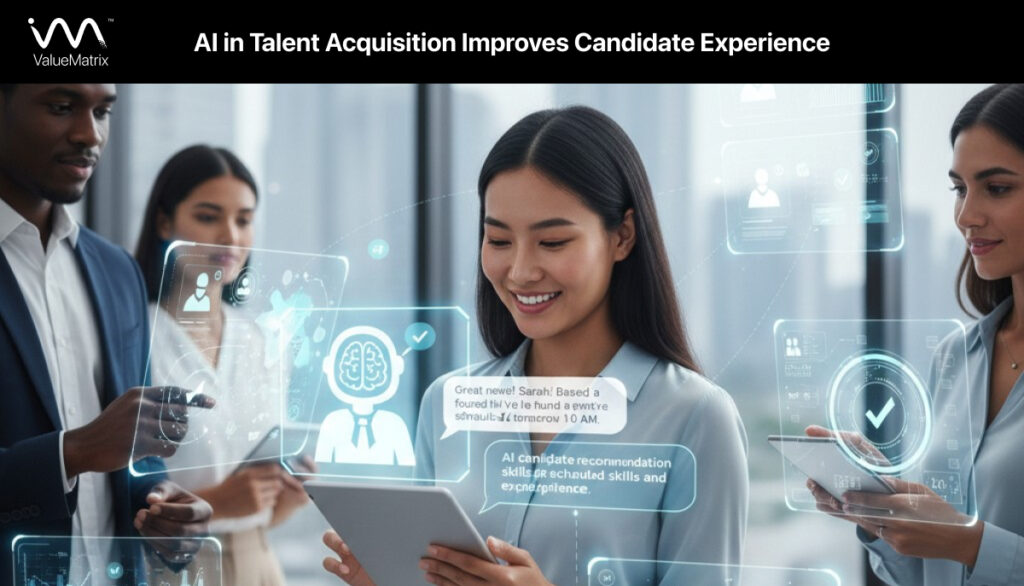
For decades, the hiring process has been exasperating for job seekers: slow responses, and, as they say, the “resume black hole.” These last few years have significantly altered that aspect with new technologies. Companies have begun adopting intelligent and highly advanced AI recruitment solutions to improve candidate experience, moving from impersonal transaction-based hiring into personalised journeys. This change gives value to candidates and enables companies to acquire top talent quickly, as it enables recruitment through the application of artificial intelligence for candidate experience. These changes in the use of AI in recruitment candidate experience change every applicant to feel valued by the brand, whether it ends positively for them or not.
The Urgency of the Shift: From HR Manager to Growth Manager
The modern talent landscape calls for more than just the traditional management of human resources. Present-day organisations face unprecedented challenges of retaining the elite workforce; nowhere else have employee expectations gone higher for career development and personal growth beyond what was previously recorded. In such an environment, a radical transformation in leadership becomes necessary: moving from the traditional HR manager who reacted by bricks of doing admin and compliance checks and performance evaluations into a proactive Growth Manager.
This tool would be something like a Growth Manager, which redefines the role into an effective strategic steward of talent, holding advanced talent intelligence for managers to coach, develop, and inspire their teams, and fundamentally improves AI for employee retention efforts. This is not just a change of semantics; this is a deep and tactical response to spiralling turnover costs and the urgency to develop a durable, future-ready workforce in which every employee feels truly invested in and supported.
Why Is the Traditional Candidate Journey Broken?
The conventional applicant’s journey is mostly broken as it is very much subjective, stretched, and shady, leaving the applicant wondering about the status of their application. Almost nothing but bad impressions about an employer’s brand is created by a lack of communication. AI hiring solutions improve candidate experience by giving them the clarity and speed that they have been expecting.
With AI not integrated into the system, recruiters were finding it hard to cope with excessive administrative work that made them unable to personalise the experience of each applicant. This void has resulted in the gap between candidate expectations and reality.
- The Communication Void: Acknowledging applications and completely unending periods of silence bring frustration to applicants.
- Generic Processes: A one-size-fits-all application does not appreciate the unique value of the individual.
- Slow Hiring Velocity: Lengthy hiring times usually mean that the ideal candidates are lost to competitors.
So finally, the traditional manual model will not be sustainable for an increasingly speed and personalisation-driven market model.
How Exactly Does AI Transform the Candidate Experience?
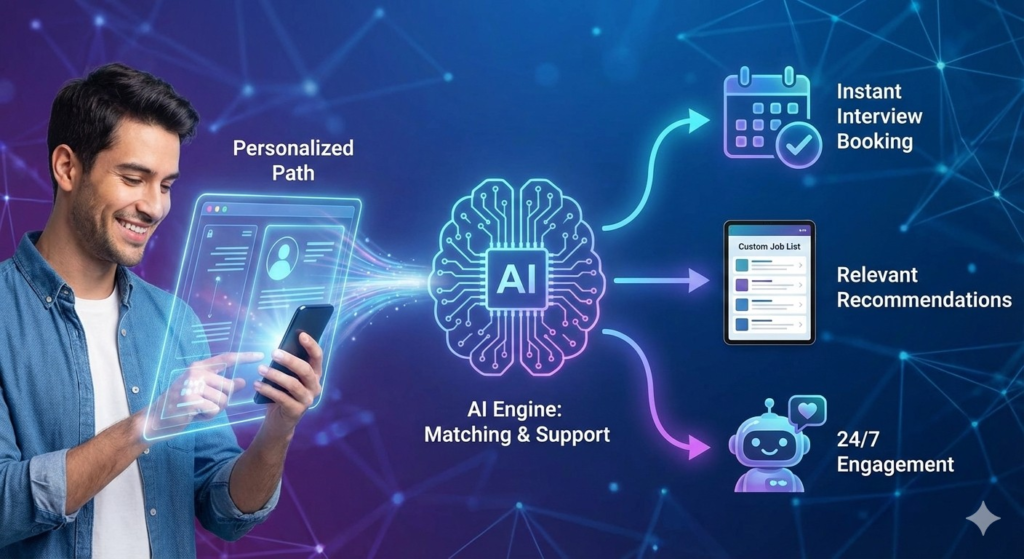
AI has made an incredible change in the experience of candidates from reactive manual filtering to proactive personalised engagement. With such changes, the applicant receives feedback quicker, gets related job offers, and gets a 24-hour guide throughout the whole journey toward their profession.
AI supplements but does not replace human interaction. It replaces repetitive high-volume activities that fill precious time in recruiters’ lives so that they can now focus on building true relationships with the candidates. This results in a process that is much more candidate-centred and not simply a series of gatekeeping exercises.
- Instant Gratification: Automated acknowledgements keep candidates informed instantly.
- Personalised Pathways: AI alters the application flow according to a candidate’s specific profile.
- Reduced Friction: Automatic parsing of resumes cuts out the tedious and frustrating data entry of candidates.
In summary, it bridges to make the connection between the candidate’s needs and the organisational goals for a smooth and most civilised recruitment process.
AI candidate screening tools are trained in such a manner that they analyze the resume in terms of actual talent and skill, going beyond keyword matching. This would enable a more thorough assessment of the AI candidate’s recommendation skills and experience matches, ensuring applicants are considered for roles that best align with their capabilities.
How do AI candidate recommendation skills and experience Engines Work?
Most of the conventional systems would reject a well-qualified applicant simply because they don’t see the specific buzzwords in the resume. Modern AI delves deeper and examines the intent and complexity behind working in previous roles to uncover raw talents.
- Understanding Context: AI will understand if a Project Lead or Program Manager is interchangeable under the same core competencies.
- Inferring Skills: Skills, such as data analysis, are inferred by the system irrespective of whether the same is mentioned in the candidate’s profile.
- Better Job Matching: It ensures that these candidates are rightfully given priority for jobs they will find fit, thus greatly enhancing their experience.
In validating, AI candidate recommendation skills and experience have rendered the merit and potential superior to the construct of a resume.
In What Ways do AI recruitment solutions improve candidate experience Through Communication?
AI recruitment solutions enhance the candidate experience, to begin with, by means of conversational AI chatbots, which are present as instant 24×7 interfaces for interaction. These instruments answer FAQs, schedule interviews in real-time, and give status updates on the process that put candidates’ minds at ease, alleviating anxieties about waiting for some human to respond.
Communication bottlenecks are still large pain points for candidates. Conversational AI will bridge these gaps and provide that constant communication touch throughout the hiring lifecycle.
- Always On Support: Candidates searching for jobs after hours can get their questions answered immediately.
- Automated Scheduling: Making a time for someone to interview takes seconds, highlighting differences with long days of emailing.
- Timely Feedback: AI ensures timely feedback for all candidates, notifying even those not moving forward respectfully.
Hence, constant and open communication is the best way to raise and protect your employer branding during high-volume hiring.
How Can AI Create a Seamless Onboarding Experience?
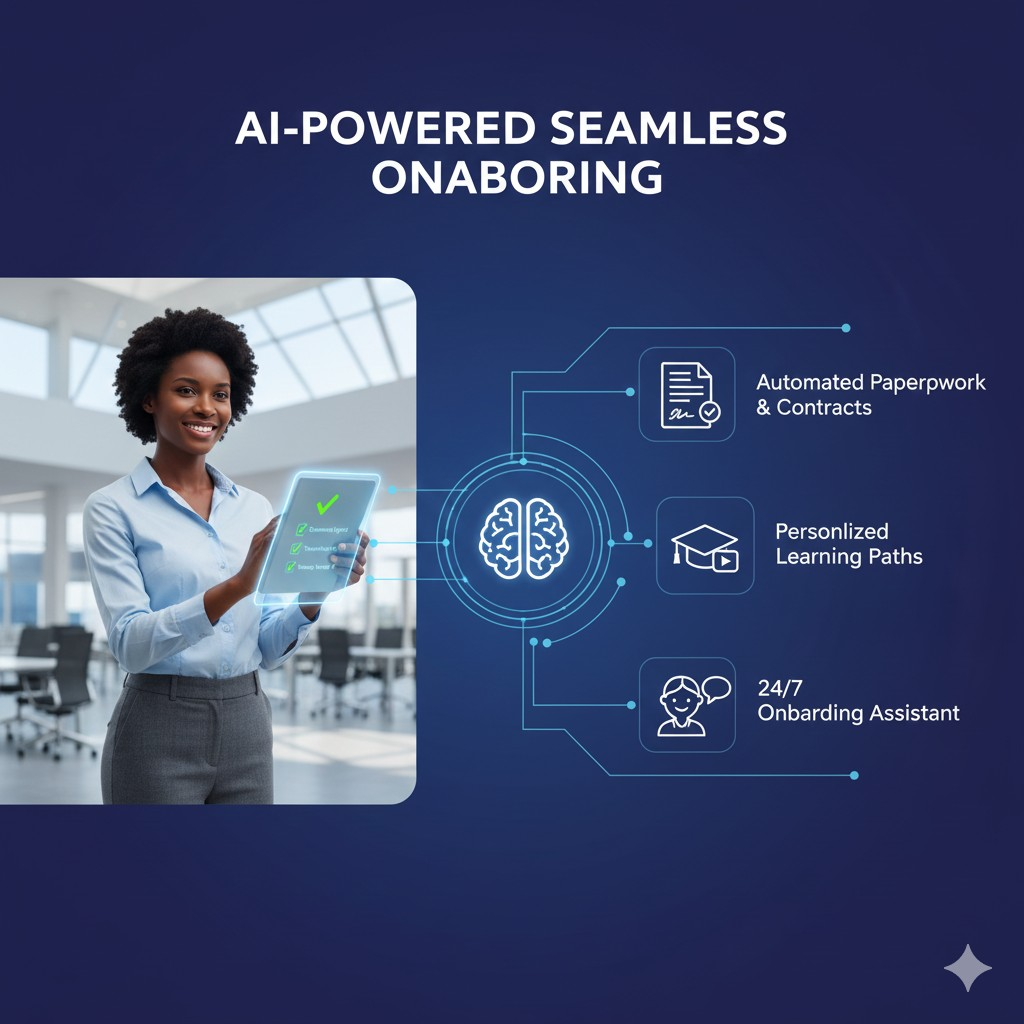
Automating paperwork and personalising onboarding modules is an AI-enabled way to create a just-in-time onboarding experience. AI candidate experience would keep engagement and morale high in the candidate’s mind long after acceptance and thereby facilitate an efficient company transition.
An onboarding program is quite an important step, passing from opportunity to employment; if onboarding is poorly defined, high early turnover becomes relevant: hence, using AI for retention.
- Automated Document Workflows: AI does the tax forms and contracts, so all the new hire has to concentrate on is being a team player.
- Personalised Learning Paths: AI suggests personalised learning modules based on analysis of AI candidate recommendation skills and experience during the interview.
- 24/7 Onboarding Assistants: Digital assistants provide answers to general questions regarding benefits, associated office policies, and team structures.
The further AI candidate experience clouds to the onboarding period, thereby ensuring continued momentum and trust that the recruitment has built.
What Role Does Sentiment Analysis Play in the AI Candidate Experience?
Sentiment analysis plays a role in the AI candidate experience by using natural language processing for assessment of the applicants’ feedback and the emotional tone in the course of the hiring process. These AI recruitment solutions have improved the candidate experience through the identification of points of frustration in the funnel where real-time adjustments could take place.
It is as important to know how a candidate feels about things as it is to know the skills they possess. Sentiment analytics has grown directors learn how to emotionally drive large-scale hiring.
- Capturing Real Time Feedback: AI studies responses from the survey and chats to measure candidate satisfaction.
- Identifying Friction Points: Alerts the team to fix the issue at hand.
- Improving Brand Sentiment: Energy Data-responsive Proactive Changes Impact high ratings intrinsic to organisations on employer ratings sites.
Emotional intelligence, coupled with AI, will make it possible for organisations to respond with speed and precision to candidate demands that have never been experienced before.
How Do Mobile-First AI Tools Enhance Candidate Accessibility?
Mobile-first AI tools to improve access to candidates by allowing applicants to do everything through their mobile phones. This will cater well to very diverse populations that businesses will be able to connect with continuously while on the move, therefore requiring work on flexible terms.
Accessibility is an important dimension of fairness. In this way, if organisations communicate with candidates from their mobile devices, they will widen their net on talent outreach quite significantly.
- Smartphone Applications: AI forms make for swift applications without having to upload heavyweight documents.
- Mobile Assessments: Wherever they are, candidates can undertake cognitive or skills-based games and assessments.
- Asynchronous Interviews: Candidates get to record their responses with video AI tools at their own time, thus complying with current work schedules.
Ultimately, making the AI candidate experience mobile is a key to reaching the modern always-connected professionals and thereby ensuring total inclusion.
Conclusion: Empathy at Scale Through Technology

It’s not just about improving the efficiency of HR processes with AI in talent acquisition-it’s all about improving the journey of the job seeker. Such sophisticated instituting of AI recruitment systems improves the experience of candidates; the systems could deliver the responses, fairness, and personalisation that modern professionals crave. Positive AI effects in recruitment candidate experience changes shall ultimately build a stronger employer brand, redefine employer attraction, and retention ability for necessary future growth.
Key Takeaways and Solutions: A Summary Table
| Candidate Pain Point | AI Solution | Strategic Benefit |
| Lack of Communication | Conversational AI and chatbots for 24/7 engagement. | Eliminates the black hole and reduces candidate anxiety. |
| Poor Job Fit | Advanced AI candidate recommendation skills and experience matching. | Increases success rates and ensures candidates apply for the right roles. |
| Slow Processes | Automated scheduling and document workflows. | Speeds up hiring velocity to secure top talent before competitors. |
| Accessibility Barriers | Mobile-first AI application and assessment tools. | Improves inclusivity and creates a wider, more diverse AI candidate experience. |
Statistics: The Data Behind AI Candidate Experience
| Source and Insight | Key Figure | Reference Link |
| CareerBuilder | 82% of employers agree that a positive candidate experience is crucial. | CareerBuilder Stats |
| IBM Smarter Workforce | Positive experiences make candidates 38% more likely to accept offers. | IBM AI Hiring Study |
| Talentgy Report | Over 50% of applicants decline offers due to a poor hiring journey. | Talentgy Report |
| Mobile-friendly applications increase candidate volume by up to 20%. | LinkedIn Recruitment Trends |
FAQs
No, it’s quite the other way around; AI makes all these administrative tasks expedited and automated, leaving recruiters to engage with candidates in real conversations. Better experience at large for the candidate.
Today’s engines are accurate, in most cases, owing to language processing, like many times recognising talents fitting the context of an experience that would be missed if screened by a human.
They are going to take place in speed and transparency. The candidates are not going to stay in the dark; on the contrary, they would appreciate the instantaneous feedback and the quicker process for scheduling interviews set up throughout the journey.
AI ensures informing each candidate on time. It even gives reasons why one was considered a bad match for the particular role and goes further to give suggestions for suitable fix-up roles in the company for the profile of the candidate
Yes. AI candidate recommendation skills and experience ensure a better match; hence, employees are allowed to position themselves in a truly suited job, boosting their job satisfaction and long-term retention opportunities.