
Key Takeaways
- AI talent matching reduces time-to-hire from 42 days to 16 days and cuts screening time by up to 75%
- Modern platforms use semantic embeddings, NLP, and cosine similarity — not keyword overlap — to match candidates
- AI-driven talent matching increases diversity hires by 25–35% through objective, skills-based scoring (source needed — see Section 4)
- ValueMatrix goes beyond skills matching: cultural fit, team dynamics, and The Big Five (OCEAN) Model assessment before the first interview
- Implementation takes 3–4 months: one-week assessment → ATS pilot → full rollout → quarterly optimisation
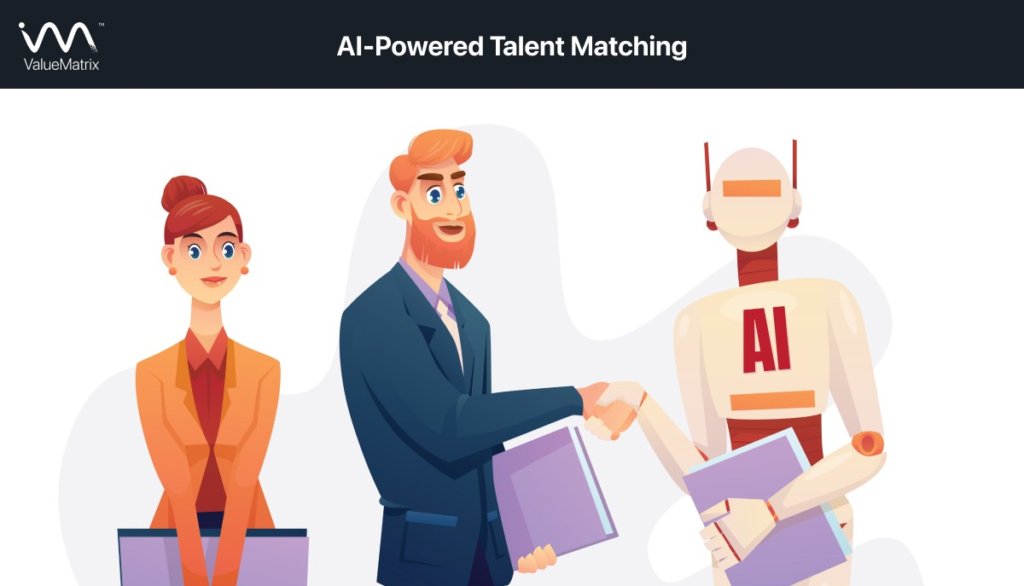
Talent matching AI is an artificial intelligence-based tool for recruitment. It matches candidates to jobs based on their skills, potential and fit. It allows for faster and less biased recruitment. However, many organizations are underutilizing talent matching AI. This blog covers how AI talent matching works, its benefits, how it is applied in ValueMatrix, and how to implement it.
How Has AI Transformed Talent Matching in Modern Hiring?
AI-enabled talent matching has replaced keyword searching with semantic matching․ It applies natural language processing (NLP) and vector embeddings․ It enables AI to analyze the potential‚ culture fit and retention likelihood of a candidate․ Customary systems match job titles and requirements․ Modern AI-based solutions fit candidate’s skills‚ abilities and personality to jobs․
How Does AI Talent Matching Work? Core Components Explained
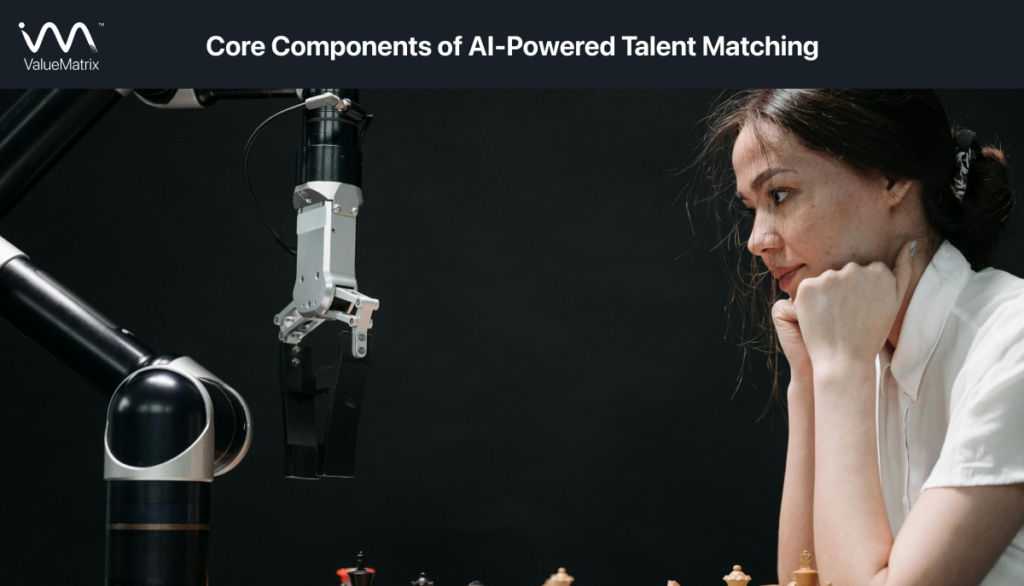
AI talent matching can match candidates’ profiles and job descriptions using numerical vectors and determining their proximity using cosine similarity․ This allows platforms to match candidates on the basis of their skills‚ potential and cultural fit‚ and not merely on keywords and phrases․ The best platforms now have predictive accuracy of 85%․
What Are the Key Benefits of AI-Powered Talent Matching?
The key benefits of AI-powered talent matching include a 63% reduction in time-to-hire, a 25–35% increase in diversity hires, and a 30–50% reduction in recruitment costs — achieved by replacing subjective, bias-prone manual screening with objective, data-driven candidate scoring based on verified skills and cultural fit
| Benefit | Traditional | AI Talent Matching |
| Time-to-Hire | 42 days | 16 days |
| Bias Risk | High (subjective) | Low (data-driven) |
| Retention Rate | 70% | 90%+ |
| Cost Savings | Baseline | 30-50% reduction |
How does ValueMatrix Aid Talent-Matching?
ValueMatrix is a holistic top talent-matching platform that flips the script on keyword matching. ValueMatrix takes culture/team fit into account before a first engagement, validating resumes, even those artificially manipulated, with in-depth profiles, micro-expressions, voice and language, cognitive and emotional factors, and cognitive gamification.
Utilizing data from external job boards, success predictive scoring, and internal mobility matching, the platform helps identify high potentials for leadership pipelines. In this way, DEI efforts are strengthened, uncovering potential as opposed to the common profile templates.
Multilingual neural nets and neuroscience interviews eliminate bias across Indian industry. They save 75 hours per recruiter annually with advanced filtering. Companies report increased confidence in acquiring the right talent, high-performing teams. ValueMatrix integrates with applicant tracking systems to turn talent match into data-backed precision.
Which Are the Best AI Talent Matching Platforms in 2026?
Eightfold’s talent matching system, used by Fortune 500 companies, leverages deep learning to achieve 2x faster fills and 28% greater retention. HireEZ’s agentic AI automates outreach to 30 databases for 75% faster sourcing.
Enterprise-grade tools range from Recruitly’s semantic search (identifying hidden talent) and SmartRecruiters’ Winston which provides explainable matches, to SMB systems like Zoho’s AI talent matching that also address multilingual Indian markets.
| Platform | Key Strengths | Best For | Approx. Cost |
|---|---|---|---|
| ValueMatrix | Cultural fit, team dynamics, The Big Five (OCEAN) Model, cognitive gamification, psycholinguistics for AI-profile detection | Mid-market to enterprise; DEI-focused hiring; India market | Contact for pricing |
| Eightfold AI | Deep learning semantic matching, 2x faster fills, 28% higher retention | Fortune 500 enterprise | Enterprise pricing |
| HireEZ | Agentic AI, 30+ database outreach, 75% faster sourcing | High-volume recruitment | SaaS subscription |
| SmartRecruiters (Winston) | Explainable match scoring for mid-enterprise | Mid-size organisations | Mid-tier SaaS |
| Zoho Recruit | AI matching with multilingual support, SMB-friendly | SMBs and Indian market | Affordable SaaS |
How Are Companies Using AI Talent Matching to Transform Hiring Results?
Unilever replaced recruiting processes with an AI-enabled talent matcher, screening 1.8M candidates yearly, cutting interviews by 75%, and improving diversity. A Mumbai, India tech company used AI to reduce engineering recruitment bias by 40%.
With Tracker RMS, agencies can create company-specific talent match criteria per client, increasing recruiter productivity. Gloat’s internal mobility platform saved them hours by proactively matching talent.
| Case Study | Platform | Results |
| Unilever | Custom AI | 75% fewer interviews; diverse hires |
| Tech Firm (India) | Zoho-like | 40% bias reduction |
| Agencies | Tracker | Faster cycles; skill-gap insights |
| Enterprises | Eightfold | 28% retention gain |
How Does AI Talent Matching Address Bias and Ensure Fairness in Hiring?
AI talent matching addresses bias through adversarial debiasing, training models to ignore protected demographic attributes, combined with Explainable AI (XAI) dashboards that reveal decision logic, regular disparate impact audits against EEOC Four-Fifths Rule thresholds, and mandatory human oversight on final hiring decisions
How Do You Implement an AI Talent Matching Platform? A Step-by-Step Guide
Assess Needs
High volume? Compare HireEZ to others. Internal focus? Consider internal solution. Gloat-style talent matching platform.
Select and Integrate
Pilot AI-powered talent matching with ATS APIs for $10K-50K/year. Train via vendor workshops.
Launch Pilot
Fit 20 roles considering offer acceptance >40% and diversity.
Scale and Optimize
Retraining on these outcomes yields quarterly accuracy of 90%+.
| Step | Timeline | Metrics |
| Needs Assessment | 1 week | Volume analysis |
| Tool Selection | 2 weeks | Integration test |
| Pilot | 1 month | 50% time save |
| Full Rollout | 3 months | 30% quality hire boost |
Challenges and Mitigations
Privacy concerns? Federated learning analyzes data on-device. Skill gaps? Vendor-managed services can fill them.
Need scalability for your peaks? Cloud tools can do it. For startups, start with open-source NLP, then go to SaaS.
Future Trends
By 2027, multimodal AI talent matching solution will interview for soft skills with videos and VR, agentic AI will negotiate offers, and talent marketplaces will enable internal gigs.
Blockchain for credential verification; 80% white collar adoption expected.
Conclusion
AI-powered talent matching is technology that fundamentally changes the way organizations source candidates‚ assess candidates and make hiring decisions by eliminating subjective and keyword-based screening and objectively assessing candidates’ skills‚ personality and cultural fit․
Where other platforms start with automation of talent matching at scale with millions of candidates and algorithm-triggered scoring for long-term job performance prediction‚ ValueMatrix provides organisations with a step change in compounding hiring performance․ ValueMatrix uses The Big Five (OCEAN) Model‚ cognitive gamification and computational psycholinguistics as the basis for objectively validating cultural and team fit and skills before the first interview․
FAQs
1. What is a talent matching platform?
AI matches candidates with roles according to their skills and suitability, rather than keywords.
2. How does AI talent matching reduce bias?
Via anonymization, objective scoring, and debiasing algorithms for equitable outcomes.
3. What differentiates ValueMatrix?
Features include cultural fit pre-screening, AI resume validation and personality analytics for diverse teams.
4. Top talent matching AI platform?
ValueMatrix, Eightfold and HireEZ: excellent scale, semantics, integration.
5․ What is the ROI of AI-powered talent matching?
Timescale: 3-6 mo‚ 3-5 hires․ Accelerated by faster hiring and lower turnover․
6․ What is AI talent matching‚ compared to customary keyword-based talent screening?
Rather than a simple keyword match as used in many resume file screeners‚ AI talent matching relies on semantic embeddings‚ natural language processing (NLP)‚ and cosine similarity to assess skills‚ potential‚ and cultural fit to more objectively and holistically match job seekers to jobs with 85% predictive accuracy․
7․ Algorithm-based talent matching: how does it work?
Algorithms create numerical vectors from profiles using skills‚ personality and culture fit‚ to match them to jobs and each other․ They compare vectors using cosine similarity which provides a proximity score․ Platforms like ValueMatrix use NLP‚ vector embeddings and models like the Big Five OCEAN to provide a data-driven score․
8․ What types of data do AI talent matching platforms use to create scores?
AI platforms process resumes and detailed profiles‚ micro-expressions‚ voice‚ language patterns‚ cognitive/emotional traits‚ gamification data‚ external job boards‚ success predictors and internal mobility data to determine whether candidates possess needed skills and fit the employer’s culture․
9․ Is AI talent matching in compliance with the GDPR and India’s DPDP Act 2023?
Compliant platforms have also used adversarial debiasing‚ Explainable AI‚ anonymization‚ disparate impact auditing‚ and human oversight․ Federated learning‚ a privacy-preserving technology‚ can be used to comply with GDPR and India’s DPDP Act 2023 by processing data on-device․
10․ How long does it take to implement an AI talent matching platform?
In 3-4 months‚ we identify needs in 1 week‚ select tools in 2 weeks‚ pilot for 1 month‚ then implement across the organization in 3 months with quarterly optimizations․ Includes ATS integration‚ training‚ and scaling for a 30% increase in quality of hire․