
Table of contents
- Recruiting in 2026: Why Old Hiring Playbooks No Longer Work
- Introducing the need for smarter talent mapping
- Why are CHROs rethinking how talent pools are defined?
- What is Talent Intelligence in Recruiting?
- What AI Talent Mapping Reveals That Traditional Recruiting Misses
- What the Future of AI Talent Mapping Looks Like(Conclusion)
- FAQs
Recruiting in 2026: Why Old Hiring Playbooks No Longer Work
2026: The year when Resumes lost relevance
Today AI talent mapping has taken over traditional style of hiring. If you remember, 2024 was all about SEO-optimizing your resume for the algorithms because your resume wasn’t being read by human eyes but scanned by an Application Tracking System(ATS), which approved or rejected applications based on keyword-matching.
Candidates started using ChatGPT to optimize their resumes, and the internet was replete with “Resume Optimization Experts” charging you a pretty penny for their services.
The trend carried into 2025, and then suddenly, everything changed. All the fanfare around resume optimization was swept away. By the latter half of 2025, companies had started giving more weightage to skill-based hiring.
Skill became the most talked-about metric in the hiring space. New platforms built around helping companies do skill-based hiring emerged. The resume wasn’t discarded completely, but its relevance shrank, and the noise of optimization around it died almost instantly.
Nace’s Job Outlook Survey reveals that 70% of employers use skill-based hiring.
Which is a lot considering the trend is only one year old. You must have felt this pivot in the hiring market yourself if you’re a recruiter.
That’s because most employers are looking for job-relevant abilities rather than Ivy League colleges or past experience.
The shift from stable roles to fluid
Another shift that has happened is role fluidity. More and more companies are looking to build cross-functional teams. AI has pushed the corporate world towards collaboration. In today’s functioning, roles will be overlapping each other, cutting across departments.
For example, architecting a new hiring strategy would require the backend and HR departments to come together and work in unison. Furthermore, cross-functional teams reportedly enhance innovation, problem-solving and productivity because it takes ideation from being a siloed process to being a multi-departmental process.
Introducing the need for smarter talent mapping
The job market has turned into a battleground for companies. They are all scrambling to get the best talent available, and they are deploying all the tools at their disposal. And it’s not just the companies; the hiring climate is changing at lightning speed. We’ve seen how quickly the switch was from resumes to skill-based hiring. Your company needs an air-tight talent mapping strategy so you don’t get left behind the market curve.
Talent Mapping isn’t as simple as recruiting people; it’s an elaborate science that includes finding the right type of talent, succession planning, finding dormant employees who aren’t applying currently but may look for a switch-up in the near future, anticipating skill gaps your firm might face in the future, and much more.
Talent Mapping is a comprehensive strategy that makes your business foolproof.
Here are some of the ways a solid Talent Mapping strategy can give your business the ultimate leverage
Bolsters recruitment efficiency
Talent Mapping can give you a detailed blueprint of the skills required to fill each position. It helps your HR narrow down their search and devise a recruitment strategy for the said skills. So that anything outside of that ambit is immediately ignored.
Improves your ROI on hiring.
When you hire people aligned to your goals and their skills aligned to your requirements, the attrition rates drop. People feel synergy at work, and their performance elevates, because no guesswork was involved in hiring them for their role. By removing hunch from the hiring pipeline, Talent Mapping ensures a more robust, leak-proof funnel.
Corrects workforce planning.
Talent Mapping, if done right, can predict your hiring shortfalls in advance and help you plan ahead of time. It can also forecast skill gaps your company might face, so you can implement training programs and modules in due time. This proactive approach helps you navigate staff and skill shortages with relative ease.
Why are CHROs rethinking how talent pools are defined?
Earlier, the Talent Pool consisted of active applicants. But now, Talent Mapping can help you scout employees who might not be applying currently, but will soon. This feature alone widens the ambit of Talent Pool by a lot.
The CHRO now has to devise strategies, keeping the fluidity of roles in mind. As we discussed earlier, many roles across departments will be converging. They’ll demand unyielding collaboration between finance, marketing, engineering, and HR as we have never imagined before. This is a sharp departure from fixed roles in the past.
While cross-departmental diversity can boost innovation and creativity, it also brings along its own set of challenges.
Absence of hierarchical structure
When diverse groups come together, it lends a certain flexibility to decision-making, as people may find it hard to gauge who is the final authority figure across all departments.
Furthermore, if a head is even selected amongst departments, employees may find it difficult to bypass their department boss and directly take orders from that authority head. This can create confusion in the chain of command structure of the organization.
Also, because of this confusion, people may waste unnecessary time seeking approvals or deferring decision-making to someone else.
Conflict between departmental priorities.
The teams still belong to their respective departments, and they will be handling projects that are exclusive to their respective department, as well as projects that are collaborative ventures. In that scenario, the teams might prioritize projects that are their sole responsibility over projects that are a joint effort.
Cultural Clashes
There is a subset of culture within departments that may vary from each other. Culture is usually moulded by the higher-ups and flows top-down. So even within a company, subcultures of departments could be very different from each other, and when these departments mingle with each other over projects, cultural clashes could surface.
What is Talent Intelligence in Recruiting?
Talent Intelligence is a subgroup of AI Talent Mapping; it’s when Talent Mapping goes granular.
Talent Mapping provides the overall framework of your hiring strategy; meanwhile, Talent Intelligence deals with on-ground implementation of that framework. Let’s discuss further.
What Talent Intelligence actually entails
Talent Intelligence in recruiting is the practice of collating, analyzing, and applying data-driven insights to make more informed decisions around recruiting. It extracts information from sources like HR systems, labour market data, AI-driven tools, and social platforms to provide a 360-degree view to the recruiters.
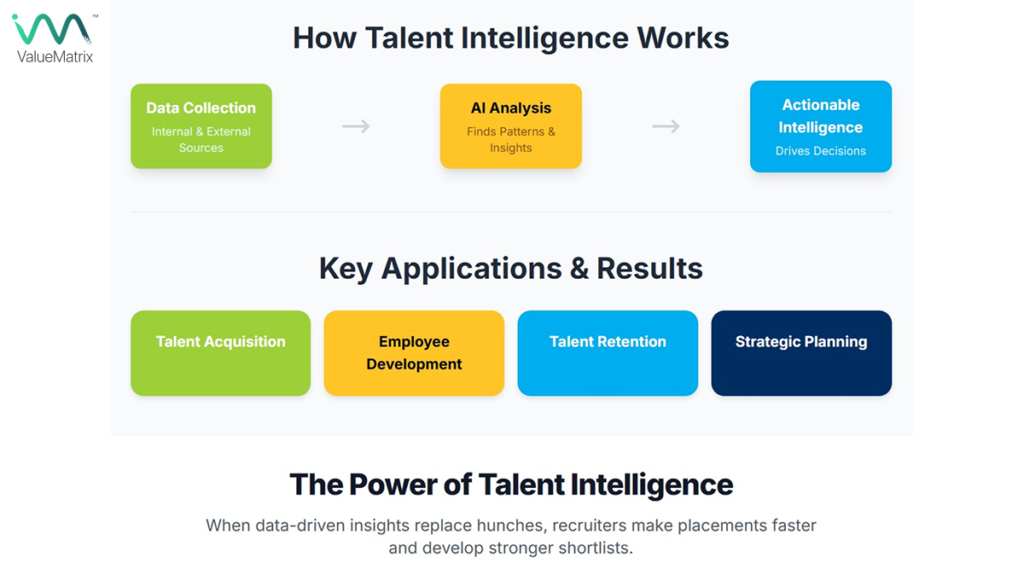
Here are some of the key components of Talent Intelligence
Data Collection
Data Collection is the backbone of Talent Intelligence. Data is mined from sources such as performance reviews, recruitment channels, employee surveys, and even social media. After that, this data is analysed to study trends, skill gaps, hiring shortfalls, etc.
Integration with HR
A sign of a great Talent Intelligence piece is its ability to integrate with existing HR systems, HR Information Systems(HRIS), Application Tracking Systems(ATS), and other performance management tools. This integration ensures a smooth hiring workflow, where Talent Intelligence fits the existing system like a mod, and the transfer of information between platforms is seamless.
Deploying AI and Machine Learning to its full effect.
Artificial Intelligence(AI) and Machine Learning(ML) are the powerhouses behind an effective Talent Intelligence setup. Predictive Analytics, Sentiment Analytics, and Gamified Assessments are some of the tools these systems deploy to assess an employee’s compatibility with pinpoint accuracy.
Let’s discuss some of the benefits of Talent Intelligence
Speedy sourcing and screening
Speeds up the manual labour of sifting resumes. It narrows down your search from a wider talent pool to compatible candidates based on their profile, saving you time and accelerating the hiring process. It can also customize the outreach timing and message based on the candidates for optimal response rates.
Improved Match Making
AI Talent Mapping channels the power of Predictive Analytics to comb through the shortlisted candidates to find your best match. It doesn’t end at hiring. Talent Intelligence, powered with Predictive Analytics, can map the candidate’s progress in his job and can forecast his future success in the company.
Agile Hiring Strategy
AI Talent Intelligence allows you to change your sourcing and screening strategies on a dime based on real-time market changes. It auto-adjusts the number of people you want to recruit based on market supply and demand. It can also update role requirements based on an upcoming skill gap in the market or the company, and even suggest training or modules to fill that gap.
Magic Happens at the Intersection
When Talent Intelligence connects your workforce data, i.e., roles, performance, tenure, turnover, productivity, etc., with labour market statistics, you get a comprehensive view of your recruiting needs. Nothing is left to a hunch or guesswork. You can forecast future talent needs, plan succession accordingly, and decide on solid data whether to hire externally or internally.
How AI Powers Talent Mapping
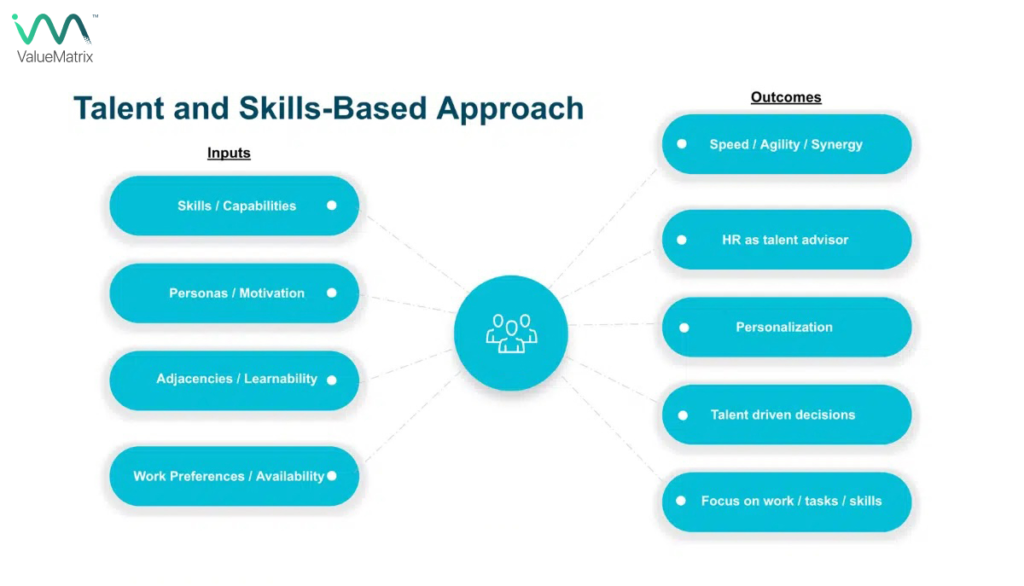
How AI identifies patterns across resumes, profiles, skills, and career paths
Modern AI systems, Natural Language Programming(NLP), and Machine Learning(ML) are great at contextualizing and interpreting disjointed data like CVs, Profiles, Job Descriptions at scale, instead of just keyword matching. It’s not easy to stuff job-relevant keywords and fool the ATS like it used to be.
AI tools also deploy semantic parsing to detect patterns in careers and experiences that humans might overlook.
Understanding adjacent skills and non-linear career trajectories
The current systems are savvy and nuanced, unlike their predecessors. In earlier models, there had to be an exact word match between the job description and the resume. But the current systems don’t just look for exact matches, but correlated and adjacent skills as well.
For example, if you know Java, the systems could make out that you must also know Beacon, that’d be your adjacent skill. In the same manner, if you are in sales, the systems can correlate that with negotiation skills as well.
AI as a decision-support layer, not a decision-maker
Despite all its advantages, it’s important to know that Talent Intelligence is a supporting act and not a main act. The final decision still rests with humans. It’s a lot like modern airplanes equipped with an autopilot system. Yes, they can help pilots land and take off, but that doesn’t mean autopilots are deciding the final destination. The final decision whether to land in bad weather or not still rests with the pilot.
In the same way, it’s not Talent Intelligence making the final decisions for you. It still follows the decisions made on the CHRO’s drawing board.
What AI Talent Mapping Reveals That Traditional Recruiting Misses
Hidden and underutilized skills
AI talent mapping has the capability to screen vast amounts of data with a detailed eye. It can assess not just surface skills, but latent skills as well. It also has the ability to assess correlated and adjacent skills, which is next to impossible for humans, especially at that rate.
AI’s ability to parse and make sense of buried data as well is what makes it a game-changer.
Recognising Emerging Skills Before They Enter Mainstream
AI-powered talent intelligence can parse vast amounts of unstructured data alongside labour markets. This helps AI predict skills that will dominate the job market ahead of time. This predictability factor is what gives AI a leg up over traditional recruiting.
This means organizations can prepare themselves before the market takeover by these skills. It buys HR extremely important time to either train their existing employees in these skills or initiate recruitment drives for candidates who possess these skills.
Recognising Talent Pools Under The Surface
One of the biggest limiting factors for traditional hiring is that it has forever relied on standard hiring metrics such as job postings, referrals, and internal hires. Basically, what has remained in sight is what has been on their mind. But AI faces no such human limitations and operates far beyond these traditional channels. It can excavate dormant candidates from the internet who aren’t applying right now but may in the future.
The advantage for the organizations is that instead of wasting their time sifting through candidates with irrelevant skills, they can get directly to the gold mine of worthy clients and make a move before they do.
Some Common Challenges in Adopting AI Talent Mapping
Redacted Data
AI is great at extracting a candidate’s profile from all over the internet, but it can only exhume what candidates intend to show. AI can’t access data that is deliberately hidden by the candidates. Candidates are getting savvier, and in many instances, they make separate profiles or email accounts for job hunting; AI hits a roadblock in that case.
Trust gaps between recruiters and AI systems
There is a trust deficit among the candidates when it comes to AI. A Gartner survey shows that only 26% of candidates trust that AI will fairly evaluate them. This trust gap is often compounded by AI’s black box problem. It is when AI starts giving outputs without any fair reasoning behind it. Some large models tend to develop an opacity in their functioning, where you can see the input and the output, but you have practically no idea what goes on in between.
This has eroded the trust of many candidates who believe they have been weeded out by the systems despite having strong credentials for the job.
Bias in AI systems
Predictive AI models still work on the data fed to them by humans. So if there was any bias in practice in previous hiring, it’ll show up in your AI systems as well. A very famous example of Amazon comes to mind. Amazon developed a machine learning tool designed to help it recruit people for technical roles. The machine learning model was fed on Amazon’s past hiring data of a decade. The result was that it started downgrading women applicants.
It also revealed Amazon’s previous history of hiring bias. Needless to say, Amazon scrapped its AI tool in 2005.
Resistance to changing long-standing hiring habits
When ATS rolled in in the mid 2010’s, its application was frictionless and universal. That’s because it automated a manual aspect of HR’s job, but with sophisticated systems like Predictive analytics and Sentiment Analysis, it is on its way to sharing cognitive workload as well.
This makes some people nervous, especially those without any experience in analytics. Hence, many HR teams resist forsaking similar practices for new ones. The cultural shift is always harder than the technical one. So HR’s resistance to change and skill gaps in analytics or AI are the main obstacles to making a complete cultural transformation.
What the Future of AI Talent Mapping Looks Like(Conclusion)
AI Talent Mapping is not just a new upgrade to the hiring process but a watershed moment. It just speeds things up like ATS, but introduces a new paradigm that didn’t exist before. It’s the difference between a calculator and an internet-enabled supercomputer. But it’s far from being independent; it works on human data and on human diktats. So, people afraid of end-to-end automation need not be. HR should develop an AI temperament to work in a symbiotic environment with the AI.
FAQs
Yes, AI can reduce bias by focusing on verified skills and consistent criteria, but it requires regular audits to prevent inherited bias from data or models.
Human oversight ensures accountability, interprets AI outputs, and maintains ethical hiring standards alongside automated AI processes.
The most valuable data combines internal sources like HRIS, performance systems, and ATS records with external market intelligence, including labor market trends, compensation benchmarks, and competitor hiring activities. Integration is key—having these sources work together in one platform.