
The 2026 Tipping Point
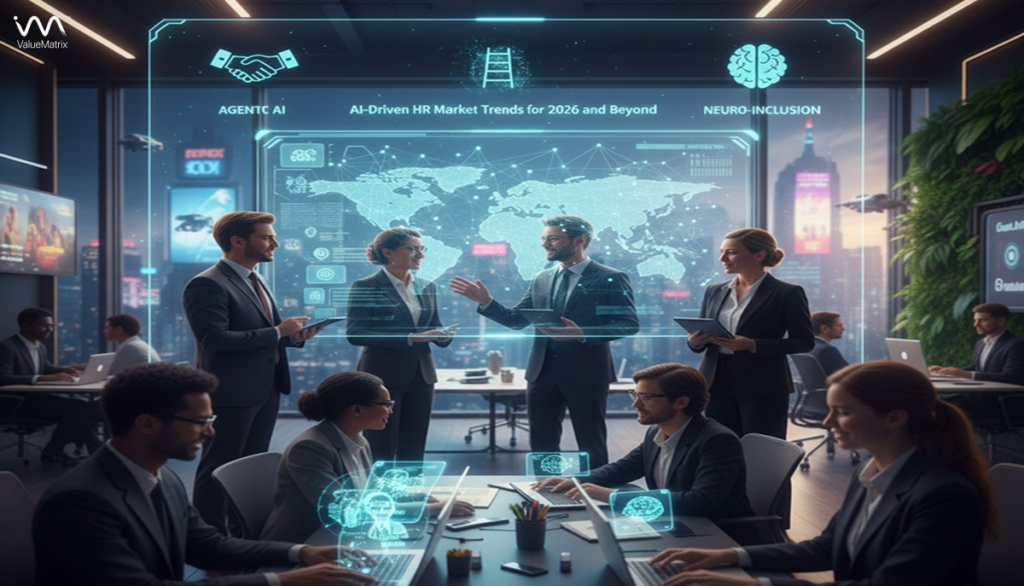
The entire structure of human resource management will transform because of the changes that will occur in 2026. We progress from generative AI, which helps users create text, to agentic AI, which performs predefined functions. The AI HR trends 2026 establish a framework for “Skills-First” practices, which enable Growth Managers to transform from basic management functions into complete organizational control through autonomous systems.
The most important AI HR technology trends 2026 that will emerge show how companies will develop digital labor systems to create a high-performance team. It includes both digital workers and human employees. Organizations need to treat their workforce as a living skills ecosystem rather than fixed job roles because this approach enables them to handle the 2026 HR trends successfully. The organizations that will endure until 2027 will be those that have successfully implemented autonomous systems to enhance efficiency while developing their human resource capacity.
1. The Agentic Era: Moving Beyond Simple Automation
2026 is the “Agency” year of Agentic AI. Unlike all legacy systems’ major automation efforts, Agentic AI can conceptualize and administer workflows over multiple steps in action. C-HROs also project a 327% increase in agent adoption by 2027, when AI agents will autonomously carry out everything from payroll validations to multi-country onboarding.
Beyond providing administrative relief, Agentic AI would radically change corporate learning. In 2026, HR teams realize that employees are using agents to “blow through” standardized training, requiring a shift from completion-based metrics to outcome-based assessments in learning. We are headed toward a world where AI agents assume “study partner” and “process co-pilot” roles, meaning that learning is not only finished, but done in real-time application.
2. The Skills-First Revolution: Mapping Capability over Pedigree
Hiring will soon be on a steady decline, as organizations are increasingly utilizing real-time updating “Skill Graphs” as pools of talent. With this change, recruiters can now search by verified capability instead of static job titles, increasing the talent pool nearly 8.2x.
By 2026, the traditional job description will be almost nonexistent. Leading firms are already deploying AI-driven “Skill Gap Modeling” to predict which roles are at high risk for automation and proactively reskilling those employees for human-centric roles, such as empathy-based leadership. This “Liquid Workforce” strategy will ensure that internal mobility becomes the primary source of talent, thereby dramatically lowering costs in external recruitment.
3. Hyper-Personalization: EX as the New Operating System
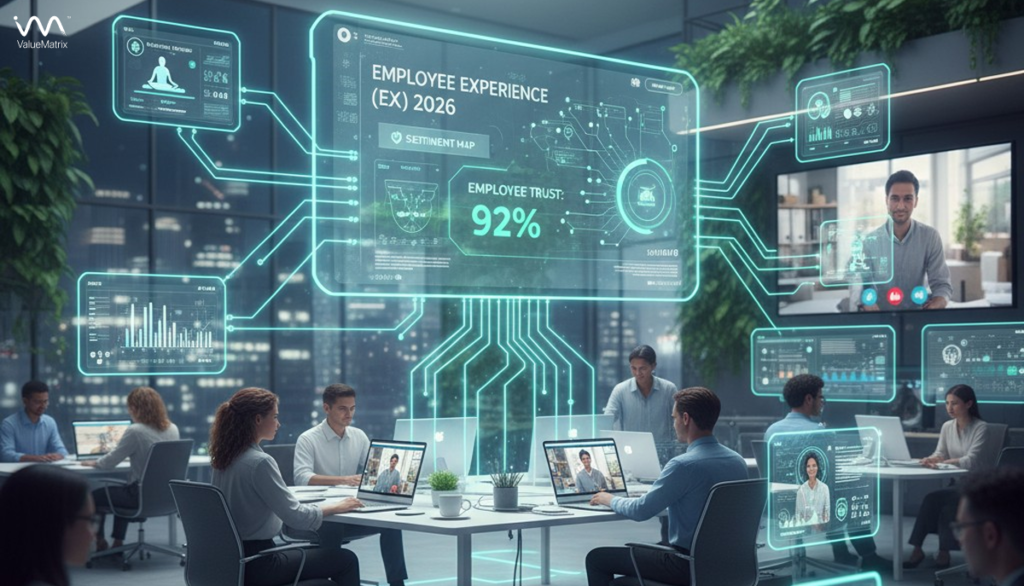
Employee Experience – EX has transitioned from “one-size-fits-all” to “segments of one.” “Digital Nudges” now fall under AI, tracking individual sentiment daily and suggesting career paths or wellness breaks before burnout occurs.
It extends down into methods of communication. People cite that over 50 per cent of company messages are either irrelevant or so exclusive to their specific role, context-aware updates through personal apps is how 2026 will be. Essentially, HR becomes a “Marketing Function for Talent,” using data to ensure all employees are feeling valued, supported, and uniquely recognised in the larger mission created by the company.
4. Predictive People Analytics: Foreseeing Burnout and Growth
The global market for HR analytics is worth$28.1 billion. In 2026, that model can identify turnover risks that are 85% accurate. Managers can now use these insights for “Stay Interviews” endeavors before resignation is ever submitted.
The real breakthrough that 2026 will hold will be the change from descriptive (what happened) analytics to prescriptive (what should we do) analytics. HR systems can now simulate how a 5% salary increase will affect, for example, certain departments and compare this against offering extra days to work from home, predicting which lever will maximize retention. Data has finally moved from the back-office spreadsheet to the frontline manager’s dashboard.
5. The Hybrid Workforce: Human-AI Team Redesign
Roles are “unbundled” into tasks. Managers become “Coaches,” dedicating their attention to empathetic and creative strategy while handing over heavy data orchestration to their AI counterparts.
Such a design will entail a paradigm shift with respect to building leadership. In 2026, managers are trained for “Human-AI Synergy,” where they lead a team that has up to 30% of its work being carried out by autonomous digital agents. The mission is the optimal usage of “Human Advantage”-those irreplaceable skills like complex negotiation and ethical judgment-while technology handles high-volume repetitive logistics.
6. Ethical Governance: Navigating the 2026 EU AI Act
As of August 2, 2026 August 2, 2026, AI in HR was classified as “High-Risk”-this is when the regulation for using XAI for grossly harming artificial intelligence would come into effect. Companies must provide Explainable AI (XAI) to prove their algorithms are not biased, or face fines of up to €35 million.
Governance is now a tool to build trust; a practice of providing AI-related reports to candidates and employees shows transparency, which then sets this organization apart in the crowded radar of the competitive market. HR leaders work closely with legal and their “AI Officer” to ensure each automated decision is audited, is fair, and is well documented for regulatory scrutiny.
7. Neuro-Inclusion & Mental Health: Supporting the Diverse Mind
Neuro-inclusion is now competitive. Companies now try to adjust to interview processes that are more inclusive of ADHD and autistic talent: These are deemed essential to solving the really big problems that the head of this species has not been able to crack.
The research indicates that neurodiverse teams can be up to 30% more productive in data-intensive and error-prone situations. For HR as it is practiced in 2026, it is coming to the time that the answer is the development of “skill-based work samples”. These are being used for tests instead of traditional, socially long and intense interviews to carve the way for neurodiverse candidates to show off their “superpowers” in the confluences of focus and pattern recognition. The shift from “social fit” to “cognitive contribution” creates the new look or talent landscape along the walls of 2026.
8. AI Sovereignty: Navigating Global Data Residency
“Sovereign AI” simply ensures that employee data and AI model training remain within national borders to comply with increasingly strict regional data residency laws.
This means that growth managers on a global scale are waving goodbye to any instance of a single, possibly centralized global HR cloud. In 2026, HR technology stacks are being “federated,” with models based on local servers in the European Union, the US, and Asia to guarantee 100% compliance with the regional AI Acts. This way of bringing operations in a decentralized fashion, apart from ensuring security for data, ensures that AI models are trained on the specific nuances of a local culture and labor laws.
9. The Blue-Collar Renaissance: A Gen Z Career Pivot
As AI impacts entry-level white-collar roles, Gen Z is shifting to “AI-proof” skilled trades. The construction and energy industries saw a wage hike of more than 8% in 2025, which further urged HR to rethink their educational pipelines.
A “Return to Reality” movement continues to sweep away the trade stigma; workers from Generation Z are increasingly selecting career paths associated with immediate financial independence, zero student debt, and high automation resistance, such as HVAC technician or electrician. HR management has responded by crafting “High-Tech Apprenticeships” as a way of combining traditional craft and digital tools like AR and IoT.
10. Internal Talent Marketplaces: Enabling the “Great Stay.”
“Great Resignation” is being filled with a concept called “Great Stay.” AI marketplaces that are being introduced in companies match employees with internal “gigs” and projects to drive an increase in the retention rates of high-potential talent, all to the tune of 30%.
Basically, these marketplaces turn a biggie into an artificial micro-startup ecosystem. Gone are stubborn structures forcing people to leave to try a new role; instead, they can work for a 3-month internal role to learn a new skill set. “Gigification of Internal Work” will bring the variety that both Gen Z and Millennials have grown with, while retaining institutional knowledge, which is very important for sustained growth.
11. Functional Fluidity: The Merger of HR, IT, and Finance
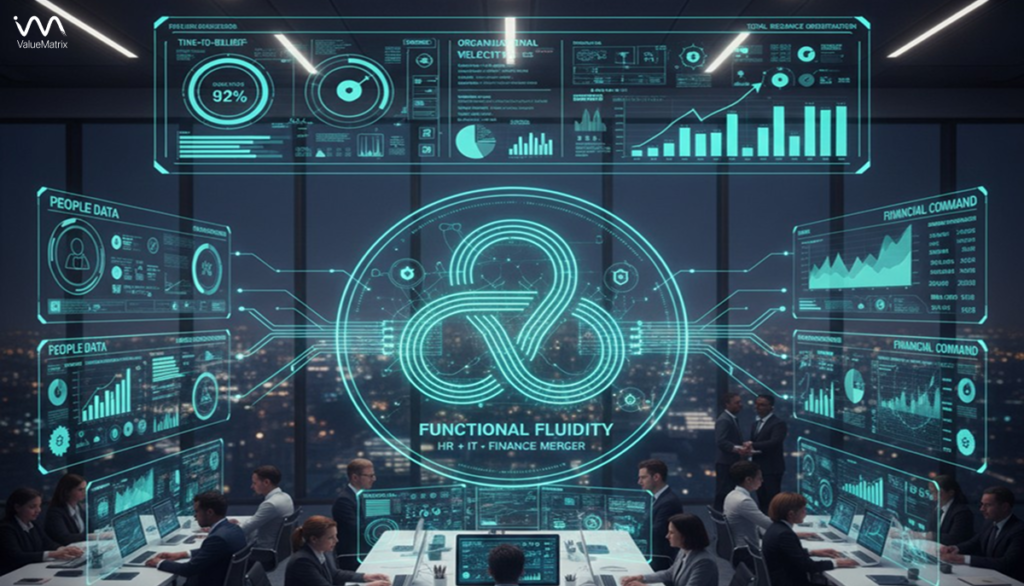
64% of IT leaders anticipate a merger that functions with HR within five years. The new mandate: HR provides the “People Context”, and IT provides the “Data Foundation.”
This merger creates the “Office of the Workforce, a single department that manages both human and digital labor budgets. HR professionals by 2026 will be data-literate, and IT teams will be trained in organizational psychology. This fluidity facilitates “Total Resource Orchestration.” It will enable firms to pivot their entire workforce strategy in just weeks, not years.
12. Glocal HR: Managing Global Strategy with Local Precision
AI allows small teams to manage global workforces by autonomously tailoring benefits and compliance to local laws in real-time.
Glocal HR is the ultimate efficiency hack envisioned for 2026. An Agentic AI monitoring 150+ different labor law jurisdictions will allow a small HQ team to guarantee that a developer in Poland and a salesperson in Brazil both receive compliant, locally-optimized contracts. This precision allows organizations to scale globally without the massive overhead of regional HR administrative centers.
13. Continuous Learning: Integrating Education into the Workflow
Learning is no longer an “event.” AI suggests 2-minute micro-learning modules exactly when an employee hits a roadblock in their daily software.
We are basically witnessing a shift toward “Always-On” upskilling due to the rapid obsolescence of technical skills. In 2026, companies are funding “on-demand” learning platforms that offer micro-certifications to allow employees to stack “bite-sized” credentials reflecting their current capabilities. This ensures that the workforce remains agile and that the “capability chasm” is bridged with daily, incremental growth.
14. Asynchronous Culture: Moving Beyond the “Meeting Trap.”
An AI system, designed to reduce meeting fatigue, will attend synchronous meetings, summarize discussions, and ensure employees can work asynchronously without losing contextual relevance.
The shift toward a Document-First culture defines operational change for 2026. Organizations freeing up hours of deep work to come into being are prioritizing expressiveness in writing over video calls. AI systems now serve as Knowledge Librarians to immediately recover the context of a decision made three months ago, enabling teams to continue with their work while waiting for meetings to be scheduled.
15. Total Wellbeing 3.0: Financial and Social Fitness
Wellbeing now integrates AI-driven financial governance (student loans, retirement) and consciously programmed “Social Connection” rituals against digitalized loneliness.
By 2026, Well-Tech will have become a standard employee benefit. Wearables and AI nudges for mental well-being are gamified to engage employees in stress management, but the real problem to crack is Financial Wellness. Understanding that financial stress is one of the biggest engagement killers, HR is rolling out tools to help Gen Z manage debt and empower Gen X to think about retirement in real-time.
16. The “Phygital” Workspace: Designing the Office as a Cultural Hub
No longer for work, offices are for belonging. With “Phygital” spaces, corporate culture is sensed and restored in those settings that facilitate fun group energy instead of lonely deskwork.
It is a destination, not a mandate. The 2026 office will revolve around Collision Zones, areas intended for spontaneous employee interaction between teams. By exploiting IoT data to track which spaces maximize collaboration, HRs continually redesign workspaces to serve as a social battery, recharging employees’ connection with the company culture.
17. Algorithmic Transparency: The Candidate Bill of Rights
Candidates in the year 2026 will demand a Right to Explanation. AI will be required to provide a transparent report to rejected candidates, explaining the reasons behind the rejection; thus, transparency will become a valuable branding asset for the organization.
This Candidate Bill of Rights was a long-overdue initiative aimed at combating virtual career destruction through AI. Top talents will no longer engage with organizations that use black box algorithms; in fact, companies that embrace transparency about how AI is used in the hiring process are building a trust-first employer brand, a quality that attracts the crème de-la-crème of applicants who expect fairness and direct feedback.
18. Green HRM: Sustainability as a Talent Magnet
Sustainability has come to reside under the domain of HR’s stewardship of the people. Green HRM discourages emissions by promoting remote work and provides Green Benefits like EV subsidies.
By 2026, sustainability will be a hiring mandate. 89% of Gen Z workers link their job satisfaction to a company’s environmental purpose. HR sets an example by measuring the carbon cost of commuting and pushing toward Sustainable Productivity, where business growth comes not at the cost of the planet or employee well-being.
19. Fractional Leadership: The Rise of the “Executive-on-Demand.”
Full-time executive hiring costs being what they are, the boom in Fractional Leadership was almost inevitable. C-level expertise is now sold by the hour for 10-15 hours a week, with clients gaining elite strategy minus $400k overheads.
It seems that, as we transition into and through the year 2026, the fractional model has transmogrified from “experimental” to “default” for many middle-market companies. The older executives are opting for “Portfolio Careers” whereby they work simultaneously across 3-4 organizations to achieve their greatest impact and autonomy. This offers growth managers access to world-class HR or tech strategy just when they need it, scaling leadership up and down along with the business.
20. Digital Twins of the Workforce: Simulation-Based Planning
Digital Twins allow HR to make a virtual twin of the real organization. Growth Managers can simulate a 20% downturn in the market or a merger and see how exactly it will affect headcount and skills gaps before any action is taken.
This Cognitive Workforce Twin acts as a digital nervous system for the business. By feeding real-time performance and collaboration data into the mix, it will be possible to generate tests on how a team reacts to the introduction of a new manager or structural change in a risk-free environment. In 2026, we are finally moving away from gut-based decisions to simulation-based high-fidelity mapping of objective organizational health.
21. Employee Digital Rights: Privacy in the Era of AI Surveillance
2026 is the year of Digital Rights, with 50% of companies using monitoring software. New regulations mandate employee access to their own productivity data and the right to disconnect from AI after work hours.
The leaders in this field are already ahead of the regulations by adopting “Data Transparency Charters.” These contracts will clearly delineate what is being tracked and, more importantly, why. By handing over ownership of their digital footprints, HR culture is being built on mutual accountability rather than a top-down surveillance paradigm that has been one of the major propelling forces of engagement in the remote-work economy in 2026.
22. The “Hollow Structure” Risk: Protecting the Middle Management Bench
As AI replaces entry-level and junior roles, organizations face a “Hollow Middle.” HR must deliberately create “Leadership Labs” to ensure there is a future bench of senior leaders who have not lost the foundational rungs of the career ladder.
Hollow Structure is probably the most dangerous unintended consequence of the AI revolution. Without juniors to guide, the next generation of leaders isn’t gaining the reps they need. In 2026, wise HR teams are manufacturing “practice roles” for aspiring managers to lead AI-human hybrid teams so that the company’s leadership pipeline remains secure in the long run, while the bottom of the pyramid gets automated.
23. Strategic Workforce Intelligence: People Data at the Board Level
People data now stands shoulder to shoulder with financial data. By 2026, boards will interrogate Capability Forecasts and Agility Scores with the same discipline they apply to P&L statements.
Growth Managers no longer present Turnover Rates; they present Skill Velocity and Innovation Capacity. Boardrooms have grasped the fact that a company’s stock price is directly related to Collective Intelligence—namely, the speed with which its people learn and operationalize new technology. Strategic Workforce Intelligence is the key lens through which investors now assess a company’s long-term resilience.
24. The AI Outcome Era: From Experimentation to ROI Measurement
The hype phase is over. In 2026, HR must justify AI’s effect on Time-to-Value and Revenue-per-Employee, transitioning from speculation about what AI can do to claims of what AI has actually delivered.
The 2026 budget cycle is merciless on any AI applications that are not evidence-based. Any tool employed must showcase an explicit ROI, from a 40% decrease in time-to-fill to, say, a 15% increase in employee trust due to transparent pay analytics. HR is now a Performance Hub, which means it constantly audits its technology applications to ensure that every dollar spent on automation delivers a measurable increase in organizational speed.
Summary Table: 2026 HR Tech Strategic Matrix
| Trend Category | Core Technology | Strategic Advantage | Primary Source |
| Agentic AI | Autonomous Process Agents | 70% reduction in admin task load. | ADP Spark 2026 |
| Digital Twins | Workforce Simulation | Risk-free scenario testing for mergers. | HROne 2026 |
| Fractional Talent | Executive-on-Demand | Access to elite skills at 1/3 the cost. | Strategic HR 2026 |
| Ethical AI | Explainable AI (XAI) | 100% compliance with the EU AI Act. | IRIS Global Compliance |
Statistics: The Data Behind the 2026 Shift
- Agentic Growth: CHROs project a 327% growth in AI agent adoption by 2027. (Source: ADP)
- The “Hollow” Risk: 20% of organizations may use AI to replace middle management functions by late 2026. (Source: Gartner)
- Productivity Gap: Companies using human-AI augmentation see 2.5x higher revenue growth. (Source: GSDC)
- Gen Z Pivot: 37% of Gen Z graduates are now pursuing blue-collar trades to avoid AI replacement. (Source: ResumeBuilder)
FAQs
Yes, those roles are purely transactional. HR must pivot middle managers into Strategic Coaches and AI Orchestrators to prevent a hollowed-out leadership pipeline.
They facilitate the testing of possible skill combinations for a new hire compared to the existing Skill Graph of your team before even making an offer. This step allows culture and performance gain to be foreseen.
It is the right of experience to know which AI measured what on them, for what such data is used in their evaluations, and the way to contest performance rank orders generated by AI.