
Digital twinning of human capital is a relatively new concept. However, digital twins (DT) of machines have been in vogue for a few decades now. The idea originated during NASA’s Apollo program in the 1970s, when replicas of space vehicles were constructed to simulate the space environment on Earth and predict their behavior. In 2003, Professor Michael Grieves of the University of Michigan introduced DT, previously referred to as the Information Mirroring Model, as part of the product lifecycle management in manufacturing. Eventually, the concept spread to other functions, the latest being employee digital twinning. Read on to know how digital twinning differs from traditional employee lifecycle management and how twinning can be beneficial to organizations and employees.
What Is Digital Twinning In HR?
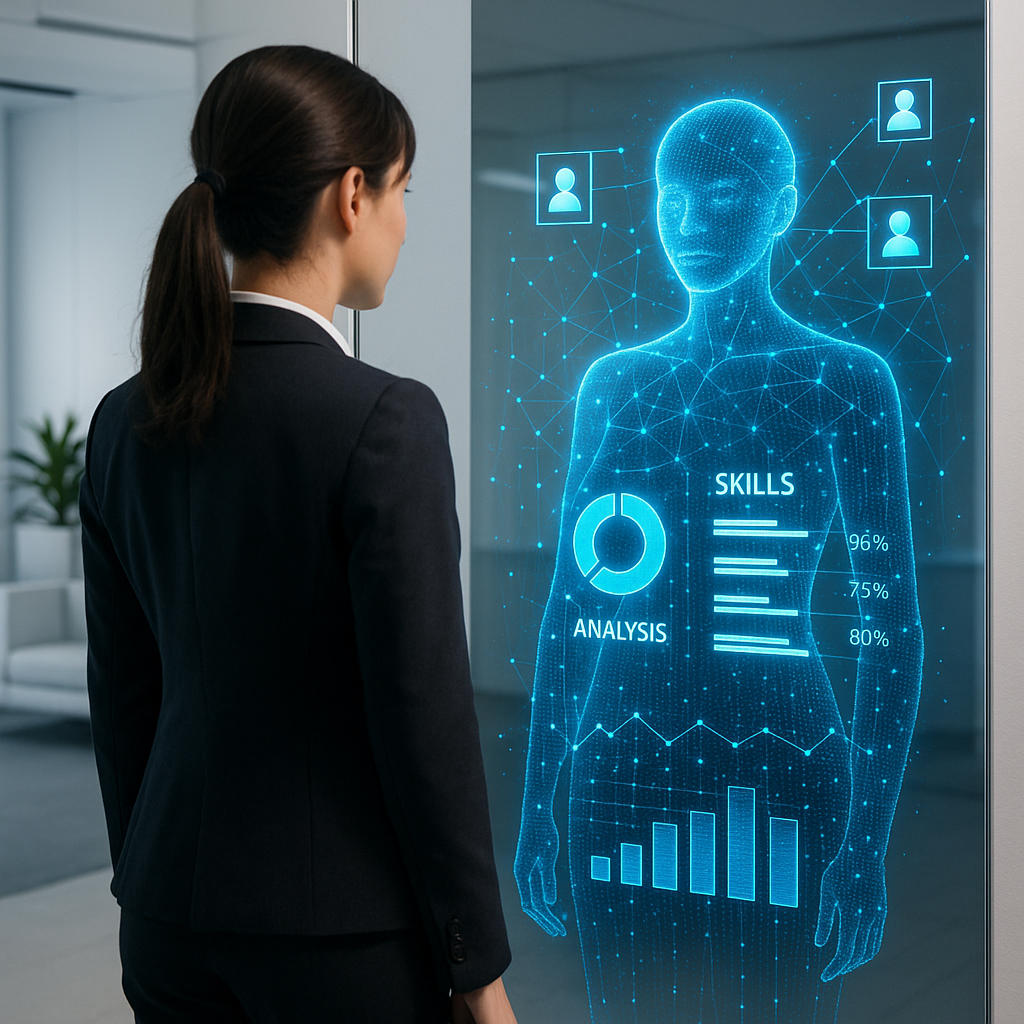
A digital twin is a virtual model of a real machine, person, or situation. It acts and reacts like its real-life counterpart, enabling the stakeholders to make data-driven decisions supported by predictive analytics. Digital twinning is gaining traction in HR, with applications in organizational planning, resource allocation, and talent development.
An employee digital twin digitally replicates a person’s skills, strengths, weaknesses, aspirations, behaviors, and potential risks, encompassing their entire career lifecycle. It continuously evolves with support from AI algorithms that aggregate data from multiple sources, including performance reviews, learning platforms, engagement surveys, skill assessments, communication patterns, and wellness metrics.
Let’s consider a real-world example.
Marty is a mid-level marketing strategist. As per the data integrated by his digital twin, Marty is strong in campaign management, has completed digital analytics courses, shows interest in leadership positions, and is high in engagement, but with recent instances of stress.
When the company is considering Marty for a senior position, the digital twin simulates whether he can thrive in the new role or if he risks burnout. Marty’s digital twin predicts that he would be a good fit for the role but recommends stress management support.
Role Of Digital Twinning In the Hire-to-Retire Lifecycle
The hire-to-retire (HTR) lifecycle refers to the employee journey mapping in an organization from their recruitment to retirement (or exit). It includes,
- Hiring
- Onboarding
- Development (training and upskilling)
- Engagement (maintaining motivation and satisfaction)
- Career progression
- Retention
- Offboarding
Traditionally, HR maintained these in silos; however, digital twinning of employees (DToE) revolutionizes this approach with continuous and personalized support. Each employee receives a tailored career path based on their skills, past work experiences, and aspirations.
DToE ensures a seamless transition from one stage of the HTR lifecycle to the next as the system continuously upgrades with the latest employee data. This ongoing evolution ensures better talent management strategies.
Traditional Lifecycle Management vs. Digital Twinning
| Aspect | Traditional Hire-to-Retire Lifecycle | Digital Twin–Enabled Lifecycle |
| Data approach | Occasionally updated and fragmented data across various sources, such as ATS and HRIS | Data collected in real time and stored in a single source with clear visibility |
| Decision-making | Reactive, based on past performance and manager judgment | Predictive with data-driven insights |
| Employee development | Generic learning programs and fixed career paths | Personalized learning and dynamic career paths, designed using data |
| Performance tracking | Annual reviews; subjective assessments | Ongoing insights from behavioral and performance patterns |
| Employee retention | Issues addressed after they occur (burnout, disengagement, resignations) | Pre-emptive interventions through engagement, workload, and behavior signals |
Digital Twinning Across The Employee Lifecycle
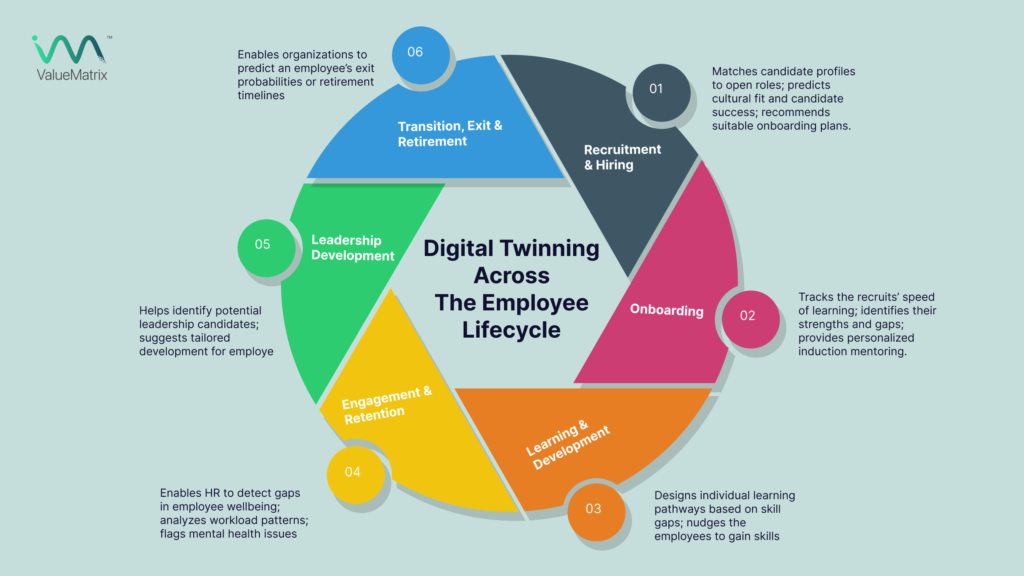
This simulation creates an ever-evolving AI persona of each employee in an organization to provide real-time insights and personalized interventions.
Recruitment and hiring
Digital twinning enables HR to match candidate profiles to open roles and shortlist the most suitable aspirants based on their skills, potential, and early behavioral indicators. By analyzing historical hiring data and past performances of various candidates, it predicts the cultural fit of a candidate and recommends suitable onboarding plans.
Outcome: More accurate hiring decisions and a reduction in early attrition.
Onboarding
During the onboarding stage, the DToE tracks the recruits’ speed of learning, adaptation, and early engagement. It identifies their strengths and gaps to provide personalized induction mentoring.
Outcome: Faster time-to-productivity through targeted training.
Learning & development
The twin designs individual learning pathways based on skill gaps, learning patterns, and career aspirations of an employee. It nudges them to gain the future skills needed for their growth. Moreover, managers can get visibility into workload distribution, burnout risks, and optimal team composition via the simulation models.
Outcome: A growth trajectory aligned to employee aspirations and organizational needs.
Engagement & retention
Digital twinning enables HR to detect gaps in employee well-being. Analyses of workload patterns can flag mental health issues such as burnout and disengagement, leading to high attrition. HR can act early by implementing personalized retention strategies.
Outcome: Higher retention and proactive HR action before problems escalate.
Leadership development and succession planning
Through DToE, organizations can identify potential leadership candidates early and prepare them to take up higher roles when the need arises. They can design tailored development programs for employees targeting their areas of improvement. During succession planning, organizations can make more informed decisions using historical data and predictive analytics.
Outcome: Diverse leadership pipelines that reduce dependency on external hiring.
Transition, exit & retirement
Organizations can predict an employee’s exit probabilities or retirement timelines using their digital twin. They can plan a timely knowledge transfer and a smooth transition, while making the exit experience as pleasant as possible for the employee.
Outcome: Smoother transitions and better organizational continuity.
Organizational Benefits Of Digital Twinning In HR
DToE supports HR digital transformation through a predictive, personalized, insight-driven approach – empowering employees while remaining cost-effective for organizations.
Accuracy in decision-making
Digital twins eliminate guesswork by providing data-driven insights. Organizations can make informed choices about promotions, team assignments, and employee development plans based on real-time information rather than yearly or half-yearly performance review data.
Proactive talent retention
By continuously monitoring engagement levels, workload stress, and career satisfaction indicators, digital twins identify flight risks before employees actively consider leaving. This early warning system allows HR to intervene with targeted retention strategies, whether through career development opportunities, workload adjustments, or personalized recognition.
Personalized employee experience
An individualized approach to employee development, benefits, and work arrangements ensures a sense of belonging among the employees. Instead of one-size-fits-all programs, employees receive learning recommendations, wellness initiatives, and career pathways tailored to their unique profiles, preferences, and goals, significantly enhancing engagement and satisfaction.
Optimized workforce planning
Simulation capabilities allow organizations to model various scenarios—restructuring, succession planning, skill shortages—before making changes. This reduces the risk of costly missteps and ensures workforce strategies align with both current capabilities and future business needs.
Continuous skill development
Real-time skill assessment ensures employees know their true capabilities and the need for skill enhancement. It helps them take steps towards reaching their career goals. This supports organizations by aligning their future succession framework with employees’ career needs.
Improved operational efficiency
Automation of routine tracking, analysis, and reporting allows HR professionals to focus on strategic initiatives and human-centered activities that require empathy and judgment.
Challenges and Considerations With DToE
In the near future, digital twinning is going to become an inevitable part of the employee lifecycle as organizations experience its benefits. However, like any technological innovation, DToE comes with challenges that require attention.
Data privacy and employee consent
Organizations will have to collect large volumes of data about employees. Information on their skills, behavior patterns, performance, productivity, and other parameters will be needed to create their digital twins. This means organizations must be transparent about the data they collect and adhere to privacy laws. Employees need to know the extent of data collection and usage; clear consent from them is a prerequisite to moving ahead with digitization.
Data security and confidentiality
The greater the volume of data, the higher the security burden for the organization. Sensitive employee information may attract cyberattacks. There is a potential risk of exposing personal information. Unauthorized internal access to the information can be a serious problem in the absence of strong data protection measures. Organizations can avoid data breaches by investing in cybersecurity infrastructure and access controls.
Psychological burden of surveillance
Constant monitoring of their performance and behaviors can make the employees feel probed. Surveillance can become a burden, making them conscious about every move they make and every decision they take at work. There is a risk of eroding trust as employees might fear that the data will be used punitively rather than constructively. Therefore, organizations must define boundaries for data collection – specifically, what data will never be tracked, who will have access to it, what transparency measures are being implemented, and how decisions based on digital twins will be audited.
Data quality and integration
Digital twins are as good as the quality of data collected. If the records are inconsistent or outdated, or the internal systems are not properly integrated across functions and teams, the digital twin may not accurately represent the employee. This leads to inaccurate predictions and probably wrong decisions. Organizations need to make significant investments in technological infrastructure for internal systems integration and their ongoing maintenance.
Organizations cannot shy away from embracing DToE due to these challenges, but take employees into confidence and implement a functional governance system.
Roadmap To Implement Digital Twinning
Organizations can avoid the roadblocks and make the system acceptable across the hierarchy by taking systematic steps towards its implementation.
Step 1: Define business use cases
Before investing in technology, identify its business use cases aligned with HR and organizational goals. Clarify the need for digital twinning, the existing or foreseeable problems that it can solve, and the processes that need it first. For instance, priority use cases can be skill gap mapping, predictive attrition insights, or personalized learning pathways.
Step 2: Audit and prepare HR data
One of the major challenges of digital twinning is the quality of data input into the system. Audit the existing data and prepare high-quality, connected data by mapping all the HR data sources (HRIS, ATS, LMS, PMS, engagement tools). Assess the data quality, completeness, and consistency, and establish governance and access controls to build a strong and reliable foundation.
Step 3: Adopt a skills framework
Create a skills taxonomy and map skills to roles, levels, and career paths because a digital twin is driven primarily by skills intelligence. Identify behavioral and leadership competencies required within the organization and integrate the labor-market skill trends.
Step 4: Choose the right technology platform
Select the tools needed for digital twinning, such as AI/ML models for prediction and personalization, talent intelligence platforms, and analytics and dashboarding tools. Choose a platform that offers a customized set of tools that meet your requirements. Value Matrix’s hyper-personalized technology provides accurate, data-driven insights while seamlessly integrating with existing HR systems. Its advanced algorithms mitigate unconscious bias, ensuring a fair system.
Step 5: Create a pilot digital twin prototype
Start small and controlled within a selected group (sales team, tech roles, new graduates).
Define success metrics, such as accuracy, adoption, and performance impact. Build twin profiles that include skills, behavior patterns, learning data, and performance signals, and validate predictions with managers.
Step 6: Develop governance frameworks
The framework must include policies that safeguard trust:
- Data transparency and consent guidelines
- Bias testing and auditing mechanisms
- Rules on what data will not be collected
Establish an ethical oversight committee with various stakeholders as members.
Step 7: Train managers and HR teams
Provide training on interpreting twin insights, using predictions, combining human intelligence and judgment with data, and being transparent with employees. This ensures the managers and HR are confident in using the insights correctly and responsibly.
Step 8: Build trust among employees
Help employees understand what their digital twin is, how it benefits them, what data it uses, and their rights around data and privacy. Conduct townhalls and create educational videos and FAQs. Train some employees to be change ambassadors who can ensure higher acceptance and reduced resistance.
Step 9: Scale across the organization
Once the pilot is successful, roll out to more business units. Integrate with internal learning platforms, performance systems, internal job marketplaces, and engagement tools. Once it is implemented, monitor the system regularly because DT is iterative and requires tracking for its accuracy, employee satisfaction, and business impact. This ensures continuous improvement and long-term sustainability.
Digital twinning transforms the employee lifecycle from a static model to a dynamic, predictive, and personalized experience. Employees gain from real-time visibility into their performance, future career pathways, and skills they need to reach their goals. Meanwhile, organizations benefit from better internal mobility, a diverse leadership pipeline, and employee well-being and retention. However, the system’s success depends on addressing ethical considerations through a robust governance framework.
FAQs
Traditional HR analytics provide insights based on past data, while twinning involves the creation of a virtual model that continuously evolves with new data. Unlike the traditional system that provides historical trends, digital twinning supports decision-making with predictive analytics.
Data safety depends on an organization’s access controls and governance framework. Enterprise-grade encryption, strict access controls, and regular security audits ensure data protection, building trust among employees.
Employee digital twins integrate data from multiple sources across the organization. Core systems include HRIS platforms (personal information, job history, compensation), performance management systems (reviews, goals, feedback), and learning management systems (training completions, certifications, skill assessments).
Employees receive personalized career development recommendations based on their skills, learning patterns, and aspirations rather than generic training programs. Digital twins provide visibility into skill gaps and growth opportunities, enable fairer performance evaluations by reducing bias, and facilitate internal mobility by matching employees with roles. The technology can also be used to provide mental health support in time to prevent burnout and disengagement.
About Us
ValueMatrix is an AI-powered talent intelligence platform that helps companies hire better, faster, and without bias. We go beyond resumes to assess skills, behavioral traits, and cultural fit using advanced AI and proven psychological frameworks. Our platform delivers data-driven insights that improve hiring accuracy, reduce time-to-hire, and elevate candidate quality.
ValueMatrix AI enables hiring teams to make confident hiring decisions and build high-performing teams at scale.