
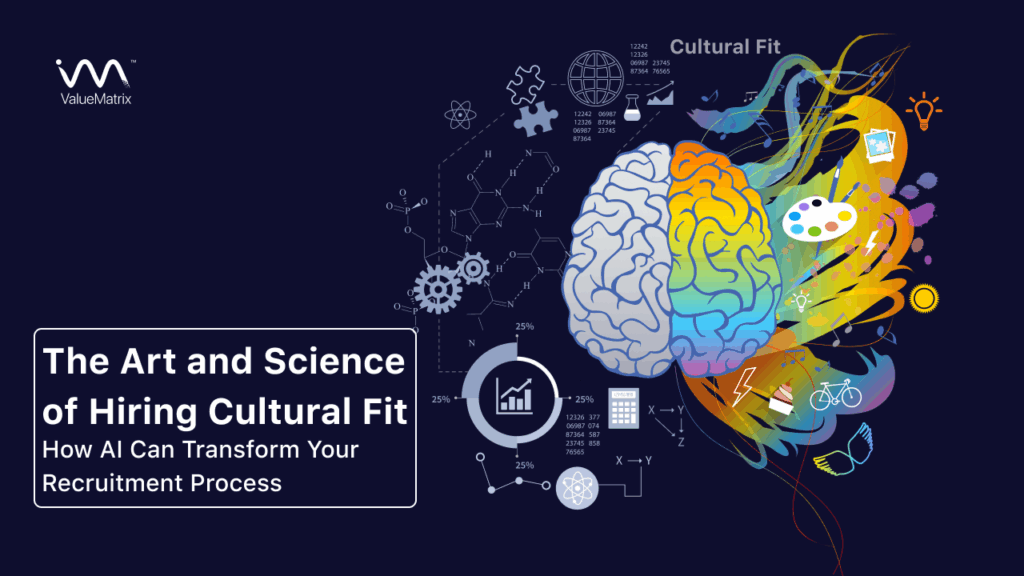
What Is Cultural Fit and is It Overrated?
Let me put a question to you first – Do you think Rishabh Pant is “culturally fit” to play the 5-day test format for the Indian cricket team?
What comes to mind when you think of it?
Culture fit, or cultural fit, is a simple idea. It asks: “Will this person mesh with our team’s values and way of working?”. It checks how well a person’s values, attitudes, and preferred work habits line up with a company’s values, norms, and ways of working.
With this definition, Pant settles right in the “culture” of the team. But what did first come to your mind when you thought of the question?
Maybe his strokeplay? Reverse sweeping fast bowlers aiming at stumps with a swinging new ball? Or his ability to take unnecessary (or unconventional) risks? You thought about the test cricket format, its history and legacy, and how he doesn’t fit the “gentleman’s game culture”
If your answer is yes, then you (including most of us) are looking at “culture” in the wrong way.
What is “culture” in a company?
Take the cricket analogy and now put it to an organization. The way people work and behave together in a company or an organization is what you call a culture. This culture shapes the common beliefs, values, and habits of people working together. It shows up in decision-making, team handling, and how people define and celebrate wins.
You can also identify culture in small things, like how your colleagues handle issues and what they expect from their peers. There’s culture in routines, the way leaders or managers lead, or how coworkers treat each other.
Simply put, it’s everywhere. The culture of a workplace is its identity – its personality. It is what separates a great company from a mediocre one.
Unpacking the Flaws of Culture-Fit
While cultural fit sounds so logical on the surface, it comes with serious problems that cannot be overlooked. First of all, the concept is vague and hard to measure. Finding the right “fit” often comes down to “my gut feels right about her” for the interviewer. Or it can be how the interviewer thinks of the company’s culture, and then places the candidate in that picture.
This is such an intuition-led process. Instead of banking on hard evidence, such a process opens the door to favoritism or personal bias.
Often (vague?) questions like “Could I be stuck in an airport with them?” or “Would I enjoy a beer with them?” (popularly known as the “Beer Test”) take the center stage. Answers to these questions dictate the decisions rather than evaluating the real professional value of the candidate.
Another key problem is that it tends to limit diversity. When companies hire people who “fit in,” they generally pick those who already act or think like the existing team. This creates sameness. It pushes out fresh voices and new ways of thinking. Slowly, teams start to look and sound the same, even when differences could make them stronger. It also opens the door to bias. Hiring becomes more about instinct than clear criteria.
Hiring only people who “fit in” will lead to everyone thinking the same way. And if everyone is thinking the same way, you will lack innovation and creativity. There will be less diversity of ideas. And most importantly, there will be little room for constructive conflict.
While having a bunch of people with a similar working mindset is good for a comfort zone, it doesn’t lead to a productive environment in the long run. Even worse, if the current culture is toxic, hiring the “culturally fit” players will only spread the dysfunction.
At the same time, there’s a risk that cultural fit can drive away members who can transform the company’s way of working or even challenge the existing structure. You may end up rejecting strong candidates just because they don’t fit the current bill. You are blocking the entry of unconventional thinking (shout out to Rishabh Pant hitting reverse sweep to James Anderson), which might just unlock growth for your company.
The Evidence Gap for Cultural Fit
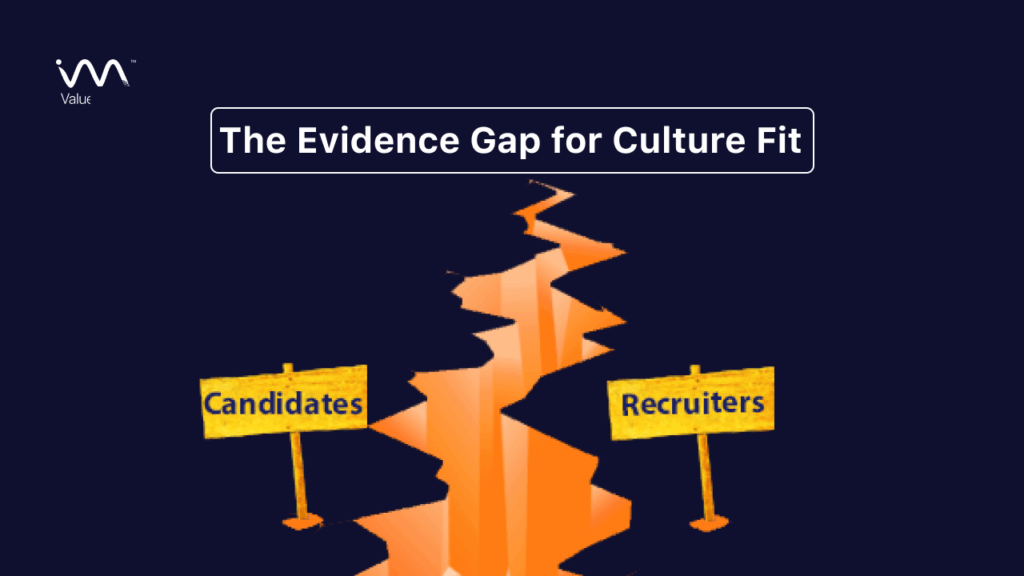
Let’s just talk about the data on its impact on job performance and engagement.
Academic literature on cultural fit questions the validity and predictive power of the concept. Decades of research in Industrial-Organizational Psychology consistently find that general mental ability (IQ scores) and the trait conscientiousness explain a much greater share of performance variance (about 20-30%) than cultural fit, which is not typically tested at that level.
There is also a chance of it becoming a self-fulfilling prophecy. Cultural fit assessments are inherently subjective and do not measure the quality of the hire. They are easy to trick and fall prey to socially desirable answers from the candidates. They appear to influence performance, but mostly because those perceived as a “fit” get favourable reviews, which reinforces a loop that looks like predictive validity but isn’t.
There is little solid evidence tying culture fit to long-term engagement, too. In fact, the literature suggests work engagement is far more strongly influenced by the job compensation, job meaningfulness, managerial support (leadership), and personal traits – not just alignment with vague cultural traits.
Rethinking Cultural Fit: Better Alternatives for Hiring
1. Cultural Add
A great alternative to cultural fit is cultural add. This flips the old idea on its head. Instead of asking “Will this person fit in?”, companies ask “What will this person add that we don’t already have?” It’s about bringing people who bring new perspectives, skills, or lived experiences to the table. This might mean hiring from a different industry, someone who challenges group norms, or someone who offers a fresh way of thinking. Cultural add recognizes that difference isn’t a problem – it’s an opportunity. It helps in making more creative, resilient teams and prevents groupthink.
2. Values Fit
Another valuable concept that can be used is values fit. Bringing in diverse viewpoints is crucial, but without any common ground to unite teammates, you can end up with a lot of division and inclusion challenges. Shifting focus from “culture fit” to ‘values alignment’ helps you to hire people who share your goals, not necessarily your backgrounds or viewpoints. Instead of asking whether someone acts like the rest of the team, it asks: Do they believe in the same things?
Focus on deeper principles – what they really care about. Look at their ability to innovate, their honesty, or their ability to take charge of a social cause. For instance, if your company values sustainability, you should hire people who care about the environment, even if their views on sustainability differ from yours. A difference of opinion shouldn’t be an evaluation criterion for a team working towards a common goal.
To measure values fit, you need to ask specific, deliberate, and consistent interview questions (the same ones, in the same order, for every candidate) designed to speak to each of your core values. Then, each interviewer should be trained to evaluate a good, not-so-good, or just OK answer for every question objectively.
Values fit thus help build teams that are united by purpose, not just personality.
3. Role Fit and Potential
A third, evidence-based option is hiring for role fit and potential. This is more about performance than personality. It includes the use of structured interviews, scenario-based tests, and job-specific tasks. Let’s take a classic (cliché) example: your hiring manager should be asking the sales candidate to “sell a pen” rather than “tell me about yourself”. Performance over personality.
Such interactions will give your interviewer a better picture of the candidate’s abilities. It will also reduce the role of bias or first impressions, which often cloud decisions in unstructured interviews.
Role fit also includes assessing the candidate’s motivation. Why is the person interested in taking this job, and what is their idea of growing into the role? These answers look for potential, not experience.
4. Behavioural Flexibility
Another growing focus is on behavioural flexibility. Today’s workplaces change fast. Roles evolve. Teams shift. New tools, new clients, and global challenges are the norm. So, you must hire someone who can quickly adapt.
A candidate with behavioural flexibility is well-versed in taking feedback and collaborating with a wide range of colleagues and teams. You can measure this through situational tests that need emotional as well as cognitive flexibility. You can also assess this by measuring personality traits such as how open they are to a new experience and neuroticism (from the Big 5 Factor Model)
Such assessments are far from perfect. But it’s all about the willingness to change and learn when asked for. A candidate who can learn quickly, aces at handling uncertainty, and can communicate across teams and cultures screams long-term backing than someone who just “fits” the culture.
And when hired in such fashion, the recruits also tend to be more inclusive. When you focus on skills, values, and abilities instead of surface-fit, you open the door to a broader candidate range. This benefits not only underrepresented groups but also the company itself. Diverse teams solve problems better. They reflect the real world more closely. They also help companies build products and services that work for more people.
In a candid conversation with ValueMatrix, Shobana Kailash, senior HR Leader and consultant at Benevolve opines:
that hiring has evolved from rapid scaling to intentional, thoughtful selection prioritizing exponential talent over role-fillers—assessing ambiguity navigation, soft skills as core infrastructure, and culture addition beyond JDs. Success profiles, powered by AI insights, define role success through competencies, values, and culture—elevating hires that outperform 50% of current teams.
Redefining Cultural Fit with AI
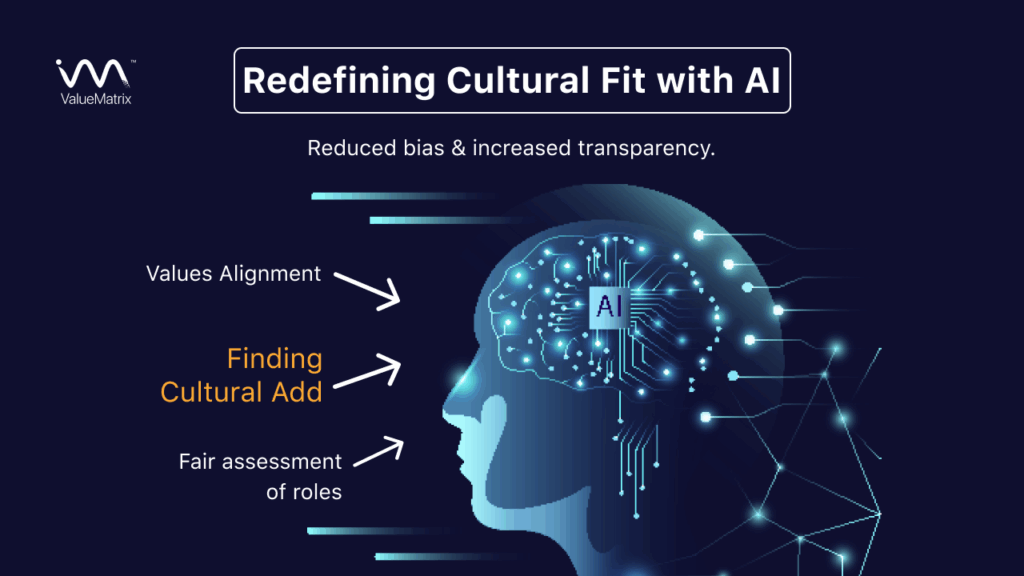
In practice, bringing alternatives and transforming “cultural fit” takes vision and conscious effort from the CHROs. It requires methods to identify core values in candidates, a commitment towards diversity, innovation, and more valid testing tools. But the payoff is worth it. Hiring becomes more strategic and objective. Teams become stronger and adaptable. And companies grow not just in size, but in depth and direction.
This is where AI can be a game-changer, helping us redefine this journey with modern hiring tools.
1. From Culture Fit to Values Alignment
One of the biggest shifts AI can support is moving from “culture fit” to values alignment. Instead of asking “Does this person act like us?”, the question becomes, “Do they care about what we care about?”
AI can help by analysing the language candidates use in applications, assessments, and interviews. Natural Language Processing (NLP) tools can pick up on patterns in how people talk about work, leadership, and collaboration. These patterns can be compared with a company’s stated values. Let’s say, if you value transparency, then candidates who show a preference for open communication and accountability might score higher on alignment.
AI doesn’t reward sameness. It allows different styles and voices, as long as they match the mission. It also gives hiring teams more structured insights than just a gut feeling in an interview.
2. Finding “Cultural Add” with AI
Hiring for “cultural add” means looking for what a candidate can bring, not how well they blend in. This can be hard to do manually. You need to spot gaps in the present team and identify candidates who can fill them in useful ways.
AI can scan current team profiles and look for patterns – education, experience, personality traits, or problem-solving styles. Then, it can identify candidates who bring something different but complementary. For example, a team made of analytical thinkers might benefit from someone more creative. Or a team used to fast decision-making might grow with someone who slows things down and asks tough questions.
AI can surface these insights through clustering techniques or diversity mapping tools. These aren’t just about demographic diversity, but also cognitive and experiential diversity. The goal is to build stronger, more balanced teams – not just comfortable ones.
3. Assessing Role Fit More Fairly
Traditional hiring often rewards people who “interview well” or have polished resumes. But this leaves out a lot of great candidates. AI can help you level the playing field by using skills-based assessments and simulations that mirror real-life tasks. It can create coding tests, writing samples, or situational judgment questions. AI can score these in real time, flag patterns, and even give feedback to hiring managers. This reduces reliance on biased signals like college names or previous job titles.
AI can also track learning agility – a person’s ability to pick up new skills or solve novel problems. This is often more valuable than experience alone, especially in fast-changing industries. Tools that track how a candidate reasons through new information or adapts to feedback can offer stronger predictions of success.
4. Behavioural and Team Compatibility
Another way AI is reshaping hiring is through behavioural fit, not just cultural fit. Behavioural fit looks at how someone works, rather than whether they “act like us.”
Using data from personality inventories, work simulations, and past behaviour, AI can give you a picture of how a person communicates, handles stress, or collaborates. This can then be matched with team dynamics. Let’s say a team lacks a steady, organised thinker; AI can identify people with those traits.
This isn’t about stereotyping people into boxes. It’s about creating well-rounded teams based on data. AI can even offer “team chemistry” tools that predict how different people might work together – something that’s hard to judge in a short interview.
5. Reducing Bias and Increasing Transparency
One of the promises of AI is that it can reduce human bias. But this only works if the systems are trained carefully. AI must be trained on inclusive data and regularly audited. Otherwise, it can repeat the same problems it’s meant to fix.
When you train the system correctly, AI will identify patterns that you ignored previously or missed completely. Let’s say if your hiring manager favors more outspoken candidates, AI will suggest equally skilled candidates who may not be as outspoken. The result: your talent pool expands, and it challenges the inherent bias positively.
Some AI tools now provide you with proper explanations. They give out logical reasoning behind a certain choice or a rejection. This output provides a perfect pitch for recruiters to understand candidates better. More importantly, it adds transparency. The process is driven by logic and trust. Not by gut feelings and whims.
6. Creating a Better Candidate Experience
AI also changes the experience for the candidate. Smart chatbots can guide people through the application. Instant feedback tools can give them updates and help them understand their strengths. Candidates no longer feel ghosted or judged by vague standards.
AI can also personalize assessments. For example, a candidate applying for a product role might be asked to complete a design task, while another applying for a customer role might get a service simulation. This creates a more relevant and engaging process.
And because AI can handle large volumes of applicants, companies don’t have to rely on first impressions or time constraints to make decisions. More people get a fair shot.
Conclusion
To conclude, defining cultural fit is not as easy as it sounds. It’s a vague and often subjective concept – shaped by personal bias, gut feeling, and loosely defined traits. This makes it hard to measure fairly and even harder to apply consistently. The result is a hiring practice that often excludes rather than includes. It favours similarity over diversity and comfort over competence. Worse, research shows that cultural fit has limited predictive power when it comes to actual job performance or engagement.
The good news is that we don’t have to keep using flawed tools. Alternatives to cultural fit offer more inclusive, reliable, and future-ready ways to build teams. And AI plays a crucial role in this shift. It won’t solve everything, but rather reflect our biases if not designed with care. It shouldn’t replace human judgment, but it can support it.
When used ethically, AI can help assess candidates more fairly, reduce bias, and surface hidden potential. It can move hiring away from guesswork and toward data-driven, human-centred decisions. In doing so, it doesn’t just replace culture fit; it redefines it. With AI, hiring can transform from “Who fits in?” to “Who can make us fit?”
FAQs
01. How do we make sure AI doesn’t confuse “similarity” with “fit”?
You do this by programming AI to prioritize diversity of perspective and experience as positives, not negatives. Define “fit” in terms of shared values and job-relevant behaviors – not personality clones. AI must be trained on the data of successful hires who come from different backgrounds and styles of work.
02. How do we know whether AI is reducing the biases rather than reinforcing them?
Bias reduction starts with training AI on representative and diverse data and auditing it regularly. AI can flag patterns human recruiters might overlook, like consistently favouring one personality type. It can also present anonymized candidate profiles that remove details like gender or institute names to keep the focus on skills and values.
03. How do we know if our AI hiring tool is giving us the right fit?
Track these metrics over time: quality-of-hire, retention rates, and diversity statistics for hires identified as high matches by AI. Compare these against previous hiring methods. Regularly audit the system for bias and accuracy, and adjust accordingly
04. Will focusing on the new, transformed cultural fit metrics slow down hiring?
No, a well-designed process can take care of it. AI can speed up the screening process by identifying candidates with new perspectives and adaptability. Pre-hire assessments can run automatically and in parallel with other steps, reducing time-to-hire while still improving quality.
05. Should we replace interviews entirely with AI-driven assessments?
No. AI cannot and should not replace human evaluation. It is best used as a decision-supporting tool. It can improve objectivity, surface hidden talent, and handle larger datasets, but human judgment ensures context, empathy, and nuance in hiring decisions.