

Key Takeaways
- A talent marketplace is a digital pool of skilled professionals.
- A marketplace can be external (third party) or internal (within a company).
- Talent marketplaces provide employers with access to global talent.
- Employees get to work in a flexible environment on multiple projects.
- AI talent marketplaces use predictive analytics and algorithms to match skills with requirements.
What Is A Talent Marketplace?
A talent marketplace is a digital platform that meets the demand for skilled people by providing a talent pool. It serves as an intermediary between the workforce and employers, benefiting both parties.
A marketplace is akin to an e-commerce platform where buyers can shop for products from various sellers, but here, organizations/employers select professionals for a project, gig, or contract. They are gaining importance among organizations for their ease in hiring the right talent, without the process of job posting, screening, and interviewing candidates. For employees, it provides a platform to showcase their experience and skills through their profiles and portfolios.
Talent marketplaces can be both external and internal. An external marketplace, such as Upwork or Fiverr, connects freelancers with organizations globally. Large companies have an internal talent marketplace that offers employees an opportunity to work on short gigs or projects within the organization.
What Are The Types Of Talent Marketplace?
Talent marketplaces are mainly of two types: internal and external. Internal marketplaces are typically created within big organizations to tap the talent from across teams. External marketplaces are third-party aggregators, where professionals share their work profiles and portfolios. The following table shows various types with their specific use cases.
| Type of Talent Marketplace | What It Is | Typical Use Cases |
| Internal | Matches existing employees to internal roles, projects, gigs, or stretch assignments based on skills. | Internal mobility, reskilling, project staffing, and leadership development. |
| External | Provides a pool of professionals with specialized skills from outside the organization. | Temporary hiring needs, non-repetitive projects. |
| Project-based | Focuses on short-term requirements rather than permanent roles. | Innovative projects, non-repetitive tasks. |
| Specialist/niche | Provides access to professionals from a specific niche/ skillsets. | Projects requiring specialized expertise. |
| On-demand | Meets workforce demand for short-term or urgent tasks. | Simple tasks; local services. |
| AI talent marketplace | Platforms such as ValueMatrix, which use machine learning to do intelligent matching of internal resources. | Companies focused on tech; data-driven hiring. |
| Vertical industry platforms | Offers deep talent in a specific industry, such as construction, healthcare, and legal. | Specialized requirements in a given industry. |
What Are The Benefits Of Talent Marketplaces?
For employers, it’s easier to hire specialists with rare skills, who are only temporarily needed for a specific project or task. Meanwhile, for professionals, marketplaces offer flexibility to work with any global organization at a time of their choice.
According to Business Research Insights, the talent marketplace platforms are growing rapidly due to demand for skilled professionals and the expanding gig economy. A flexible work environment makes it attractive for young professionals. From USD 1.16bn in 2026, the global talent marketplace market is expected to reach USD 1.83bn by 2035, with a projected CAGR of 10.5%.
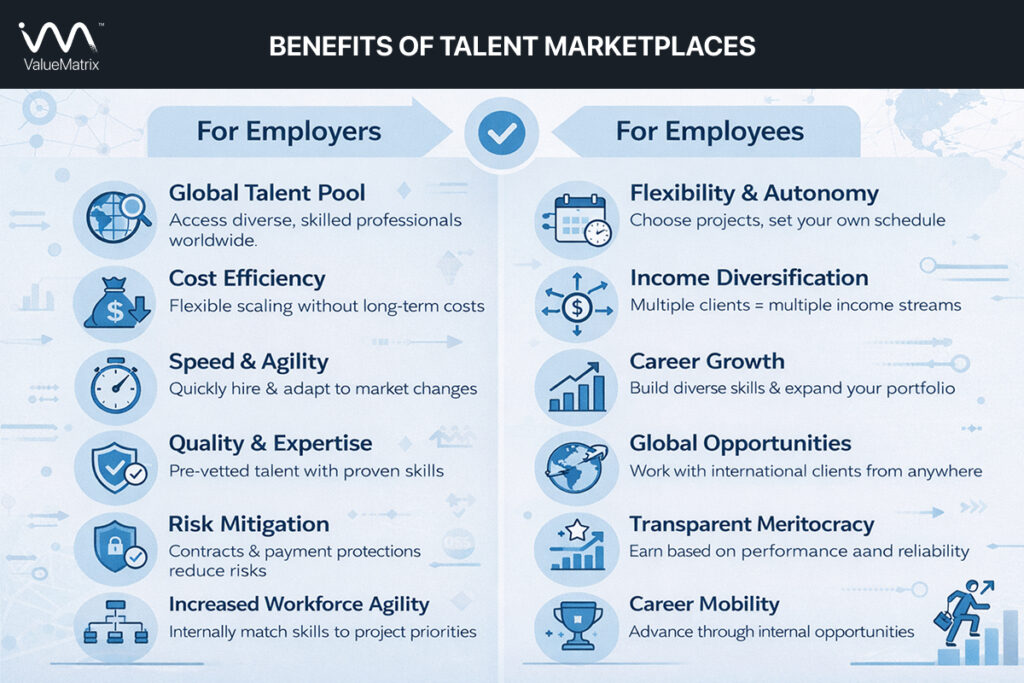
For Employers
Access to a global talent pool: Organizations can hire professionals from across the globe to suit the niche requirements. They can employ workers from regions with low labor costs and yet maintain quality. Moreover, people working from different time zones can ensure 24/7 operations in rotations.
Cost efficiency: Marketplace hiring enables flexible scaling without long-term commitments. Organizations can reduce their recruitment costs and overhead expenses as they pay only for the work delivered. It saves overhead costs, including statutory and other employee benefits, onboarding investments, and office space.
Speed and agility: Hiring timelines come down from weeks to days. Managers can quickly assemble teams, reducing the time gap between projects. Internal marketplaces give organizations greater flexibility to move employees from one project to another. This helps in a better response to market changes.
Risk mitigation: Hiring from multiple marketplaces from different regions cushions organizations from market fluctuations in a region. It reduces the risk of depending on a single talent pool and project failures, as candidates can be sourced from multiple pools.
Increased workforce agility: In an internal marketplace, existing employees can be moved based on project priorities, enabling them to meet tight timelines with quicker responses.
Stronger engagement: Transparent access to opportunities within an internal marketplace improves employee trust, motivation, and engagement – the attributes necessary for any company to ensure a smooth workflow and reduce employee turnover.
For Employees
Flexibility and autonomy: Candidates can draw their own work schedule and choose projects that meet their financial and professional standards. This is especially suitable for Gen Z workers who are eager to explore various options instead of restricting themselves to a fixed job. They have the freedom to take breaks in their career and accept a new gig when needed.
Income diversification: Individuals can utilize their secondary skills to open an additional stream of income. Continuous participation in stretch projects increases the potential to earn a higher income in the long run. Diversified income sources indemnify them from market changes and economic uncertainty.
Career growth: Employees get a wider exposure by working across the organization. It increases their adaptability to new tasks, increasing their employability. Practical learning and continuous feedback help build a strong portfolio, paving the way for faster career progression.
Global opportunities: As organizations tap international talent pools, skilled professionals can get opportunities from across the globe. They can be a part of professional networks and work internationally while residing in a location of their choice and convenience.
Meritocracy: Employees get equal opportunities to progress, as hiring from talent marketplaces is usually transparent. Standardized selection protocols provide a level playing field across regions and projects.
Personalized career development: Individuals can draw their own career plan and work independently towards their goals. By building strong portfolios, they can have a faster role progression within the organization.
See how ValueMatrix supports intelligent talent mobility in your organization. Request a demo.
What Are The Key Use Cases Of A Talent Marketplace?
A talent marketplace is useful when companies want to hire for projects with a limited scope and time. They can also be tapped for seasonal employment or for specialized skills. The following are the most common use cases.
Project-based work
Organizations use talent marketplaces for projects that run for a limited time with a defined purpose. Talent needs may change at different stages of work. For instance, in a construction project, different professionals are needed for project design, legal compliance, planning, and construction. Marketplaces enable project owners to do precise skill matching at each stage.
Seasonal and peak demand
Retail businesses, such as apparel stores or bakeries, experience peak demand during the festive season, when they need additional hands to attend to their customers. Similarly, travel businesses need more agents during the holiday period. Such a seasonal spike in requirement can be met through the marketplaces.
Specialized expertise
Talent platforms supply experts, such as AI/ML specialists, legal experts, data scientists, and cloud architects, whom companies need periodically. Organizations may not need them on their permanent payroll due to the nature of their work, but they are inevitable for niche tasks.
Temporary filling
Temporary vacancies arising due to maternity/ paternity leaves, medical emergencies, or unplanned long leaves can be filled using internal or external talent pools. This ensures continuity of work during exigencies.
Internal talent optimization
Large companies maintain internal talent pools to provide employees with additional opportunities within the organization. This enables talent retention by providing new learning and additional earning opportunities to employees. Organizations can make better use of internal talent with AI. AI platforms like ValueMatrix support cross-functional talent match through predictive analytics and skill-based recommendations.
Cost-constrained operations
Marketplaces supply highly skilled professionals to startups and small businesses, which, otherwise, cannot afford them due to limited budgets. They can hire experienced professionals as consultants and utilize their services for as long as needed. This gives them scope to compete with bigger companies in their niche.
What Are Challenges Of A Talent Marketplace?
Employees sourced from marketplaces are temporary in nature. They do not get enough time to adjust to the team culture, posing a risk of poor communication and coordination. Additionally, the freelance workforce raises security concerns.
Trust and security concerns
Organizations may face data privacy and confidentiality risks from the temporary workforce. Short-term employment may not provide sufficient scope to build trust, thereby increasing challenges to intellectual property protection and security vulnerabilities.
Quality control and vetting
Though the talent platforms vet candidates, verification of their skills and credentials may not be accurate. Similarly, ratings from past employers may or may not be relevant because of dissimilarities in work. Marketplaces are not an option when companies plan mass hiring, as it may not be possible to ensure quality at scale.
Communication barriers
Misalignment of the internal and external workforce can result in poor communication. Varied time zones, cultures, and languages might complicate it further. The managers may feel the burden of coordination among team members, escalating feedback, and iteration challenges.
Legal and compliance issues
Hiring professionals from different countries will necessitate companies to comply with varying labor and tax laws. They may face contract enforcement difficulties and regulatory compliance in specialized industries.
Integration and workflow challenges
Integrating external talent with internal teams presents significant workflow challenges. A mismatch in the use of technologies will require additional training. Knowledge transfer may be incomplete when hires from an external marketplace exit. Moreover, short-term internal projects by team members may affect the timelines of their parent project.
Dependency and business continuity risks
One significant challenge of hiring from marketplaces is talent retention. Over-reliance on specific freelancers or external talent can affect a project when they discontinue on short notice. Moreover, the availability of niche talent can become a problem, particularly in experimental projects.
The successful use of a talent marketplace relies on overcoming challenges and planning around its limitations. This is possible with a robust implementation plan, with different approaches for internal and external marketplaces.
How To Build A Successful Internal Talent Marketplace?
Organizations can build an internal marketplace by securing executive and employee participation. Managers must see its value, while employees must see growth opportunities. For this to happen, HR must follow a systematic approach.
Secure executive buy-in
Involvement of the leadership is crucial for the success of an internal marketplace. HR must draw a roadmap aligning the initiative with organizational goals. They can plan a realistic budget and demonstrate RoI through a pilot program.
Choose the right AI platform
Choose a platform like ValueMatrix that integrates with existing HR systems (HRIS, LMS, performance management) and has a mobile-friendly interface. It comes with automated skill matching and predictive analytics.
Create a skills taxonomy
Develop a standardized taxonomy of technical, soft, and leadership skills of the existing employees. Link them to roles, projects, and career paths and provide scope for emerging skills and continuous updates.
Design a clear governance policy
A systematic approach to building the marketplace will encourage stakeholder participation. Governance policy will make the initiative transparent. Define eligibility criteria for participation, establish guidelines for working on stretch projects, create manager approval workflows, and set performance expectations.
Build manager buy-in
Manager support is integral for the success of the initiative. Take them into confidence, clear their concerns about temporarily losing team members, and demonstrate the benefits of a marketplace. Incorporate their feedback in establishing protocols.
An internal marketplace can flourish when complemented by training and skill development programs for employees. HR must be instrumental in fostering a culture of continuous development and awareness. Most significantly, these gig contributions need to be integrated into the rewards and recognition programs through weighted evaluation.
Planning to build an internal talent marketplace for your organization? ValueMatrix makes it easy. Request a demo.
Talent marketplaces can be an effective alternative to regular employment for organizations. They also provide flexibility and freedom for professionals to select their assignments. However, they pose a few challenges, which can be addressed through a strong implementation roadmap. Before leveraging a marketplace, HR leaders must assess organizational needs and ensure alignment with broader goals.
ValueMatrix powers intelligent talent mobility for high-performing teams. Book a demo to know more.
FAQs
- How are talent marketplaces useful for different organizations?
Talent marketplaces are suitable for organizations of different sizes. Large companies create internal talent pools for the quick assembling of teams and offering diverse career opportunities to employees. Startups can scale operations or meet temporary skill needs without straining their budgets. Mid-size companies can build and dismantle teams by employing talent from marketplaces.
- How does a talent marketplace work?
Professionals create profiles with details such as their qualifications, skills, and experience. When employers post role requirements, the platform recommends suitable candidates using algorithms. The platform also alerts professionals to relevant opportunities that align with their skills and interests.
- How is an internal marketplace different from external marketplaces?
Internal marketplaces leverage talent within the organizations for cross-functional projects. Here, employees can work on multiple projects within the company to enhance their skills and growth opportunities. On the other hand, external marketplaces are independent platforms not aligned with a single company. They provide access to professionals from across geographies.
- Do internal talent marketplaces enhance employee engagement and retention?
Yes, internal marketplaces enable organizations to engage their employees with multiple projects. The opportunity to work on new projects helps them meet their career goals and contributes to retention. Employees can grow within the organization, learn new skills, and supplement their income through internal projects.
- What is the role of AI in a talent marketplace?
AI supports recruiters with predictive analytics and skill-matching insights. It enables them to select suitable candidates from a vast pool of talent.
- What are the precautions to take when using an external marketplace?
Research the platform’s reputation, pricing model, and compare the costs with similar platforms. Before shortlisting the candidates, check their ratings and reviews from past employers. Once they are selected, provide them with comprehensive documentation and training to quickly bring them on board.
- Are talent marketplaces unbiased?
Transparent practices with a strong governance policy keep marketplaces fair. AI-powered talent marketplaces can mitigate biases as they are data-driven. Regular audits and human oversight help them stay unbiased.
- How do talent marketplaces ensure quality control?
Talent marketplaces screen the candidates, assess skills, and verify their portfolios and credentials. However, employers should conduct their own due diligence before hiring from the pool.
- Are talent marketplaces suitable for confidential projects?
Talent marketplaces can be suitable for confidential projects, but companies must put in additional levels of security, such as access control and NDAs. Internal marketplaces are more reliable and secure than external.
10. What role do talent marketplaces play in the future of work?
Talent marketplaces will play a unifying role in the future when work becomes more modular, with a blend of employees, freelancers, and gig workers. They will drive continuous upskilling, thereby aligning the workforce with evolving industry demands.