

Key takeaways
- Employee engagement remains under pressure worldwide. Gallup reports global engagement fell to 21% in 2024, and disengagement cost the world economy $438 billion in lost productivity that year.
- Highly engaged teams outperform low-engagement teams on hard outcomes, including 18% higher productivity, 23% higher profitability, up to 81% lower absenteeism, and lower turnover.
- Managers are the biggest lever in the system. Gallup says managers account for 70% of the variance in team-level engagement.
- Performance metrics work best when they are used for clarity, coaching, and recognition, not surveillance or punishment.
- The real advantage comes from linking business metrics with people signals such as eNPS, pulse feedback, and movement risk, so leaders can act early instead of reacting late.
Why engagement is a performance strategy, not an HR nice‑to‑have?
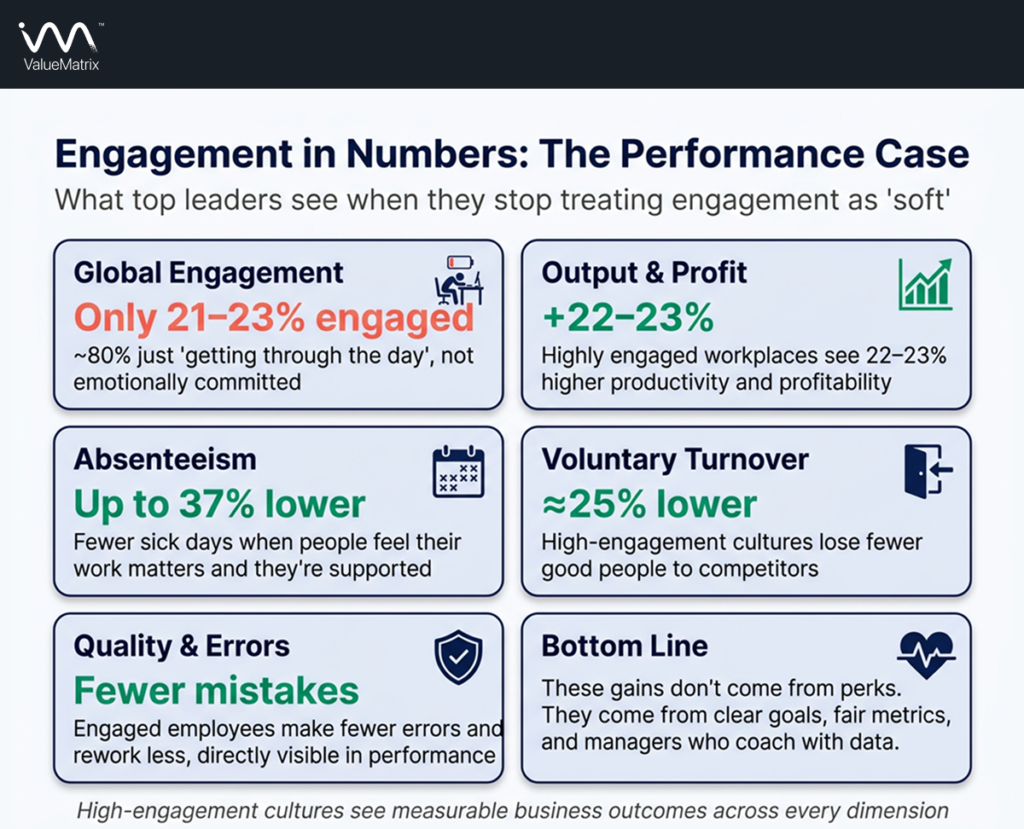
Global engagement levels are still worryingly low. The Gallup State of the Global Workplace report shows that worldwide employee engagement ranges from 21 to 23 percent, depending on the specific year, which means that about 80 percent of workers only perform their tasks without any real commitment. The problem of disengagement extends beyond a simple mood issue because it creates financial challenges for organizations.
Multiple large‑scale studies link high engagement to hard business outcomes. Organizations with highly engaged employees see about 22–23% higher productivity and profitability, up to 37% lower absenteeism, and around 18% lower turnover in high-turnover industries and up to 43% lower in low-turnover organisations. Those gains don’t come from free snacks; they come from employees knowing what good performance looks like and feeling supported to get there.
The interesting shift in the last decade is this: top companies no longer look at performance metrics only after the fact. They design metrics that shape behaviour, coach managers on how to use the data in conversations, and tie those metrics tightly to meaning, growth, and recognition.
What are the core performance metrics that actually drive employee engagement?
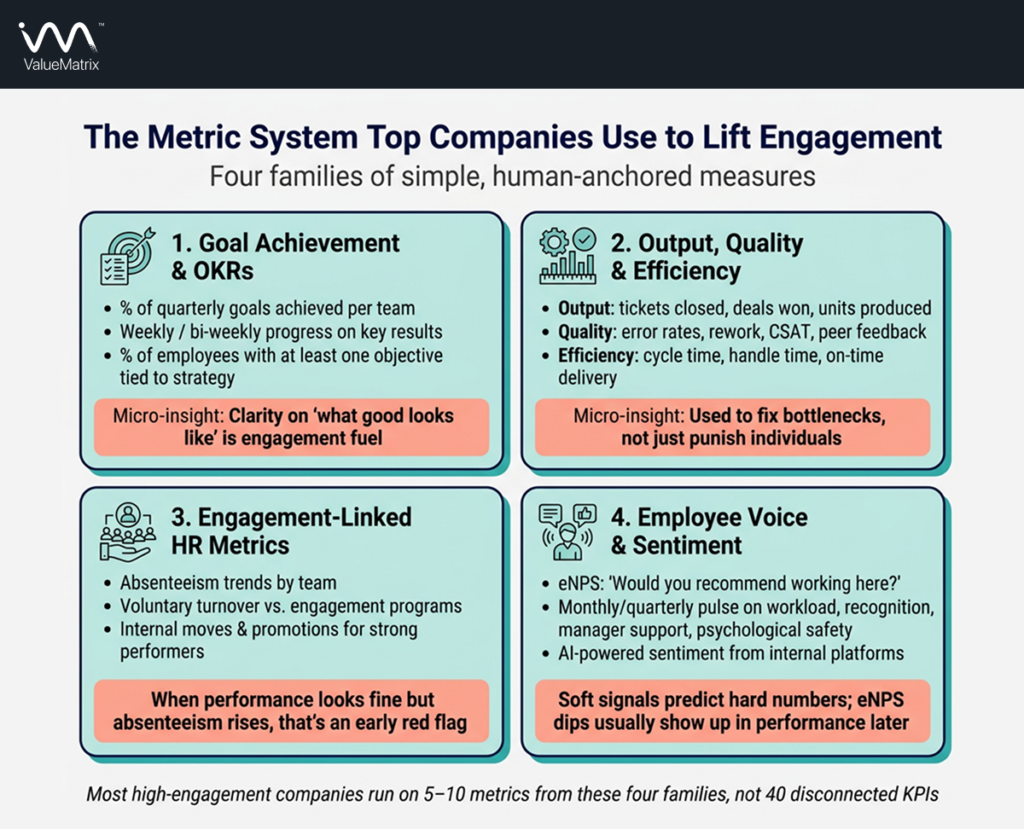
The companies that get this right are very selective about what they measure. Instead of drowning people in dashboards, they focus on a handful of simple, human‑anchored metrics.
1. What does goal achievement tell you about engagement?
Clear goals are engagement fuel. The percentage of objectives employees complete during a specific period serves as the primary performance metric that organizations use to measure their employees’ work performance. Companies using OKRs (Objectives and Key Results) or similar frameworks track:
- Percentage of quarterly goals achieved per team.
- Progress against key results is updated weekly or bi‑weekly.
- The percentage of workers who have at least one objective that links to a strategic goal.
The ability to see their actual work results in measurable terms causes people to experience their role as more valuable than something which would treat them as unimportant workers.
2. How should productivity and quality metrics be used?
Engaged employees tend to produce more and make fewer mistakes, and that shows up clearly in performance data. Mature organizations balance:
- Output metrics: completed tickets, closed deals, units produced.
- Quality metrics: error rates, rework, customer satisfaction scores, peer feedback.
- Efficiency metrics: cycle time, handle time, and on‑time delivery.
These metrics are not used just to ask “why are you behind?” They are used to spot bottlenecks, overloaded teams, and broken processes that quietly kill engagement.
3. Which HR metrics are most closely linked to engagement?
The smarter companies join the dots between performance metrics and classic HR indicators:
- Absenteeism: The first study shows that workforces with high engagement levels have absenteeism rates which go up to 81 percent according to different studies and different work environments.
- Voluntary turnover: The second study shows that organizations that provide high employee engagement programs experience 25 percent lower turnover rates compared to their competitors.
- Internal mobility: Lateral moves and promotions show whether strong performers see a future in the company.
When a team’s performance numbers look fine, but absenteeism is rising, leaders at top firms treat that as an early engagement red flag, not a “people will be people” nuisance.
4. How do employee voice metrics fit into performance management?
Modern performance systems now weave in direct input from employees. Apple and Microsoft, for example, measure eNPS (employee Net Promoter Score) to ascertain how likely employees are to recommend their workplace. Many pair that with:
- The organization conducts pulse surveys every three months or every month to assess four specific areas, which include workload assessment, recognition programs and manager support, and psychological safety.
- The organization uses AI-powered sentiment analysis, which operates on their internal systems to monitor their emotional atmosphere throughout the day.
These “soft” metrics predict the “hard” performance numbers; when eNPS dips, productivity, quality, and retention usually follow if nothing changes.
How do top companies use performance metrics to boost engagement without killing it?
Collecting data is easy. Using it in a way that makes people more motivated is the hard part. The best organizations follow a few consistent patterns.
1. Why should employees help shape the metrics?
Metrics imposed from above often feel arbitrary or unfair. Leading companies bring employees into the process of defining success:
- They run listening sessions and surveys to understand what “a good week” looks like in each role.
- They test draft scorecards with teams, then trim or adjust things that feel unrealistic or not in employees’ control.
This co‑design step makes a huge difference. When employees believe the metrics are fair and within their control, they see them as a guide, not a threat.
2. Why does purpose matter in a metric system?
At high‑performing firms, performance dashboards rarely sit alone. They are connected to customer and mission metrics:
- Frontline teams see how their quality scores link to customer satisfaction and NPS.
- Tech teams see deployment frequency and incident rates alongside user adoption or uptime.
That line of sight matters. Research consistently finds that when employees understand how their work helps the organization succeed, engagement and discretionary effort climb.
3. How should managers use metrics in one-to-ones?
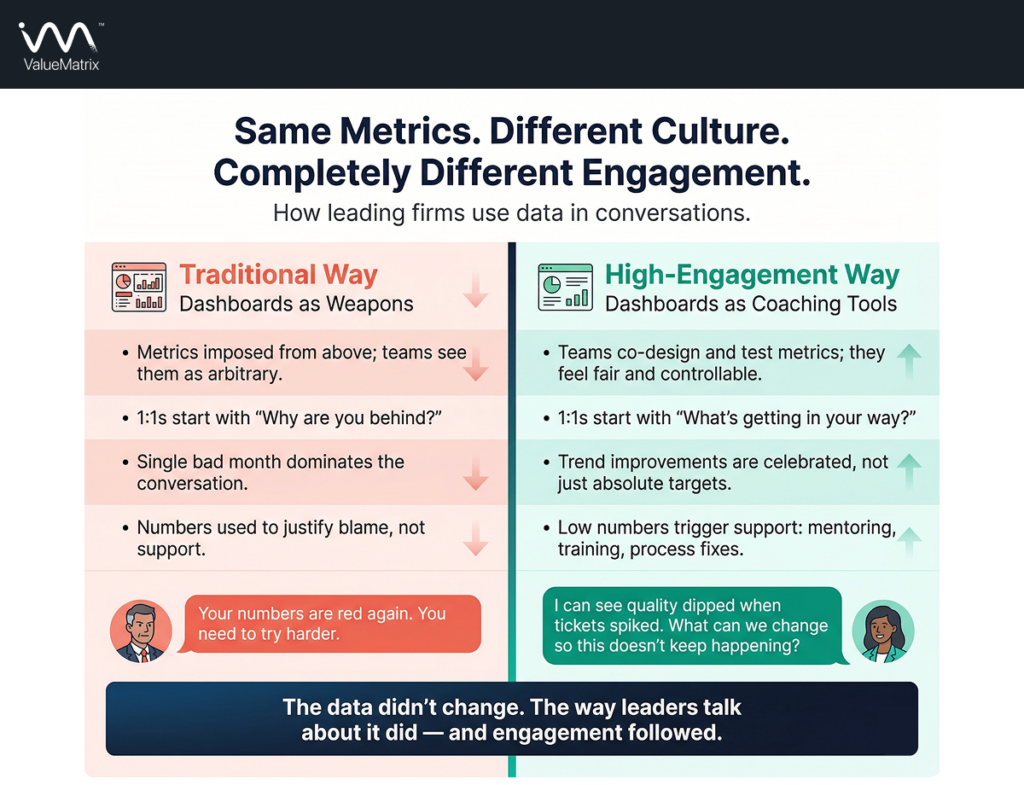
One of the quietest engagement killers is the “dashboard as stick” culture. Top companies actively train managers to do the opposite:
- Use one‑on‑ones to ask “What’s getting in your way?” rather than “Why are you behind?”
- Celebrate improvements in trend lines, not just absolute numbers, so people see that effort and learning count.
- Pair lower‑than‑expected performance metrics with support: mentoring, training, process change, or resource shifts.
Where this is done well, performance reviews become continuous, evidence‑based conversations instead of an annual ambush.
4. Why does transparent team-owned data improve engagement?
High‑engagement cultures rarely hide the numbers. Instead, they give teams live access to the data that matters and let them act on it:
- Weekly stand‑ups review a simple scorecard: goals, quality, customer feedback, capacity, and wellbeing.
- Teams run short experiments – for example, tweaking handovers or meeting rhythms – and watch how that moves metrics like cycle time and satisfaction.
That combination of autonomy plus data is powerful. People feel trusted to solve problems rather than simply being measured.
What are the pros and cons of using performance metrics to drive employee engagement?
How are top companies using performance metrics to drive real engagement results?
Specific case studies differ, but a few themes pop up again and again when you look at how leading firms use performance metrics to lift engagement.
Tech and product companies
Tech firms are used to instrumenting everything, and they are now turning that mindset on their people practices:
- Netflix established effective people analytics systems, which showed a combination of survey results, performance assessments, training documentation, and recruitment information.
- The team used the metrics to identify the points at which high performers exited the organization and the locations where promotion opportunities stopped progressing, and they discovered which managers developed the most dedicated teams.
The program brought about measurable results by delivering more precise development initiatives, which resulted in higher satisfaction ratings and decreased voluntary departures from essential employee groups.
Digital‑first global firms
Large global companies like Airbnb use frequent “pulse” surveys to track engagement by location, function, and manager. When pulse scores or eNPS fall for a team, they don’t wait for annual reviews:
- The HR and business leaders, together with team leads,s study three areas,s which include workload assessment, goal achievement evaluation, and recognition value assessment.
- The team will modify their existing structures and resources, together with their recognition programs, to observe how employee engagement and performance data will evolve during the following three months.
This tight feedback loop keeps engagement and performance aligned even as the business changes quickly.
People‑centric brands
Organizations that consistently rank as top employers tend to invest heavily in wellbeing metrics alongside performance:
- The company monitors burnout danger through three specific indicators, which include overtime work hours, and after-work email correspondence, and employees who report stress through their survey responses.
- The business justification for workload redistribution and wellness initiatives is established through their analysis of operational metrics, which include error rates, customer complaints, and employee turnover.
The lesson is simple: treating wellbeing and performance as a single, integrated dashboard pays off both in employee experience and in customer outcomes.
How do you turn performance metrics into an employee engagement engine?
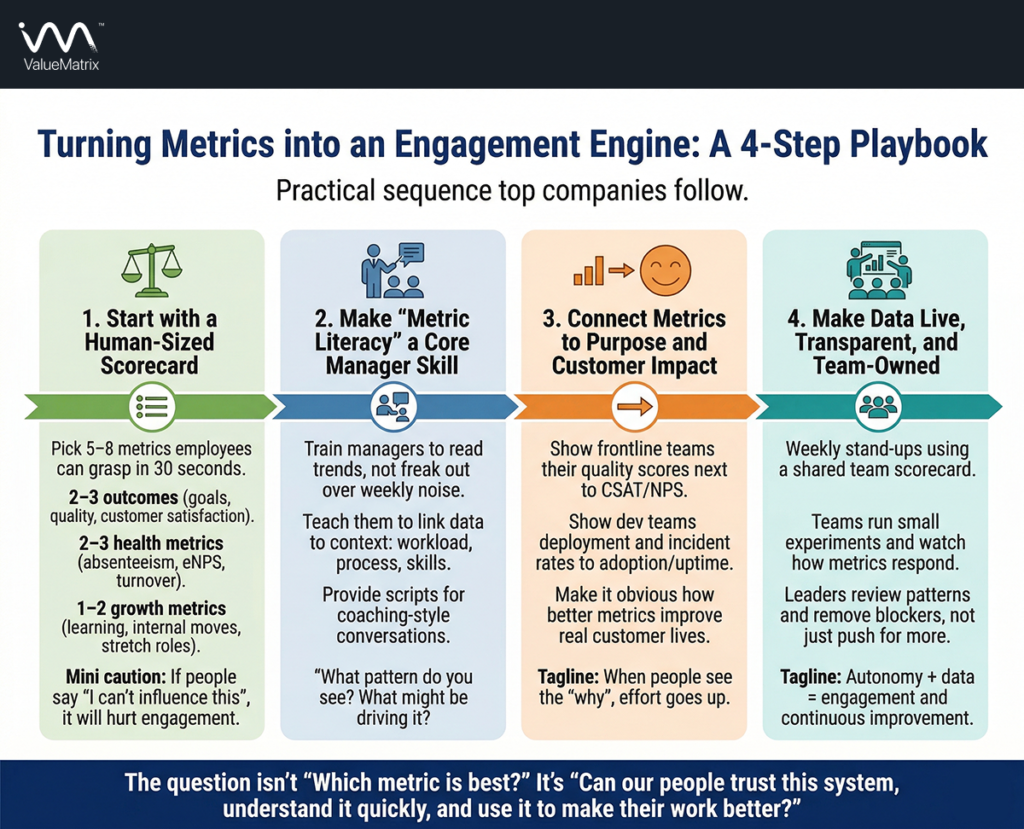
For leaders and HR teams, the question is not “Which metric is best?” but “How do we build a simple, trusted system our people will actually use?” A practical approach usually moves in four stages.
1. How many metrics should be on the scorecard?
Resist the urge to copy a Silicon Valley dashboard. Begin with five to eight metrics that any employee can understand in 30 seconds:
- 2–3 outcome metrics: goal completion, quality, customer satisfaction.
- 2–3 health metrics: absenteeism, eNPS or survey engagement index, turnover.
- 1–2 learning or growth metrics: participation in learning, internal moves, stretch assignments.
Review this with employees before locking it in. If people say, “I can’t influence this,” that metric will hurt engagement more than it helps.
2. Why is metric literacy a manager skill?
Top companies don’t assume managers magically know how to talk about data. They train them to:
- Read trends rather than obsessing over week‑to‑week noise.
- You should connect metrics to their specific context by showing how they relate to product changes, process changes, market changes, and team composition changes.
- People should use data to start discussions instead of ending them. The numbers suggest X; does that match what you’re seeing?
Organizations achieve better engagement results when their managers demonstrate metric confidence while practicing empathetic metric usage.
3. Why linking metrics to recognition and growth is important
Compensation matters, but engagement responds even more strongly to fairness and recognition. Leading organizations:
- Reward not only outcomes, but also improvements and contributions to team success, as picked up in 360‑degree feedback and collaboration metrics.
- Use performance data to nominate people for learning opportunities, visible projects, and internal moves, not just bonuses.
When employees see metrics being used to open doors rather than label people, trust in the system rises sharply.
4. Why does closing the loop matter so much?
The fastest way to kill enthusiasm for a new measurement approach is to collect data and do nothing with it. High‑engagement companies do the opposite:
- After every survey or performance cycle, they publish a short “here’s what we heard, here’s what we’re doing” update at the company or team level.
- They explicitly tie process changes – new tools, staffing adjustments, meeting norms – back to insights from performance and engagement metrics.
Employees then learn that speaking up, rating honestly, and engaging with the numbers is worth their time.
When do performance metrics damage employee engagement instead of driving it?
Performance metrics are powerful, and like any powerful tool, they can backfire.
Common failure modes include:
- Measuring too much: Dozens of KPIs with no clear priority create confusion and anxiety.
- Focusing only on lagging indicators: Looking only at quarterly sales or defects leaves no room for proactive course correction.
- Ignoring fairness: Metrics that don’t account for territory potential, resource differences, or role complexity are quickly seen as rigged.
- Using numbers without narrative: People hear “you are your dashboard”, which pushes them into risk‑averse, box‑ticking behaviour.
Top companies avoid these traps by regularly reviewing their metrics portfolio, involving employees in that review, and dropping measures that do not clearly help performance, engagement, or decision-making.
Where is this all heading?
Looking ahead, performance metrics and engagement measures are converging into a single, integrated “people performance” views. HR analytics teams are already combining operational metrics, survey data, collaboration patterns, and even digital wellbeing signals to pinpoint where culture is strong and where it is fraying.
Done the right way, this isn’t surveillance. It is a more honest picture of how work actually feels and performs on the ground. In a world where only roughly a fifth of employees are engaged, the companies that master this balance – rigorous metrics plus real humanity – will keep winning on talent, innovation, and resilience.
In the End
A strong performance culture and a strong engagement culture are no longer two separate projects. The same conversation gets presented through two different perspectives. When metrics are clear, fair and connected to purpose, people know their current position and their upcoming path. The ability to learn their next steps from your program brings them dedication during difficult times, and they stay driven during successful periods.
The companies that successfully attract top talent at present have established new evaluation methods which differ from existing assessment frameworks. Organizations have changed their approach from using historical scorecards, which showed only target failures, to using dynamic dashboards which enable teams to make real-time performance adjustments while acquiring new skills. They view performance data as a communal resource which should not be used against others, and they want managers to act as translators and coaches who should not restrict access to information. In those environments, engagement is not an HR campaign. It is the natural outcome of working in a system that feels transparent, humane, and anchored in reality.
The contemporary competitive advantage exists as the only option for organizations that strive to achieve prolonged development. The market will continue to experience fluctuations, while technological advancements will proceed to evolve, and organizations will require continuous updates to their strategic plans. People who comprehend financial information, have confidence in its application, and discover their personal growth paths through numerical data will achieve faster organizational adaptation than any existing strategic guide. The question is no longer whether you should connect performance metrics and engagement. It is how quickly you can redesign your system so that every datapoint makes work a little clearer, a little fairer, and a lot more energising for your people.
FAQs on performance metrics and employee engagement
1. What is the single most important metric for employee engagement?
Organizations lack a single perfect measurement tool, yet they consider engagement survey results and eNPS scores as their main indicators because these metrics show employee sentiments about their workplace experience. The most effective companies pair those sentiment metrics with a small set of performance indicators – such as goal completion, quality, and absenteeism – to understand both how people feel and how work is actually flowing.
2. How often should engagement‑related metrics be reviewed?
The company conducts monthly executive meetings to assess high-level operational results, and its team members review these results during their weekly meetings. The organization conducts its annual engagement surveys two times per year while using ongoing pulse assessments and real-time performance measurements to identify problems before the annual evaluation period starts.
3. Can heavy measurement reduce trust and hurt engagement?
The task execution leads to negative results when performed in an improper manner. The practice of monitoring people at extreme detail through individual tracking, which lacks a definite objective,s causes people to experience stress and resistance because they perceive it as surveillance. The process of developing metrics together with people who use the metrics to assess their own outcomes for coaching purposes leads to increased trust between them.
4. How do small or mid‑sized companies start without big HR analytics tools?
Small organizations start their operations with basic tools, which include quarterly targets, a brief employee survey, fundamental systems for tracking employee absences and turnover rates, and two customer satisfaction indicators. Organizations achieve better results when their executives hold effective discussions with staff members about their operational analysis results and subsequent organizational transformations.
5. How quickly can better metrics improve engagement?
The time needed for organizations to show better engagement scores after they establish precise objectives,d provide regular assessments, and show actual progress on survey results will range from one to two quarters. Organizations that want to achieve better cultural transformation and performance improvement need to maintain their new procedures for a minimum of 12 to 24 months while training their managers and making ongoing changes to their measurement systems.
6. How often should engagement-related metrics be reviewed?
Operational metrics should usually be reviewed weekly or monthly, while pulse surveys can run monthly or quarterly depending on team size and change intensity. The key is to review often enough to act early without creating survey fatigue or constant reporting noise.
7. Can too many metrics hurt engagement?
Yes. Too many metrics reduce clarity, make priorities fuzzy, and increase the sense that employees are being watched rather than supported. Metric overload is one of the clearest ways a performance system turns from helpful structure into a source of anxiety.
8. How can smaller companies start without a big HR analytics stack?
Smaller companies can start with a simple scorecard that includes goals, quality, absenteeism, voluntary turnover, and one employee voice measure such as a short pulse survey or eNPS. The value comes less from sophisticated software and more from consistent review and manager follow-through.