
Hiring is quickly evolving. Resumes and traditional interviews no longer provide the full picture. This blog explores how AI-powered cognitive skill assessments are transforming HR. This kind of cutting-edge testing measures not only how much a candidate knows, but also how the candidate thinks. These tests help companies identify the best candidates, neutralize hiring biases, and foster stronger teamwork with diverse talent. Organizations must adopt AI-based assessments to ensure they make informed and fair hiring decisions that lead to long-term success and effective employee retention.
Recruitment practices are witnessing rapid change in the way companies are scouting new talent. A mere laundry list of many old jobs or a degree from some historically prestigious university does little justice to the worth of a human being nowadays. The world today demands more than just knowledge; it requires critical thinking, adaptability, and the ability to learn rapidly. Enter cognitive skill assessments, a powerful means of evaluation that looks beyond the resume to a candidate’s true potential. Combine this with cool AI tools, and it establishes a new standard of hiring altogether. This guide aims to demonstrate how these tools enable HR teams to make smarter, fairer, and more effective decisions than ever.
What are the major drawbacks of Conventional Hiring methods?
Old hiring mostly depends on two very core pillars, which are resumes and personal interviews. Both have lots of traps and can be very misleading. Resumes contain lots of biases. The recruiters may unconsciously favor candidates with specific backgrounds or schools. It may skip brilliant people whose stories are simply different. Rather, interviews can be affected by the personal emotion of a recruitment-held halo effect, judging someone solely based on one particular good thing about him/her. This method of hiring is not only unfair, but it is also quite slow and very costly. Time spent sorting through the hundreds of resumes is a lot of wastage of resources.
The AI Advantage in HR
The first step in hiring can often be the slowest. HR teams spend countless hours reviewing resumes and cover letters. This is where AI truly shines. An AI-powered assessment platform can automatically send the cognitive skill assessment to every qualified applicant. Then, they sort candidates and rank them according to the scores, and you have a list of the most promising people to interview. This kind of automation saves a significant opportunity cost in terms of time and money, allowing your HR team to focus on the human aspects of hiring.
How AI-Powered Assessment Works
Artificial Intelligence gives these assessments much more power and insight than just a simple test.
Adaptive and Gamified Test
The tests can be made engaging and fun by AI systems, almost like a game, which keeps the candidates motivated. The tests are also adaptive to the test taker. For example, once a person answers a question correctly, the next question is a bit harder. This quickly provides an extremely accurate score without prolonging the test.
Deep Data Analysis
An AI system scrutinizes test results in real-time. It looks at patterns and insights from the data that human beings would never be able to see in such a short span. Thus, you can quickly find the top candidates using objective data. This kind of data-driven hiring really makes a difference. 70 percent of companies say that as the AI tool enters definition, it significantly increases their hiring efficiency.
Eliminating Bias and Finding Hidden Talent
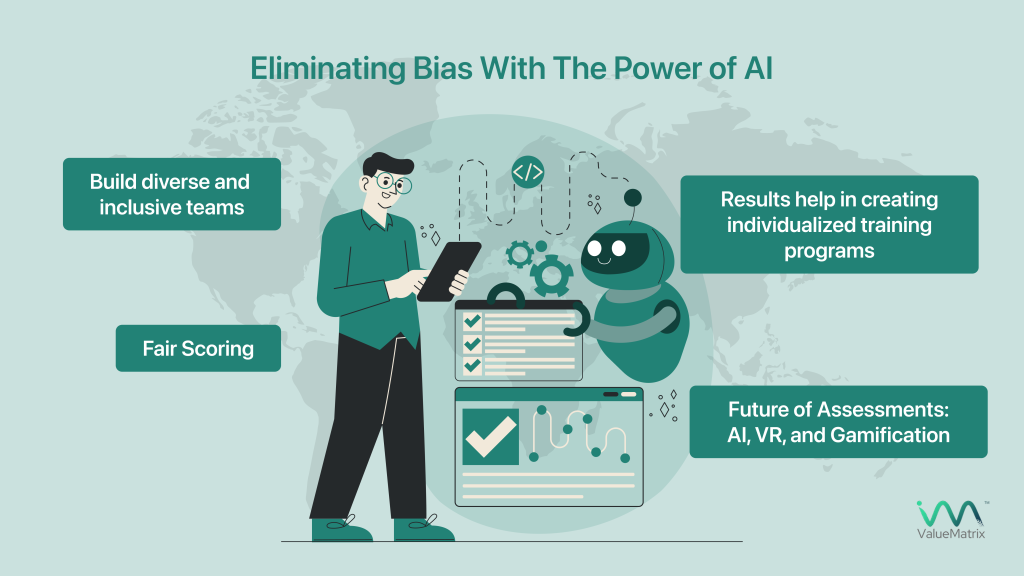
This is one of AI’s biggest advantages; it enables you to build diverse and inclusive teams.
Fairness with Scoring
There is equal judgment for all candidates according to the same principles. Slight things such as one’s name, age, record, or experience don’t hold any relevance to the scoring. All participants are judged solely on their potential. This is designed to create a fair meritocracy. The Report shows a 20% cut in gender bias in pricing for companies leveraging AI assessments. Example: An extraordinary candidate for an IT job might not possess a degree in computer science. An AI assessment would see their great problem-solving skills and flag them as a clear prospect. A human recruiter might miss them just by checking out their CV.
What AI and Cognitive Assessments Measure
Simply put, a cognitive skill assessment is a test to measure how people think. This is different from school kinds of tests. Those tests question you about historical facts or math formulas. Rather, it estimates general mental abilities vital for success in today’s industries.
Science behind cognitive assessments
A cognitive skill assessment is based on the sound psychology of cognitive ability tests. It isn’t about what you’ve memorized. It tests your raw mental horsepower. This is something psychologists and research studies refer to as “fluid intelligence”: essentially defined as the capacity to reason and solve problems in novel situations, independent of any knowledge from the past. By measuring this, you get a much clearer picture of what someone’s future potential could be. This is a power move away from the traditional methods of hiring that only considered prior experience.
Types of Skills Measured
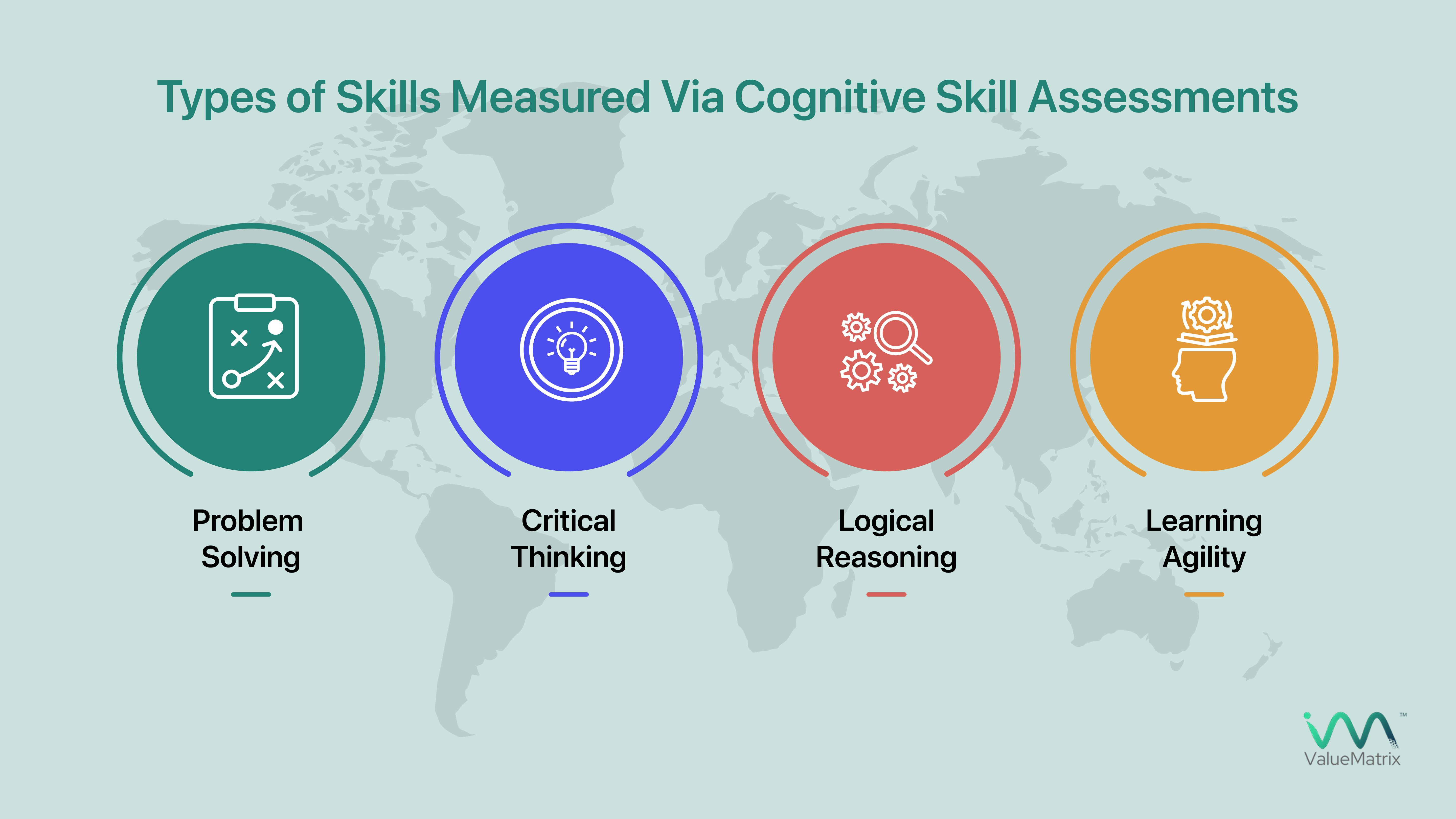
These assessments test a wide range of intellectual capabilities. They consist of:
Problem Solving:
This tests the speed and effectiveness of coming to grips with new problems. This tests your creativity and logical reasoning under pressure.
Critical Thinking:
It involves the ability to analyze the information and make a wise judgment about it, the application of clear insight, and wise decisions.
Logical Reasoning:
It shows how much you think and connect ideas in a flow of thought. For instance, in the cognitive tests that have a numerical reasoning part, an examinee may be required to see a pattern that develops in a series of numbers. It shows how well you process information that’s rather complex.
Learning Agility:
This is how much you can learn and apply those new skills in real time. One of its most important angles is that in a rapidly changing technology-based world of new and evolving job roles, learning is going to be quite critical.
Cognitive Assessments as a Way To Measure Soft Skills
The Internet has deceived many into the belief that only hard skills are put to the test by these tests, but nothing could be further from the truth. There is a whole array of soft skills that can be inferred from these characteristics. A test designed to assess how a candidate traverses a complex problem under pressure can help give a fair measure of his/her resilience. The attention to detail exhibited in numerical reasoning in a cognitive test can be an indicator. This form of indirect insight helps in knowing the style of work of an individual and perhaps how he/she would tackle the different challenges at work.
Role of Valuemetrix in Transforming Cognitive Skill Assessments
Valuemetrix.AI is a pioneer in this new era of intelligent hiring. Instead of resorting to guesswork, their platform features a powerful suite of AI-driven cognitive assessments programmed to provide HR professionals with the department’s inside knowledge of what a candidate might be. When plugged into existing workflows, their tools will assist in moving away from traditional resumes and interviews and toward a more objective data-based hiring decision. Thanks to Valuemetrix.AI, the foundation of a smarter, more productive, and diverse workforce is being built.
Valuemetrix.AI’s platform is a conscious step forward in creating a non-biased and fair hiring procedure. It employs scientifically established, core skill-focused assessments that include problem solving and critical thinking, but neither considers nor influences a candidate’s background, name, or past experiences. This institute actively works to eliminate biases from the hiring process. Every candidate is evaluated on a level playing field- widening and diversifying your talent pool, to ensure that the best person for the job is selected purely on merit.
Well, again, the magic of the AI-powered platform – fast and valid. The Valuemetrix.AI assessments are adaptive, i.e., questions get easier or harder depending on the responses given by a candidate. Quicker engagement on tests equals a more accurate assessment without spending too much time, as the more time you take in this instance, the more relevant your choice becomes irrelevant. And the deep data analytics now help your HR teams interpret easily and get actionable insights that lead to an overall streamlined hiring process.
Benefits Delivered by Valuemetrix’s AI-Driven Assessments
The Business Case for Intelligent Hiring
It is really not a fashion to use modern assessments; it’s an exciting business case in addition to directly impacting success for your company.
Lower Cost and Time to Hire
The first of these benefits is efficiency. AI does all of this screening in a fraction of the time it would take to assess candidates one-by-one. This gives HR a good amount of time that can be assigned to more strategic work. Less time spent on busy work incurs less cost in the hiring process. Companies using AI-driven assessments see a 30% reduction in time-to-hire.
The factors contributing to employee retention
The first step to employee retention is recruiting the right person. If possible, hires fit the job cognitively, they are bound to do well and be happy. Job satisfaction leads to low turnover, thereby saving your organization the expenses of re-hiring and training.
Effects of Cognitive Skills on Team Culture
Hiring is not just a matter of finding a qualified individual; it is also about making hiring into a strong team. A cognitive skills assessment may offer insight into a person’s working style and how harmoniously they may fit into your established team. For example, a team needing creative problem solvers may want to seek different cognitive strengths than a team requiring meticulous logicians. This data-driven approach fosters building a much more cohesive team culture. Also, it creates a difference between a person’s personality vs cognitive ability so that one may hire to create such a blend.
How Assessments Shape Candidate Experience
Your method of an AI recruitment platform interacts with candidates’ perspectives toward your company. Long, clunky, or poorly designed assessments create an unhappy candidate experience that can erode your company’s branding, causing early exits of potential hires. Good, gamified skills testing tools should be kept short and engaging while also requiring little skill to undertake on any device. They should also clearly state what the test is measuring and what will happen next. Such forethought translates to useful data for you and a pleasant experience for candidates.
The ROI of Cognitive Assessments in Detail
Not just speed and equity, but also money. The return on investment regarding the use of cognitive assessments is calculated from several areas. Because the costs of hiring the bottom few decrease and employee turnover declines, one also saves a lot of time for one’s HR team. Over time, the expense of the smartest hiring tool pays for itself by building a more productive and stable workforce.
Ultimately, Valuemetrix.AI gives you a very clear pathway to a better ROI on your hiring. These candidates are identified with the right cognitive skills for the job; hence, you are more likely to hire individuals who succeed and remain a long-term fit for your company. So, focusing on who is likely to remain long-term improves sources of employee turnover and those high costs that are associated with turnover. Collaborating with a solution like Valuemetrix.AI is a strategic investment that yields tangible returns, allowing you to build a stable, skilled, and effective team going forward for your organization.
How AI and Human Expertise Complement Each Other
AI is a good assistant, but not an ultimate judge. The best hiring process is thus a mixture of data and human perception. AI can identify the best skills and qualified candidates, but the interview process itself is where one meets the person. Be guided in the interview by the assessment results. Pose scenarios exploring a candidate’s strengths/weaknesses revealed by the test. This balanced approach results in being smart, fair, and well-rounded in decision-making toward hiring.
Best Practices for Getting Started with AI Assessments
Simplicity is the secret to getting started with AI. These steps will ensure that this process yields results for your organization.
- Start Small and Learn
Using the AI tool for a single department or even a role is a good way to start. Assess its applicability and gather users’ feedback. You can broaden the use of AI to other parts of the organization subsequently.
- Human Oversight
AI issues strong recommendations; however, the recruiting person must still have the ultimate decision to go ahead and hire. Use AI as an empowering resource for human beings rather than replacing human judgment.
- Be Transparent with Candidates
Be upfront with the candidates regarding how AI is being used in the process. It increases their trust in your company, as it will be made clear that it is for the fairness of the process for all.
Placement Assessments to Identify Potential for Future Roles
Hiring is not simply about providing today’s vacancies; it is about future-proofing your company. The psychology behind cognitive ability tests allows you to see a person’s potential for growth. Assessing a candidate’s core mental skills reveals who learns quickly and can adapt effectively. They may not fit a job in front of you, but they may become your selection for a manager or team lead down the road. This is a smart way of leveraging your hiring data through AI for succession planning and a long-term talent strategy.
Choosing a Suitable AI Assessment Platform
With so many tools available, how do you choose the one that is right for you? An AI recruitment platform that is considered good should be easy to use from a candidate experience point of view, but convenient for your team to administer. It should provide rigorous data and insights that are coherent and lucid enough for all to grasp. It is also crucial to choose a tool that is regularly audited for bias. An equitable and transparent AI hiring tool is critical in cementing your process as ethical and efficient. This careful selection process is a key part of a successful HR technology adoption guide.
Future Trends: Cognitive Assessments and AI in HR
The place of cognitive skills in the future of work
Work is constantly changing, and frequently these days. Most of the jobs today will probably sound much different in the next five or ten years at the current speed of technological advancement, for example, AI. Thus, the capacity of individuals to think, adapt, and learn quickly will become less and less important than their immediate knowledge. When hiring, by administering a cognitive ability test, you are hiring not just for a job; you are hiring for the future of work. You are looking for individuals who quickly learn new skills and deal with new problems, whatever shape the future of your business holds.
The Future of Assessments: AI, VR, and Gamification
The hire-tech world is quite buzzing, not standing still. The coming assessment is going to be more engaging. Increasing use of virtual reality cognitive assessment for performing realistic testing will be even more of the new immersive tests provided through VR simulation of the working environment in which the prospective employee performs. For example, looking for connecting cues to solve a problem in a virtual reality office. The company will get a better insight into how a person thinks and performs in a real-life context. This kind of gamified skills testing makes the candidate’s experience enjoyable and provides a clear picture of the person’s potential.
Integrating Assessment into the Human Resource Tech Stack
For a company, these tools work best when connected to your other HR systems. Good AI recruiting platforms can share information with the company’s computerised applicant tracking system (ATS), as well as with other HR software. It would make things easier throughout the hiring process. Such a seamless HR technology adoption guide would now show you how to get these systems to “talk” to each other to create a stronger and efficient workflow.
Legal and Ethical Implications of AI Hiring Tools
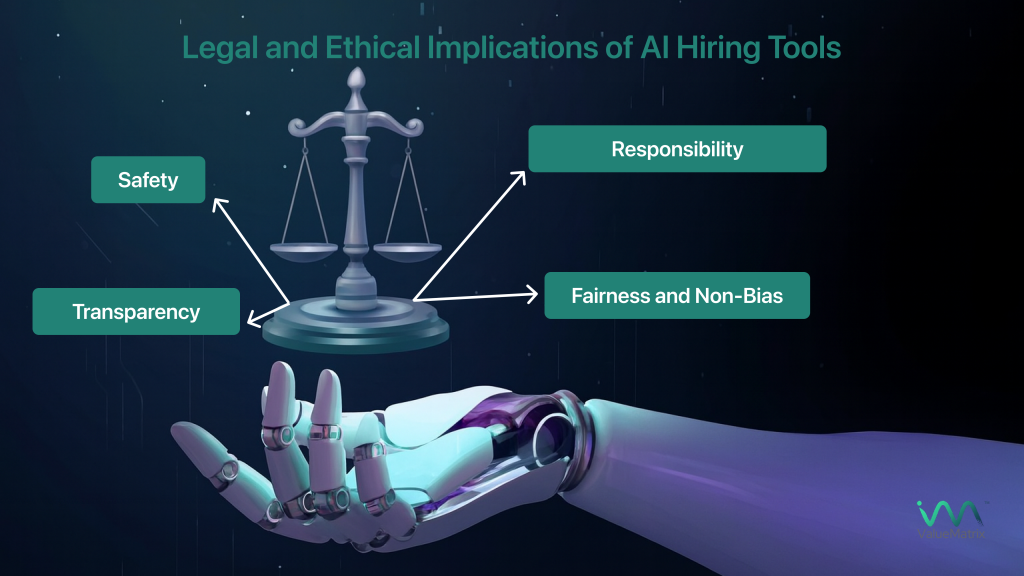
The use of AI in hiring is a very sensitive area for organizations. Hence, legalities and ethical issues have to be kept in consideration. Fairness and non-bias must be considered in the training data for the AI. Similarly, privacy laws must be followed, as many countries provide strict rules on how to use a candidate’s data. This is one significant way to ensure the use of AI hiring tools in an ethical way.
Importance of Test Validation and Reliability
Before cognitive skill assessment, the test should be fair, and the very purpose of the test should be validated. A validated test is one that, through scientific evidence, has proven to measure what it expresses it is measuring. For example, while a test is supposed to measure problem-solving, if it has an added variable of measuring how fast a person can read, this becomes a fault. Always check with your provider for the up-to-date validity news of the test. Thus, reliability is when taking a test under similar conditions, the instrument would present the same results at a different time for that individual. This will mean that your AI hiring tools provide consistent data that is well-founded and complete with strong evidence.
Conclusion
These AI-powered cognitive skill assessments revolutionize recruiting for HR professionals. They speed up, make the process more equitable, and enhance the effectiveness of hiring. Create a more robust, “intelligently” capable team for the future by focusing on an individual’s potential to achieve much more in terms of improvement. This is the new method to find talent.
The Future is Intelligent Hiring. These AI-powered cognitive skill assessments revolutionize recruiting for HR professionals. They speed up, make the process more equitable, and enhance the effectiveness of hiring. Create a more robust, “intelligently” capable team for the future by focusing on an individual’s potential to achieve much more in terms of improvement. This is the new method to find talent.
Assessment results aren’t just valued at the time of hiring someone; they become an answer to other needs in your organization in terms of L&D. The reports of cognitive assessments serve as a guide to your L&D programs within your company. The insights drawn from these types of assessments are also applied in creating individualized training programs geared towards the employees. For instance, when a certain employee exhibits high potential in a certain area, the company can organize specific training to boost that area. L&D Cognitive Assessments are valuable resources for up-skilling your existing workforce and developing a stronger team from within.
Candidate’s Point of View: A General Overview
For those of you hunting for a job, you might wonder what the cognitive ability test is that you will be taking. This usually goes over the internet; it’s time-limited, and it may contain puzzles, logical questions, or situational problems to be solved. Key rule: think clearly and relieve stress. This is designed to be fair, allowing everyone an equal chance to show their true potential, one of those levels.
FAQs
01. What is a cognitive ability test for hiring?
A cognitive ability test for hiring is a type of assessment that is used by companies to measure the mental abilities of the job candidate. It assesses properties such as problem-solving, logic, and critical thinking. It is the single most crucial tool for young data recruitment.
02. What is a Google cognitive ability test?
Although the precise tests used by corporations such as Google are not always in the public domain, the term denotes cognitive and problem-solving testing companies within the technology sector that are applied as a broad outline for hiring. These tests are tailored to find the best talent by pure skill and potential, rather than mere credentials.
03. How is a cognitive assessment different from an IQ test?
Cognitive assessments for hiring are different from a traditional IQ test. They are designed to assess skills directly linked to job performance. They are usually targeted towards a specific range of skills needed for a certain role.
04. How does AI help in these assessments?
AI streamlines and improves test administration. It enables the testing of large groups of individuals and scoring fairly, and it minimizes human subjectivity in the scoring process, thus offering an equitable opportunity to every applicant.
05. What is a numerical reasoning cognitive test?
A numerical reasoning cognitive test is an assessment specifically designed to gauge a person’s ability to work with numbers, including logical reasoning and pattern recognition, both of which are vital skills for many jobs.
06. What is a cognitive skill assessment?
A cognitive skill assessment method measures a person’s thinking and reasoning skills. It helps the employer determine the candidate’s potential to learn and succeed on the job, which is far more pertinent in predicting future success than just looking at a resume.
The AI Advantage Cognitive Skill Assessments Changing the Face of HR
About Us
ValueMatrix is an AI-powered talent intelligence platform that helps companies hire better, faster, and without bias. We go beyond resumes to assess skills, behavioral traits, and cultural fit using advanced AI and proven psychological frameworks. Our platform delivers data-driven insights that improve hiring accuracy, reduce time-to-hire, and elevate candidate quality.
ValueMatrix AI enables hiring teams to make confident hiring decisions and build high-performing teams at scale.