

Summary
AI workforce planning is a strategic work approach for making the best use of talent in artificial intelligence. Organizations can use predictive, instead of traditional, static methods to predict future skill needs. They can assess existing internal talent inventories, predict the future, and then streamline the whole talent lifecycle. It includes sourcing and acquisition to internal mobility and retention. Data-driven approaches enable organizations to recruit and retain even more agile and skilled employees, while promoting diversity, equity, and inclusion. Such human-AI partnerships take business growth levels higher.
The Shifting Landscape of Workforce Planning 🗺️
This section examines how traditional, static methods of workforce planning are becoming obsolete in a fast-paced market. It introduces how the integration of AI is transforming HR from a reactive function into a proactive, strategic business partner.
The Limitations of Traditional Methods
In the current environment, the classical model has become inefficient to work with economic uncertainties and shifts in skills. The companies would deplete key talents or build an oversupply in areas where it was not needed. Mostly, these skill deficits were addressed in a last-minute fashion. This turns out to be hurriedly done, quite disadvantageous, and extremely costly. Such a traditional approach would not be able to match the requirements of a dynamic and modern business world.
The Emergence of AI in HR
With the advent of artificial intelligence, a new awakening is emerging for the domain of human resource management. Artificial intelligence employs the use of machine learning and natural language processing to analyze very large and complex datasets from all sources imaginable: HR records, market trends, and even social media.
It transforms workforce planning from a static and annual effort to one of a dynamic, continuous, and futuristic one. AI leverages computing capabilities to identify trends. It’s done with astounding precision, thus helping HR leaders to access the data that could underpin active strategic decisions directly aligned with organizational business objectives. Such changes would foster a data-driven approach to talent management. It promotes HR from being a support function to becoming a genuine strategic partner to the business.
What is AI-Driven Workforce Planning? 🤖
This defines the core concept of using AI for strategic workforce planning. It outlines the key technological components that make an AI-powered system effective in optimizing a company’s talent strategy.
Defining the Core Concept
The AI-based workforce planning approach enables forecasting of talent requirements, identifying areas in which skills are already in deficit as well as under threat in the future, and optimizing the entire talent lifecycle. It has an advanced character, given that predictive analytics techniques are used for planning beyond headcount numbers-from ensuring that an organization has the right people with the right skills in the right roles at the right time, while looking ahead in anticipating future demands. This is not a case of developing a model that replaces human decision-making but rather empowers human decision-making with large amounts of supportive data.
Key Components of an AI-Powered System
All of these juxtapositions transform a mosaic of interdependent ingredients into effective AI-based workforce planning. The first of these is total data integration, which means that various HR systems, such as HRIS, performance management, and payroll, need to feed information into the pool.
The pumping station is an advanced predictive modeling engine that takes advantage of machine learning algorithms to extract valuable predictions from data. This entire mechanism is streamlined yet further by a real-time analytics platform where an easily viewable workforce is available. Finally, it assembles automated insights and recommendations to present actionable intelligence to the managers and HR personnel for speedy and easy action.
What Is Predictive Analytics In Talent Forecasting? 🔮
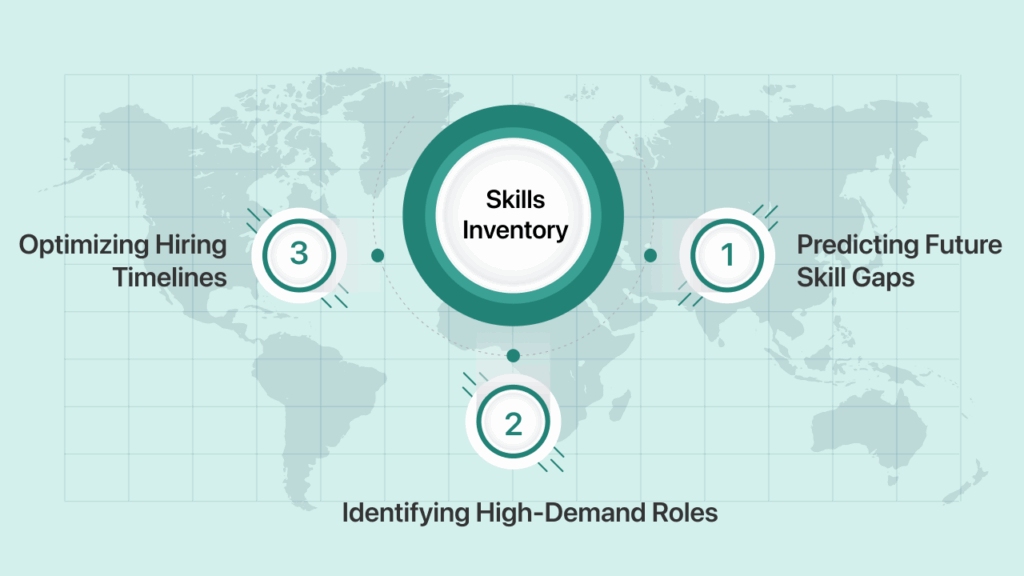
This section delves into how AI uses predictive analytics to anticipate future talent needs. It explains how this technology helps organizations forecast skill gaps, identify high-demand roles, and optimize hiring timelines.
Predicting Future Skill Gaps
AI’s predictive ability is revolutionizing talent forecasting. Basically, by analyzing a combination of internal data (employee skills, tenure, performance) and more external predictions of market trends (industry reports, economic forecasts), an AI will tell with almost complete accuracy what skills will be in the limelight at any point for the next few months and years. Thus, organizations can set up proactive reskilling and upskilling programs to groom their employee base toward future needs and alleviate potential talent droughts. According to a McKinsey report, companies that use strategic workforce planning are three times more likely to report a competitive advantage in talent management.
Identifying High-Demand Roles
AI systems will be identifying and predicting the growth of key roles that will be important for the success of any business in the future. The system can therefore identify which roles are most likely to be in high demand in a particular time frame by analyzing historical hiring data, project pipelines, and market benchmarks. Such foresight allows HR and business leaders to set priorities around hiring strategies and resource allocation and to build a talent pipeline for future needs.
Optimizing Hiring Timelines
Recruits sometimes take longer durations and incur costs in the process. Average time for filling specific roles based on market situation, location, and skills needed can be predicted for the purposes of setting realistic expectations by managers and more effectively planning recruitment activities. For instance, if a model predicts that it will take six months to fill a critical role, hiring managers can begin preparations much earlier in time to avoid operational bottlenecks.
What Is Meant by Skills-Based Talent Inventory and Analysis?🧠
This part of the blog explains the concept of a skills-based approach to talent management. It highlights how AI can map employee skills, uncover hidden talent, and analyze skill gaps to inform training and development.
Mapping Employee Skills and Capabilities
A skills-based paradigm forms the basis of modern workforce planning. AI creates a dynamic and holistic inventory of employee skills, qualifications, and abilities beyond mere listing in a conventional CV. It infers skills from project work, certifications, and even casual conversations, thus providing a much richer and accurate picture of internal talent for an organization.
Uncovering Hidden Talent within the Organization
One of the mighty advantages of a skill-based inventory is that it helps in discovering talent. AI can identify employees with the skills for a new job or assignment that is completely different from their present work. By doing so, it promotes internal mobility and ensures key resources are not lost, resulting in reduced external hiring.
Skill Gap Analysis for Training and Development
AI can identify specific, measurable skill gaps by comparing the current inventory of skills of the organization to projected future needs. Skill gap analysis thus provides an accurate roadmap for training and development. Instead of the generic type of training, organizations can now build a highly focused, personalized learning path for each employee, thus ensuring that the development interventions truly deliver value in an efficient manner, as well as align with strategic goals.
What Is Meant By Dynamic Talent Sourcing and Acquisition? 🎯
This section focuses on how AI modernizes the recruitment process. It discusses the automation of candidate screening, the enhancement of job descriptions, and the ability to predict candidate success.
Automating Candidate Screening
Indeed, the first steps involved with recruitment usually take up the most time. Scanning thousands of resumes and applications within minutes, AI-enabled software programs can set up algorithms that will pick the talent to be interviewed from a preset set of criteria. According to the Society for Human Resource Management (SHRM), AI tools can reduce the time-to-hire by up to 40%. This not only accelerates the process but also diminishes unconscious bias since it takes into consideration nothing other than capability and experience.
Enhancing Job Description and Ad Targeting
AI could analyze the profiles of the top-performing employees within the organization, using what it learns to create more effective job descriptions and recruitment ads. In short, pinpointing the traits, keywords, and skills that lead to success helps target advertising to the most suitable and qualified candidates on the right platforms.
Predicting Candidate Success
Predictive modeling extends beyond screening to identify applicants more likely to succeed and stay with the company over time. The system evaluates the candidate’s profile against historical data on the success of past employees to give an overall predictive score for that candidate. This gives hiring managers greater data to evaluate candidates against, allowing them to identify candidates who are not just good fits for the job but perhaps also for the company culture.
Optimizing Internal Mobility and Career Pathing 🚀
This explores how AI facilitates internal talent movement and career growth. It explains how the technology assists in identifying internal candidates for new roles and creates personalized career development plans.
Identifying Internal Candidates for Open Roles
Internal mobility builds employee engagement and retention. Using AI algorithms, internal employees can be matched to available open roles, enabling career switches and speeding up the time-to-fill for open roles, thereby showing a visible commitment to employee growth, thus boosting morale.
Creating Personalized Career Development Plans
AI would create Personalized Career Development Plans. For example, the model may recommend individualized career development plans based on the employee’s skills and aspirations, plus performance data. This would mean that the AI recommends specific roles to target and identify required skills to learn; it would even recommend mentors or some training modules. It empowers the employees to take control over their career journeys with a clear, data-backed path.
Reducing Time-to-Fill for Internal Positions
Time-to-fill for internal positions is reduced. Internal hires usually allow for quicker and cheaper placements compared with external hiring. AI further accelerates this process by quickly and accurately identifying all qualified internal candidates. Hence, it critically reduces time and costs involved in talent acquisition, enabling the company to fill extremely critical positions far more efficiently and ensure projects remain on track.
How To Utilize AI for Succession Planning? 👑

This section details the application of AI in building a strong leadership pipeline. It explains how AI helps identify high-potential employees and assess their readiness for future leadership roles.
Identifying High-Potential Employees
Succession planning is one of the important processes, yet one that is always considered labor-intensive. But AI can be of help by automating and enhancing its processes by sifting through performance information, feedback, and skilling to find high-potential employees. This will help in further creating an objective view of who can take on greater work responsibility and bolster a leadership pipeline.
Assessing Leadership Readiness
AI systems assess the employee’s competencies and development path to determine if they are ready to pursue a leadership role. At the same time, it can pinpoint skills or experiences a potential leader still needs. Doing so presents a viable map for that individual to grow in preparation for that leadership position.
Building a Robust Leadership Pipeline
AI has a continuous assessment and nurturing of high-potential talents, and this enables firms to create a good and ready pipeline for future leaders. That ensures business continuity and transition of leadership, thus creating a emptiness of talent at once when a key role is left vacant.
How To Focus On Personalized Employee Development and Training? 🌱
This part of the blog discusses the use of AI to create tailored learning experiences. It explains how the technology recommends relevant training modules and helps measure the return on investment of development programs.
Recommending Relevant Training Modules
AI can act as a personal learning advisor for every employee. Based on an individual’s current position, identified skill gaps, and future career goals, the system recommends training modules, workshops, or courses. This ensures every hour of their learning is enhanced.
Tailoring Learning Paths to Individual Needs
AI allows a sharp departure from a one-size-fits-all training approach toward one that recognizes individual needs. This goes a long way toward ensuring employees spend no time on information they already know while focusing on developing skills impacting their careers and the organization the most.
Measuring the ROI of Training Programs
Traditionally, training had a hard time measuring return on investment. AI would measure the impact of a training program on employee performance, productivity, and retention with a crystal-clear and quantified method to show the value of developmental initiatives. It then empowers organizations to refine their training strategies to achieve better results.
How To Leverage AI for Employee Retention? ✨
This focuses on how AI can proactively address employee turnover. It describes how the technology predicts attrition risk, identifies influencing factors, and suggests proactive intervention strategies.
Predicting Attrition Risk
Employee turnover is one of the biggest expenses within any organization. AI models can process and analyze many different data sources, such as engagement survey data, performance reviews, tenure, and even sentiment analysis from internal communications. Using this data, organizations could pinpoint employees who are likely to resign-proactive measures to predict.
Identifying Factors Influencing Employee Turnover
AI not only predicts but is also trained to flag certain reasons that may cause an employee to leave the company. The analysis may lead to various patterns linking factors such as career stagnation, inequity of pay, or friction with the immediate supervisor, which ultimately trace the real cause of attrition.
Proactive Intervention Strategies
The components of attrition triggers and causes are well defined, thus allowing HR officials and managers to engage in proactive measures such as having conversations about career aspirations, developing individual learning and development plans for employees, or diving deeper into the reasons for these attrition risks, all to prevent employees from leaving.
How To Enhance Diversity, Equity, and Inclusion?🤝
This section highlights AI’s role in creating a more equitable workplace. It explains how the technology can mitigate algorithmic bias, ensure fair hiring practices, and provide data-driven insights on diversity metrics.
Mitigating Algorithmic Bias
With effective designing and training, AI can facilitate the movement toward that DEI objective. Audits may also be conducted on algorithms to identify processes in which unconscious bias may be introduced into hiring and promotions, so that applicants are considered on a level playing field based solely on the merit of their skills and potential, not on demographic classification.
Ensuring Fair and Equitable Hiring Practices
AI assures fairness for all candidates through standardized screening and assessments in the entire recruitment process. It may detect job descriptions written with biased language and ensure that all resumes are screened against the same criteria by Human Resources to form a more diverse and inclusive candidate pool.
Analyzing Diversity Metrics
AI automatically gives granular and real-time analytics on diversity metrics across the organization. Organizations will understand on a granular level how their strategic DEI initiatives are faring, where sub-representation is occurring, and be able to assess how well inclusion efforts have been working; thus, turning DEI from nebulous ideas to concrete assessments of business objectives enabled by such data.
What is the Role of Data and Technology? 📊
This part of the blog emphasizes the technological and data-related requirements for successful AI implementation. It includes key considerations like system integration, data privacy, and selecting the right platform.
Integrating with Existing HR Systems
For effective implementation of workforce planning using AI, integration with an organization’s existing technology stack is necessary. A technology stack represents an evolving process for integrating HRIS platforms such as Workday and SAP SuccessFactors, along with payroll, performance management, and learning management systems. A strong data ecosystem forms the core on which analysis and predictive insights can be built with certainty.
Case Study: IBM’s Predictive Retention Model
In a move that hit the bull’s-eye, IBM inaugurated a predictive retention model powered by AI to counter employee turnover. A complex series of data points was fed into the system-right from the grateful smiles one wins due to programming, companies’ definitive salary packages injustice, developing competitive skills, till the promotion that the employee is seeking-that at one time or another might lead certain employees to leave. With an impressive 90%-95% success rate, the AI tool managed to predict the probable attrition from the company. This pre-emptive action has saved almost $300 million in retention costs to date, as managers can have targeted conversations on the future and give the person solutions to the addressed concern. Training, for instance, offers them emphasis on various areas of development concerning careers. Do you need extra motivation? Put in a little more coursework and climb the next level in your career.
Case Study: Unilever’s AI-Driven Recruitment
Unilever, a globally known consumer goods company, was confronted with a challenging problem when trying to manage approximately 1.8 million job applications received annually against the 30,000 or so available positions. Unilever took the road of collaborating with an AI recruitment platform with the idea of simplifying its talent acquisition process. The first assessment entails a series of gamified tests for the candidates, being tested for logic, aptitude, and risk-taking abilities. These tests are supported by machine-learning algorithms that match successful profiles with employees for similar job roles. This pioneering approach reduced time-to-hire from four months to four weeks while improving the quality and diversity of the incoming talent.
Ensuring Data Privacy and Security
Being used in the AI ecosystem of employee data raises significant concerns about privacy and security. An organization will have to come up with a crystal-clear data governance policy, besides one technology implementation, to make sure that all of the sensitive data related to HR is collected, stored, and ethically used in a manner compliant with regulations such as GDPR and CCPA. It is very much about maintaining the trust and privacy of its employees.
Choosing the Right AI Platform
Crucial for any organization, guarding the right AI platform is a major executive decision. Selecting a product scalable and secure with reference to its strategic goals is absolutely crucial. A right AI platform with a user-friendly interface, strong integration capabilities, and ethical AI principles could mark the successful path to a future-proof, complete AI application.
Future Outlook: The Evolution of Workforce Planning 📈
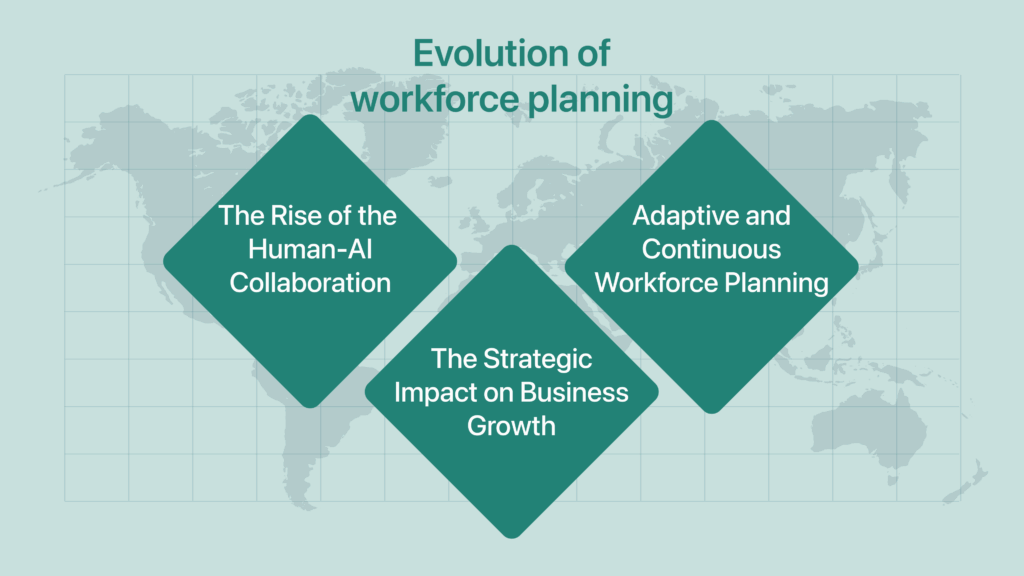
This final section looks ahead to the future of workforce planning. It discusses the growing collaboration between humans and AI, the shift to continuous planning, and the strategic impact on business growth.
The Rise of the Human-AI Collaboration
It’s not that AI will replace humans in workforce planning; that was not the idea. Rather, AI would enable humans to collaborate more powerfully than before. While AI will manage data analysis, prediction, and repetitive tasks fully automated, human HR professionals will focus strategically on employee relations and empathetic decision-making. Importantly, this partnership will bring more effective, efficient, and human-centered talent management with its toolkit.
Adaptive and Continuous Workforce Planning
The traditional annual workforce planning cycle will become obsolete. AI will provide continuous adaptive planning models with real-time insights that allow organizations to respond instantly to market changes. That agility will be a very important differentiator in very successful competitive terms to keep companies one step ahead in the race for talent.
The Strategic Impact on Business Growth
AI in the workforce will become the primary driving factor for business strategy and long-term growth for businesses. It will enable the development of a more agile, skilled, and engaged workforce. It innovates and executes business objectives more effectively. Simply put, AI will transform the function of workforce planning from a mere administrative duty into a strategic engine for continued success.
Conclusion
AI workforce planning radically changes traditional and mostly reactive methods into proactive ones based on data-driven techniques. Through predictive analytics and machine learning, organizations can make smarter decisions about the talent related to the future requirements, skill gap closure, retention enhancement, and diversity and inclusion. Therefore, in the end, this creates flexible and strategic HR functions that promote sustained growth and competitive advantage by optimizing the company’s dearest asset-its people.
About Us
ValueMatrix is an AI-powered talent intelligence platform that helps companies hire better, faster, and without bias. We go beyond resumes to assess skills, behavioral traits, and cultural fit using advanced AI and proven psychological frameworks. Our platform delivers data-driven insights that improve hiring accuracy, reduce time-to-hire, and elevate candidate quality.
ValueMatrix AI enables hiring teams to make confident hiring decisions and build high-performing teams at scale.
FAQs
1. What is the primary goal of AI in workforce planning?
The main goal is to shift from reactive to proactive, predictive planning. AI ensures the right talent is available at the right time. By forecasting needs, identifying skill gaps, and automating tasks, HR can lead to high-value strategic work.
2. How does AI help with talent retention?
AI boosts retention by using predictive analytics. It flags employees at risk of leaving, allowing managers and HR to intervene with personalized support and career enhancement, thereby retaining valuable talent.
3. Is AI replacing human recruiters in this process?
AI is a tool that makes HR recruiters more efficient. It automates tasks like resume screening, freeing up human professionals to focus on strategic decisions, communication, and relationship-building. The human touch remains irreplaceable.
4. What are the main challenges of implementing AI-driven workforce planning?
Major challenges include ensuring data privacy and security, overcoming algorithmic bias for fair decisions, and integrating new systems with the existing HR tech. Change management is also key to building trust and understanding among employees.
5. How can a company get started with AI-driven workforce planning?
Start small by piloting AI in a high-impact area like predictive attrition analysis or skills-based talent mapping. This shows value and ROI, building a case for wider implementation and stakeholder buy-in.