
Table of Contents
- Executive Summary: The 2026 Imperative
- What is Skills Transformation (and Why Now?)
- From Chaos to Clarity: The Structural Challenge of Skill Gaps
- The AI-Powered Toolkit: NLP and Predictive Skill Mapping
- Engineering the Dynamic Skills Taxonomy: A 2026 Framework
- The Psychology of Reskilling: Overcoming Learning Resistance
- The Continuous Learning Loop: Micro-Learning & Experiential Growth
- The Economic Value: ROI of Skill Transformation
- Conclusion: The Future-Ready Workforce
- Frequently Asked Questions (FAQs)
Key Takeaways
- Workforce Agility: Skills transformation significantly improves organizational agility, allowing teams to pivot as market demands shift.
- Real-Time Visibility: AI provides instant visibility into hidden talent, eliminating “skills chaos” and reducing hiring gaps.
- Reduced Hiring Costs: Organizations can lower their dependency on expensive external recruitment by 75% through internal upskilling.
- Higher Retention: A skills-first approach enhances internal mobility, leading to an 88% retention rate among high-performing staff.
- Measurable ROI: AI-driven transformation delivers a 3x faster ROI on new initiatives by accelerating time-to-productivity.
Introduction
The transformation of skills constitutes a strategic method which organizations employ to utilize AI and data-driven methods for changing their fundamental operational structure from rigid job descriptions to a dynamic system that prioritizes skills. The modern enterprise requires this transition because it has become a vital process that enables organizations to continue existing after 2026.
The corporate landscape of 2026 is defined by rapid technological shifts, where technical skills lose their value within just 2.5 years. Organizations now prioritize cognitive agility as their method to achieve competitiveness, whereas they previously relied on talent acquisition. Leaders must adopt a new perspective that sees their workforce as a “liquid” resource of constantly changing competencies instead of treating job descriptions as permanent documents.
The implementation of a proactive transformation framework enables businesses to defend themselves against “Quiet Atrophy,” which represents the slow decline of their competitive edge due to insufficiently updated expertise. AI-powered workforce intelligence now enables leadership to transform impending disruptive events into chances for market domination and organizational resilience.
1. Executive Summary: The 2026 Imperative
The corporate landscape in 2026 exists under the influence of “The Great Transition.” The fast pace of technological progress causes technical skills to lose their value to employers within 2.5 years. Organizations now pursue cognitive agility instead of traditional talent acquisition. The modern enterprise needs skills transformation because it has become a crucial mechanism for survival in contemporary business operations.
The traditional job description system has reached its end. The new system establishes an adaptive system that includes various competencies. Leaders who think ahead now choose to implement proactive skill development instead of waiting for their workforce training needs to emerge. The approach requires organizations to recognize their workforce as a movable resource that contains both permanent functions and temporary skills. Organizations need this mandate to build their capacity for internal resilience.
Static workforces become operational risks when market conditions experience rapid fluctuations. By developing transformation abilities, businesses establish a “liquid workforce” that can transition into different product lines, digital markets, and new service delivery methods without needing to conduct extensive organizational changes.
The company adopts this transformation process to protect itself against “Quiet Atrophy“, which results from outdated knowledge replacing the competitive advantage. The organization maintains continuous operational availability through its proactive transformation framework while leadership uses upcoming disruptive events as opportunities to gain market advantage.
2.What is Skills Transformation (and Why Now?)
Organizations now use skills transformation to replace their fixed role-based hiring methods with an AI-powered system that enables them to hire based on skills. The process begins with capability assessment which determines current abilities and impending skill requirements while data-driven training helps workers develop skills needed to respond to changing market needs and technological advancements.
The transformation of skills in organizations proceeds through a systematic process, which redefines organizational DNA to create a system that prioritizes capability development more than credential achievement. The new method of evaluating human capital constitutes an essential transformation of human capital valuation. In 2026, this company will transform its entire workforce through digital training to develop skills that drive business achievements while maintaining its intellectual property rights to support its business objectives.
Agentic AI has reached its mature state, which creates the driving force for the current need to exist. AI has automated the “task-based” elements of most jobs, which creates a need for workers to develop “human-centric” skills that include complex problem-solving, emotional intelligence, and ethical judgment. The process of skill transformation provides a single pathway that enables people to move from traditional job functions into modern employment requirements.
The “Skills-First Economy” has emerged as an increasingly dominant economic system in our current time. Global investors and ESG regulators increasingly view “Human Capital Value” as a primary indicator that assesses the financial status of companies. Organizations that implement a skill transformation strategy can effectively reduce their employee risks, which makes them an appealing option for investors who want to invest long-term in their business operations.
The emergence of decentralized learning platforms has created educational opportunities that allow people to access education without needing to complete traditional degree programs. The process of skill transformation functions as an essential verification mechanism for companies, which allows them to validate their employee performance data instead of depending on outdated external competency assessment methods.
3. From Chaos to Clarity: Why do organizations struggle with skills gaps?
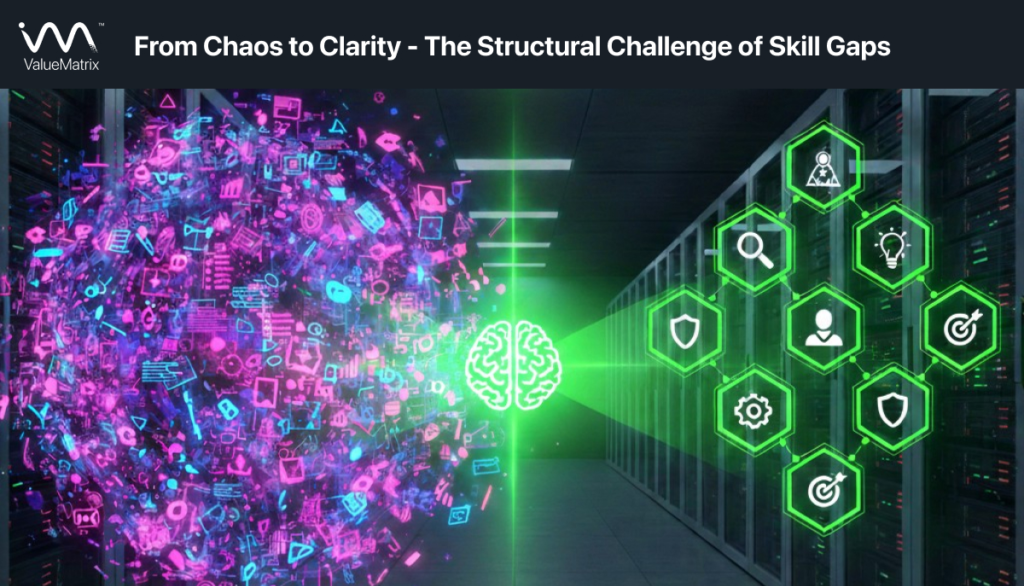
Organizations struggle with skills gaps primarily due to “skills chaos”—a lack of visibility into the hidden talents of their current workforce. The absence of a centralized data system prevents organizations from sharing their internal skills which leads to duplicate hiring practices and the development of hidden job openings that reduce operational efficiency.
The company loses productive capacity through unrecognized “Skills Chaos.”The situation occurs when executives realize their organization has lost its competitive edge, yet they lack the information needed to solve the problem. The absence of visibility creates “Ghost Vacancies”, which occur when positions remain empty for extended periods because essential skills have not been properly identified. The organization needs to conduct an extensive assessment of its employees’ abilities, which goes beyond their documented work history.
Employees often “trap” their skills inside their departmental boundaries. The finance department requires advanced data visualization skills, which a marketing manager possesses, but the skill transformation process will not reveal this ability. The organization faces redundant staff recruitment, ineffective training resource expenditure, and dissatisfied employees who believe they have been typecast into specific roles.
Organizations need to implement the “Granular Lens” to achieve streamlining from chaos into order. The process requires breaking jobs into smaller tasks, which will reveal the essential micro-skills needed to perform each task. The “skills gap” creates a misleading perception because it actually represents a “skills distribution problem.” The process of establishing clarity enables organizations to precisely match their current workforce resources to their most pressing requirements.
The process of structural renovation enables the identification of “Capability Leakage”, which describes how skilled employees quit their position because their training development requirements remain unrecognized. The organization provides individual-level transparency, which enables the company to create personalized development plans that match the employee’s career growth with the organization’s strategic goals.
👉 Learn how to identify hidden talent in your workforce
4. The AI-Powered Toolkit: NLP and Predictive Skill Mapping
How does AI enable skills transformation?
AI enables skills transformation by acting as a digital nervous system that extracts skills from unstructured data and maps them to business needs. The AI system employs NLP to determine present talent distribution while it uses predictive modeling to forecast upcoming skill deficits which will impact business operations.
The manual process of handling skill transformation management will become impossible in 2026. The scale of data requires an AI-powered engine. The HR department uses AI as its Core Digital Nervous System to detect skill development patterns and forecast skill shortages, which will create operational problems before they occur.
AI-powered platforms use Natural Language Processing technology to examine project results, internal messages, and employee evaluations for the purpose of creating Dynamic Skill Passports, which contain information about all staff members. The passports automatically refresh their contents to show current skills that a person has, instead of displaying their permanent past accomplishments. AI Skill Assessment in Recruitment Improves Hiring Process. AI enables organizations to create predictive models for their required skills.
AI informs Growth Managers that Prompt Engineering is becoming less valuable, while AI Governance will experience upcoming increases in demand. The organization can start transforming its skill base before its rivals because it possesses advanced knowledge about upcoming skills.
The AI tools enable organizations to conduct Skills Benchmarking, which allows them to compare their internal skill density against the skill levels of top organizations without revealing their particularities. The external view of talent is essential for skill transformation because it prevents companies from viewing their talent base as their entire talent pool while they develop their internal capabilities.
5. What is a dynamic skills taxonomy? A 2026 Framework
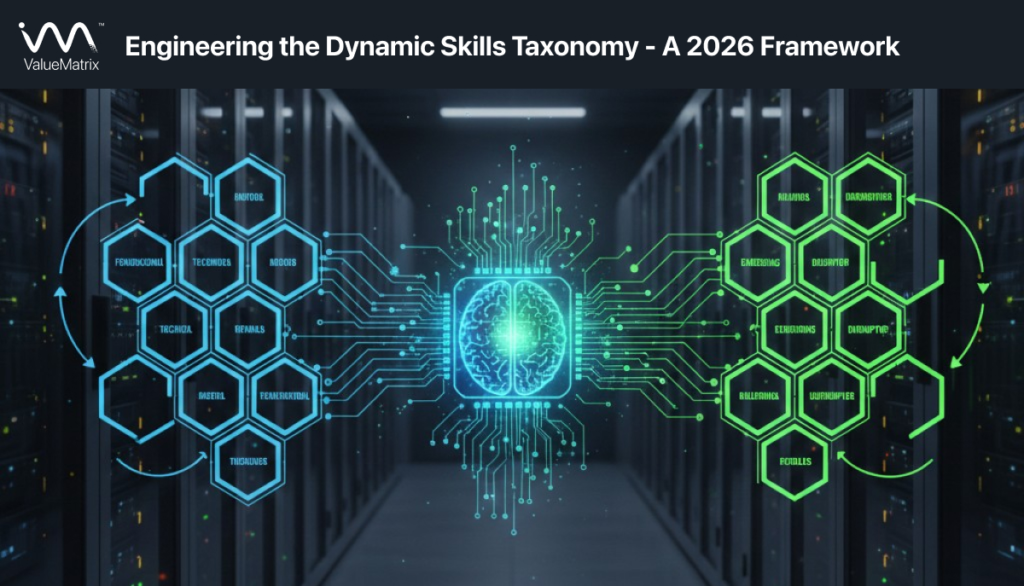
A dynamic skills taxonomy is an evolving data framework that categorizes workforce capabilities into fluid clusters rather than static job titles. The system uses AI technology to identify skill relationships which enable employees to acquire new skills 40% more quickly because they can use their current knowledge base as a foundation.
The Dynamic Skills Taxonomy serves as the foundation for creating workforce transparency. A dynamic taxonomy works as an active data system that updates its job categories according to current changes. The system divides skills into three categories, which include Core Foundationals (ethics, communication), Functional Technicals (coding, accounting), and Emerging Disruptors (quantum computing, sustainable supply chain).
Organizations need to combine their internal data resources with information about the external labor market to create this system. AI identifies Skill Adjacencies because it understands that people who possess advanced data analysis abilities can learn to perform AI model auditing. The process of Skill-to-Skill mapping enables organizations to achieve swift skill development because it allows employees to learn new skills at a rate that is 40 percent faster than traditional methods of skill development.
The development of a complete taxonomy requires the establishment of a common Skill Language. The Sales team uses Data Analysis to mean something different from what the IT department understands in every company. A unified taxonomy ensures that when the system identifies a need for a specific skill transformation, everyone across the organization understands exactly what that competency entails. The taxonomy requires the addition of a Depreciation Scale element.
The pace of skill aging differs among emerging abilities in 2026. The skill transformation engine uses specific technical proficiencies as its shelf-life point to detect when teams reach their Skills Obsolescence stage. The system activates its upskilling process to prevent productivity drops, which it detects when team members begin to lose essential skills.
| Skill Type | Example | Impact |
| Core Foundational | Ethical Judgment, Communication | Drives leadership and culture. |
| Functional Technical | Python, Statistical Accounting | Enables specific task execution. |
| Emerging Disruptor | Quantum Computing, Sustainable Supply | Powers future market advantage. |
6. Why do employees resist reskilling?
The main reason employees do not want to learn new skills is because they experience identity-based resistance which makes them believe that upcoming technology will take away their professional worth. Employees experience learning fatigue together with psychological safety problems which make them see transformation programs as threats to their employment instead of opportunities for personal development.
The main obstacle to skills transformation progress stems from human behavior, which leads to people fearing they will become outdated. Workers decide against picking up new skills because they believe their ongoing job situations will lead to unstable employment conditions. In 2026, psychologists have found that “Identity-Based Resistance” is the primary reason transformation programs fail. Workers who self-identify as “Manual Accountants” view skill development programs as personal identity challenges that threaten their self-definition.
Organizations need to change their story about “Augmentation” from “Replacement” to achieve their goal. Organizations must create work environments that safeguard employee mental well-being to achieve their goal of improved skill development results. Workers need to understand that their worth depends on their capacity to adjust to different situations instead of their ability to use one particular tool. AI enables employees to develop their skills through “Low-Stakes Learning” environments, which allow skill practice to occur without the threat of performance assessment.
Cultural elements here play an essential part. All leaders must demonstrate the required actions through their personal skill advancement process. When a CEO publicly shares their progress in learning “AI Strategy” or “Sustainability Reporting,” it makes it clear to the entire organization that learning is a continuous journey for everyone, regardless of hierarchy.
Organizations will have to solve the problem of “Learning Fatigue” through active application. The 2026 workforce is bombarded with information; therefore, skill transformation must feel like an energy generator, not a drain. Companies that match learning activities with personal goals while providing actual “well-being credits” for progress milestones will turn resistance into active engagement.
7. How does continuous learning enable skills transformation?
The process of continuous learning establishes skill development through its permanent system which replaces traditional training methods with micro-learning activities and hands-on learning experiences. The system operates by providing instant skill updates which enable employees to transition between learning new material and implementing it in their most important work tasks.
The “one-and-done” training seminar format has become outdated in the fast-moving business environment of 2026. Organizations must establish a skills transformation process that continues to operate throughout time. AI-powered “co-pilots” deliver micro-learning content to employees as they work by providing training modules that last 3-5 minutes.
Students need to practice what they learn in theoretical knowledge to achieve effective learning results. The second part of the loop consists of Experiential Growth. AI matches employees who completed “Agile Facilitation” training with appropriate projects that need these skills. Employees use the “Internal Gig Marketplace” to demonstrate their acquired skills through taking part in significant projects.
The loop completes its operation through “Social Learning.” AI identifies internal experts and facilitates peer-to-peer mentoring. Organizations use employee teaching of newly acquired skills to strengthen understanding while creating a workplace that encourages teamwork. The system develops its own internal capacity to establish skills while minimizing needs for outside trainers.
The loop requires operation without any obstacles that create additional challenges. The best skill transformation platforms of 2026 provide direct integration with work tools such as Slack, Teams, or specialized IDEs. The system enables users to move from “Doing” to “Learning” and back to “Doing” while staying on the same digital platform, which helps them acquire and learn newly acquired skills.
8. What is the ROI of skills transformation?
The ROI of skills transformation results in 75% lower talent acquisition expenses and 3x quicker productivity gains for new projects. The organizations which focus their hiring efforts on internal mobility achieve 88% employee retention while increasing their market response capability by 50%.
The financial argument for skills transformation is overwhelming. Employee replacement costs, which companies must pay when they hire external workers, are avoided by companies that invest in their current staff. The skills-based organization demonstrates superior agility by 57 percent, and its ability to create new products demonstrates a 49 percent improvement over traditional organizational structures.
| Metric | Traditional Model (Hiring) | Skills-First Model (Transformation) | 2026 Financial Impact |
| Cost per Hire | $25,000 – $60,000 | **$5,000 – $12,000** | 75% reduction in talent spend. |
| Time to Productivity | 6-9 Months | 2-3 Months | 3x faster ROI on new initiatives. |
| Retention Rate | 65% (Avg) | 88% (High) | Predictive Analytics in HR |
| Skill Agility | Low (Fixed Roles) | High (Fluid Teams) | 50% increase in market response. |
The “Risk of Inaction” extends beyond its immediate financial impact. The 2026 economy punishes businesses that delay their market response. Skill transformation provides organizations with an effective method to defend against staff members who become outdated. Your most valuable asset, which consists of your people, will keep increasing in value through this process. AI-driven workforce planning enables organizations to create job role models for the year 2030.
The “Capital Efficiency” concept requires evaluation at this stage. Current employees who possess optimised skills enable organizations to achieve revenue growth without needing to increase their workforce count. The value of skill transformation through “Skills-Based Scalability” has reached boardroom status because it enables companies to pursue rapid expansion while keeping their operational teams small and highly competent.
9. Conclusion: The Future-Ready Workforce
 The path that leads to workforce clarity from skills chaos requires ongoing dedication
because it establishes an unending change in the company’s core values. The market will reward 2026 competitors who can learn, unlearn, and relearn faster than their rivals. Skills transformation serves as the engine that drives organizational transformation.
Growth Managers can build resilient organizations through their strategic AI partnerships and their use of skills as currency. The system provides equal chances to all participants who receive acknowledgment based on their actual abilities. Leadership performance will be measured in 2030 through their capacity to manage effective transformation of skills and strategic development.
The skill transformation process represents a dedication to enhancing human capabilities. The process recognizes that human creativity and empathy-based leadership abilities serve as the core value drivers while technology keeps progressing. Organizations that supply transformation tools for their employees to use during the AI era will definitely establish their position as leaders in this new technological environment.
10. Frequently Asked Questions (FAQs)
1. What is the difference between Upskilling and Skills Transformation?
Upskilling requires a person to master a particular new ability. Skills transformation requires organizations to completely redesign their hiring process through internal talent development activities, which use a data-driven skills-first system to manage all talent movement processes from hiring through internal promotions.
2. How long does a typical Skill Transformation take to show ROI?
The implementation of an AI-powered skills taxonomy and tracking system leads to financial benefits. They cut recruitment expenses while boosting internal employee movement within 6 to 12 months after its launch.
3. Is “Workforce Clarity” only for large enterprises with big budgets?
No. SMEs actually require skill transformation more than large organizations because they must minimize their employee count to stay within budget constraints. The system enables organizations to achieve maximum performance from their entire workforce, which creates a significant competitive edge in specialized industries.
4. How does AI prevent bias during the Skill Transformation process?
AI systems use objective data points, which include project results, certified skills, and technical evaluations. They help to create performance assessments that eliminate the “Credential Bias”, which gives preference to specific degrees, and the “Subjective Bias,”; which leads to favoritism in traditional human-led promotions.
5. How do organizations identify skill gaps effectively?
Organizations use artificial intelligence to evaluate current employee skills against their future strategic needs and industry standards, which helps them identify skill gaps. The AI system detects “Capability Leakage” through project data analysis and performance review evaluation, which shows areas where talent is not being fully used. The AI system recommends learning paths that will follow the identified capability gaps to maintain operational efficiency.
6. What industries benefit most from skills transformation?
Every sector benefits from skills transformation, but its effects reach their peak in fast-paced fields such as technology, finance, and manufacturing. These sectors face rapid technological shifts where technical skills depreciate quickly. Through skills transformation, these organizations can redeploy employees who have been trained for their existing positions to enter new fields such as AI ethics, quantum computing, or sustainable supply chain management.
7. How does skills transformation reduce hiring costs?
The process of skills transformation enables organizations to save 75% of their hiring expenses, because it enables them to move staff members to new positions instead of needing to hire new staff members from outside. Organizations choose to develop their existing workforce rather than pay for headhunters who require high fees and travel expenses and lengthy onboarding procedures. Companies can achieve revenue growth through “skills-based scalability” because this method enables business expansion without needing to hire more employees.
8. What tools are used for skills transformation?
The most effective tools include AI-driven workforce intelligence platforms like ValueMatrix, which provide granular behavioral insights and predictive analytics. The essential tools for organizations include dynamic skills taxonomies and internal gig marketplaces and micro-learning co-pilots, which function through Slack and Microsoft Teams to support continuous employee development.