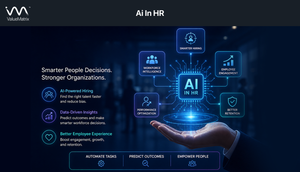


AI is no longer merely a buzzword or a hollow cliché; it is a future reality that will redefine industries and everyday life.
Over the recent years, AI has traversed from the edge to the core of talent intelligence—how businesses gather, assess, and hire employees.
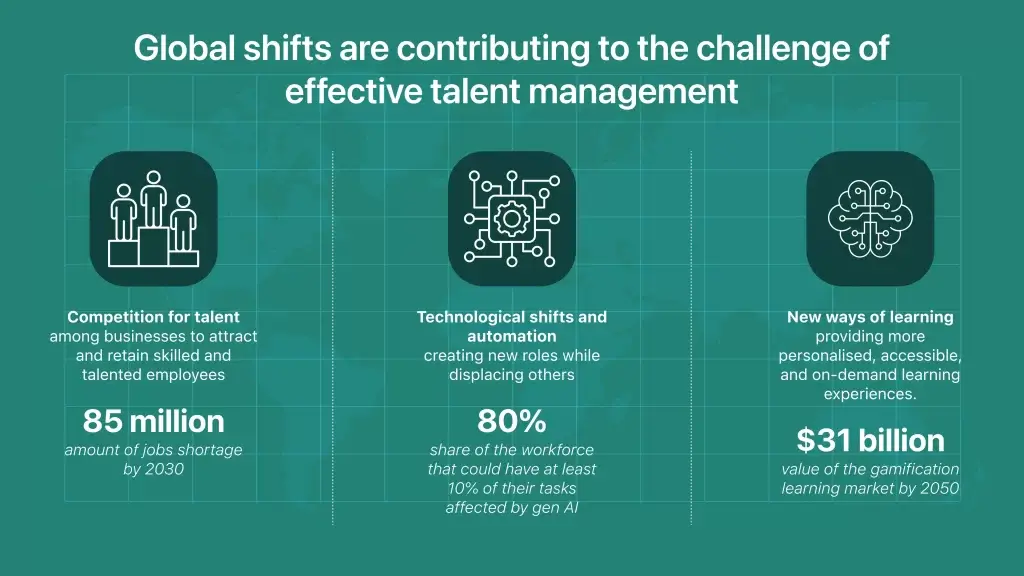
The World Economic Forum states, “By 2025, AI is expected to eliminate 85 million jobs globally, but it will also create 170 million new jobs.” This immense change means new generation workers will have to be more adaptable, digitally literate, and able to work alongside intelligent mechanisms.
Given the changing future job market, preparing for the 2030 job market means implementing the new AI-driven hiring strategy. The same WEF report states that by 2030, 40% of new expertise will be needed for most job roles.
Analytical thinking, technical skills, and the use of AI for data analysis will become necessary. AI will do mundane tasks, leaving recruiters time to find the right employee and build strong future teams.
This blog will offer convincing insights into how job roles change with AI, what skills will be expected, and how to future-proof workforce planning.
Here, you will understand AI’s challenges and opportunities, how AI helps in hiring processes, and tips for supporting a workplace of continuous learning.
How AI is Influencing Recruitment
A. Automating Hiring Process
AI automates most of the hiring process. Here’s how AI is changing the core steps of the recruitment flow:
1. Parsing Resumes
AI scans resumes almost instantly, ranks, and shortlists the right candidates, saving recruiters’ efforts and time. In addition, AI maps hiring history, thus improving with every use in picking the best brains.
2. Sourcing Candidates
It can also assess the business’s existing candidate database to select the right people for future jobs and new openings, utilizing the value of past applicants.
Artificial Intelligence assesses huge repositories, job boards, and social channels to pick and invite the best aspiring candidates for vacant roles. This filtered approach ensures personalized outreach and a better chance of enticing the best brains.
3. Interacting with Candidates
These bots connect with candidates throughout recruitment, scanning, and collecting first-hand information. They even map qualifications, narrate JD, and suggest next steps, ensuring aspirants stay posted and interested.
4. Allocating Interview Slot
AI-driven tools even book time slots for the interview process, connecting candidates and interviewers at mutually agreed-upon times. This eliminates delays and frees recruiters to make more value-driven decisions.
Thus, technology automation is rewriting recruitment codes by expediting operations, making them more candidate-centric. It’s allowing organizations to make intelligent hiring choices in this dynamic talent market.
In this context, according to a McKinsey research, by 2030, nearly 30 percent of current working hours could be automated.
B. Evolution of Job Roles and Skills

Jobs Getting Automated or Transformed by AI
Intelligent systems are automating iterative, monotonous, routine, or heavily data-driven jobs, thus drastically changing the work scenario across multiple industries. These include:
- Retail and Customer Service: Chatbots and virtual assistants are the new customer support tools. They can also take over sales roles, eliminating human intervention.
- Administration and Finance: We are entering the world of automated merchandizing and loan processing.
Roles More Likely to be Eliminated
- Manufacturing and Labor Market: AI-powered bots and automated tools widely perform menial tasks such as collecting, packaging, performing QC, and operating machines in manufacturing units. Even the roles of bank tellers, loan executives, and administrative officers are at risk of being extinguished.
- Logistics and Transportation: In this industry, self-driving vehicles’ inventory systems are taking over the jobs of transporting, warehousing, and delivering.
AI cannot take over these jobs overnight. It starts by automating some tasks within a job and inspiring staff to adapt and switch to higher-value responsibilities.
Evolving Roles in the AI Era
While AI takes over some roles, it generates new roles for future aspirants.
- AI and ML Specialists: People who develop, implement, and adapt to AI tools are in demand.
- AI Regulatory Specialist: With the growing impact of AI, the code makers are also in great demand. They will resolve performance issues, deploy fairness, and ensure responsible ML in companies.
- Hybrid Workforce Managers: They work as a connection between human workforce and AI.
- Big Data Engineers: Trust in data-driven insights created this opportunity for data mining, interpretation, and insight generation.
- AI Curators: These people train AI tools, build datasets, and tailor algorithms for different business needs.
Skills Required for AI Career
With the evolving work culture and future challenges, the workforce will require some critical expertise:
- Analytical skills: With AI performing menial tasks, humans will make thoughtful decisions, solve complex issues, and generate unique concepts.
- Agility and Upskilling: Continuous learning, multitasking flexibility, and adaptability to a challenging ecosystem will be necessary.
- Tech Expertise: Proficiency in digital space and tools, and quick learning skills will be necessary.
- Contributing Team Member: The potential to work well in a team will be required, as most companies have diverse teams.
Eventually, high-tech and multitasking workers with an analytical mind, a teamwork approach, and a willingness for continuous improvement will thrive and succeed.
Critical Expertise for Future Jobs
With the evolving workplaces, many skills will be needed for the current and future workforce:
- Judgment and Critical Analysis: With AI handling more repetitive work, the human workforce can focus on problem-solving, innovation and strategic skills.
- Collaboration and Engagement: Coordination with teams and hybrid human-AI ecosystems will maximise AI and digital evolution.
- Digital Capability: Technology skills are essential for learning and using new tools and technologies.
- Flexibility and Lifelong Learning: Future employees must be adaptable and willing to upskill to remain valuable and in demand.
Strategic Workforce Planning With AI
A. Workforce Evaluation and Forecasting Analysis
Using the above insights, AI can discover:
- Skill Deficiency
- Evolving Roles
- Workforce Churn
Risk Assessment for Diverse Premeters
Companies can perform circumstances-based AI evaluation, such as market slumps, technological advancements, regulatory shifts, or market outreach.
Core Stages of AI-driven scenario planning include:
- Identify Scenarios: Organizations consider expected future states such as fast growth, recession, technology adoption, and aligning with their industry and revenue model.
- Performance Analysis and Resilience Checking: Businesses analyse their workforce strategy in alignment with business standards to determine whether they are disaster-ready.
- Testing: AI platforms evaluates how each circumstance would impace the workforce intelligence, skill gaps, results and forecasts.
- Intelligent Decision-Making: Such planning helps HR experts and CEOs to make strategic decisions about recruiting, training, and resource allotment under challenging scenarios.
Companies can future-ready their teams by combining scenario planning and predictive analytics. This gives them confidence that they have the required team to thrive in difficult times.
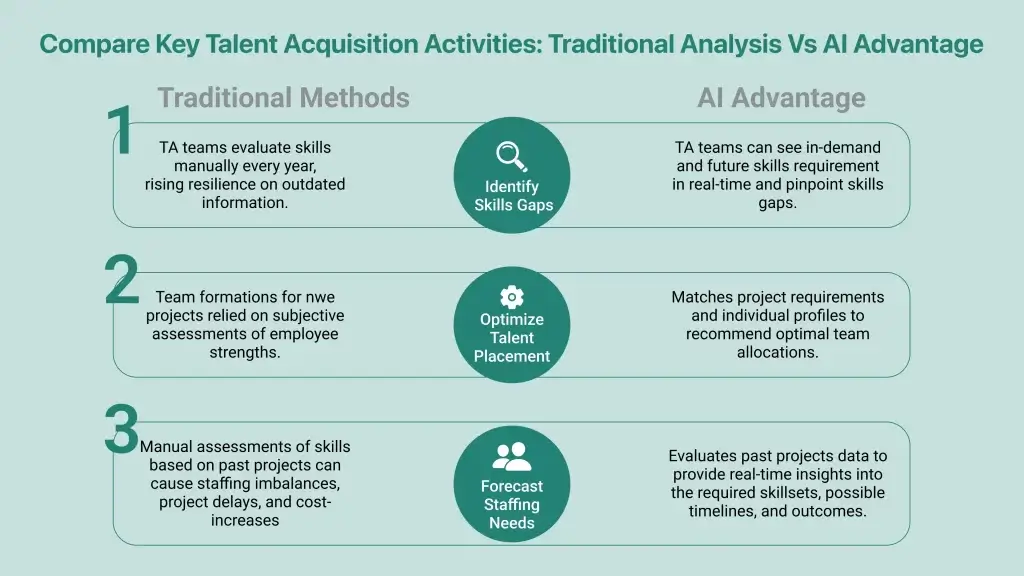
B. Skill Gap Diagnosis
AI-driven talent mapping is rewriting how companies manage their employees’ potential.
AI offers an instant, fair manifestation of each employee’s capabilities by assessing data from sources like resumes and performance data. This ongoing mechanism allows companies to detect skill gaps quickly, personalize employee growth, and adapt training with changing requirements.
This depicts the true picture of the talent ecosystem of business.
Why is Patching Up Skill Voids Important in Recruitment Strategies?
Identifying and closing skill gaps ensures an organization hires the right talent to meet current and future business workforce needs. It also promotes productivity, reduces hiring costs, and strengthens employee retention.
This proactive initiative keeps businesses in the game.
Upskilling – Need of the AI Era
Today, learning is necessary to stay in business or have an edge. With developing technology, companies need a flexible workforce ready to embrace change and eager to learn. Ongoing learning is the key to keeping the workforce valuable and in demand.
According to an IBM report, most company owners say that 35% of their staff require reskilling, compared to only 6% in 2021.
A. Implementing Effective Learning and Development Programs
To build a culture of continuous learning, companies can take some steps, which include:
- Align L&D with Company Goals
Harmonising the learning and development modules with the company’s vision is necessary for the relevance and effectiveness of training programs. - Craft Expandable Learning Modules
Create workshops, online modules, and training lessons to meet various learning needs and brush up on needed skills. - Perform Periodic Skills Gap Analysis
Through performance reviews, surveys, and analytics, HR professionals can assess current employees’ skills and evolving needs, spotting key upskilling and reskilling needs. - Design Programs with Clear KPIs
Set actionable benchmarks for training programs, track participation and growth, and collect feedback to ensure causes are addressed; if not, redefine benchmarks. - Exploit Technology and Multiple Formats
Employ e-learning concepts, mobile apps, microlearning and gamification for making training/learning intuitive, accessible, and enjoyable to all employees - Embrace Laissez-faire Policy for Development
Encourage workers to learn from mistakes, experiment and learn, and pursue continuous growth with minimal management intervention. Reward and appreciate such learning initiatives.. - Amp Up Training Modules
Start with beginner’s training, scale up popular ones, and regularly upgrade content to keep pace with the changing industry and workforce needs.
B. Building a Future-Ready Talent Pipeline
Collaboration for Talent Development
With AI reinventing the job market, recruiters, companies, and schools should collaborate to seal skill gaps and develop a powerful talent funnel. This association ensures that talents align with future role expertise and prepares qualified candidates for the future.
How Collaboration Promotes Talent Acquisition
- Vocational Training: Internships provide on-the-job experience, allowing students to build practical skills and develop strategic networks for seamless transition from education to work.
- Narrowing Skill Void: A Curriculum with material synchronizing with the industry needs creates a job-driven workforce.
- Constant L&D: Continuous training program helps a future-ready career aligned with the company vision.
- Technology-based growth: Using AI and research insights, associates foresee skill requirements and accordingly deliver training, making the employees resilient and future-ready.
How to Develop Talent Repository for Future Jobs
- Polishing Leaders: Spot and mentor proactive and enthusiastic leaders through tailored development programs and challenging assignments.
- Rely on Talent-based Job Roles: Promote scalable talents, not mere qualifications; expand the candidate pool and promote workforce agility.
- Encourage Everyday Learning: Plan to conduct training program every day at the workplace and reward skill acquisition.
- Meet Training Needs: Create learning modules that meet the diverse skill needs of all staff inclusively.
The joint effort of training bodies and businesses can be instrumental in building an effective talent repository. Such associations can develop and train the right candidates who can strategically fit within the culture and job requirements of the businesses.
It not only delivers useful learning opportunities but also creates an everlasting supply of agile, highly scalable, and reliable talent for the future workforce.
Promoting Diverse and Inclusive Hiring with AI
Reducing Bias in Recruitment Processes
Hiring can often be unfair. With biases sneaking into hiring, AI is a ray of hope in instilling nondiscrimination in this industry. By establishing judiciousness in recruitment, AI can build a more reliable playing field for all players seeking jobs.
AI can rewrite the history of the recruitment industry by parsing and picking candidates without favoritism.
- Fair Job Classifieds: AI finds and hides terms that might offend some people, welcoming candidates from all strata of life.
- Private Screening: AI purposely withholds the applicants’ identity for fair screening.
- Neutral Evaluation: AI assesses candidates, prioritizing their capabilities using transparent, fair standards.
- Inclusive Practice: Using diverse inputs to coach AI, tracking AI regularly for prejudice, and installing fairness into the AI’s program enable fair recruitment.
The Importance of Transparency and Fairness in AI Use
Reliable AI can lead to fair and efficient recruitment. It underscores smart decision-making and data use. Strategic use of diverse data, fair audits, and ethical governance can set the flow for diverse and inclusive hiring operations.
Smooth Transition to AI Adaptability
Transitioning to a new role must not be a roller coaster ride. The company must ensure the switch is easy and painless.
Checklist for Seamless Transition
- Open Door Policy: Justify the benefits of evolving and training the workforce early to retain a synergistic ambience with the least conflict.
- Right Training: Use different training layouts – guides, workshops, and visuals – to offer diverse learning choices and catapult new skills.
- Boost Top Management: Support leaders eager to accept changes and try building a culture of creativity and critical soft problem-solving skills.
- Constant Support: Provide guidance to the help hubs, Q&A sessions, and help them learn to resolve challenges as they arise.
- Tailored Tutorials: Such tutorials will keep the staff focused and deliver project-driven learning choices for improved engagement.
Such strategic transitions allow the workforce to navigate the changes easily, without stonewalling the company’s growth and workforce development.
Conclusion
AI is not new to HR, and workforce planning with AI is critical to the complete HR cycle. It can drastically influence its incubation, implementation, and operation, thus driving incredible efficiency, accuracy, and new opportunities.
AI today can automate iterative tasks, better navigate candidate sourcing, and prompt data-driven decisions, freeing CHROs to spend enough time on strategic talent management and building an inclusive and high-performing batch of teams.
Using AI’s ability to profile skills, foretell talent needs, and tailor learning, businesses can know and meet the needs of skill gaps and stay competitive in a fast-changing market.
However, this paradigm shift requires HR professionals to accept continuous learning; they must promote innovation and master ethical and transparent use of AI to ensure judiciousness and inclusivity. The point is that investing in AI and lifelong learning is essential for any business to spearhead the future talent ecosystem.
About us
ValueMatrix helps organizations build culturally cohesive teams with AI-powered recruitment and retention strategies. We educate corporate leaders on the need to involve and encourage all generations to adapt to enterprise values and participate actively to gain excellence.
Our AI-powered platform transforms talent acquisition with intelligent hiring techniques backed by established psychological frameworks. We partner with HR professionals to conduct unbiased and holistic assessments for aspiring candidates.