
In This Article
- How is AI transforming the hiring process in 2025?
- What are the advantages of using AI in hiring?
- Why is legal and ethical compliance critical when using AI in hiring?
- What are the main legal risks and compliance challenges with AI in hiring?
- What real-world examples illustrate AI compliance failures in hiring?
- What are the key laws and regulations governing AI in hiring globally?
- What best practices should organizations follow to use AI legally and ethically in hiring?
- How Valuematrix AI is using AI in hiring and staying on the right side of the law
- What are the predicted trends for the future of AI in hiring?
- How can organizations balance the benefits of AI with the need for human judgment?
Introduction
Artificial intelligence in hiring is no longer a new concept. It is changing the entire hiring segment by making it quicker, more professional, smarter, and more accurate.
Do you know that the AI in the Talent Acquisition market is expected to reach a value of $1.35 billion by 2025, with a revenue forecast of $2.67 billion? This predicts the impact of AI in Talent Intelligence.
Until recently, recruiters manually reviewed and selected thousands of applications. It was a slow and tedious process, often resulting in mismatched hires due to human error.
Today, AI in the hiring process can do all the mundane tasks. For example, sorting applications, fixing interviews, and even engaging applicants to address their concerns via chatbots.
This automation enables hiring teams to spend more time on constructive and productive relationships, ultimately leading to better hiring decisions.
However, the fact is, innovation comes with responsibilities. Using AI in hiring is no different. Although it can simplify recruiters’ jobs, it may lead to biases if not managed well.
Given the threat, some set laws govern the use of personal data and the recruitment process. Companies should deploy secure and transparent AI tools free from discrimination to follow these rules.
Non-compliance leads to penalties, lawsuits, and irreparable damage to the company’s reputation.
In a nutshell, AI in hiring can empower companies only if used fairly.
The Rise of AI in Hiring and Advantages
Worldwide Adoption
Almost every company has now started including AI-based HR hiring tools. HR professionals in most countries, especially in the United States, use some form of AI tools in the hiring process. Ninety-nine percent of HR experts utilize some type of AI system in their hiring funnel.
Common Uses of AI in the Hiring Process:
- Profile Evaluation: Sorts many resumes to pick the right applicants.
- Candidate Pairing: Matches applicants’ potential and experience with the job requirements.
- Interview Setting Up: Automates the streamlining of interviews, saving time and effort in hiring professionals and applicants.
- Trend Analytics: Anticipates job roles and candidate success driven by data patterns.
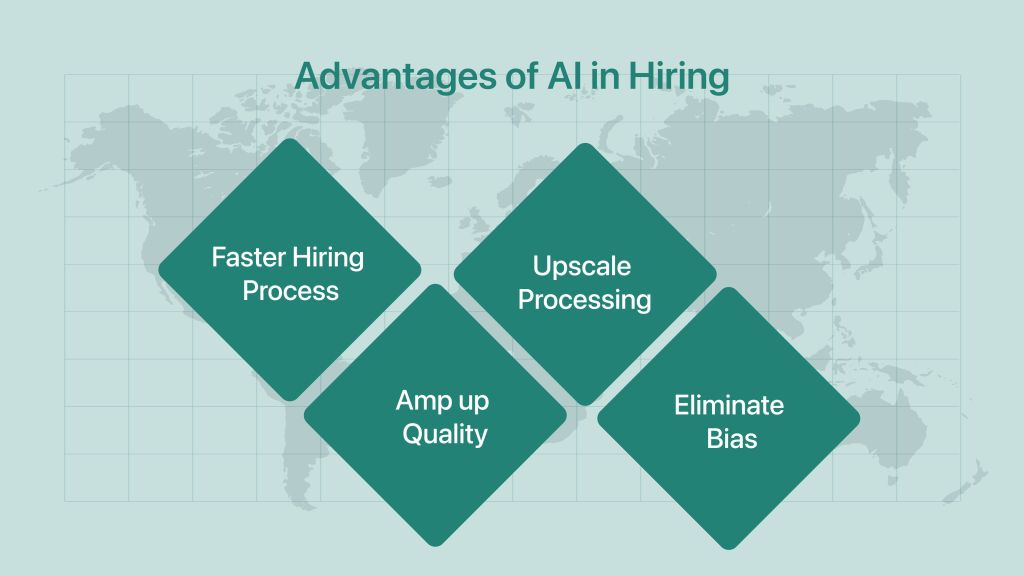
- Advantages of AI in Hiring:
- Faster Hiring Process: AI reduces hiring time by 70%, streamlining the recruitment cycle.
- Upscale Processing: With the aid of AI, HR professionals can efficiently manage thousands of applicants.
- Amp up Quality: Data-driven predictive evaluation increases hiring accuracy by 40%, and helps to select the most suitable applicants.
- Eliminate Bias: If processed accurately, AI helps reduce unintentional human biases by capturing objective data.
- Human-AI Combination:
AI’s collaboration with humans will bring better results than replacing them. The best hiring is the right balance of AI’s speed and data insights with human judgment and intelligence.
Legal Risks and Compliance Challenges
Every evolving technology comes with risks and challenges. AI in hiring is no exception. Here are the core legal threats and setbacks:
Bias & Discrimination
- AI can take on and use past biases:
- AI can fetch and learn from available data. If the data has biases, AI in hiring will reproduce and often intensify these biases in the hiring process.
- For example, suppose AI is fed with data from a manufacturing unit with a pattern of hiring men for mechanical roles. In that case, it might start picking only male candidates for the role, rejecting female applicants, even if they are qualified.
- Often, AI resume screening software chooses white and male applicants over others.Black males were not selected over white male candidates.
- Even Amazon faced gender bias in its AI hiring tool, which is a real instance ofalgorithmic discrimination.
- Multidimensional biases—where multiple identities play a role in AI bias, not only a single type of bias.
- Such AI discrimination in hiring does not comply with anti-discrimination laws like the U.S. Equal Employment Opportunity Commission (EEOC) guidelines and attracts legal action against the companies.
Data Privacy & Consent
- The intensely critical pool of data requires privacy laws:
- A large volume of data is generated daily in this technologically evolving world. AI software must process a vast amount of sensitive data, including addresses, assessments, reports, and data from social media platforms.
- To protect such data, laws such as the General Data Protection Regulation (GDPR) in Europe and the California Consumer Privacy Act (CCPA) in the United States have been enacted. These laws require data generators to disclose how they gather, store, and process the data, and with due consent from the data providers.
- Non-compliance with these laws can result in severe penalties. Recently, a European company was fined €20 million for unlawfully using facial recognition technology.
- Apart from this, companies must be transparent in their data usage and provide individuals with the right to access, edit, and delete their data.
Transparency & Explainability
- “Black box” AI models warrant non-compliance:
- The black box is mostly deployed for its unparalleled accuracy in complex tasks. These are called hiring tools decisions, which are not easy to justify.
- Absence of transparency doesn’t go well with the defined laws that ask companies to divulge how AI makes hiring decisions. A live example is New York City’s Automated Employment Decision Tools (AEDT) law, which requires businesses to explain how AI-driven decisions were made and to conduct annual bias audits periodically.
- Non-clarity can also dilute credibility with candidates and regulators, intensifying the threat of legal actions and reputational damage.
Key Laws and Regulations Impacting AI Hiring
USA
Here are the laws governing AI tools in the HR industry:
- Federal Laws
- State Law
- Rise in State-led AI Bills
With the rise of AI tools, nearly 400 AI laws have been established in about 41 states, a remarkable increase, reflecting growing concern about AI’s impact on workplaces. - Colorado Artificial Intelligence Act (CAIA):
It was the initial detailed state bill on AI hiring tools that became effective on February 1, 2026. According to this bill, “high-risk” AI mechanisms used in recruitment decisions require unbiased audits, disclosures, documentation, and risk assessment. - California:
These regulations for automated decision-making tools came into existence in March 2025, likely effective July 1, 2025. This law requires employers to test for bias, maintain logs for four years, and ensure AI filters are job-driven and unbiased. - Remaining States:
NY, Connecticut, and NJ plans to expand laws on bias audits, candidate notifications, and annual impact evaluations for AI hiring systems.
- Rise in State-led AI Bills
- Other Legal Updates
- Litigation:
Courts permit discrimination claims against businesses and AI system vendors to proceed, like the 2024 class action against Workday Inc. for alleged AI-driven hiring bias.
- Litigation:
European Union
- EU AI Act:
Initiate new guidelines for transparency, liability, and risk management in AI-driven hiring initiatives, protecting fundamental rights. - GDPR (General Data Protection Regulation):
It oversees the collection, processing, and personal record keeping, requiring transparency and confirmation for AI use in hiring.
Other Territories
- India:
It still plans to create new AI rules to ensure compliance in talent intelligence and protect against AI discrimination. - APAC:
Other countries across the Asia-Pacific territories are working on their data protection and transparency initiatives, focusing on AI’s impact on hiring ecosystems.
Tips for Regulatory and Ethical AI Hiring
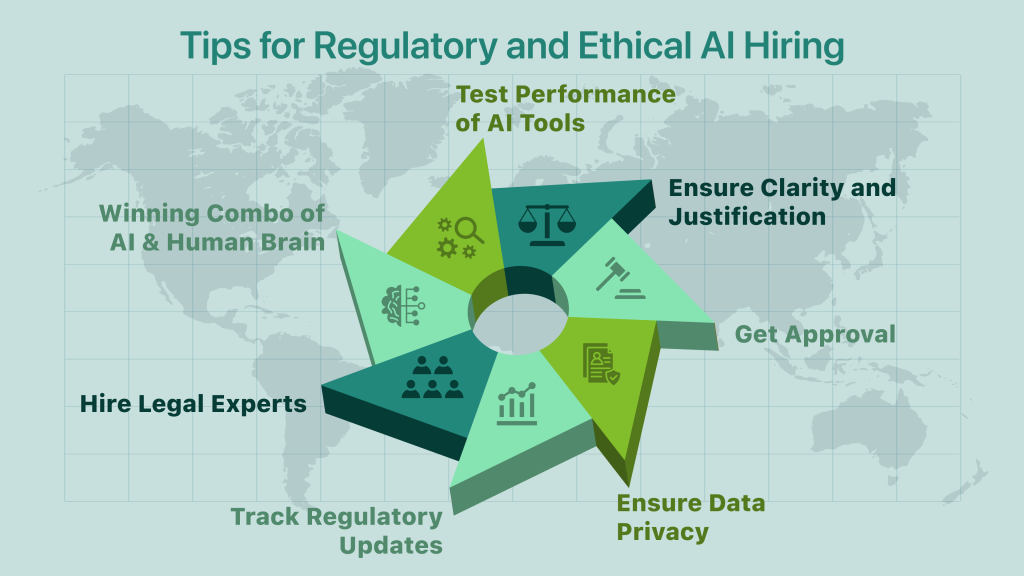
Here are the core ethical and legal AI hiring practices that require immediate attention:
Test Performance of AI Tools
- Keep AI tools’ functioning under check for bias-free results.
- Get third parties for occasional audits, as laid out by new regulations about AI usage in recruitment.
- Periodic audits identify and remove unintended biases before they impact the applicant or attract legal action.
- Maintain records, action plans to mitigate bias, and steps to take fairness measures to ensure compliance and improvement.
Ensure Clarity and Justification
- Inform candidates when and how AI is used in recruitment, like resume sorting/scheduling interviews.
- Explain to candidates about automated decisions, particularly when rejected or filtered out.
- Be clear in AI algorithms and decision-making stages, and include human intervention when necessary.
- Clarity builds trust with candidates and helps follow laws requiring disclosure of AI systems, such as the NYC Automated Hiring Act.
Get Approval
- Obtain candidates’ consent and inform them about the use of AI in the hiring process and the type of data you collect, use, and store.
- Get written consent from candidates before using their critical data in AI-based hiring.
- Offer applicants the option to deny AI processes, where possible, or offer alternative evaluation methods.
Ensure Data Privacy
- Comply with government and local privacy polices regarding applicants’ critical data management.
- Collect only the needed data for evaluation purposes; keep it secure.
- Allow applicants to review, edit, or request termination of their data, as per existing legal bylaws.
Track Regulatory Updates
- Keep track of international and regional legal updates, as AI guidelines evolve quickly.
- Update internal policies to stay compliant with new and existing guidelines.
- Train HR and legal staff on updated legal requisites and ethical practices on AI recruitment.
Hire Legal Experts
- Get the attorney to review AI tools, vendor NDA, and internal rules to comply with legal best practices.
- Store history of legal compliance, audits, candidate notifications, and vendor activities.
- Hire outside specialists to help you understand emerging risks and solutions.
Winning Combo of AI & Human Brain
- Do not use AI to replace human workers. Rather, use AI as their assistant, especially for decision-making and engaging candidates.
- Human decisions bring empathy, cultural alignment, and mindful decisions in the hiring process.
- Use when the human review is required as a game changer.
How ValueMatrix uses AI in hiring and stays on the right side of the law
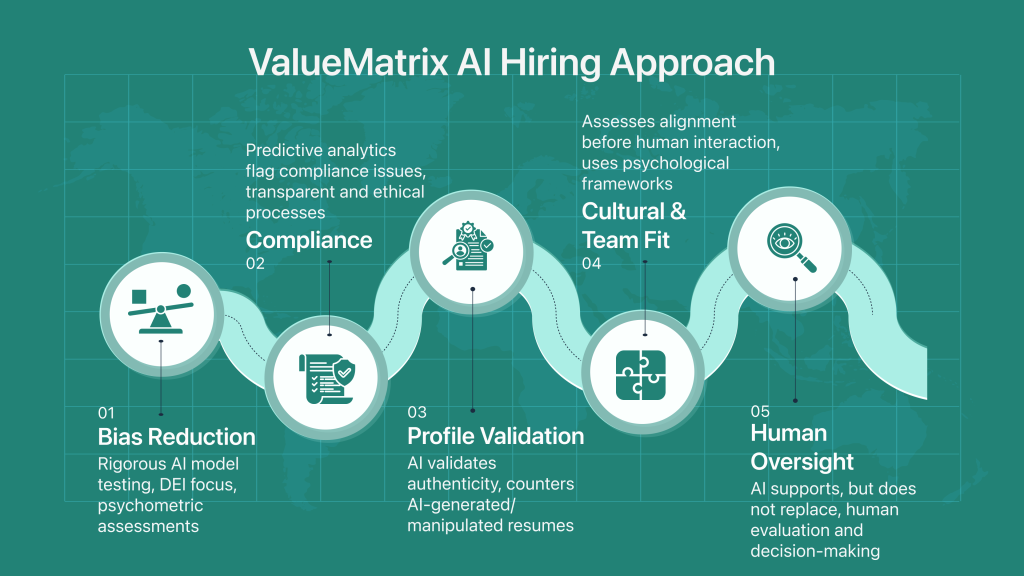
1. AI-oriented, Data-based Smart Hiring
ValueMatrix deploys advanced AI, ML, and data science to remodel recruitment. It’s more than traditional resume screening. It focuses on overall candidate evaluation, including cultural and team balance, before any human touch. This way, it spots candidates with the right skills, fits in the company culture, and is a team player, cutting time and resources spent on flagged applicants.
2. Impartial and Non-invasive Hiring
The core mission of ValueMatrix is to promote fair, unbiased, and non-disruptive hiring. The platform periodically audits its AI tools to detect blind spots of both data and developer bias, thus offering an even playing field for all candidates. Leveraging cognitive frameworks and psychometric evaluations to assess required skills and cultural fit, promoting equity, diversity, and inclusion (DEI) initiatives.
3. Profiling Candidate Suitability
As AI-generated resumes have become common, ValueMatrix relies on subtle technology to verify candidate profiles. It considers things beyond basic details to pick real talent, helping avoid hiring based on fake information.
4. Staying within the Law
Observing legal limits, ValueMatrix uses predictive analytics to help HR professionals flag legal concerns during the interview stage. It enables businesses to follow the legal and ethical standards, protecting employers and candidates.
The design of Valuematrix’s platform ensures that all AI-driven evaluations are transparent, non-intrusive, respect candidate privacy, and compliant with evolving regulations around AI and employment practices.
5. Human Review and Ethical AI Go Well
While AI is the lifeline of the hiring process, ValueMatrix does not ignore human oversight. Recruiters prioritize in-depth evaluation and rapport-building, ensuring that technology improves rather than replaces human intelligence. Valuematrix defends regular training, ethical AI usage, and candidate consent to staying on the right side of the law and using AI responsibly.
AI in Hiring – Trends and Predictions
AI in hiring transforms recruitment by prioritizing talent, cutting time-to-hire, and reshaping how companies pick and hire talent. The future of AI in recruitment demands stringent regulations, better explainability, and fairness and inclusion.

- Rapid Growth of AI-Specific Hiring Laws
- Growing Demand for Explainable AI and Candidate Rights
- Proactive, Transparent, and Accountable AI Governance
Key Takeaways
AI redefines the hiring ecosystem by automating repetitive jobs like resume parsing and interview scheduling. Thus making hiring faster and efficient while reducing costs and time-to-hire.
Given the increasing use of AI, companies should manage threats, like bias and data misuse, as new legal guidelines require transparency and candidate consent.
The ideal outcome comes from uniting AI’s algorithm and speed with human oversight, regular bias audits, and clear communication. All these enable companies to recruit fairly, stay compliant, and develop powerful and diverse teams.
If you are looking for an HR tool packed with all the above ingredients, ValueMatrix is the place to find the recipe.
About us
ValueMatrix helps organizations build culturally cohesive teams with AI-powered recruitment and retention strategies. We educate corporate leaders on the importance of involving and encouraging all generations to adopt enterprise values and participate actively to achieve excellence.
Our AI-powered platform transforms talent acquisition with intelligent hiring techniques backed by established psychological frameworks. We partner with HR professionals to conduct unbiased and holistic assessments for aspiring candidates.