

As AI rapidly becomes the gatekeeper in modern hiring processes, certain incidents remind us that a human-AI collaboration, where AI amplifies the efficiency of recruitment officers, might be the most balanced and responsible approach.
Not long ago, in 2020, an incident in the UK highlighted why AI tools should never be granted free rein to decide human lives. Anthea Mairoudhiou, a celebrated makeup artist at MAC Cosmetics, was asked to reapply for her job after being furloughed during the pandemic. But this time, she had to face a camera and an AI-powered tool- HireVue, which claimed to assess candidates based on facial expression and body language.
Ironically, despite being widely praised for her artistry and customer friendliness online, the AI misread her expressions of isolation stress as “unfavourable,” which led to her losing her job. After doing irrevocable career damage to Anthea, HireVue quietly disabled its facial analysis algorithm. After severe backlash, the matter was settled outside the court following negotiations with MAC’s parent company. (PersonnelToday)
This incident underscores a deeper issue: in our rush to embrace automation and AI-driven efficiencies, are we inadvertently eroding human judgment, empathy, and fairness? When algorithms determine who is worthy of employment, are we penalizing individuality? For enterprise leaders, brooding at the crossroads of humane values and technology, Anthea’s story is a wake-up call. Without human and AI collaboration, AI is a cold gatekeeper of exclusion, not progress.
Getting it right: Collar group’s human-AI synergy
Contrast this with Australia’s Collar Group, a recruitment agency that has successfully integrated AI into its hiring processes without sidelining human judgment. Collar Group has implemented AI for candidate discovery and passive outreach, emphasizing the importance of human connection. This AI-human collaboration ensured that their hiring AI only augments, but does not replace, the human recruiters. This approach has allowed them to build efficient and productive teams, preserving the human touch essential in recruitment.
Why new age recruitment requires a mix of heart and hiring AIs
The rise of AI-generated resumes has led to new hiring challenges. It’s gotten to the point where even the ATSs are scratching their digital heads, wondering, “Didn’t I already read this resume… five minutes ago?”, as it stares at yet another “dynamic team player with a passion for innovation!” With many applications now featuring similar phrasing and structure, traditional screening methods, including standard ATS systems, are increasingly challenged in distinguishing truly unique candidates.
So in today’s high-volume, competitive hiring, a human-AI hybrid hiring system helps recruiters wade past resume déjà vu and focus their expertise and energy on candidates who are well-sorted based on their behavior, skills, capabilities, and academics.
It has become a requirement for today’s competitive job market to assimilate the strengths and mitigate the weaknesses of AI and traditional hiring with an AI and human collaborative model. In this collaborative approach in hiring both the expertise of a human recruiter and the precision analytics of AI are utilized to their fullest.
Here are three major aspects that AI contributes to hybrid hiring systems.
- Efficiency: AI scores way ahead when it comes to skimming candidate resumes. AI takes only a fraction of the time taken by a human recruiter or even a traditional ATS system. It is tried and tested that automating repetitive screening tasks enables hiring teams to focus on meaningful interactions with top candidates, speeding up the entire recruitment process.
- Consistency: The same criteria are set for all applications in a particular job profile, and it does it without any fatigue, mood swings, or unconscious biases affecting the results. This ensures solid guidelines are in place to assess the process, where each candidate is evaluated based on objective parameters, not subjective impressions.
- Data-driven insights: AI is brilliant at discovering patterns within vast pools of data, including behavioral trends, skill matches, and hiring outcomes. It is these types of insights that allow hiring staff to make smarter decisions and foresee employees’ long-term association.
Talking to ValueMatrix, Shobana Kailash, senior HR leader and consultant at Benevolve
Says that over the next five years, agentic AI will revolutionize recruitment by automating tactical tasks like sourcing, screening, and scheduling while augmenting human decision-making with culture-fit nudges based on organizational values and past successes. AI will dramatically compress hiring timelines without replacing emotional intelligence requirements like reading between the lines, assessing leadership gravitas, and executive presence, elevating recruiters to strategic roles
The irreplaceable human expertise in AI human hiring:
Experienced interviewers assess candidates beyond their resumes. Here are the key aspects contributed by humans to AI human hybrid hiring model.
- Gait and posture: Confidence and professionalism can be assessed by an experienced interviewer by the way a candidate stands and approaches their seat.
- Body language: Facial expressions, eye contact, and gestures can express enthusiasm or nervousness.
- Microexpressions: Flashes of unconscious facial expressions may reveal true feelings.
- Speech patterns: Tone, tempo, and clarity reveal communication skills and confidence.
- Integrity of speech delivery: Consistency between words and non-verbal cues suggests authenticity.
Techniques employed by interview specialists
Interviewers utilize various methods to gauge candidate suitability:
- Behavioral Questions: Assess past experiences to predict future performance.
- Situational Scenarios: Evaluate problem-solving and decision-making skills.
- Cultural Fit Assessments: Determine alignment with company values and team dynamics.
- Emotional Intelligence Evaluation: Understand how candidates perceive and manage emotions.
Experienced recruiters often improvise these techniques to probe into the character specialties of the candidate.
The limitations of human judgment
Even seasoned interviewers can miss subtle cues. As one recruitment expert notes, “Despite years of experience, it’s easy to overlook fleeting microexpressions or let unconscious biases influence decisions.” Such oversights can lead to hiring mismatches, affecting team cohesion and productivity. These weak areas of standalone human and AI hiring tech can be efficiently covered with a human-AI collaborative recruitment system where one strengthens the other.
The high cost of wrong hires
A misaligned hire can have multifaceted repercussions for an organization. In 2023, TCS faced serious backlash which led to blacklisting and firing of its senior executives accepting bribes from recruiting agencies to hire unqualified candidates. Similarly, just a few years before this incident, Infosys too was in hot water, losing 5.8 billion USD in market value after dubious financial practices were reported at the top.
These incidents underline the high stakes involved in recruitment. It is no longer enough to assess the skills and expertise alone. Organizations must also gain deeper insight into the psychological righteousness, team match, and character strength of potential hires.
Leveraging cutting-edge technology built on verified psychological models can help ensure that the integrity of new hires aligns with company values.It requires vigilance, integrity, and a strong sense of responsibility.
Why infuse human touch into AI hiring
While AI offers numerous advantages, certain human traits remain unmatched. Infusing this humanness into AI systems will contribute these four essential traits to an AI and human hybrid hiring model.
- Intuition: The ability to sense underlying issues or potential beyond what’s presented.
- Empathy: Understanding and relating to candidates’ experiences and emotions.
- Contextual Awareness: Grasping the nuances of specific situations or industries.
- Cultural Sensitivity: Recognizing and respecting diverse backgrounds and practices.
Smarter hiring starts with humane AI: The ValueMatrix’s Human-In-the-Loop approach:
Rather than viewing AI and human recruiters as adversaries, effective AI companies like the ValueMatrix advocate for a collaborative Human-In-the-Loop approach. By combining AI’s analytical capabilities with human expertise and empathy, ValueMatrix aims to enhance the recruitment process humanely. This human and AI collaborative hiring model ensures that while AI handles data-driven tasks, human recruiters focus on building relationships and understanding candidate nuances.
ValueMatrix human-AI collaboration: Humaneness in hiring
Seasoned interviewers bring a depth of perception that no machine can replicate. They read the candidate, intuitively picking up on how a candidate enters a room, holds eye contact, or responds to pressure. A slight shift in tone, a moment’s pause, or a mismatch between words and expression can speak volumes for an experienced interviewer. These professionals rely on empathy, experience, and emotional intelligence to assess not just what a candidate says, but who they are. It’s this human element that reveals passion, sincerity, and potential.
The human AI hybrid hiring module within the ValueMatrix’s HR system aims at amplifying this human HR expertise. ValueMatrix hybrid hiring tools are designed to work with interviewers, not instead of them. By analyzing microexpressions, speech patterns, and behavioral signals, ValueMatrix’s recruitment technology catches what even the most experienced eyes might miss. It flags inconsistencies, highlights hidden strengths, and sorts out an objective list, allowing recruiters to make faster, fairer, and more informed decisions.
AIs analytical edge
AI can detect patterns and anomalies that might escape human notice, for instance.
- Consistent nervous blinking: Could indicate discomfort or dishonesty.
- Closed body posture: May suggest defensiveness or lack of confidence.
- Unmentioned career gaps: AI can cross-reference passively collected data to identify discrepancies in employment history.
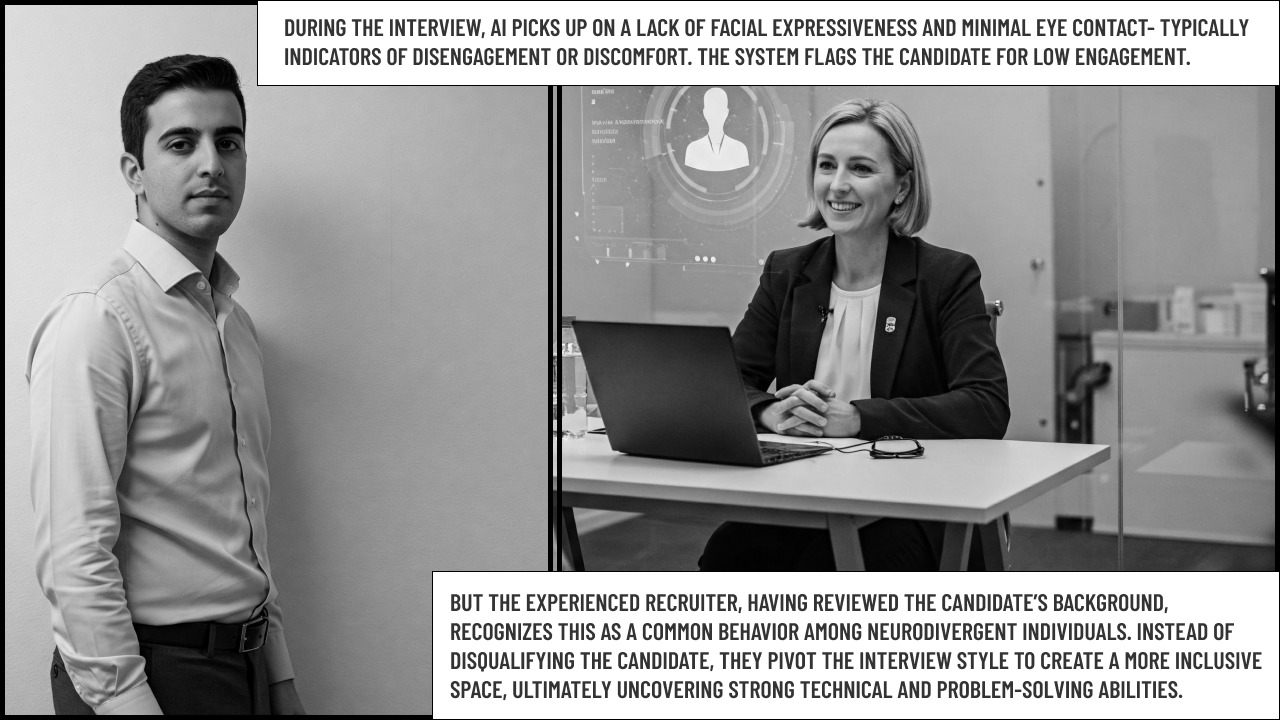
If these AI-generated flags go unchecked by an experienced human recruiter, qualified and top-tier candidates may be unfairly excluded early in the hiring process. Only a skilled human interviewer in an AI-human collaborative system can assess and override circumstances, such as stress or health conditions, that might cause the AI to wrongly flag a candidate.
The power of AI human hybrid interviews
Collaborating AI and human insights leads to more comprehensive evaluations. Building great, sustainable teams requires the intersection of both. AI human hybrid interviews combine the analytical sharpness of artificial intelligence with the nuanced perception of seasoned recruiters. Together, they create a balanced evaluation process that is fairer, more inclusive, and remarkably insightful. As the old saying goes, “Two heads are better than one”, and when one is powered by data and the other by empathy, the final results are redefining the hiring game. Here are some scenarios to explain how the human-AI synergy works for the comprehensive assessment of a candidate during an interview.
Scenario 1: First impressions and gait

Scenario 2: Facial expressions and neurodivergence
Scenario 3: Voice modulation and passion
.
Scenario 4: Body language during a challenging question

Scenario 5: Closing the interview

Why did the ValueMatrix approach work?
ValueMatrix’s human AI collaborative model allows data-driven objectivity as a guideline for human expertise and empathy. Its AI provides consistency, identifies complex patterns between human psychological models and candidate behaviour, and helps in reducing unconscious bias. But it’s the human recruiter who determines the context, cultural sensitivity, and assesses the emotional depth. Thus, this model ensures that candidates are not just evaluated, but comprehended.
This human tech collaboration in hiring ensures a process that celebrates uniqueness while keeping it precise. In short, here the AI makes the expertise of a human recruiter sharper and faster in seeing the person behind the profile.
Building future-ready teams: The ValueMatrix approach
VM nails the synergy between AI and human recruiters with its uniquely developed AI/ML algorithmic model. Crunching vast datasets, ValueMatrix.ai identifies personality traits and predicts behaviors that align with organizational culture. Parallel to these AI processes, human recruiters analyze candidates’ interpersonal skills and cultural alignment to ensure a holistic evaluation. This balanced approach leads to better hiring decisions and sustainably productive teams.
In competitive recruitment, such a synergy of artificial intelligence (AI) and human intelligence is not just beneficial but a necessity. ValueMatrix is a prime example of this collaborative strategy, where AI’s analytical strengths are utilized while preserving the invaluable human aspects of empathy, instinct, and cultural subtleties.
The role of human AI collaboration in shaping a behavior-based work culture
VM utilizes a unique human AI collaboration to dive deep into the behavioral patterns of potential candidates. By examining large volumes of data, ranging from images and videos to interviews, assessments, gamification results, and even subtle mannerisms, AI algorithms can detect personality traits and forecast behaviors that align with an organization’s cultural lattice. This predictive power is invaluable for HR professionals seeking to hire and retain talent that possesses the necessary skills and integrates seamlessly into the company’s environment.
Non-invasive assessment techniques
Understanding the importance of candidate comfort and authenticity, ValueMatrix employs non-intrusive methods:
- Passive data collection: Utilizing existing data sources like anonymized work samples and public documents, eliminating the need for exhaustive questionnaires.
- Behavioral data analysis: Assessing problem-solving skills and decision-making abilities through gamified analysis of behavioral data, ensuring a discreet and efficient evaluation process.
ValueMatrix’s AI and human collaborative hiring module is designed with time-tested organizational psychology principles. Once inside the system, it helps build sustainable teams that match the lattices of organizational culture. With a staunchly rooted understanding that skills can be taught, but behavior is instinctive, the VM approach to hiring and talent management begins with behavior fit.
Using AI trained on vast datasets of interviews, expressions, speech patterns, and habits, VM can accurately identify core personality traits and behavioral tendencies. These insights help predict how a candidate will respond under pressure, collaborate in teams, or adapt to feedback. Before diving into technical skills or cultural compatibility. We first ask: “Will this person thrive in the behavioral expectations of this environment?” Because when behavior aligns, everything else falls into place.
Once the behavioral fit is confirmed, ValueMatrix’s AI human collaborative model moves deeper, evaluating skills and cultural compatibility. Our predictive analytics compares a candidate’s behavior traits with the organization’s unique culture model, flagging potential clashes or synergies.
This ensures that the people ValueMatrix helps you hire won’t just do the job- they’ll evolve within it. The groundbreaking AI human collaborative recruitment model empowers HR leaders to build high-performing, value-aligned teams by placing behavior match as the entry criteria.
It’s not just about hiring someone who can work- it’s about hiring someone who will work well. With this hiring approach, ValueMatrix transforms recruitment into a long-term investment, not a short-term fix.
ValueMatrix’s human AI collaborative model: A win-win strategy
By integrating AI’s precision with human insight, the ValueMatrix ensures:
- Enhanced accuracy: Reducing biases and errors in the recruitment process.
- Improved candidate experience: Providing a respectful and engaging hiring journey.
- Better organizational fit: Aligning candidate behaviors and values with company culture, leading to higher retention and satisfaction.

In embracing this balanced human AI hybrid approach, organizations can build future-ready, productive teams that thrive in today’s dynamic work environment.
ValueMatrix doesn’t believe in replacing human expertise- it amplifies it with the proper balance of human AI collaboration in recruitment. By reading microexpressions, verbal cues, and behavioral indicators overlaid with a layer of human judgment, the ValueMatrix human AI hybrid recruitment technology detects what even the most seasoned eyes may overlook.
Together, the human touch and machine accuracy forge a hiring process that’s both empathetic and rigorous. One identifies potential and sorts it into an objective list; the other validates it. Curious to understand the science behind AI human collaboration in hiring at ValueMatrix?
About us
ValueMatrix helps organizations build culturally cohesive teams with AI-powered recruitment and retention strategies. We educate corporate leaders on the importance of involving and encouraging all generations to adopt enterprise values and participate actively to achieve excellence.
Our AI-powered platform transforms talent acquisition with intelligent hiring techniques backed by established psychological frameworks. We partner with HR professionals to conduct unbiased and holistic assessments for aspiring candidates.