
Table of contents
- The AI-Powered Shift from HR Manager to Growth Manager
- Understanding the Evolution: From HR Manager to Growth Manager
- Why Is the Traditional Manager Role Failing to Retain Talent?
- How Does Talent Intelligence for Managers Redefine Coaching?
- How Does Manager Coaching Work In Practice with AI Insights?
- What Is the Direct Link Between AI Insights and AI for Employee Retention?
- How Can We Build a Culture of Growth Managers?
- What Are the Ethical Considerations for Using AI in Coaching?
- Conclusion: The Future of Management is Data-Driven and Human-Focused
- Statistics: The Data Behind AI-Driven Retention
- FAQs
The AI-Powered Shift from HR Manager to Growth Manager
The direct manager is the most important aspect of retention for executive leaders when it comes to effectiveness. However, most managers are not well-trained to be Growth Managers, who proactively identify, coach, and retain talent. The golden bridge for closing this gap will be establishing Talent intelligence for managers right into their workflow. AI coaching for managers allows organizations to turn biased feedback into data-driven development plans. This strategic shift not only builds better leaders but also turns reality into AI for employee retention, converting turnover costs into savings and thus leading to the construction of a superb, future-ready workforce.
Understanding the Evolution: From HR Manager to Growth Manager
Today’s landscapes envisioned in talent require more than what traditional HR management can offer. Organisations encounter entirely new challenges to connect with their best talent because it has risen to all-time highs in employee expectations for career development and personalised growth. This demands a momentous transformation in leadership from the current theoretical definition: the transformation from reactive ‘HR manager’-focused mostly on administrating, compliance, and performance evaluation-to proactive ‘Growth Manager.’
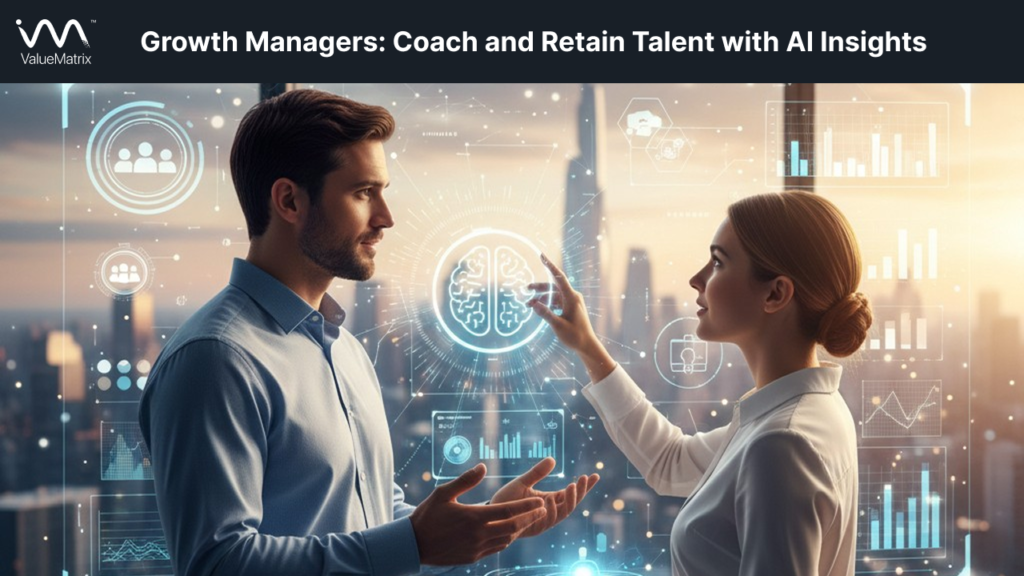
Growth Manager is a strategic talent steward who helps in converting advanced talent intelligence into certified managers on a journey to teach, develop, and inspire their units, thereby considerably enhancing AI for employee retention. This is no mere play of words. On the contrary, it is imperative to address the high costs involved in attrition and the immediate necessity of building strong, future-ready workforces that create roles in which each employee feels he or she holds something of value and would be well-supported.
Why Is the Traditional Manager Role Failing to Retain Talent?
The manager is one of the primary reasons an employee stays or leaves; however, most seem to be burdened with work and therefore resort to archaic and reactive methods. They are primarily trained to manage tasks and processes instead of being career developers strategically. This reactionary approach is failing the modern-day employee who requires continuous growth enhanced with feedback tailored to them. The absence of strategic coaching is the single greatest risk to retaining high-potential talent in the current fast-paced market.
The Problem with “Gut Feel” Coaching
Managers develop coaching methods from their instinct or set them through focusing mostly on the vocal few or even those seen as the 20% of employees that prove troublesome to management. Focusing on the vocal few ignores the silent majority and prevents the identification of low-profile, high-performing employees who may be at very high risk for attrition due to feelings of neglect.
The High Cost of Unidentified Risk Of Resignation
Managers are blindsided by a key resignation, without tools to diagnose predictive patterns: a sudden dive in engagement survey scores, and an undisturbed vacation. The last-minute efforts of a retreat will only cost them a lot and bring disruptions, an actual case of AI for employee retention.
The Skill Gap in Modern Management
The onus of developing hyper-individualized development plans that would align with employees’ long-term career goals now rests with the workforce. Most of these managers do not seem to have either the time or capacity to create such bespoke paths, leading to employees feeling disengaged and seeing their organization as unwilling to invest in them.
By addressing those fundamental constraints of traditional management, the discipline of HR will unlock the path to the Growth Manager model empowered by technology.
How Does Talent Intelligence for Managers Redefine Coaching?
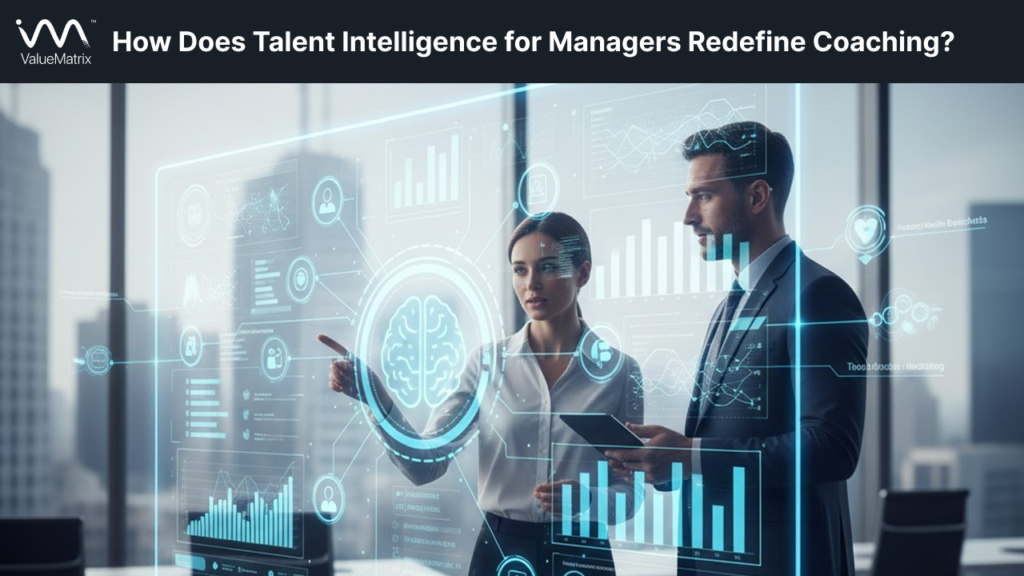
Talent intelligence for managers is the engine that converts massive amounts of internal versus external HR data renders coaching prompts that are simple and even open to action. The organization changes one from being a subjective observer to a data-informed strategist. Therefore, it uses predictive analytics, considering not just descriptions in terms of “what happened” but actually what is likely to happen and what the manager should do. This is at the core of what makes coaching effective and scalable through the use of Artificial Intelligence.
A swift empowerment of managers will democratize talent strategy and instill continuous development into the workflow and daily living.
Moving from Instinct to Predictive Data
AI algorithms comb through dozens of data points-from performance reviews to projects, from internal movement to compensation benchmarks- flag individuals ready for the next opportunity or ones at high risk of leaving. This becomes a strategic entry point for the manager to approach the next one-on-one discussions.
Identifying “Hidden” Skills and Internal Mobility
A key talent management intelligence for the managers is to analyse project data and skill assessment results for competencies. These competencies for which the employee might be qualified but is not effectively functioning in his/her present role, thereby suggesting options for internal mobility. Which, in turn, is ideal to improve AI for employee retention.
Benchmarking Team Health and Workload Balance
AI tools analyse communication patterns and work hours to alert managers to potential burnout risks or overtly unbalanced workloads before they turn into a crisis. Data managers can then reallocate resources proactively so that prevention rather than reaction becomes their workflow.
Talent intelligence for managers supplies clarity so that coaching can be seen as focused and effective rather than being generalized and time-consuming.
How Does Manager Coaching Work In Practice with AI Insights?
Manager coaching with AI insights is the transformation of one-on-one sessions by converting from a general catch-up to a guided personal development session. AI, now functioning as a “coaching co-pilot,” suggests specific contextualised advice just moments before or even during the course of a conversation to the manager. Thus, it maintains the quality and consistency of manager-level experience.
Elimination of guesses and focusing on human interaction, with the surety that the data background is solid:
The Power of Real-Time Feedback Prompts
The Power of Real-Time Feedback Prompts An example might be that the system prompts the manager: “Jane’s utilisation on the last two projects was 40% below her team’s average. Suggested coaching prompt: ‘What parts of your current workflow feel like the biggest time drains right now?'” Surprisingly, these prompts are so specific and nonjudgmental.
Personalizing the Development Conversation
The employee profile for competences as well as career interests, would very well already lead the AI into pointing to training courses, internal projects, or potential mentors. Talent intelligence for managers‘ personalization will really show the employee that they are growing and developing their worth, a very strong retention driver.
Using AI to Automate Follow-ups and Accountability
After a meeting, development goals should not be lost track of, and the AI system could even organize automatic scheduling of follow-up check-ins concerning the very goal at hand, notifying the manager of praises or constructive feedback about the subject. This prevents goal drift and accounts for consistency in the coaching experience.
By making coaching simpler and sharper, manager coaching with AI real insights improves the entire leadership function within the organisation.
What Is the Direct Link Between AI Insights and AI for Employee Retention?
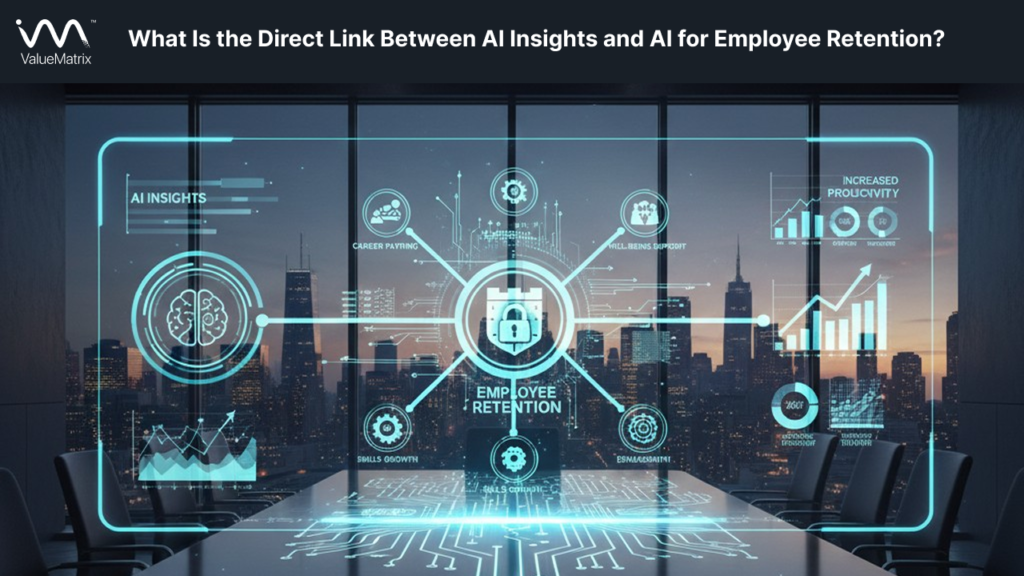
The progressive shift from using artificial intelligence for employee retention from a very passive HR function to a proactive function has gone far. AI has given the manager a very crystal ball way of understanding when to intervene before an employee starts to update his or her resume. This is not minimal surveillance but providing timely and targeted support, validating the employee’s contribution to the organisation.
Such employees would stay on dramatically when they feel seen for real and understood very well with respect to career progression.
Proactive Identification of Flight Risk
An AI model can use these changes in patterns of disengagement, such as changes in communication frequency or certain login times, and performance dips, to create algorithms that predict the probability of turnover with an accuracy of up to 76.92%. This gives the manager a 30-to-90-day window to offer personalised intervention-whether it is a monetary appraisal, altering a project assignment, or a leave of absence from work.
Tailoring Career Paths and Growth Opportunities
Lack of career advancement is perhaps the most common reason employees give as an excuse for leaving their jobs. This is addressed by AI-based tools for employee retention, which look at the existing skill profile of an employee and automatically map it to dozens of potential roles available within the company. As a result, internal mobility becomes not a mystery, but rather a seamless, obvious option.
Enhancing the Employee Experience (EX)
Hence, it drastically enhances the entire employee experience as every employee now receives relevant and timely data-backed coaching. It sends a very strong signal to the entire workforce that the company is really interested in their future through personalisation and consistency, hence increasing employee loyalty and engagement significantly.
The best AI for employee retention can come up with is data-driven coaching in combination with the provision of the clearest growth paths.
How Can We Build a Culture of Growth Managers?
Cultural changes are a will of the organisation beyond the technology that allows the transformation of a traditional manager into a Growth Manager. HR leaders must take this to their constituents and employees as a rather philosophical shift to view talent as something to name as an asset and not a resource: instead of being managed, they are grown. That includes putting in place training and specifying the requirement from the executive level that coaching should come as a core requirement of management responsibility, non-negotiable. Technology-enabled but brought to life by the management commitment in this cultural change for its sustainability.
Train leaders to interpret AI data. They must not just be trained on the AI platform but must learn to interpret what comes out of it with empathy. Managers must appreciate that a flight risk score should elicit a supportive conversation with an employee and not trigger a disciplinary warning.
Training Leaders to Interpret AI Data
Managers must be trained not just on how to use the AI platform, but on how to interpret the insights with empathy. They need to understand that a flight risk score is a prompt to start a supportive conversation, not a trigger for a disciplinary warning.
Shifting Focus from Policing to Developing
HR needs to have metrics that reward managers for internal mobility, for developing team skills, and for retention of newcomers, rather than punishing high individual output. That will now refocus their incentives to be aligned with the goals of AI for employee retention.
Integrating AI Tools Seamlessly into Workflow
The best systems are invisible. The talent intelligence for managers should be seamlessly integrated into the tools that managers already use (e.g., Slack, Teams, or their performance management system) in order to minimise friction and ensure delivery at the time of need.
Creating a Growth Manager‘s culture converts the organisation as a whole into a proactive retention and development engine.
What Are the Ethical Considerations for Using AI in Coaching?
Manager coaching with AI insight offers the opportunity for proactive addressing such ethical pitfalls that can influence trust-based relationships by HR leaders. So much so, that the main issue that arises is related to the way employee data is collected and interpreted, and how this data is used in its reflection through comparison of or without seeing the implementation of the first two. Trust is the foundation of effective coaching – missteps in ethical practice almost instantly erode it, jeopardising all efforts in AI for employee retention.
Transparency and rigorous governance fight against legal architecture and cultural backlash.
Ensuring Data Privacy and Security
As for the employees, what data is collected (e.g., communications sentiment, time tracking, learning progress) will tell them how it is used-for example, coaching prompts or not as a pay cut. Strong data security protocols must be established to protect this highly sensitive personal information.
Mitigating Algorithmic Bias
AI is as good as those who are fed up with history with this biased data, and talent intelligence for managers will easily report some demographic groups as “flight risks” or “no-growth opportunity”. Regular auditing is necessary to attain fairness and equity.
Maintaining the Human Element in Feedback
Indeed, the AI can furnish the facts, whereas the human manager provides the context. Rather than saying that “AI thinks you might be a flight risk”, it is better put this way: “I think your engagement is low; please help me understand what I can do to help you better accomplish your goals”.
An ethical governance framework thus has to ensure that AI functionalities enhance human interventions rather than replace them.
Conclusion: The Future of Management is Data-Driven and Human-Focused
The fate of talent strategy is in the hands of the Growth Manager, for whom data is everything when conducting hyper-personalized coaching. Using talent intelligence for managers, combined with manager coaching with AI insights added to coach information, puts organizations at the forefront of building career paths that employees would be ready to take on by themselves. This leads to a highly proven, very significant reduction rate in voluntary turnover and, on the other hand, provides a clear, measurable ROI in AI for employee retention.
Statistics: The Data Behind AI-Driven Retention
| Metric | Key Finding/Statistic | Source |
| Prediction Accuracy | AI systems can predict employee turnover with up to 76.92% accuracy. | Seixas et al. (ResearchGate) |
| Performance Boost | AI integration can increase staff retention by 51% and improve employee performance by 27%. | Edstellar |
| Coaching Effectiveness | Companies that train managers in coaching see a 130% increase in business performance. | Bersin by Deloitte |
| Personalization Impact | Personalized learning—often driven by AI—is up to 50% more effective than standardized training. | Brandon Hall Group |
Case Studies: Companies Transforming Managers into Growth Coaches
1: Large Tech Firm’s Internal Mobility Platform- Kuehne+Nagel
- The Fix: AI-enabled and Talent intelligence for managers was introduced in a major tech company that mapped all employees’ skills against every open role and project across the globe.
- The Result:The company experienced a 40% increase in internal transfers and a 15% decrease in voluntary turnover. This was due to employees now being able to see clear, data-backed paths for growth without leaving the organization.
2: Financial Services Company’s AI Coaching Nudges- DBS Bank
- The Fix: For a financial services firm, a system was installed for manager coaching with AI insights that analysed day-to-day communications and provided managers with real-time “nudges.”
- The Result:The managers were prompted to give timely praise and corrective feedback, which resulted in a 24% increase in positive employee feedback scores. This was possible post post-manager support and a more engaged workforce.
FAQs
A traditional manager is focused on task completion and performance review. Growth Manager focuses on career acceleration, skill development, and proactive retention by Talent Intelligence for managers considering all team members as assets to be grown.
No. AI for employee retention reduces administrative activities and provides data-derived insights. What comes to the fore is the role of HR as a strategic interpreter and ethical governor, moving away from data collector to focus on high-value human interaction with strategy across the organisation.
Employee and external data: a combination of internal-performing review, learning activity in-role, compensation, internal patterns of communication vs. industry salary benchmarks, and market skill trends- a holistic view on insights.
Yes, when correctly built, AI facilitates the alertness of gaps in feedback or promotion between demographic groups, forcing an organisation to confront its own unconscious biases, leading toward equitable and consistent coaching for all employees.
About Us
ValueMatrix is an AI-powered talent intelligence platform that helps companies hire better, faster, and without bias. We go beyond resumes to assess skills, behavioral traits, and cultural fit using advanced AI and proven psychological frameworks. Our platform delivers data-driven insights that improve hiring accuracy, reduce time-to-hire, and elevate candidate quality.
ValueMatrix AI enables hiring teams to make confident hiring decisions and build high-performing teams at scale.