
Table of contents
- Systemic Misperception of “Learning” vs. “Listening”
- Pillar 1 – The Strategic Dilemma: Continuous Learning vs. Continuous Listening
- Pros of a “Learning-Only” Focus
- Cons and Fatal Flaws of a “Learning-Only” Focus
- Pros of a “Listening-Only” Focus
- Cons and Fatal Flaws of a “Listening-Only” Focus
- Pillar 2 – The Pitfalls of “Learning-Only”: Capability Without Context
- So, what should a modern Learning function do differently?
- Pillar 3 – Empowerment Is a Flywheel, Not a Checklist
- Why the Flywheel Outperforms Every Other Model
- Pillar 5 – Careers Accelerate When Clarity Replaces Guesswork
- Pillar 5 – Managers Are the Makers or Breakers of Empowerment
- Conclusion: Empowerment Is the Operating System-Not an Initiative
- FAQs
Systemic Misperception of “Learning” vs. “Listening”
Organizations frequently use confident phrases like “We put people first,” “We build capability,” and “We listen to our workforce.” These statements look polished in presentations, but the real question remains, “Do everyday systems genuinely enable employees to perform at their best, or do they only give the appearance of support”?
Most companies operate in two parallel realities. One is the structured world of training programs, capability frameworks, and LMS dashboards, the “Learning” universe. The other is the operational, human-centred reality of friction points, unclear processes, repeated bottlenecks, and ownership confusion, the “Listening” universe.
While both are essential, organizations often treat Learning and Listening as independent priorities with separate budgets, owners, and KPIs. This fragmentation creates an unintended outcome where employees are trained yet not empowered to act, or they are heard but lack the capability or authority to resolve issues.
If learning functions alone, organizations understand problems only in retrospect. If listening functions alone, organizations accumulate insight without the ability to translate it into action. True empowerment occurs where both intersect.
This article offers a practical examination of six pillars explaining why treating Learning and Listening as competing objectives undermines empowerment, and how a unified, systemic flywheel can convert employee insight into capability, authority, and measurable progress.
Pillar 1 – The Strategic Dilemma: Continuous Learning vs. Continuous Listening
“The annual engagement survey is a post-mortem; continuous listening is a real-time diagnostic.”
Repeat it. Internalize it. This single statement frames the core of the entire discussion.
Most leadership teams rely on an annual survey, conduct a town hall, and occasionally deploy a pulse tool. They assume that once responses are collected, the organization has “listened.” This is a misconception. Listening, when intended to empower people, is not an isolated activity but an operational discipline. The ability to detect early signals while challenges are still developing, rather than acknowledging them after the impact has already materialized.
Learning appears structured. It comes with defined owners, LMS dashboards, completion metrics, and ROI spreadsheets. Listening, by contrast, is inherently complex. It produces outliers, contradictory inputs, and minor observations that reveal major patterns, as well as the responsibility to distinguish what is meaningful from what is incidental.
HR budgets are predominantly allocated toward Learning. People, Operations, Employee Experience, or Analytics teams typically govern Listening. Neither function wants to appear ineffective, and during budget constraints, decisions become competitive. The essential question is not, “Which half of empowerment should we invest in?” Instead, it should be, “How do we ensure that every rupee spent on Learning directly addresses an insight surfaced through Listening?” Listening should identify the agenda; Learning should deliver the intervention.
Learning Without Context

If an organization over-invests in Learning and neglects Listening, it builds “shelf-ware”, well-designed courses that fail to influence real outcomes. Employees complete modules, yet their daily workflow remains unchanged. Frustration multiplies. “Learning-Only” strategy attempts to mandate empowerment from the top down. It produces capable individuals who are immediately constrained by an environment unwilling to evolve, reinforcing the false divide between Capability and Culture.
Pros of a “Learning-Only” Focus
| Benefit | Description |
| Rapid Skill Scaling | Enables quick, centralized deployment of mandatory competencies (e.g., compliance, new system rollouts), establishing a baseline skill level. |
| Clear Career Structures | Offers well-defined developmental pathways and certifications, motivating employees who seek structured advancement. |
| Competitive Edge (External) | Keeps the workforce aligned with macro-level industry changes (e.g., AI adoption), even if internal processes lag. |
| Managerial Simplicity | Provides managers with a straightforward mechanism (training) to address performance issues, converting complex organizational challenges into skill gaps. |
Cons and Fatal Flaws of a “Learning-Only” Focus
| Con/Flaw | Strategic Cost | Impact on Empowerment |
| Irrelevance and Shelfware | Significant loss of time and budget on training that fails to address real, verified friction points identified only through listening. | Erodes Trust: Employees perceive training as punitive and disconnected from their actual needs. |
| Contradiction of Autonomy | Mandated training undermines empowerment by assuming the organization knows the employee’s needs better than the employee. | Fosters Resentment: Employees interpret this approach as a lack of respect for their judgment. |
| Ignoring Systemic Barriers | Builds individual capability without addressing process issues, outdated systems, or structural blockers. | Creates Disillusionment: Skilled employees become discouraged when they cannot apply what they have learned. |
| Data Blindness | Without listening, organizations lack evidence on whether the acquired skills are used or relevant. | Wastes Capability: Skills remain theoretical, failing to generate tangible business value. |
Listening Without Solution

If an organization over-invests in Listening and neglects Learning, it unintentionally fosters a culture of complaint. Employees accurately identify issues, but lack the support and capability to resolve them. This leads to disillusionment with being heard without any meaningful response, which feels less like engagement and more like betrayal.
Pros of a “Listening-Only” Focus
| Benefit | Description |
| High Psychological Safety | Rapidly strengthens trust, encouraging employees to speak up, report risks, and share innovative ideas. |
| Accurate Problem Identification | Delivers precise insights into systemic obstacles, recurring friction points, and root causes of burnout. |
| Inclusion and Voice | Ensures quieter or underrepresented groups are heard, preventing decisions from being driven solely by vocal individuals. |
| Risk Mitigation (Early Warning) | Serves as an early detection mechanism for cultural toxicity and potential attrition spikes. |
Cons and Fatal Flaws of a “Listening-Only” Focus
| Con/Flaw | Strategic Cost | Impact on Empowerment |
| Feedback Cynicism | Gathers valuable insights but offers no follow-through, damaging credibility. | Destroys Trust: Employees conclude leadership is unwilling or unable to act. |
| Wasted Data Insight | Investments in diagnostic and analytics platforms fail to translate into action. | Erodes Agency: Employees feel their input has no influence on outcomes. |
| The Capability Gap Widens | Issues are identified but remain unresolved due to insufficient training support. | Increases Burnout: Teams struggle with known problems without the skills needed to fix them. |
| Negative Self-Fulfilling Prophecy | The organization becomes fixated on diagnosing issues rather than solving them. | Stagnation: The culture orients around problem-identification instead of empowerment. |
A “Listening-Only” strategy provides context but not capability. It validates concerns without equipping employees to overcome them, reinforcing the flawed binary of Culture versus Capability.
So, what should leaders actually do? Begin by redesigning incentives:
1. Create an L&D metric directly tied to verified listening data.
If listening reveals that a specific friction point affects a defined percentage of employees, allocate part of the learning budget to address it and measure pre- and post-impact using the same signal.
2. Simplify governance for tactical, low-cost interventions.
Small, fast-moving investments often outperform large, slow-moving ones. Build a rapid decision mechanism that integrates Listening + Learning + Pilot.
3. Reassign ownership through cross-functional teams.
Assign teams’ responsibility for categories such as processes, tools, and approval flows. Listening provides evidence; Learning designs micro-interventions; and the cross-functional team ensures immediate execution.
The leadership principle is clear: Empowerment begins with the humility to listen continuously and the discipline to allocate learning resources only when they close a validated capability gap.
The sequence: listen, validate, learn, empower, eliminates the unproductive “either/or” debate permanently.
Pillar 2 – The Pitfalls of “Learning-Only”: Capability Without Context
Training often receives disproportionate attention and loyalty. It appears polished, supported by vendors, virtual classrooms, and completion certificates that look impressive on employee profiles. However, training delivered without context becomes an expensive and demoralizing organizational habit.
A Learning-Only approach is comparable to prescribing medication without diagnosing the underlying issue. For example, assigning a 12-module leadership program simply because managerial scores are low may overlook the real constraint that managers may be required to approve every minute of their team’s schedules, leaving no room for developmental initiatives. Similarly, analysts may be trained on new analytics platforms while still experiencing a three-day wait for data refreshes. Skill and environment are fundamentally distinct, and building one does not automatically improve the other.
The following represent the most damaging outcomes of a Learning-Only mindset:
1. Shelf-ware and Budget Waste.
Organizations invest in high-quality content that remains unused because the real barriers stem from flawed processes or restrictive policies.
2. Resentment.
Employees perceive training as a corrective or punitive action imposed on them, rather than a collaborative solution designed with them. This fuels the belief that training exists for compliance rather than support.
3· Ignored Systemic Barriers.
While individual capability may increase, outdated systems, weak process design, and skewed incentives continue to inhibit practical application. Teaching employees to make better decisions means little if they lack the authority to act on them.
4· Data Blindness.
Learning teams frequently lack the diagnostic insight to validate impact. They can report completion statistics, yet cannot demonstrate whether the training addressed the issues employees originally identified.
So, what should a modern Learning function do differently?
1. Micro-target Learning to Listening Signals.
Establish a policy that no major learning program is deployed without a direct connection to a verified listening insight. This ensures the true nature of the issue, whether skill, process, or authority, is accurately diagnosed before investment.
2. Design for the Flow of Work.
Deliver learning where work actually occurs. Make learning accessible at moments of need through micro-learning within tools, short walk-throughs embedded in workflows, and just-in-time templates.
3. Pair Learning with System Fixes.
When diagnostics reveal both skill and process gaps, allocate resources to address both. Equip employees with the capability while simultaneously correcting the systemic barriers that undermine it. One cannot substitute for the other.
4. Evolve Metrics.
Shift from surface-level metrics (such as completion percentages and training hours) toward outcome-driven indicators, for example: reduction in time taken to resolve a friction point, improvement in first-time resolution rates, or decreases in approval layers required for decisions.
When Learning moves away from being an automatic response and instead becomes a precise, accountable, and insight-driven intervention, it stops being organizational noise and transforms into a genuine lever for change. This is the moment where capability effectively meets opportunity.
Pillar 3 – Empowerment Is a Flywheel, Not a Checklist
Most organizations fail because they confuse motion with momentum.
Motion refers to launching initiatives, deploying courses, running surveys, and introducing new tools.
Momentum occurs when these actions connect, reinforce, and compound into meaningful behavioural change.
Organizations invest heavily in motion but rarely in momentum. Why?
Because momentum requires a disciplined system, something like a living loop that most companies avoid maintaining.
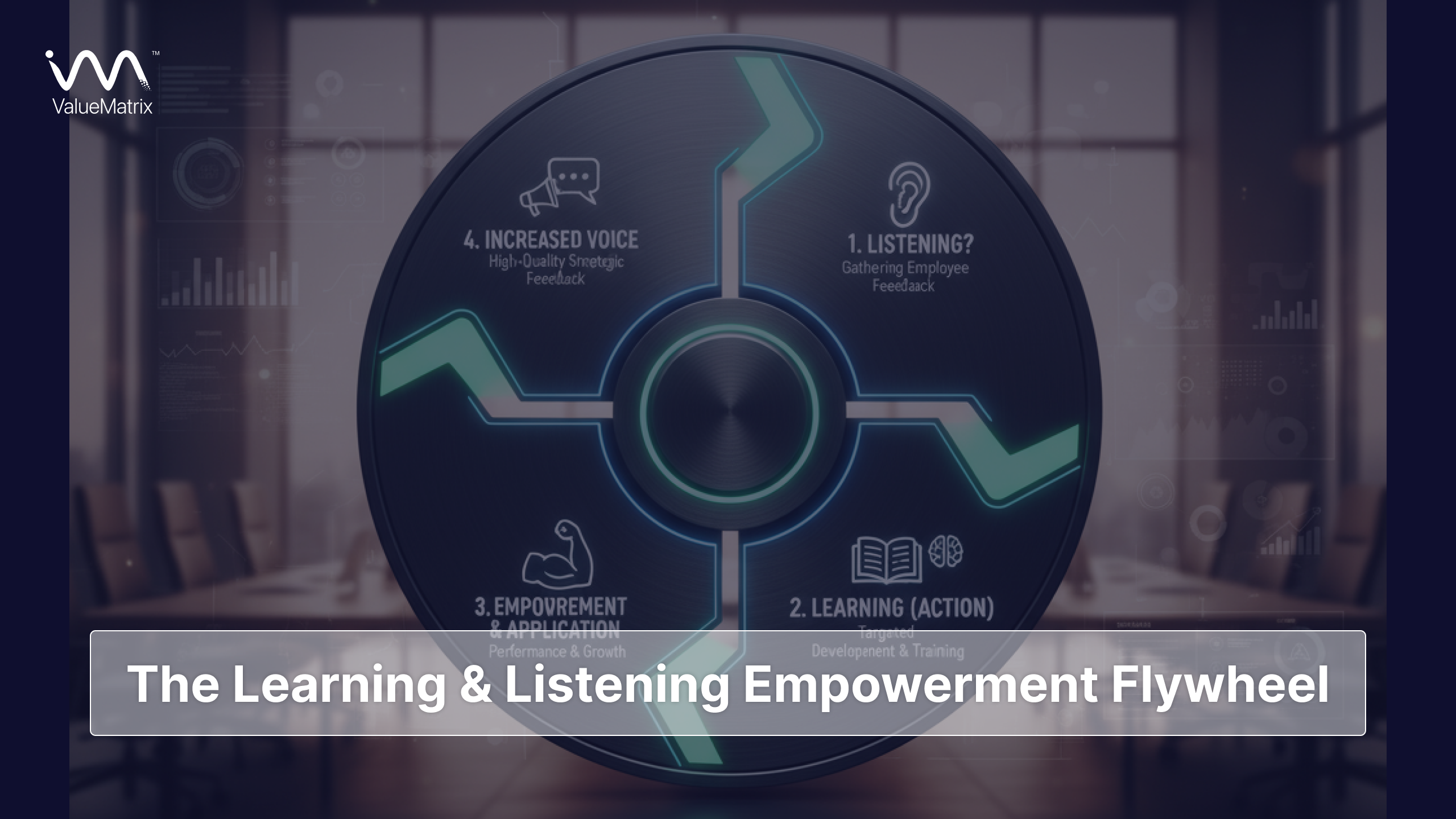
Empowerment depends on that loop. When the Employee Empowerment Flywheel spins, it creates clarity, capability, and action at a speed that checklists cannot deliver.
Below is a precise breakdown of the flywheel.
Step 1: Listen-Detect the Friction Early
Common Sources of Employee Friction (Chart)
| Source of Friction | Description |
| Broken Workflow | Steps are disjointed, slow, or unclear. |
| Pointless Approval Step | Unnecessary hierarchy delays decisions. |
| Data Bottleneck | Required data is slow, outdated, or inaccessible. |
| Unclear Decision Rights | Employees do not know who owns decisions. |
| Outdated Tools | Legacy technology slows work and increases errors. |
| Inconsistent Expectations | Different leaders communicate conflicting standards. |
Key Insight:
Most performance issues are not skill-related; they are system-related. Continuous, non-defensive listening reveals this truth. You cannot empower employees if you do not understand what is disempowering them.
Step 2: Analyze – Diagnose the Real Cause
What Happens When Analysis Is Skipped (Chart)
| Mistake | What Was Needed Instead |
| Training rolled out unnecessarily | A process redesign |
| Coaching given unnecessarily | Clear escalation pathways |
| Workflow overhaul initiated | A simple mentoring intervention |
| New tools purchased | Access rights cleanup or simplification |
Types of Gaps (Diagnostic Chart)
| Gap Type | Solved By |
| Skill Gaps | Learning interventions |
| Process Gaps | Process redesign |
| Tool Gaps | Technology upgrades or simplification |
| Authority Gaps | Decision-right re-allocations |
| Clarity Gaps | Communication and expectation-setting |
Key Insight:
Strong analysis turns broad change into surgical interventions. Surgical interventions work. Broad changes exhaust people.
Step 3: Learn- Apply Only What Matters
Characteristics of Real Learning Inside a Flywheel (Chart)
| Attribute | Description |
|---|---|
| Short | Delivered in concise formats |
| Targeted | Built for specific friction points |
| Practical | Directly applicable to work |
| Contextual | Relevant to the employee’s real environment |
| Immediately Usable | Provides instant utility |
| Tied to Friction | Based on verified listening insights |
| Co-Designed | Created with involvement from frontline teams |
Key Insight:
Employees want learning that solves this week’s problem, not a multi-module promise of uncertain value.
Step 4: Empower: Give Authority to Use What They Learned
Forms of Real Empowerment (Chart)
| Empowerment Lever | Description |
|---|---|
| Ownership of Decisions | Authority to decide without escalation |
| Control Over Workflow | Ability to modify or optimize steps |
| Approval Authority | Power to finalize actions |
| Escalation Autonomy | Discretion to escalate differently |
| Trust in Judgment | Confidence to act without hand-holding |
Key Insight:
Learning without authority is corporate theatre.
The moment an employee uses a skill without seeking approval, empowerment becomes real.
Step 5: Close the Loop — Inspect, Adjust, Repeat
Loop Closure Checkpoints (Chart)
| Checkpoint | Purpose |
|---|---|
| Did friction decrease? | Validate impact |
| Did the employee feel the change? | Confirm experience improvement |
| Did new authority stick? | Assess sustainability |
| Did new problems surface? | Detect secondary issues |
| Did anything unexpected change? | Identify positive/negative side-effects |
Key Insight:
Closing the loop = respect + accountability. It also generates the next listening signal, restarting the flywheel.
Why the Flywheel Outperforms Every Other Model
Flywheel Advantages (Chart)
| Strength | Reason |
|---|---|
| Simple | Easy to understand and adopt |
| Sequential | Clear, logical progression |
| Repeatable | Functions as a continuous system |
| Exposes Weak Leadership | Reveals those who avoid accountability |
| Eliminates Guesswork | Replaces assumptions with evidence |
| Demands Responsiveness | Requires timely action |
| Forces Systemic Accountability | Shifts responsibility from individuals to systems |
| Creates Visible Wins | Each cycle produces measurable improvement |
| Builds Confidence | Enhances ownership and initiative |
Most Important Principle:
The flywheel replaces hero-led leadership with system-led empowerment.
When the system works, empowerment is no longer dependent on individual managers — it becomes embedded in how work flows.
Pillar 5 – Careers Accelerate When Clarity Replaces Guesswork
Across industries and roles, one consistent truth exists: employees are not afraid of hard work; they are wary of invisible rules.
Careers rarely stall due to limited talent or ambition. They stall when the path ahead is unclear, political, or dependent on managers who lack time, clarity, or confidence to advocate. This is where the connection between Listening and Learning becomes transformative. Once the flywheel operates, careers stop feeling accidental and start becoming predictable and navigable.
No Guesswork and Only Clarity-That Drives Acceleration

1. Listening reveals aspirations and the barriers that slow people down.
Continuous listening gives leaders direct visibility into employee aspirations:
- “I want to work across functions.”
- “I want to move into analytics.”
- “I want to lead a team.”
- “I want to deepen my craft.”
It also surfaces the real blockers:
- Lack of visibility
- Limited stretch opportunities
- Insufficient exposure
- Weak coaching
- Unclear decision rights
When ambition and obstacles are visible together, they form a workable career map.
2. Learning becomes targeted and timely, not ceremonial.
Once aspirations and blockers are clear, learning does not need a 20-module curriculum.
It becomes a focused intervention aligned to immediate needs.
Examples:
- Before leading their first project, a short module on scope definition
- Before joining the cross-functional a brief session on stakeholder alignment
- Before moving into analytics- a curated data literacy primer
Employees learn faster when the learning solves today’s challenge, not a future one.
3. Empowerment provides the space to apply and validate capability.
Career progression requires evidence of impact. Without empowerment, authority, ownership, and decision rights, employees cannot apply what they learn.
When the flywheel functions, employees receive:
- Stretch tasks
- Project ownership
- Decision autonomy
- Escalation rights
- Visible wins
This is how individuals build influence, not just skill.
4. Careers shift from depending on luck to depending on momentum.
In many organizations, advancement happens because someone “noticed” an employee.
In a functioning flywheel, advancement emerges from:
- clarity
- capability
- visibility
- impact
- trust
Not politics, not personality and not a chance.
When Listening, Learning, and Empowerment work as one system, careers accelerate because the path is visible, obstacles are addressed, and opportunities are clear. Employees no longer guess their next move; the system enables it.
Pillar 5 – Managers Are the Makers or Breakers of Empowerment
If the Flywheel is the machine, managers are its operators, and this is where many organizations quietly fail. A company may design strong systems, refined learning programs, and advanced listening tools, but if managers continue using outdated habits, the system collapses immediately.
Most managers are not promoted for empowering others. They rise because they excelled as individual contributors, and naturally default to control. Empowerment, however, requires a different manager, not a supervisor or task allocator, but a diagnostic coach who identifies friction, removes barriers, and deliberately transfers authority.
Here is the managerial evolution the Flywheel demands:
1. Managers shift from “performance inspectors” to “environment designers.”
Traditional management asks, “Why aren’t you performing?” Empowered management asks, “What’s slowing you down?”
This shift moves the focus from investigating the employee to examining the system.
A diagnostic manager looks for:
- workflow choke points
- outdated or rigid rules
- unnecessary approvals
- missing resources
- unclear ownership
- tool failures
- decision-right ambiguity
And they keep asking: “Is this a capability issue or a system issue?” Most of the time, it is the system.
2. Managers delegate authority, not just tasks.
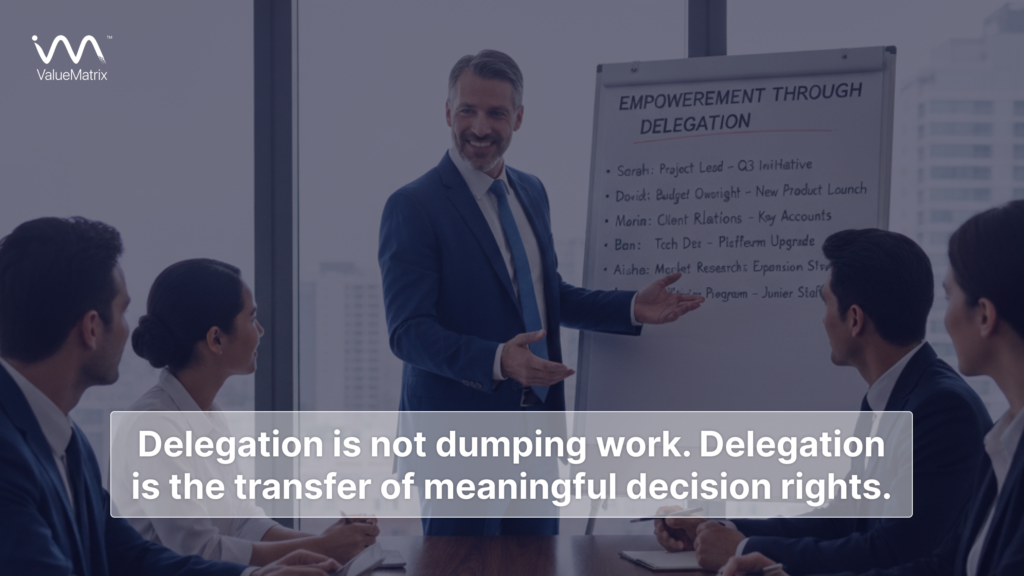
Delegation is not offloading work; it is transferring meaningful decision rights. Careers accelerate or stagnate at this moment. Without authority, employees cannot demonstrate capability.
Empowered managers intentionally hand over:
- project ownership
- final decisions within clear boundaries
- stakeholder management
- risk-balanced approvals
- accountability for specific outcomes
Authority builds confidence.
When managers hold it too tightly, growth stalls; when they share it, growth accelerates.
3. Managers close loops quickly.
This is the least visible yet most critical behaviour.
After listening -learning- empowerment, managers must return to ask:
- Did the change work?
- Did autonomy help or hinder?
- What new friction emerged?
- What support is needed next?
Loop closure differentiates empowered teams from chaotic ones. It signals, “I am invested in your success, not just assigning work.”
It also fuels the next rotation of the Flywheel. Momentum is built through responsiveness.
4. Empowered managers create resilient, self-correcting teams.
When managers consistently remove friction, teams become:
- proactive in raising issues
- capable of solving problems at the right level
- adaptive without drama
- collaborative instead of escalating unnecessarily
This resilience is system-driven, not personality-driven. It emerges when managers distribute power rather than guard it.
As this happens, the organization becomes faster and more stable, and managers stop drowning in escalations that should never reach them in the first place.
Conclusion: Empowerment Is the Operating System-Not an Initiative
The core truth is simple: Empowerment isn’t a perk or an HR project. It’s the operating system of a modern organization.
Everything else, like engagement programs, off-sites, culture campaigns, doesn’t matter if the underlying system doesn’t let people do real work with clarity and autonomy.
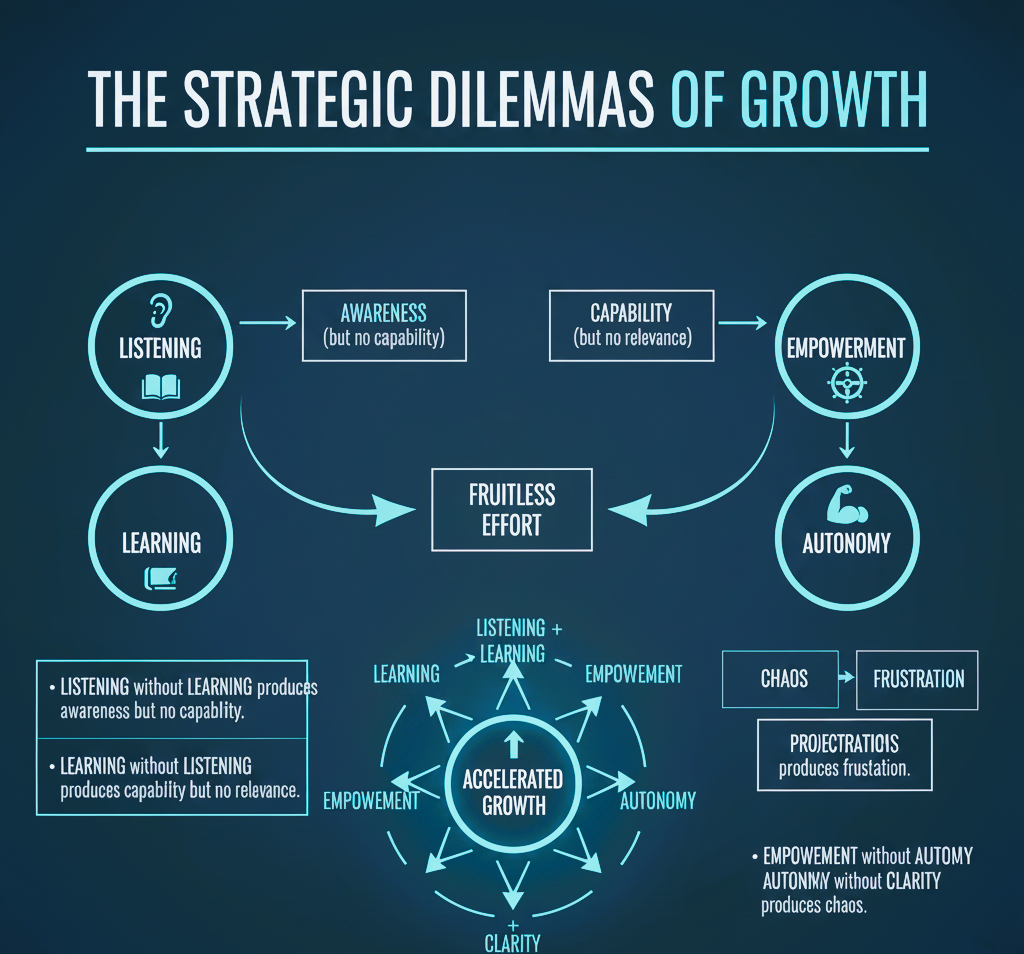
Most companies make the same mistake. They add learning but keep the friction. They gather feedback but don’t fix root causes. Rewrite values but ignore decision rights. They preach empowerment but operate through micromanagement. Employees feel this contradiction instantly.
Real empowerment only emerges when four elements align:
- Listening without action creates awareness but no change.
- Learning without relevance creates skills no one uses.
- Autonomy without clarity creates chaos.
- Empowerment without authority creates frustration.
The Flywheel—Listen → Analyze → Learn → Empower → Close—solves this by turning empowerment into a repeatable loop, not a promise. When this loop starts running, culture becomes a by-product, and most importantly, friction drops, teams stabilize, trust compounds, and people grow faster.
Tools like Value Matrix accelerate this by helping organizations hire leaders whose values already match the culture, ensuring they naturally reinforce continuous Listening and continuous Learning.
In the end, empowerment is a systemic design choice. Design it well, and everything improves. Design it poorly, and nothing else works.
FAQs
Then the system is working. Don’t protect the discomfort. Diagnose honestly, coach intentionally, and reset expectations. Fixing the environment is as essential as fixing performance.
Track operational shifts like reduced friction, faster decisions, improved time-to-close on issues, fewer escalations, and higher-quality output. Sentiment is nice, but performance is proof.
Not if you triage. Patterns to action. Isolated noise to acknowledgment. Transparency about what will and won’t be addressed is the antidote to overwhelm.
Say so. Clearly. Quickly. Respectfully. Transparency earns trust, and avoidance destroys it.
By pairing learning with authority. Capability dies in environments where people must ask for permission to use the skills they just learned.
About Us
ValueMatrix is an AI-powered talent intelligence platform that helps companies hire better, faster, and without bias. We go beyond resumes to assess skills, behavioral traits, and cultural fit using advanced AI and proven psychological frameworks. Our platform delivers data-driven insights that improve hiring accuracy, reduce time-to-hire, and elevate candidate quality.
ValueMatrix AI enables hiring teams to make confident hiring decisions and build high-performing teams at scale.