
For almost twenty years, the main goal of hiring innovation has been to speed things up. Companies were supposed to be able to keep up with a workforce that was growing quickly around the world by using faster screening tools, instant evaluations, one-click applications, and shorter interview cycles. In an economy where growth often outpaced government, speed became a way to measure progress.
But speed without accuracy has caused its own quiet problem.
Companies now have to deal with bad hires that mess up teams, bias that hides behind automation, ghostwritten applications that make people look more qualified than they are, and resumes that are more about algorithms than truth. Even with more signals, the ones that help people decide are louder. Hiring is now quick, but not always satisfactory.
This issue brings up a crucial question:
If talent represents the most significant investment a company undertakes, might we consider why decisions are still being made with incomplete information?
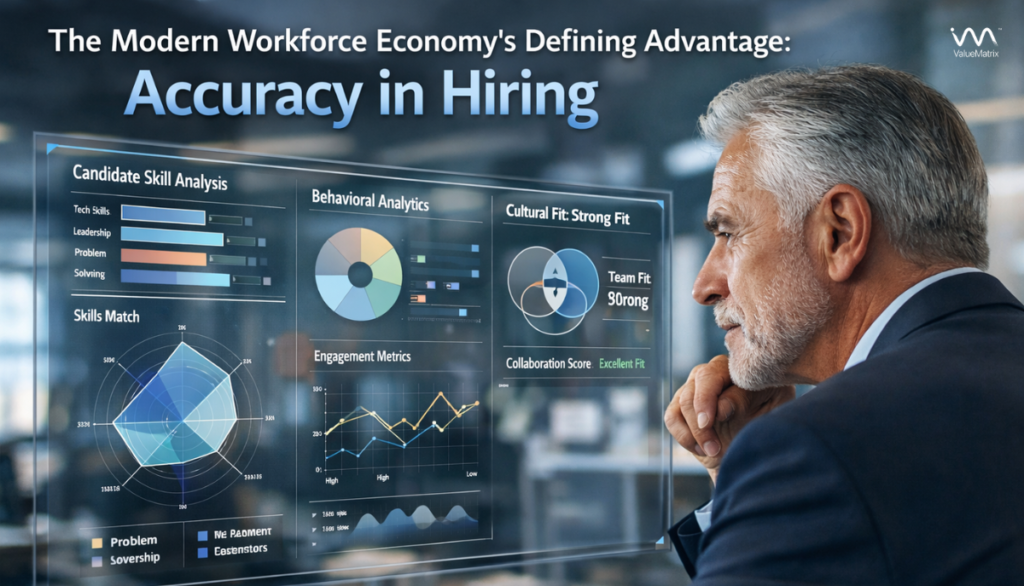
In the AI era, the fastest hiring is no longer the best. In the modern workforce economy, accuracy in hiring is what separates organizations that succeed from those that struggle. The ability to reliably understand capability, fit, and future impact is becoming the foundation of a new hiring advantage for modern organizations. This is not a metric used by HR. It is a strategic move.
The cost of making a bad hire continues to rise as work becomes more complicated, spread out, and interdependent. Leaders can regain control of that risk by being accurate, which turns hiring from a numbers game into a value discipline.
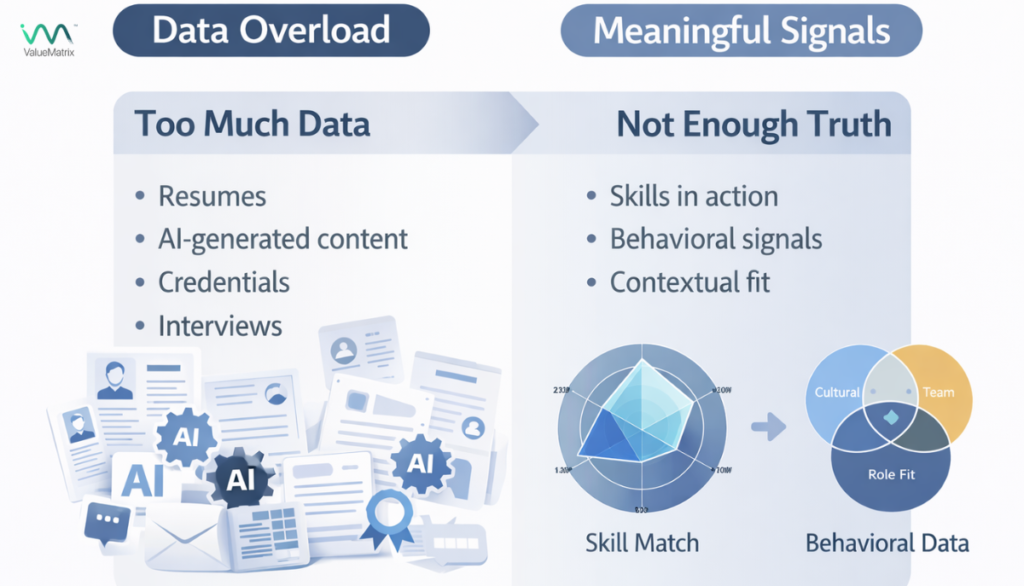
The Global Hiring Breakdown: Too Much Data, Not Enough Truth
The modern hiring ecosystem has more information than it has ever had before. But, strangely, it has never been harder to figure out what that information really means.
AI- or algorithm-generated resumes are now common. They are made to get through keyword filters instead of showing real skills. More and more, people are getting help with their employment from ghostwriters, outsourcing, and systems that make it hard to distinguish the difference between human and machine work. Thanks to coaching platforms and standardized preparation playbooks that favor clear speaking above being real, interviews are becoming like planned acts. Credentials have also gotten bigger, with more degrees, certifications, and endorsements. However, it’s harder to show that they matter for doing the job well.
The result is an ecosystem full of signals but no truth.
The result is not just a story. Several studies in the field show that hiring is becoming less reliable:
- SHRM and Harvard Business Review say that research shows that 40–50 percent of new hires fail or do poorly in their first 18 months.
- A Gartner survey reports that nearly 60 percent of hiring managers question the reliability of resumes as indicators of future success.
- HBR summarizes decades of research in organizational psychology, showing that unstructured interviews usually predict less than 20% of how well someone will perform on the job in the future.
These are not failures of intention. They don’t work because the signal quality is bad.
Organizations are making decisions that could have big consequences based on information that is becoming less and less reliable. The accuracy gap is the growing gap between what hiring processes measure and what work actually needs. This is the silent disconnect at the heart of modern talent strategy.
Companies will keep hiring efficiently but not effectively until accuracy in hiring becomes a core design principle rather than an afterthought. They will scale processes that prioritize speed over truth.
The Cost of Bad Hiring: A Slow Drop in Performance in the Organization
Hiring mistakes don’t usually show up as a crisis. There are no headlines, and it doesn’t cause problems right away. Instead, it slowly destroys an organization’s trust, performance, and momentum until the damage is too great to fix.
People’s lives and business systems both have clear costs.
The effect on the company can be measured and grows over time.
According to estimates from the industry, hiring the wrong person can cost up to five times their annual salary when you add up the costs of finding, hiring, training, and eventually replacing them. The cost in money is only the most obvious part.
Hiring people who don’t fit in with the team makes things take longer and throws off the team’s rhythm. Managers have to coach, correct, and escalate issues over and over again, which takes their focus away from strategy and toward fixing things. Projects stop moving forward when people have to relearn things and their duties change. Leaders get tired of managing over time, which makes them less likely to take risks and unable to make decisions. When every hiring choice feels risky, momentum turns into caution.
The effects on the outside are just as important. In client-facing or mission-critical roles, hiring mistakes have a direct impact on the quality of service and the trust of customers. Not because of a strategic failure, but because the wrong skills were put at the center of execution, mistakes are made, relationships are strained, and brand credibility is lost.
The influence on people is softer but as powerful.
People tend to burn out more rapidly when they are hired for positions that don’t play to their talents. Doubt grows from not doing well, and strain grows from stretching. Even very skilled people can have trouble when they are in situations that don’t match their skills, personality, or way of working.
As a result, many people endure a cycle of temporary employment, sluggish advancement, and job instability. It’s not that they don’t have talent; it’s that they don’t fit in. Psychological safety declines when these patterns occur. Individuals are less inclined to take risks, trust systems, or anticipate that their work will be evaluated fairly.
Hiring inadequate people progressively transforms the culture, making staff less self-assured, more cautious, and more competitive rather than cooperative.
This is why the issue can’t only be with HR.
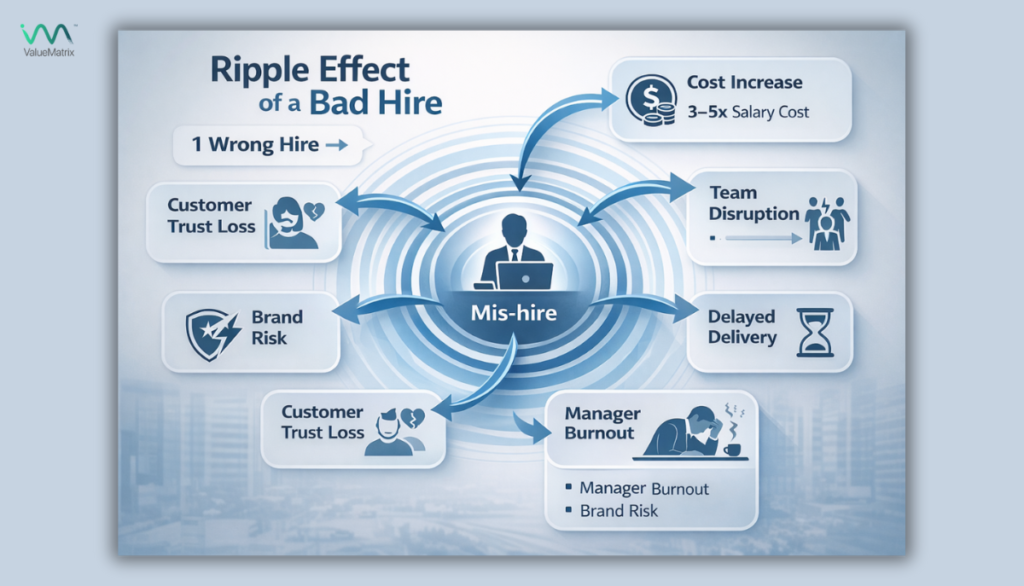
The risk of hiring the wrong person extends beyond the HR department and affects the entire company.
Why Accuracy Is Important Now: The 2026 Pressure Cooker
There has always been a case for being accurate when hiring. What has changed is the environment in which hiring now occurs. By 2026, businesses will need accuracy rather than just want it due to a combination of speedier technology, shifting work practices, and unpredictable economy.
First, the nature of employment is evolving more quickly than people can learn new skills.
AI is transforming employment right now by making it easier to learn new things, shifting roles, and introducing new talents. The gap between what businesses require and what the job market can give is increasing. In this circumstance, it’s not uncomplicated to remedy hiring blunders. You can’t just retrain someone who was hired wrong today because the job may not be the same tomorrow.
Second, there is a systemic lack of important skills.
There are always too few workers in industries like cybersecurity, healthcare, artificial intelligence, and advanced engineering. This problem won’t go away just by hiring more personnel. When things are hard to find, mistakes cost more.
Third, hybrid and remote work make traditional approaches of fixing problems less effective.
People who didn’t fit in typically produced problems in settings where people worked together, and these conflicts were usually handled informally. When teams are spread out, feedback loops are slower, which makes it tougher to figure out what’s going on and change direction. Small errors eventually result in significant performance disparities.
Fourth, the economy’s ups and downs have made people less forgiving of blunders.
Companies can’t afford to experiment with their most expensive asset—people—for long periods of time in markets that aren’t sure what will happen. Budgets are tighter, timelines are shorter, and plans for expansion need to be exact instead of open-ended.
Finally, it has become less stable to hire workers from all over the world.
Changes in the law, such as the recent rise in H-1B fees, have made cross-border talent strategies more expensive and risky. Moving around is no longer easy; it’s now selective, conditional, and expensive. This makes every decision to hire someone from another country more important.
When these forces converge, they create a pressure cooker environment in which traditional hiring methods are no longer effective.
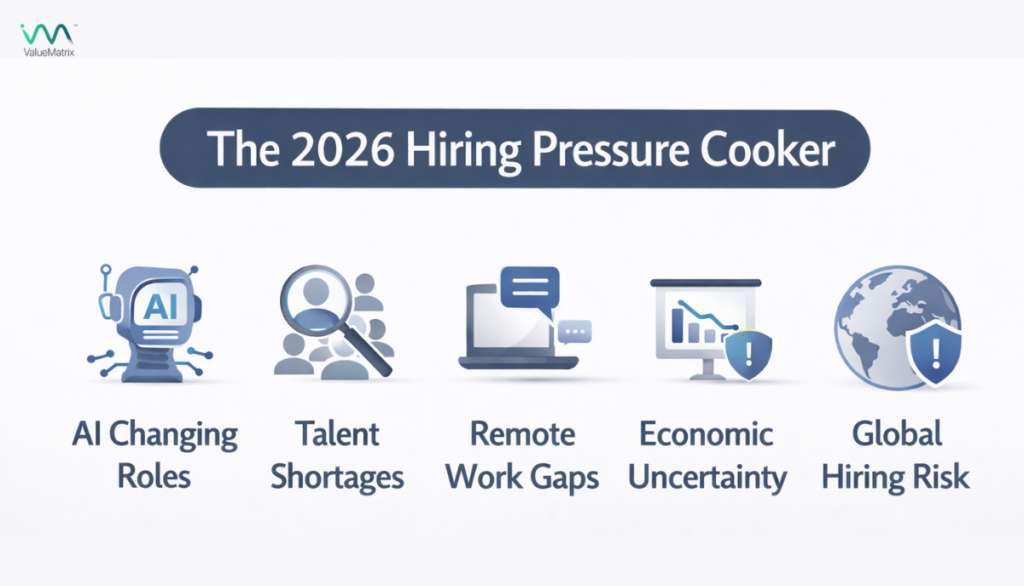
In the modern workforce economy, accuracy has become essential. It is now the only sustainable way for organizations to grow without compounding risk.
How AI Makes Hiring Reliable: The Rise of Accuracy Intelligence
As companies run into problems with traditional hiring, a new field is starting to grow: accuracy intelligence.
Accuracy intelligence is the next step in talent intelligence, enabling accuracy in hiring by moving from descriptive insights to predictive and responsible decision-making. It’s not about getting more data; it’s about understanding the data you already have. This means turning broken signals into clear information about capability, fit, and future performance.
While older systems were all about volume, efficiency, or automation, accuracy intelligence is all about reliability. The focus is not on how quickly a candidate can be screened; instead, it emphasizes how confident an organization is about the candidate’s identity, job performance, and fit within a specific context.
It is based on a few key abilities.
Behavioral signal analysis takes evaluation to a deeper level than merely looking at things like credentials or how long someone has been there. By examining patterns in work samples, writing, problem-solving techniques, and situational judgment tests, it demonstrates how people actually think, decide, and behave in circumstances that are comparable to the ones they will be in.
Contextual matching links those signals to actual results. Instead of linking skills to job titles, it links them to the demands of roles in specific settings. For example, it recognizes that the same skill can manifest differently in a startup compared to a regulated business, or in a research lab versus a sales organization.
Fit modeling combines ability with the setting. It understands that performance is shaped by an individual’s skills as well as the context and collaborators at play. You need to know how individual strengths, team dynamics, organizational culture, and leadership style all fit together to be able to guess what will happen.
Bias minimization is achieved through structure, not suppression. Accuracy intelligence diminishes the impact of unconscious biases, familiarity bias, and narrative distortion by substituting intuition-driven evaluation with evidence-based frameworks, thereby not eradicating human judgment but rather anchoring it. Deep verification makes sure that what is being tested is real. In a world where content is automated, assignments are outsourced, and online identities are carefully chosen, it is just as important to check the source and integrity of signals as it is to check their quality.
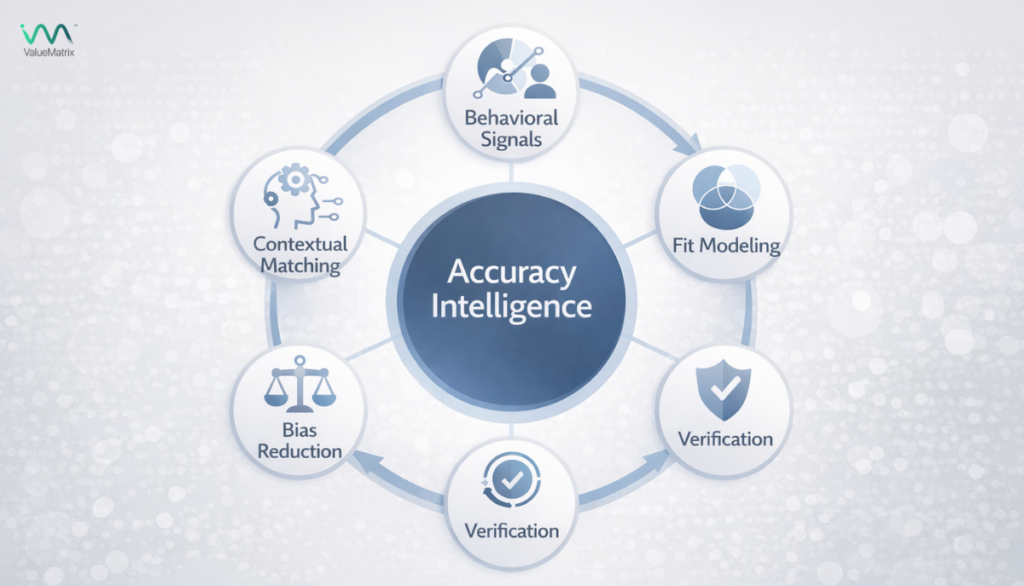
These things change how people decide who to hire by going from gut feeling to proof, from speed to substance, and from guesswork to understanding.
More data doesn’t make you more accurate; meaningful data does.
The 2026 Accuracy-First Hiring Playbook is a Strategic Framework
Hiring errors are less likely in 2026. There are more specialized responsibilities, teams depend on each other more, and friction is more expensive than delay. Filling jobs fast is not enough; you also need to ensure that new personnel strengthen rather than weaken the organization.
Here is a practical guide for embedding accuracy in hiring as a strategic discipline across the organization.
1. Define Success in the Context Of The Situation, Not on its Own
Accuracy is made feasible by the role and the team it is a part of.
Businesses must understand the fundamental STAB profile—Skills, Traits, Abilities, and Behaviors—that each position, at every skill level, and within particular functional teams requires for success. These profiles should be used in place of generic job descriptions. The same title can need very different STAB combinations depending on whether the job is in a high-ambiguity innovation team, a precision-driven operations group, or a customer-facing environment.
Hiring focuses on credentials instead of results without this contextual mapping.
2. Design for Teamwork, Not Just Individual Success
Being a good team player is not always a prerequisite for being a good worker.
When you recruit someone, you should think about how well they will get along with the rest of the team. This covers their communication styles, decision-making processes, problem-solving talents, and the diverse ways in which their brains function. This will guarantee that the new hire supports collaboration rather than exacerbating it.
Businesses that disregard compatibility lose their culture, work more slowly, and suffer an unseen price. So, we should conceive of hiring as a design option for the overall system, not as a series of individual transactions.
3. Use Evidence-Based Signals Instead of Unstructured Interviews
People still use unstructured interviews because they seem natural, but they don’t do a good job of predicting how well someone will do in the future.
They also make businesses do multi-hedging, which means having multiple rounds of interviews with different people and adding personal opinions. This costs more, takes longer, and isn’t as reliable, but it doesn’t really make the accuracy better.
Instead, recruiting should be based on proof that can’t be faked, such work samples, situational judgment tests, structured behavioral evaluations, and role-specific problem simulations that indicate how a candidate genuinely thinks and works, not just how well they talk.
4. Check the Source for Authenticity
Authenticity has become a strategic risk in a time when AI can write fluent responses and even fully “warmed” professional profiles can be bought online.
Companies need to make sure that the signals they use to hire people are real, come from the candidates, are specific to the situation, and can be verified. They shouldn’t be written by someone else, done by a computer, or sent out to someone else. You need to check both the quality and the source to make sure it’s right.
You have to make trust a part of the hiring process; it won’t just happen.
5. Use AI to Illuminate, Not Replace, Judgment
AI’s job is not to make decisions but to find patterns that people can’t see, like links between STAB profiles and long-term performance, signs of role fit, early signs of attrition risk, and systemic bias in evaluation.
AI makes it easier for people to see things they might have missed and improves them at making decisions. If you misuse AI, it will only amplify your existing assumptions.
Replacing people with machines does not make things more accurate; instead, combining intelligence with insight does.
6. Measure Backwards to Improve Forwards
Finally, accuracy should be seen as a skill that can be measured and improved.
Companies should link hiring choices to performance outcomes, retention, engagement, and team effectiveness. This will create feedback loops that constantly change what “good” means.
Without this discipline, hiring stays the same while work changes.
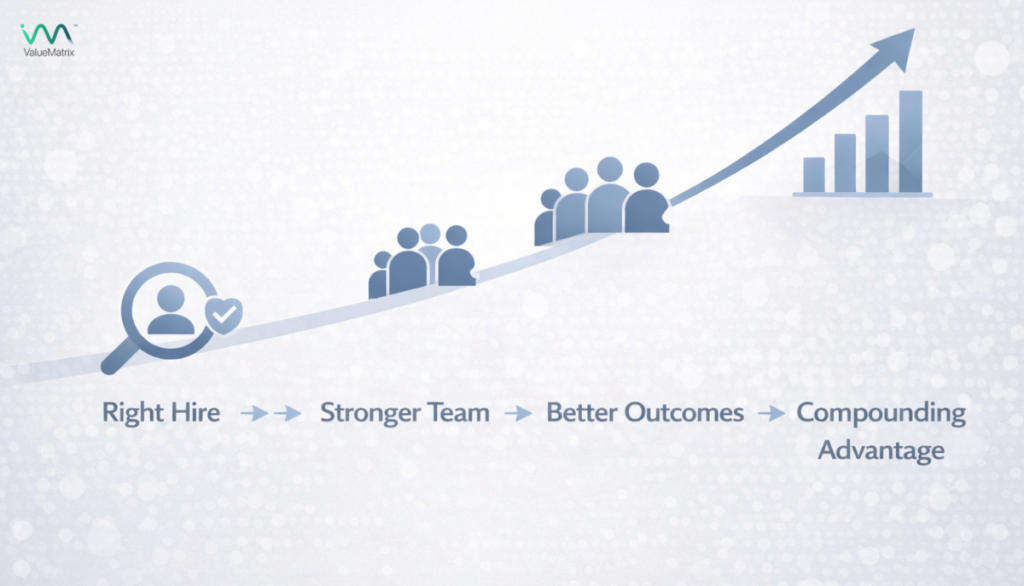
In hiring, accuracy builds on itself. Every right choice makes the next one stronger.
Conclusion—Accuracy Will Be the Most Important Leadership Trait in the Next Decade
The companies that will shape the next ten years won’t be the ones that hire the most people, grow the fastest, or automate the most. They will be those who hire with purpose, proof, and knowledge.
When it comes to hiring, accuracy in hiring isn’t about being perfect; it’s about being in sync. It’s about putting people in positions where they can do their best work, make a difference, and grow in a way that lasts. As time goes on, this alignment becomes the basis of trust between leaders and workers, teams and customers, and organizations and the communities they serve.
Volume does not build cultures. They are made up of coherence. Innovation doesn’t happen just because things are happening quickly; it happens when the right people, the right time, and the right situation come together. Fit, not headcount, determines resilience.
AI now lets leaders see things that were once hidden, like patterns of performance, signs of compatibility, and early signs of risk. But tools don’t make things happen. Mindset does. The same technology can make either wisdom or haste stronger, depending on how it is used.
So, accuracy is not a technical improvement. It is a choice for leaders.
If talent determines a company’s future, then accuracy determines its honesty.