
In September 2025, the announcement of a $100,000 supplemental fee for new H-1B visa petitions sent a jolt through boardrooms across America. For decades, the H-1B program has been the backbone of U.S. innovation, quietly powering technology, research, and healthcare with global expertise. Overnight, that backbone became a budget line many employers could no longer justify.
The regulation is a signal that the era of frictionless global mobility may be drawing to a close. Companies that once depended on a steady inflow of specialized skills now face an uncomfortable question: How do we remain agile and competitive when the freedom to move talent itself carries a premium price tag?
The $100,000 fee is unlikely to halt innovation, but it will change where and how innovation happens. It will push organizations to reconsider not just their hiring strategies, but their entire workforce architecture — from onshore and offshore balance to the economics of upskilling. In this moment of uncertainty, decisions made in haste can fracture long-term competitiveness.
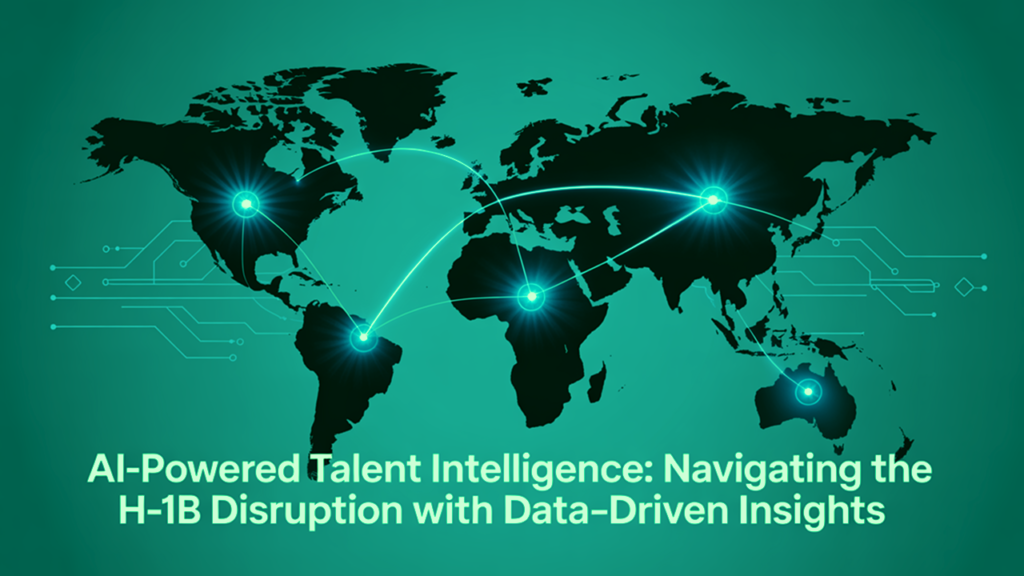
That’s why the conversation must shift from reaction to prediction. AI-powered talent intelligence offers a way to see beyond today’s disruption — to translate regulatory shocks into actionable foresight. By combining data on skills, geographies, compensation, and mobility, organizations can model scenarios, anticipate risks, and design strategies that keep them resilient, even as the policy landscape changes beneath them.
The H-1B announcement is not just a visa story. It is a reminder that workforce planning has entered a new age — one where intelligence, not instinct, determines who thrives in the global talent economy.
The Scale of Disruption — A Shockwave Across the Global Skills Graph
The new H-1B regulation marks one of the most consequential shifts in America’s talent policy in decades. Beginning September 21, 2025, employers filing new H-1B petitions are required to pay an additional $100,000 fee per application. The intent, according to policymakers, is to prioritize domestic hiring and reduce dependence on foreign labor. The effect, however, has been far broader and more immediate.
For many companies, this change has fundamentally altered the economics of recruitment. Nearly 70% of all H-1B roles are in technology, concentrated in fields such as software engineering, data science, and artificial intelligence. These are not peripheral positions; they form the backbone of digital transformation across industries. Early projections indicate a 30–40% decline in new filings, particularly among small and mid-sized firms that cannot absorb the sudden cost escalation. Startups — often the breeding ground for innovation — are the most exposed, as the new fee can exceed an entire quarter’s R&D budget.
Yet, this disruption reaches well beyond Silicon Valley. Healthcare systems, already facing physician and specialist shortages, rely on H-1B professionals to sustain critical services in underserved regions. Research institutions and universities, too, depend on international scholars and post-doctoral talent for continued scientific progress. For them, the fee introduces uncertainty not just in hiring, but in the continuity of entire projects and programs.
The impact is systemic. When talent mobility becomes a privilege rather than a principle, industries that thrive on diversity of thought and expertise risk contraction. The innovation economy — built on the free exchange of skills and ideas — begins to face self-imposed constraints.
When mobility becomes expensive, innovation becomes selective.
Economic and Human Consequences — From Skills Shortage to Strategy Shortfall
The $100,000 fee has created a ripple that travels in two directions — through corporate balance sheets and through human lives. On one side are organizations recalibrating hiring budgets, delivery models, and growth forecasts; on the other are the people who suddenly find their professional and personal plans suspended in uncertainty.
For employers, the economics have shifted overnight. Cost inflation in workforce planning is already visible: the same role that once cost $15,000 to onboard through an H-1B process now requires a six-figure outlay before salary or benefits are considered. Many U.S. companies are slowing hiring or redirecting roles to offshore delivery centers. Tech firms that previously maintained blended teams are quietly increasing their dependency on near-shore hubs in Canada and Latin America. Research labs and healthcare institutions are exploring partnerships abroad rather than expanding locally. What began as an immigration policy adjustment is fast becoming a restructuring exercise in global operations.
For individuals, the impact is deeply personal. Thousands of skilled professionals — many already contributing to critical U.S. industries — now face stalled transfers, visa renewals, or family separations. Spouses and children are left in limbo between continents. Employees who once viewed their U.S. assignments as career accelerators now question their stability and long-term prospects. In organizations that depend heavily on global mobility, this uncertainty inevitably translates into retention challenges and morale dips. When employees perceive that opportunity is bounded by bureaucracy, engagement falters.
At the macro level, the shift has intensified global competition for high-skill talent. While the U.S. tightens its entry points, Canada, the U.K., Australia, and now Germany are actively simplifying their pathways for skilled migrants. Berlin’s leadership, for instance, has positioned Germany as a destination for technology and engineering professionals, introducing streamlined residence permits and recognizing foreign qualifications more readily. The result is a subtle re-routing of global ambition: talent goes where it feels welcome, and innovation follows.
In the race for ideas, borders matter less than sentiment. Every time a door narrows in one country, another market quietly opens it wider.
The Role of AI-Powered Talent Intelligence — From Reaction to Prediction
Policy shocks like the H-1B overhaul reveal a truth that many business leaders have long suspected: most organizations understand their people only in hindsight. Decisions around hiring, relocation, or reskilling are often reactive — triggered by budget cycles, headcount freezes, or compliance updates. In an era where workforce dynamics change faster than policy itself, hindsight is no longer a strategy.
This is where talent intelligence enters the conversation. At its core, talent intelligence is the disciplined use of artificial intelligence, data analytics, and workforce modeling to anticipate rather than respond. It connects the dots between macro policy shifts and micro workforce realities — helping leaders see not only who they employ, but where their next capability will come from, how long it will take to build, and what it will cost to secure.
Its applications are as practical as they are profound:
- Scenario modeling enables companies to simulate visa-related disruptions — projecting the operational impact if 20% of critical roles become inaccessible due to regulatory constraints.
- Geo-talent mapping identifies emerging skill clusters across alternative hubs such as Toronto, Berlin, Bengaluru, or Warsaw, allowing firms to balance innovation with compliance.
- Wage and role benchmarking brings financial clarity, helping leaders compare cost structures between onshore hiring, near-shore contracting, and offshore delivery.
- Internal upskilling identification pinpoints employees within the existing workforce who can be advanced into high-demand roles through targeted learning pathways.
The real value of AI in this context is not automation — it is foresight. It transforms scattered data points into strategic intelligence that allows organizations to pivot with precision rather than panic.
At ValueMatrix.ai, this philosophy guides our approach: to help companies convert chaos into clarity. We believe that talent decisions are too consequential to be driven by guesswork. By integrating predictive analytics with contextual understanding, organizations can build resilience not just against the next policy shift, but against every uncertainty that follows.
Because ultimately, AI doesn’t replace human judgment — it replaces blind spots.
Strategic Framework — The 2026 Talent Intelligence Playbook
As organizations enter 2026, workforce volatility has become a constant rather than a crisis. The most resilient leaders are those who treat preparedness not as a contingency plan but as a core competency.
The following playbook outlines how executives can build lasting agility through data-driven talent intelligence:
- Audit Exposure
Quantify how much of your critical workforce depends on visa-linked or internationally mobile roles. Identify business units most vulnerable to policy disruption and where alternative capacity already exists. - Model Alternatives
Run scenario simulations to compare cost, capacity, and risk across geographies. Evaluate the operational impact of relocating 10 percent or 30 percent of specialized roles before policy shifts make the decision urgent. - Invest in Data Infrastructure
Unify fragmented HR, learning, and recruitment systems into a single skills-intelligence layer. Reliable data is the foundation for predictive workforce modeling and long-term readiness. - Balance Onshore and Offshore
Design flexible delivery architectures that diversify location dependency while keeping innovation cores—R&D, product design, client strategy—anchored in the U.S. This balance safeguards both creativity and continuity. - Upskill with Purpose
Use AI-driven insights to identify domestic employees capable of transitioning into hard-to-fill roles. Purposeful upskilling strengthens internal mobility and reduces reliance on external visa programs over time. - Engage Policymakers and Ecosystems
Move beyond advocacy toward evidence. Share anonymized workforce analytics with policymakers, industry groups, and academia to inform immigration and education policies grounded in actual skill-gap data.
Regulation will always fluctuate. Readiness must not.
Conclusion — Redefining Fairness and Foresight in a Post-H-1B World
The H-1B disruption has revealed something deeper than a regulatory challenge. It has shown how interdependent innovation has become—how the flow of ideas, skills, and ambition now transcends the borders that policies try to redraw. The question facing leaders in 2026 is not whether global mobility will recover, but whether organizations can evolve fast enough to thrive within its new limits.
The fee is temporary; the lesson is permanent. Talent cannot be contained by geography, but competitiveness can be eroded by complacency. Every policy shock—whether about visas, trade, or technology—demands the same response: better intelligence, stronger foresight, and humane execution.
AI-powered talent intelligence is not a remedy for policy, but a mirror for leadership. It allows organizations to see themselves as dynamic systems rather than static headcounts—to detect vulnerabilities early, uncover opportunities invisibly, and design for continuity even in uncertainty.
The leaders who succeed in the coming decade will be those who combine data with discernment, strategy with empathy, and foresight with fairness. For them, the H-1B moment will not mark a retreat, but a recalibration of how global collaboration continues to power progress.
If 2024 taught us to revisit fairness, perhaps 2026 is the year we redefine foresight.