


The JD is more than outdated; it is injurious to your business. As an industrial-age type of job description, this JD creates measurable job description bias, causes toxic salary compression, disables performance management, and creates all unnecessary recruitment challenges. This broad write-up unpacks ten significant flaws of the JD with statistics from Gartner, Textio, the Value Matrix framework, and accompanying clear actions-e.g., using Skills Taxonomy-founders can use to replace with dynamic, outcome-based job ads that actually engage world-class talent, the broken document.
⚓️ Why Did the Job Description Become the Anchor of HR Problems?
At times, it was a sort of checklist that proved its worth. Today, JDs have become a crutch and have created more bottlenecks than they solve. All hiring, pay, and review processes hinge on these rigid documents. It actively undermines everything in talent strategy. The basic flaws within this system must come to light.
An outdated tool, meant for 20th-century bureaucracy, it lends itself poorly to the pace of an up-and-coming tech company, failing its primary purpose.
The Origin: Efficiency Over Evolution
Early JDs supplemented managerial efficiency because they defined labour units. Important for successful mass production, well-defined roles worked for predictable tasks. Now, the modern knowledge economy demands such constant evolution and creative problem-solving that the JD cannot keep up. It becomes a historical record rather than a roadmap to the future. The delay goes on perpetually, leaving structures with HR problems forever.
The Core Lie of the “Static Document”
There are a few constant things with time: changes in work every six months; updates, which JDs rarely undergo; and the biggest lie: all promises made about holding constant the jigsaw pattern of a jigsaw template, inside of which is constant change. It leaves a gap of misunderstanding within employees themselves, lowers engagement, and establishes metrics for poor performance because the employee results rated were based on irrelevant task priorities.
🎯 Who is the Job Description Really Serving (and Who is it Failing)
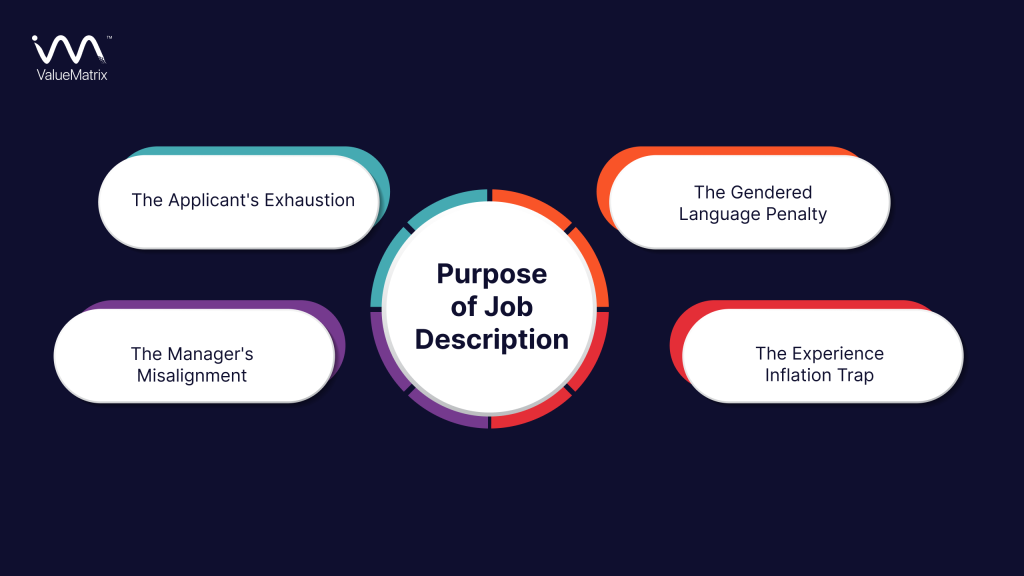
The JD indicates that it serves everyone. Well, it serves no one well. It gives managers a false sense of control and liability coverage, while applicants have a misleading image of the role. The JD is a poor form of communication. It fails to cross both ends of the hiring equation.
The Applicant’s Exhaustion (The ‘Apply-Tax’)
An “Apply-Tax” is put on candidates, where they have to see the lengthy list of requirements, and they feel they do not meet all of them. This self-selection disproportionately deters women and minorities from applying; the number of years of experience required is, at times, arbitrary and exaggerated; great talent skips the application altogether, raising recruitment challenges.
The Manager’s Misalignment
Most old JDs are copy-paste and have all sorts of possible tools and skills an organisation might need one day. They’re defining the perfect candidate, not a necessary one. When the new hire actually joins, the priorities change from what was there in the JD. This results in disappointments. The hire did not fill the current need, and there’s an immediate churn cost.
The JD is not just a document. It is a narratively engaging experience, as the way that language is used in it introduces some of the huge measurable job description biases that narrow a talent pool. Top performers are lost with that bias, and if a job posting uses biased language, then the funnel is already broken before the first candidate even applies.
🚫 How Does Job Description Bias Kill Your Talent Funnel?
The language does subtle manipulation in the JDs and acts as an invisible filter, driving away diverse and really qualified candidates.
The Gendered Language Penalty
Certain words repel certain demographics. According to Textio, terms such as “superior,” “driven,” and “exhaustive” are masculine-coded words that lead to 8-15% reductions in qualified women’s application rates (Source: Textio, 2021). This bias is measurable: fixing the language is an absolute minimum requirement for diversity.
The Experience Inflation Trap
Experience jacking is just one of the tricks available in JDs. For instance, you are demanding that you “Master’s degree and 10 years of experience” for a senior role excludes high-performing individuals who learned on the job. This is not hiring for competence. This is hiring for credentials. It systematically disadvantages those from non-traditional or accelerated backgrounds, limiting your access to innovative thinkers.
💸 Is Your JD Secretly Driving Salary Compression?
JDs were the most associated document with compensation bands. As soon as these JDs turn static, then so does the compensation, making it toxic. Salary compression occurs when new hires earn more than their predecessors. This is a huge HR problem. The outdated JD is responsible for this instability and distrust.
Rigid salary bands tied to inflexible JDs are directly causing internal equity issues and crushing employee morale.
Fixing the Internal Equity Breakdown
Employees gossip about pay. Trust dissipates when they learn that their colleague, who is two years younger, is getting a higher pay cheque even though they do the same work. The older JD would justify the lesser pay, considering the much longer-serving employee had more institutional knowledge. The antiquated JD becomes an equity disaster, driving valuable people out the door.
The Hidden Cost of Vague Scopes
Vague JDs create overlapping duties. Two might have the same designation, while one does strategic high-value work, while the other deals with low-value administrative work; both qualify for the same pay band. The ambiguities in the JD conceal the performance and value gap, thus rendering merit recognition impossible and making way for salary disputes.
📉 Why Do JDs Sabotage Performance Management?
Impact is what a good performance review weighs, and not a compliance-based performance review. The jobs force compliance. They create a you are-not-my-problem mentality. Employees follow the list of tasks, not high-impact problems. That is not much strategic initiative for the business.
The “Not My Job” Defense Mechanism
Justifying refusing a job task may lie outside the set contents of the JD. It kills cross-functional collaboration and kills innovation potential within the company. JD has turned into a personal legal cover. This structure rewards passivity but not entrepreneurial thinking for the acceleration of the organisation.
Disconnecting Activity from Business Impact
The JD list, for example, states, “Conduct 5 user interviews per week.” The sole point is asking for impact: “Discover the root cause of the 15% drop in Q3 retention.” The JD concerns itself with the wrong and, through effort measures, true contributions are masked, wasting valuable time of the management.
🔄 What’s the Real Cost of Mis-Hiring and Turnover?
The True Price is losing talents. Although money loss is clear via JD embezzlement, the highest cost is that of mis-hire. Most such undefined roles result in the recruitment challenges of hiring unsuitable people, but they often fail, forcing the organisation to repeat the difficulties that breed wasting of time, money, and morale, reportedly at a level of between 150 and 200 per cent of the annual salary of the employee.
These case studies demonstrate how the leading corporations streamlined their structural JD problems by completely changing focus
Case Study 1: Reversing the Mis-Hiring Epidemic (IBM)
Curbing the Epidemic of Mis-Hiring at IBM. IBM soon became aware that the traditional JDs contributed to their huge losses from mis-hires and attrition. They shifted from the traditional JD advertisements. Instead of traditional job postings, IBM now employs IA to develop an all-encompassing Skills Taxonomy for all employees. They recruit and promote based only on actual skills as opposed to static job titles. This would prove beneficial for talent retention and improvement on deployment agility since such an approach recognises the internal capability.
Case Study 2: The Netflix “Context, Not Control” Model
Netflix is, as everyone knows, one of the strongest advocates against prescriptive JDs. They define roles by popular purpose and context, and not by what the employee is expected to do. They hire what they call “stunning colleagues” and let them fly with enormous responsibilities and high latitude. This is a phenomenal counter to “Not My Job.” It derives their high-performance culture that they trust the hired-in person to define what needs to be done in the context, as opposed to conforming to a list.
📈 How Can Standardizing Job Descriptions Reduce HR Issues?

Standardisation bridges a big, important transition gap from static JD. It does not eliminate static problems, but it does remove much of the JD bias and noise within a job description. It ensures teams and departments are consistent within their functions.
Standardisation creates clarity and reduces many conflicts across important metrics.
Establishing Pay Equity Guardrails
Standardised job descriptions require comparable competencies and responsibilities for each title. This will make it difficult for managers to inflate responsibilities for one hire arbitrarily. It helps in preventing salary compression and addressing pay gaps proactively, thus making the compensation conversation fair.
Improving Organizational Design Clarity
When every “Senior Engineer” at the organisation has the same definitions in core outcomes and skills, career paths become clearer. Transparency improves internal mobility, as employees can easily see their next role and the skills required to get there, which thus reduces internal friction and development frustration from an HR perspective.
📊 Can We Prove JDs Are Ineffective? (The Data)
In-cases to Prove JDs’ Ineffectiveness (Data) The proof is overwhelming.Traditional JDs are not only ineffective but also positively harmful to talent acquisition and retention efforts.
These statistics and frameworks corroborate the organisational benefits that result from abandoning the traditional document model.
Statistic 1: The Skills-Based Retention Bump (Gartner)
Organisations that shift to a skills-based approach will receive a measurable benefit. Gartner suggested that such companies will experience as much as 10 percent growth in employee retention and a 6 percent increase in internal deployment (Source: Gartner, 2023). This indicates that skill development is a better retention tool than a fixed role definition.
Statistic 2: The Language Barrier in Applications (Textio)
The quantifiable impact of bias is shocking. Straightening up the subtle language in a job ad to remove gendered bias immensely increases the calibre and diversity of the applicant pool, often upward to more than 15 per cent (Source: Textio, 2021). This is a simple fix for an engrossing problem.
Value Matrix’s Contribution
Value matrix framework complements in proving JD ineffectiveness by compelling a value audit. It plots each role and task against its strategic value and cost. This exercise generally reveals that about 40-60 of duties in a conventional JD fall in the low-value/high-cost quadrant. This proves the JD is not defining value-add; it is defining waste and distraction, draining resources of a company.
✅ What is the New Standard for a Modern Job Ad?
The new JD is not just another checklist, but rather a strategic tool for communicating an opportunity. Today’s sustaining job advertisement must sell an opportunity to solve a problem. This should sell a potentially high-impact, high-revenue challenge to a new business partner.
By tackling recruitment challenges directly, one must focus on defining the what and why, and not the how.
Shifting from Tasks to Strategic Outcomes
Stop chronicling activities. Start listing outcomes. The job postings should read like a challenge: “Lead the expansion into the EMEA market and secure $5M ARR” instead of “Manage international sales operations.” Only strategic thinkers who define their own path toward success will find these positions attractive.
Building a Skills Taxonomy Foundation
Get into a skills taxonomy. This serves to define the actual abilities one would need to succeed on the job (e.g., “expertise in Python, B2B sales negotiation, and data visualisation”). Since skills can be transported and verified, HR can utilise this to match their internal employees to vacancies, bringing internal mobility into being from the outset.
🔭 Where Do Founders Go From Here? (The Future of Work)

In the future, talent management will be about continuously re-scoping and being very flexible. Technology needs to facilitate this. Founders need to lead into these thoughts and away from bureaucratic thinking.
The Role of AI in Defining Scope
AI now helps in the drafting of job ads. It analyses performance data from current employees. It predicts skill requirements for future business goals. In this manner, something like a living scope is created, with real-time updates, preventing the JD from being a static document that lags behind reality.
The Move to Project-Based Roles
Founders are talking about an agile transition to project-based staffing. Employees are assigned to those high-impact challenges. They are not assigned to a JD. When successful, the employees move on to the next challenge with the maximum coverage of business needs, and employee engagement is rewarded with learning and versatility.
💡 Conclusion: The JD Must Die for the Talent to Live
The traditional job description is long gone. It’s been the single source of many HR woes, nurturing bias, salary tensions at the tack, and performance sabotage. The founders should be radical. Get rid of the static JD altogether. Replace it with dynamic, challenge-selling job ads that focus on outcomes and skills, rather than status. Let the job description die, and let your organisation thrive and scale sturdily.
The JD does not fail as an HR problem but as a leadership problem. It is an entirely different mindset that must become the new way of building work definition on the part of all leaders. No longer will roles be defined by past compliance but by future impact. The prospect empowers managers to be talent coaches, not task-masters, and depends upon finding the best path to the desired result.
Such a change is a make-or-break issue for hyper-growth companies. A flexible, skill-based structure is your strongest defence to market volatility and your most powerful means of attracting top-tier talent. With the retirement of the static JD, you immediately eradicate job description bias, the main cause of internal friction in any organisation, and therefore allow the best people to focus on innovation rather than bureaucracy.
The Five-Minute Audit Challenge
Take five minutes right now. Pull three of your top open JDs. Circle every task vs. outcome phrase you find. If you circle over five task statements, you know what to do. Substantially revise the document today, focusing on impact, not on the task.
The Fun Section: The “Bad JD Bingo Card”
Ready to cringe? Every terrible JD has one of these clichés. If you spot them in your job postings, you get Bingo!
- “Ninja,” “Rockstar,” or “Guru” (We don’t know the scope, but we need someone cool.)
- “Self-starter a Must” (We offer zero training or guidance.)
- “Synergy Required” (Meaningless corporate jargon.)
- “Manage all aspects of…” (The scope is impossible.)
- “Roll up your sleeves” (Expect to do tasks far below your pay grade.)
The Bonus Square: Low Value Zone of the Value Matrix
If in your JD, there exist duties that are pure administrative overhead or are easily automated tasks, then you hit the Value Matrix low value high cost quadrant! Things like “Maintain complex, unnecessary spreadsheets” or “File reports no one reads” are examples of such tasks. Cross it out and delete this task. It is actively proving that this JD does not work!
FAQs
The Job Description is an internal, detailed document for use in compensation, performance reviews, and compliance. The Job Advertisement, on the other hand, is an external short marketing pitch to sell the opportunity, the mission, and the challenge to bring on board the right talent. Focus on creating high-quality, compelling Job Ads.
JD bias affects diversity inadvertently by means of exclusionary language. For instance, the use of masculine-coded words (aggressive, fearless) or inflated demands on experience qualifications that disqualify highly competent nontraditional candidates makes recruitment challenging.
Yes. Many modern, innovative, and high-growth companies are using “role charters” or “context documents” instead of traditional JDs. There are certain laws, like ADA, to which some documentation is still linked with the essential functions of the position, but the legal requirements are related to defining essential tasks and outcomes, not much to prescriptive long lists of every activity carried out on a day-to-day basis.
Skills Taxonomy is an elongated, organised list of all the verifiable skills and competencies that are required across your organisation. It is made by surveying the high performers on skills they really use to have an impact, followed by categorising these skills (e.g., technical, soft, leadership) to use for hiring and internal development.
The fastest way is to apply the “Outcome over Activity” rule. Really, every bullet should be followed by the question, “What business result will this activity achieve?”. Instead of the activity (e.g.attend weekly meetings), choose the end result (e.g.document and distribute weekly insights for cross-functional clarity).
About Us
ValueMatrix is an AI-powered talent intelligence platform that helps companies hire better, faster, and without bias. We go beyond resumes to assess skills, behavioral traits, and cultural fit using advanced AI and proven psychological frameworks. Our platform delivers data-driven insights that improve hiring accuracy, reduce time-to-hire, and elevate candidate quality.
ValueMatrix AI enables hiring teams to make confident hiring decisions and build high-performing teams at scale.