
Key Takeaways:
- About 43% of organisations use AI for HR tasks in 2025, up from 26% in 2024
- 74% of recruiters say AI makes finding candidates easier
- Workforce intelligence platforms can assist in reducing time-to-fill by up to 30%
- AI-driven workforce intelligence software improves hiring efficiency by 89.6%
- Talent intelligence can help businesses to identify high-quality candidates faster and more accurately
Workforce intelligence has evolved significantly over the years and has now become the backbone of several modern hiring strategies. It helps organizations move from reactive recruitment to predictive, data-driven decision-making. In fact, as per LinkedIn’s Future of Recruiting 2025 report, 74% of TA professionals agreed that AI has helped in making hiring much more efficient. The fact shows how HR intelligence and talent intelligence have become critical in recruitment.
So, is workforce intelligence really important when it comes to recruitment? Yes, it has now become inevitable, as traditional hiring based on gut feeling is no longer effective. This claim is supported by a report by Recruiterflow, which states 45% of employers report struggling to find qualified candidates in 2026.
Another reason opting for a workforce intelligence platform is no longer optional is that, according to Taleva’s industry projections, the global market for AI in recruitment will reach USD 1.1 billion by 2030 at a CAGR of 6.5%. This massive demand signals that data-driven talent management is now a strategic business imperative.
What Is Workforce Intelligence? (And Why Does It Matter Now?)
Workforce intelligence is the strategic practice of integrating internal HR data, artificial intelligence, and external market insights to create a view of an organization’s human capital. It allows leaders to move beyond historical reporting to prescriptive action, which helps to decide the next course of action.
In 2026, the definition of workforce intelligence has expanded far beyond simple spreadsheets. It is now an ecosystem that combines three distinct technical pillars:
- HR Intelligence: The “Who” and “Where”; it is about collecting data from payroll, performance reviews, and attendance.
- People Analytics: The “Why”; it is about applying statistical models to find correlations between management styles and turnover.
- Artificial Intelligence: The “What Next”; it is about using machine learning to forecast future hiring needs and simulate the impact of policy changes.
The role of workforce intelligence software in modern decision-making is quite transformative. Instead of HR directors spending days and weeks manually compiling all different types of reports on why a project failed or why a department is shrinking, workforce intelligence platforms offer real-time visibility into the concern. Moreover, 86.1% of recruiters agreed that using AI has boosted the hiring process, while 85% of employers agree that AI or automation has helped them save time as well as increase their overall efficiency.
The Rise of Artificial Intelligence Workforce Trends
The integration of artificial intelligence workforce technologies is reshaping hiring processes, with:
- AI- Powered screening
- Machine learning improves candidate matching
- Predictive analytics forecasts hiring success
Based on responses from 950 hiring managers to Workable’s AI in Hiring and Work survey report, using AI in hiring report 89.6% higher efficiency and 77.9% cost savings, making AI a core component of modern workforce intelligence platforms.
Why Is Workforce Intelligence Important for Modern Hiring?
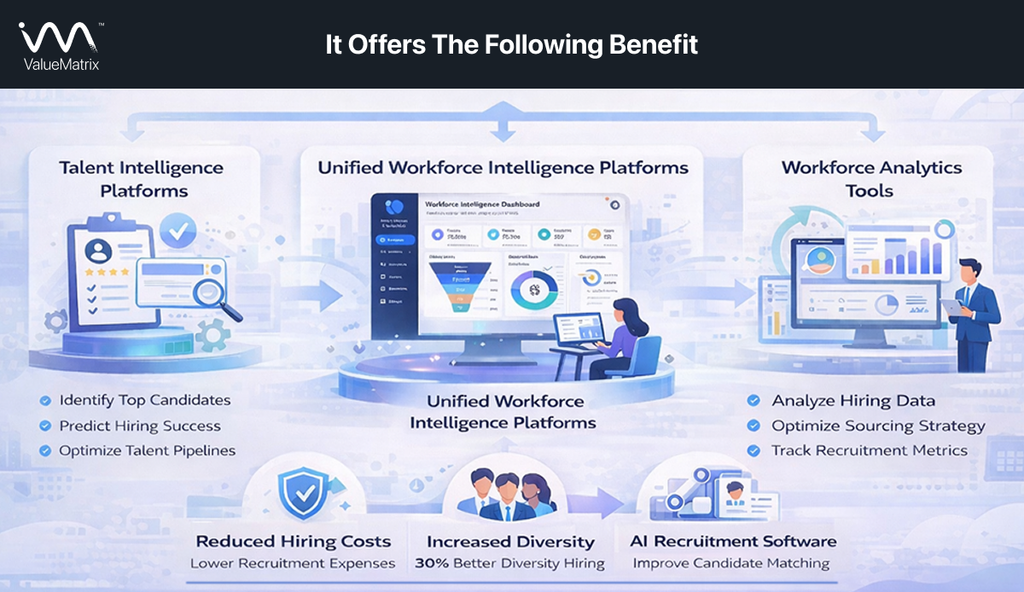
Workforce intelligence is important because it helps an organization to make faster, more accurate hiring decisions, improve candidate quality, reduce recruitment costs, as well as build sustainable talent pipelines.
Now, let us understand some of the common reasons why workforce intelligence is now the need of the hour:
1. Smarter Talent Acquisition with Talent Intelligence
Precision is more important than volume in the modern hiring scenario. Organizations can no longer rely on mass hiring approaches or manual screening methods. Instead, AI-powered talent intelligence allows companies to identify high-potential candidates more quickly, accurately match skills with job requirements, and significantly reduce dependence on manual processes.
This great shift toward data-driven hiring is supported by the LinkedIn Future of Recruiting 2025 report, which states 89% of TA professionals agree that it is highly important to measure the quality of hire. However, only 25% have confidence that their organisation is able to do so.
2. Improved Hiring Quality and Reduced Bad Hires
Bad hiring decisions can not only have financial consequences but also operational ones. Beyond salary costs, they can also have a considerable impact on team productivity, morale, and overall performance. As per the U.S. Department of Labor, a bad hire can even cost up to 30% of an employee’s first-year earnings.
Workforce intelligence is a great tool as it can help to reduce this risk by enabling organizations to define clear success profiles using historical hiring data, improve candidate-job fit via better matching, as well as standardize evaluation criteria to ensure consistent and objective decision-making.
3. Faster Hiring and Reduced Time-to-Fill
If we are to consider today’s hiring landscape, speed is a key differentiator. Businesses that can move quickly are much more likely to grab top talent before competitors do. Workforce intelligence helps an organization to shorten the screening cycles, enhance decision-making speed, and also reduce delays in the hiring process.
In fact, structured hiring processes can reduce time-to-fill by up to 30%, and can also improve recruitment efficiency.
4. Stronger Talent Pipelines
Workforce intelligence also enables organizations to shift from reactive to proactive hiring strategies. Instead of starting from scratch each time a role opens, companies can build and maintain strong talent pipelines, engage candidates consistently, and stay prepared for future hiring needs.
How Workforce Intelligence Works: Step-by-Step Breakdown
Workforce intelligence works by collecting, integrating, analyzing, and transforming workforce and hiring data into actionable insights with the help of advanced analytics and modern AI technologies.
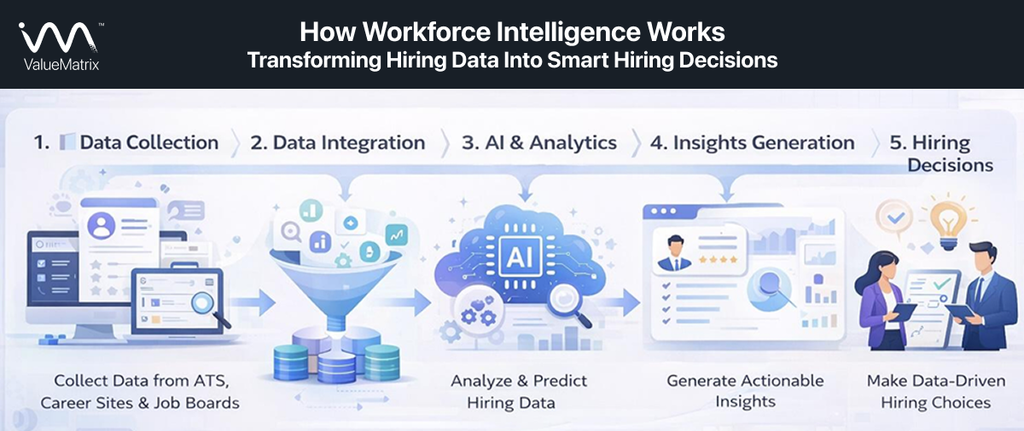
Here are the steps included in the workings of workforce intelligence:
Step 1: Data Collection Across Workforce Systems
Data is collected from various sources such as Applicant Tracking System (ATS), HR management systems, career sites, job boards, or performance and engagement platforms. This creates a comprehensive dataset that reflects the entire employee lifecycle.
Step 2: Data Integration and Cleaning
Considering that data accuracy is important, organizations need to:
- Remove duplicate records
- Standardize data formats
- Ensure consistency across systems
According to a 2020 report from Gartner, poor data quality can cost organizations $12.9 million annually. Hence, data cleaning is an extremely important step.
Step 3: Advanced Analytics and AI Processing
This stage is very important as it helps convert the data into intelligence.
- Predictive analytics identifies trends
- Machine learning detects patterns
- Behavioral analytics enhances insights
AI models continuously improve based on new data, making predictions more accurate over time.
Step 4: Insights Generation and Visualization
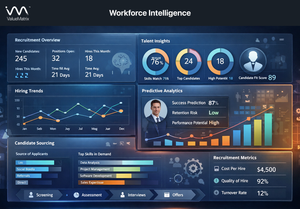
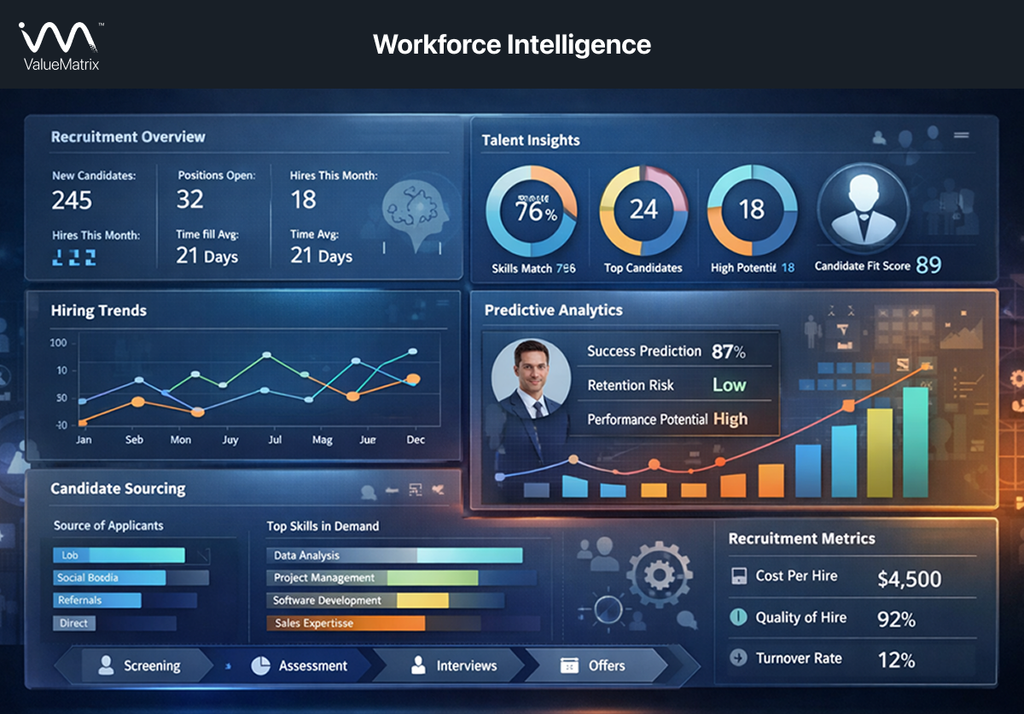
Businesses can get insights via real-time dashboards, visual analytics, or hiring performance reports. This step is necessary because organizations that use data visualization tools are more likely to ensure timely access to hiring data, which can help them make faster decisions and improve hiring speed.
Step 5: Actionable Decision-Making
In this stage, the insights further lead to strategic actions such as:
- Optimize sourcing strategies
- Improve candidate screening
- Enhance hiring workflows
Organizations that adopt workforce intelligence are known to outperform businesses that still rely on traditional hiring methods.
What Are the Top Workforce Intelligence Tools and Platforms in 2026?
Workforce intelligence tools and platforms leverage AI, analytics, and integrated data systems to improve AI-based hiring decisions, optimize recruitment processes, and enhance workforce planning.
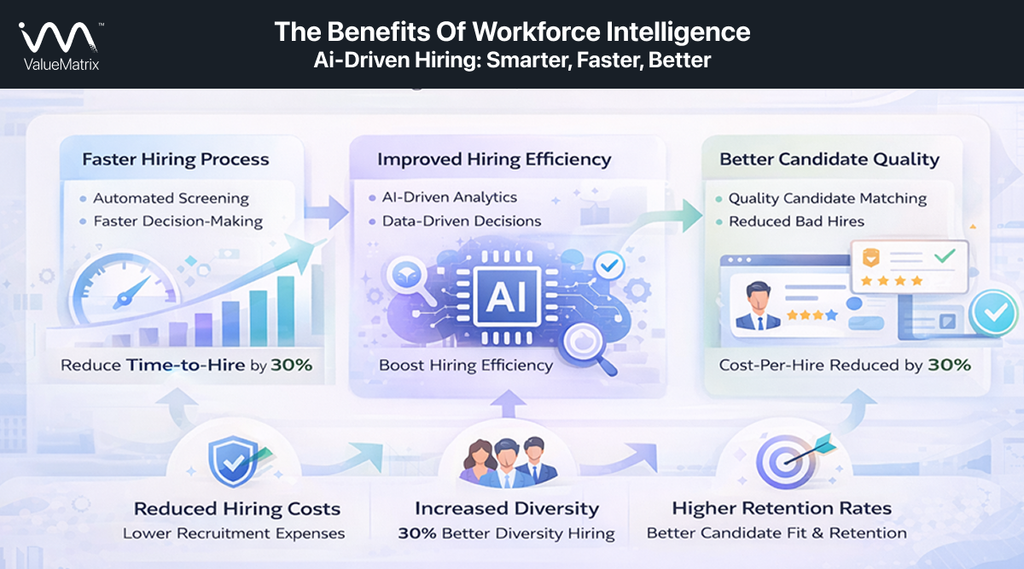
Features that businesses need to look for in Workforce Intelligence Software:
When evaluating platforms, organizations must prioritize the following:
- AI-Driven Recommendations: Does the tool show a graph, or does it tell you what to do about it?
- Real-Time Integration: Can it pull data from your existing tech stack (Slack, Zoom, Salesforce) without manual uploads?
- Predictive Modeling: Can it simulate “what-if” scenarios (e.g., “What happens if we mandate a return-to-office 3 days a week?”)?
- Ethical AI / Bias Detection: Does the platform have safeguards to ensure its algorithms aren’t perpetuating hiring biases?
Types of Workforce Intelligence Tools
- Talent Intelligence Platforms: Focus on the “Top of Funnel”, recruitment, market mapping, and employer branding.
- People Analytics Suites: Focus on the “Internal Workforce”, productivity, payroll, and retention.
- Behavioral/Culture Platforms: Focus on “The Human Element”, using science to measure culture-fit and psychological safety.
The Benefits of All-in-One Platforms
Unified solutions like ValueMatrix are becoming the industry standard. Fragmented tools lead to “Data Blind Spots.” When your recruitment data doesn’t talk to your performance data, you can’t see that your “fastest hires” are actually your “fastest leavers.” A centralized system allows the AI to see the full journey of an employee, leading to much more accurate forecasting and a higher ROI.
What Are the Proven Benefits of Workforce Intelligence in 2026?
The C-suite cares about workforce intelligence as it can have quite a direct impact on the bottom line. It transforms HR from a traditional cost center into a primary driver of financial performance and market valuation.
Reducing “Quiet Quitting” and Regrettable Turnover
In 2026, “Quiet Quitting” is often a data problem before it’s a performance problem. By using sentiment analysis and engagement metadata, leaders can now identify when an employee’s “digital energy” is dropping. Addressing burnout before a resignation letter is signed not only saves organizations millions in lost productivity but also helps in saving on replacement costs.
Precision Hiring with Workforce Intelligence Software
Stop the “guess-and-check” method. Traditional hiring is essentially a series of expensive experiments. Workforce intelligence uses historical success data to profile what a top performer looks like in your specific company culture. This increases the quality of hire and ensures that new employees hit their peak productivity faster.
Internal Mobility and Upskilling
It is a documented fact that it is significantly cheaper to train than to hire. Talent intelligence identifies internal candidates who have the potential to fill new roles, even if their current job title doesn’t match. This fosters a culture of growth and significantly reduces recruitment marketing spend.
Mitigating Bias for DEI Goals
When businesses use the ValueMatrix approach, they can now leverage AI to strip away identifying markers from candidate profiles with ease. This forces a focus purely on merit and potential. In fact, by 2026, data show that diverse teams can increase profitability by 33% compared to peers, making DEI a priority in both fiscal and social terms.
What Are the Common Workforce Intelligence Myths that Businesses Should Not Fall For?
Workforce intelligence is often misunderstood as complex or expensive, but it is scalable, accessible, and designed to enhance hiring decisions rather than replace human judgment.
Many organizations hesitate to adopt these tools due to outdated myths about AI recruitment and workforce intelligence. Let’s set the record straight for 2026.
Myth 1: Workforce intelligence is only for large enterprises.
Reality: While large firms have more data, SMBs actually have less room for error. A single bad hire in a 20-person company is more damaging than in a 2,000-person company. Scalable AI tools are now accessible to businesses of all sizes.
Myth 2: It replaces human decision-making.
Reality: AI gives the data, but humans provide the judgment and lead the decision-making process based on the data. Workforce intelligence is an Exoskeleton for HR leaders; it makes them stronger and faster, but it doesn’t take the pilot’s seat.
Myth 3: It is just another HR tool.
Reality: This is a strategic business function. In the same way that a CFO wouldn’t operate without financial intelligence, a CEO cannot lead in 2026 without workforce intelligence.
Which Are the Key Workforce Intelligence Metrics that Businesses Need to Track?
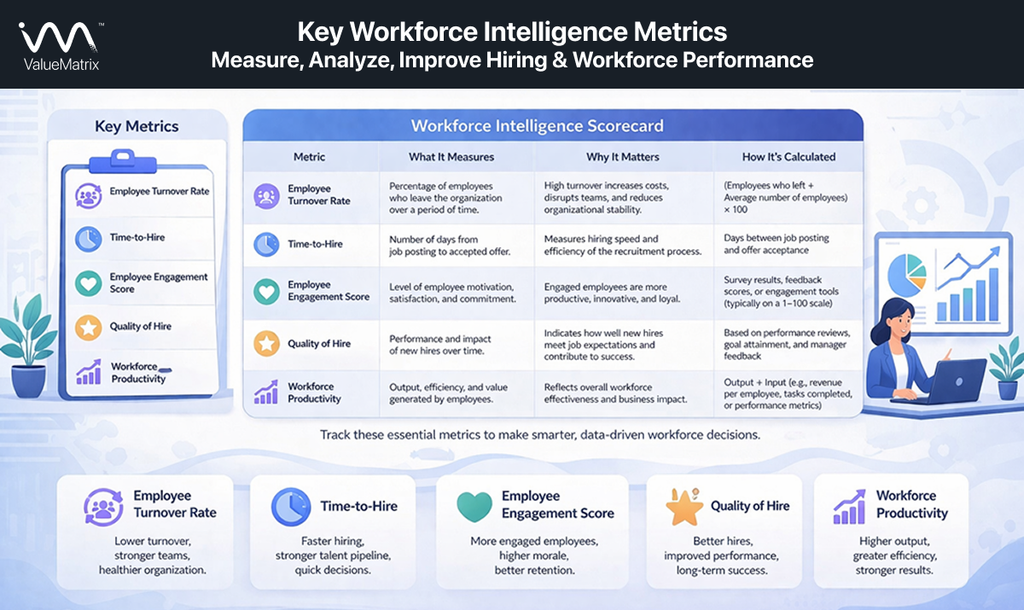
You cannot optimize what you do not measure. A robust workforce intelligence scorecard must balance traditional HR metrics like employee turnover rate, time-to-hire, employee engagement score, quality of hire, and workforce productivity with modern, predictive indicators.
Workforce Intelligence Scorecard
| Metric | What It Measures | Why It Matters |
| Employee Turnover Rate | Percentage of employees leaving | Helps identify systemic retention issues. |
| Time-to-Hire | Speed from job post to offer acceptance | Indicates recruitment efficiency and brand strength. |
| Employee Engagement Score | Workforce satisfaction and sentiment | A report from Gallup states that high engagement scores directly correlate to 23% higher profitability. |
| Quality of Hire | Performance and retention of new hires | Measures the long-term success of your hiring criteria. |
| Workforce Productivity | Output per employee/team | Identifies bottlenecks and drives overall growth. |
How Workforce Intelligence Platforms Drive Business Growth?
The intersection of data and humanity fuels growth in 2026. A workforce intelligence platform should not just sit on top of your tech stack; it should be integrated into every department, from Finance to Engineering.
The most successful companies are those that realize their “Culture” is their ultimate competitive advantage. This is where a platform like ValueMatrix becomes indispensable. ValueMatrix goes beyond traditional analytics by using advanced behavioral science and the “Big Five” personality traits to provide a “Culture-Skill Fit” score.
This score ensures that your workforce isn’t just intelligent in the technical sense, but also aligned in the cultural sense. When employees feel an alignment between their personal values and the company’s overall mission, productivity increases, and turnover vanishes. By integrating your people analytics solutions with a platform that values the human element, you turn your HR operations into a strategic engine for revenue.
Summary
In 2026, data is known to be the new currency in the field of Human Resources. Organizations that choose to ignore the signals hidden in their workforce data will inevitably be left behind by those who use it to nurture their greatest asset: their people. By moving from reactive reporting to proactive workforce intelligence, organizations can create a more resilient, productive, and equitable future.
Conclusion
Workforce intelligence is the bridge between where your company is today and where it aims to be tomorrow. It allows businesses to stop guessing and start knowing, as it is important for attracting the right talent.
Ready to transform your talent strategy? Discover how an AI talent acquisition guide and talent analytics for hiring can turn your HR department into a strategic powerhouse with ValueMatrix.
See how ValueMatrix identifies candidates with the skills, behaviors, and potential that traditional screening methods often overlook — Explore ValueMatrix!
Frequently Asked Questions
What is workforce intelligence in simple terms?
Workforce intelligence can be referred to as the use of data, analytics, and AI to improve hiring and workforce decisions. It helps organizations understand and identify variations in hiring patterns, predict candidate success, and optimize recruitment strategies using insights derived from workforce data rather than relying on intuition or manual processes.
What is a workforce intelligence platform?
A workforce intelligence platform is essentially a centralized system that integrates different aspects like hiring data, analytics, and AI tools to offer actionable insights. It helps recruiters track performance, optimize hiring processes, and make better talent decisions using real-time dashboards as well as predictive analytics.
Why is workforce intelligence important for hiring?
Workforce intelligence is important because it enables faster and more accurate hiring decisions. It aims to improve the quality of the hire while reducing hiring costs, which eventually helps organizations build strong talent pipelines, making recruitment more efficient and strategic in competitive job markets.
How does artificial intelligence workforce technology impact hiring?
Artificial intelligence workforce technology can easily automate resume screening, improve candidate matching, and predict hiring success. It reduces manual effort and speeds up recruitment. It also enhances decision-making accuracy by analyzing large volumes of candidate and hiring data efficiently.
What metrics are tracked in workforce intelligence?
Some metrics that can be tracked with the help of workforce intelligence include time-to-hire, quality of hire, cost per hire, offer acceptance rate, and candidate drop-off rate. Tracking all the necessary metrics helps an organization to measure recruitment efficiency, improve hiring strategies, and optimize overall workforce performance.
Can small businesses use workforce intelligence?
Yes, workforce intelligence is accessible even to small businesses through scalable and cloud-based tools. Such solutions can help smaller teams to make better hiring decisions, improve overall efficiency, and also compete with larger organizations without requiring significant investment.
How does workforce intelligence help build talent pipelines?
Workforce intelligence helps organizations identify and engage potential candidates early on. By analyzing candidate data and behavior, organizations can have stronger talent pipelines and reduce reliance on reactive hiring strategies.
Does workforce intelligence reduce hiring bias?
Yes, workforce intelligence can considerably reduce bias by using structured data as well as AI-driven evaluations. It mainly focuses on skills, experience, and performance indicators rather than subjective factors, which will lead to fairer and more inclusive hiring decisions.
How does workforce intelligence improve decision-making?
Workforce intelligence is known to provide data-driven insights that are extremely helpful for an organization in making informed hiring decisions. Analyzing trends and predicting outcomes can help reduce the guesswork and improve accuracy in recruitment strategies.