
Introduction
Talent acquisition has moved far beyond the basic act of posting jobs and filling open positions. In 2026, organizations operate in a market where speed, intelligence, and experience define hiring success as much as compensation. Asking What is Talent Acquisition today means understanding how hiring contributes to long-term business outcomes. Recruiters are no longer expected to serve solely as coordinators; they are increasingly viewed as strategic partners shaping workforce readiness and organizational growth. This shift has accelerated the adoption of AI Talent Acquisition and AI-Enabled Talent Acquisition across industries.
Despite this progress, many hiring teams remain constrained by outdated workflows and disconnected systems. Recruiters often spend more time managing processes than generating insights. As Automation in Talent Acquisition and Machine Learning in Hiring become standard expectations, these inefficiencies slow down decision-making and reduce consistency in hiring quality. The gap between hiring ambition and execution continues to widen, limiting progress toward a truly Scalable Talent Acquisition Strategy. Leading organizations such as Google, Amazon, Microsoft, IBM, Accenture, Deloitte, Unilever, and Salesforce have addressed this challenge by rethinking their Talent Acquisition Strategy end-to-end. Instead of relying on fragmented Talent Acquisition Services, they focus on Talent Acquisition Enablement, a structured approach that supports consistency, visibility, and scale. This marks a broader Talent Acquisition Transformation, where integrated platforms, data, and systems empower recruiters to move from reactive hiring to proactive workforce planning.
1. What Is Talent Acquisition Enablement
Definition and Core Concept
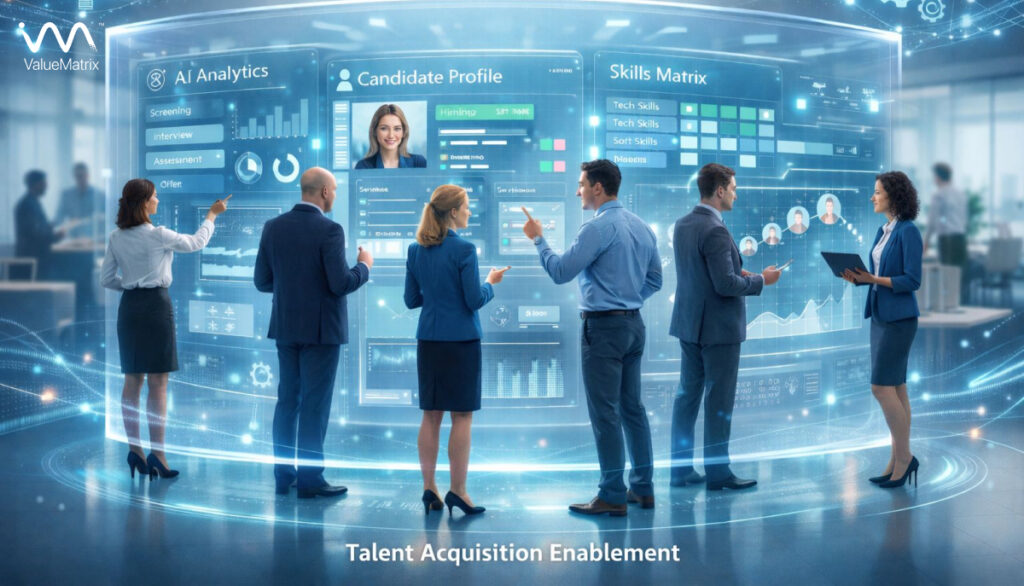
Talent Acquisition Enablement is the practice of equipping hiring teams with the tools, insights, and infrastructure required to recruit effectively and consistently at scale. It combines technology, data, training, content, and standardized workflows within a unified Talent Acquisition Platform. In the context of AI-Enabled Talent Acquisition, enablement ensures recruiters can leverage AI Recruitment Technology, Automation in Talent Acquisition, and Machine Learning in Hiring without relying on individual effort or tribal knowledge. The goal is to remove friction from hiring operations and support a Scalable Talent Acquisition Strategy, allowing recruiters to focus on high-value activities such as candidate engagement and workforce planning.
How It Differs From Traditional Talent Acquisition
Traditional talent acquisition is execution-driven. It focuses on activities such as posting roles, screening resumes, coordinating interviews, and closing offers, often supported by siloed Talent Acquisition Services. Talent Acquisition Enablement shifts the focus from tasks to capability. It evaluates whether recruiters have the right tools, insights, and support systems to deliver consistent outcomes. By embedding AI Talent Acquisition, standardized workflows, and performance visibility into hiring operations, enablement transforms recruitment from reactive execution into a proactive, insight-led Talent Acquisition Strategy aligned with long-term business needs.
2. Why Talent Acquisition Enablement Matters in 2026
Changing Candidate Expectations
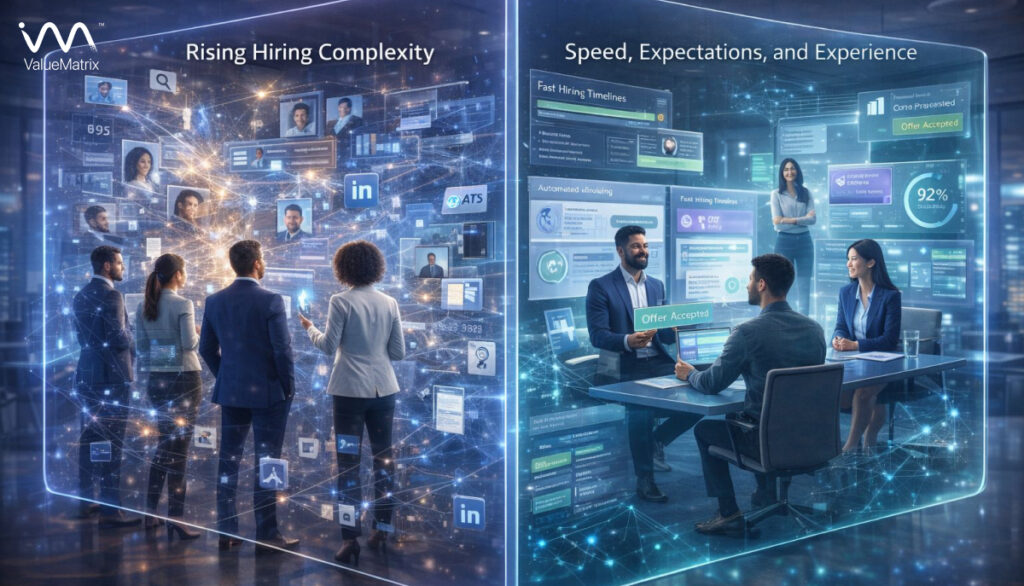
In 2026, candidates expect faster responses, personalized communication, and transparent hiring processes. Traditional hiring often struggles to deliver this consistently, causing delays, drop-offs, and reputational damage. Taent Acquisition Enablement empowers teams with AI Talent Acquisition tools, automated workflows, and standardized candidate engagement practices. These capabilities help recruiters deliver rapid updates, tailor communication, and ensure a smooth, consistent experience from application through offer, which protects employer brand and improves conversion.
Increasing Complexity of Hiring
Today’s roles are more specialized and skills-based than ever, requiring deeper market insight, alignment with hiring managers, and proactive talent pipelining. Without structured enablement, recruiters can become overwhelmed by the sheer volume and specificity of requirements. An enabled team uses AI-Enabled Talent Acquisition and a Talent Acquisition Platform to consolidate data, forecast skill needs, and collaborate more effectively with business units. This transform hiring from reactive to strategically aligned with broader workforce priorities.
Pressure on Speed and Quality
Organizations must hire quickly without compromising on quality. Automation in Talent Acquisition, predictive analytics, and clear frameworks from enablement help strike this balance reducing manual tasks, improving screening accuracy, and providing real-time insights to inform decisions. Integrating Machine Learning in Hiring ensures that high-velocity processes do not sacrifice candidate fit or long-term retention.
Real-Life Scenario
Electrolux, the global home appliance manufacturer, faced pressure to fill specialized roles amid a competitive labor market. To tackle this, the company adopted an AI-driven recruiting platform that unified candidate sourcing, screening, and engagement across channels. By using AI-powered fit scoring and automated candidate matching, Electrolux significantly improved screening accuracy and reduced time-to-hire. Recruiters could nurture candidate interest with targeted communications and maintain continuity across talent pipelines. As a result, Electrolux saw increased application conversion rates, reduced incomplete applications, and more effective collaboration between recruiters and hiring managers, demonstrating how structured enablement tools can deliver both speed and quality in hiring.
3. Key Components of Talent Acquisition Enablement
Technology and Tools
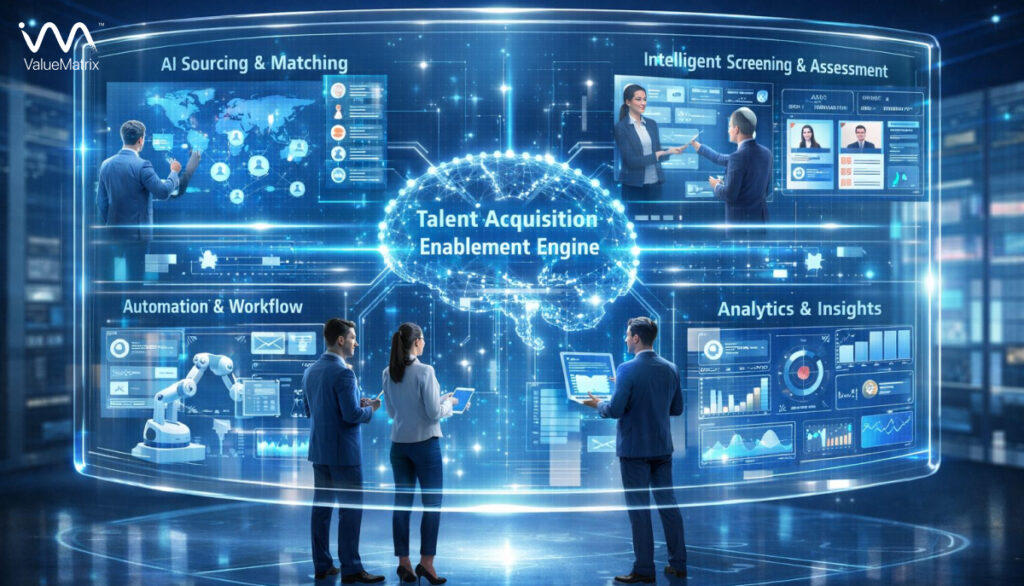
Talent Acquisition Enablemnt begins with the right technology stack. This includes applicant tracking systems, Talent Acquisition Platform tools, AI Talent Acquisition solutions, and analytics dashboards. The emphasis is on integration and usability rather th]an the sheer number of tools. When systems are connected and recruiter-friendly, teams can automate repetitive tasks, manage candidate pipelines efficiently, and deliver consistent experiences across roles and regions. AI-powered sourcing platforms and AI-Enabled Talent Acquisition tools help identify high-potential candidates faster and with greater accuracy, reducing time-to-hire while maintaining quality.
Data and Insights
Recruiters need clear visibility into metrics such as time-to-hire, source effectiveness, candidate conversion, and quality-of-hire. Talent Acquisition Enablement ensures that Machine Learning in Hiring and data analytics provide actionable insights. Accessible, accurate data allows teams to continuously refine sourcing strategies, prioritize high-value candidates, and make evidence-based decisions, transforming hiring from reactive to proactive.
Process Standardization
Standardized workflows reduce confusion and bias. Enablement involves documenting each step of the hiring process, clarifying roles and responsibilities, and ensuring consistency across teams and geographies. This supports a Scalable Talent Acquisition Strategy and ensures compliance and fairness in recruitment practices.
Training and Skill Development
Recruiters must continuously upskill to stay ahead of emerging technologies and trends. Talent Acquisition Enablement programs include structured onboarding, ongoing learning, and playbooks. These resources equip recruiters to operate confidently, leverage Automation in Talent Acquisition, and maintain high-quality hiring outcomes at scale.
4. Role of AI in Talent Acquisition Enablement
AI Powered Sourcing and Screening
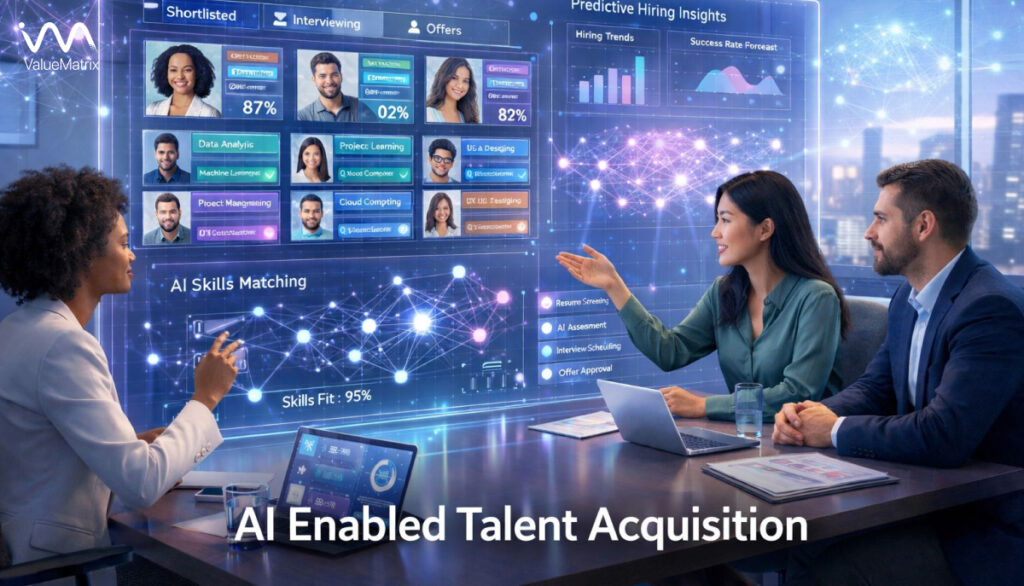
Within Talent Acquisition Enablement, AI significantly improves how recruiters source and screen candidates. AI Talent Acquisition systems analyze resumes, digital profiles, and skill signals to surface relevant candidates faster and more accurately. This reduces manual resume screening and improves the quality of the shortlist. When AI-Enablement Talent Acquisition is embedded into sourcing workflows, recruiters can focus on engaging qualified talent instead of spending time filtering applications, supporting a Scalable Talent Acquisition.
Predictive Hiring Insights
AI also enables predictive hiring insights using historical data and Machine Learning in Hiring. These insights help forecast hiring timelines, identify bottlenecks, and flag roles at risk of delay. Recruiters can proactively adjust sourcing plans, align better with hiring managers, and improve decision-making. This capability strengthens overall hiring predictability and reduces last-minute firefighting.
Personalized Candidate Engagement
Through Automation in Talent Acquisition, AI-driven communication tools personalize candidate interactions based on behavior and preferences. Timely updates, relevant content, and consistent messaging improve engagement, reduce drop offs, and enhance candidate experience across the hiring journey.
Real-Life Scenario
Mastercard faced increasing pressure to hire specialized technology talent while maintaining a strong employer brand. To support Talent Acquisition Enablement, the company adopted an AI-powered recruiting platform that unified sourcing, screening, and candidate engagement. AI-powered sourcing and screening helped recruiters identify relevant candidates faster, while predictive insights highlighted potential delays in hard-to-fill roles. Personalized AI-driven communication improved candidate responsiveness and reduced interview scheduling time. This enabled Mastercard to balance speed and quality while delivering a consistent hiring experience across regions.
5. Talent Acquisition Enablement vs Recruitment Operations
Understanding the Difference
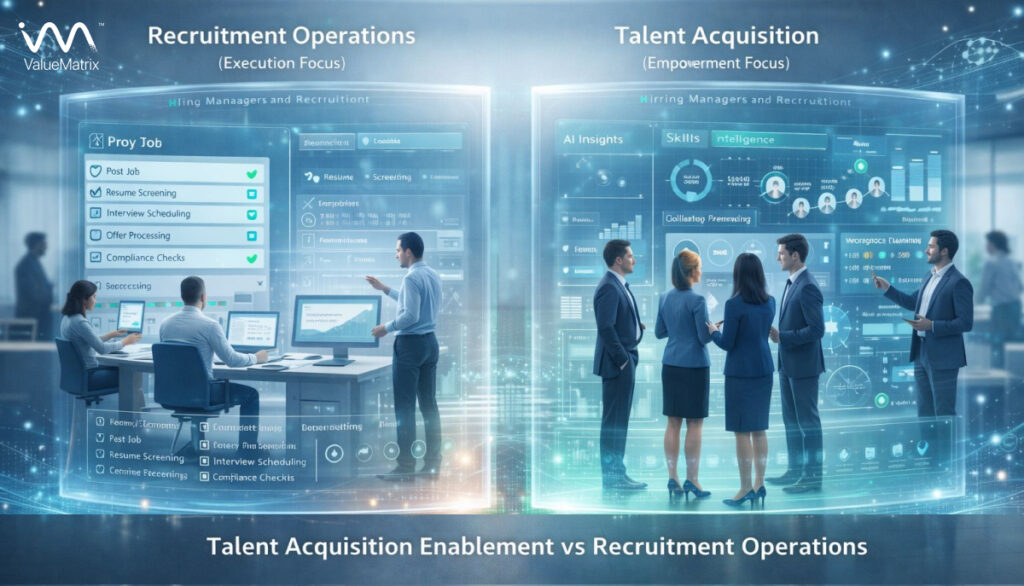
Recruitment operations are primarily focused on execution and efficiency. This includes managing workflows, ensuring compliance, tracking requisitions, and keeping hiring processes running smoothly. Talent Acquisition Enablement goes beyond execution by focusing on empowerment and effectiveness. It ensures recruiters have the right tools, insights, training, and support to perform consistently at a high level. While operations ask whether the hiring process functions correctly, enablement asks whether recruiters and hiring managers can perform at their best within that process. This distinction becomes critical as AI Talent Acquisition and automation increase process complexity.
Why Both Are Needed
Strong recruitment operations provide the structural foundation for hiring. Enablement builds on that foundation by driving capability, consistency, and scalability. Organizations that combine operational discipline with AI-Enabled Talent Acquisition are better positioned to scale hiring without sacrificing quality, candidate experience, or recruiter effectiveness.
6. Benefits of Talent Acquisition Enablement
Improved Recruiter Productivity
With Talent Acquisition Enablement, recruiters spend less time on repetitive tasks and more time on strategic work. Tools such as LinkedIn Talent Insights, SeekOut, Eightfold AI, HireVue, and ValueMatrix use AI Talent Acquisition to automate sourcing, screening, and interview analysis. Platforms like Phenom and Paradox reduce manual coordination through chatbots and automated scheduling. This productivity boost allows recruiters to focus on relationship building, pipeline strategy, and long term workforce planning.
Better Candidate Experience
Enablement improves the candidate experience through consistent, personalized engagement. AI driven platforms such as Beamery, Phenom, Paradox, and ValueMatrix enable AI-Enabled Talent Acquisition by delivering tailored communication, faster responses, and transparent updates. Automation ensures candidates are informed at every stage, strengthening employer brand perception.
Stronger Hiring Outcomes
Stronger outcomes result from better data and alignment. Tools like iCIMS AI, Greenhouse AI, Pymetrics, and ValueMatrix improve sourcing accuracy, assessment consistency, and collaboration among hiring managers. Together, these capabilities support a Scalable Talent Acquisition Strategy that improves quality of hire and long-term retention.
7. Common Challenges in Implementing Talent Acquisition Enablement
Tool Overload and Poor Adoption
Many organizations rush into Talent Acquisition Enablement by buying multiple AI tools without proper integration or training. When recruiters are forced to switch between disconnected systems, adoption drops and productivity suffers instead of improving.
Lack of Alignment With Business Goals
Enablement initiatives often fail when they operate in isolation. If AI Talent Acquisition tools are not aligned with workforce planning, diversity goals, or growth strategy, they deliver data without impact.
Change Management Resistance
Recruiters and hiring managers may resist AI-Enabled Talent Acquisition if its value is not clearly demonstrated. Without transparency and hands-on enablement, new systems are seen as control mechanisms rather than support tools.
Real-Life Scenario
Amazon faced significant challenges while experimenting with AI driven hiring tools. An internal AI recruiting system was discontinued after it showed bias against certain candidate profiles, highlighting issues related to poor training data, lack of alignment with diversity goals, and change management risks. The case became a widely cited example of why governance and enablement must accompany AI adoption.
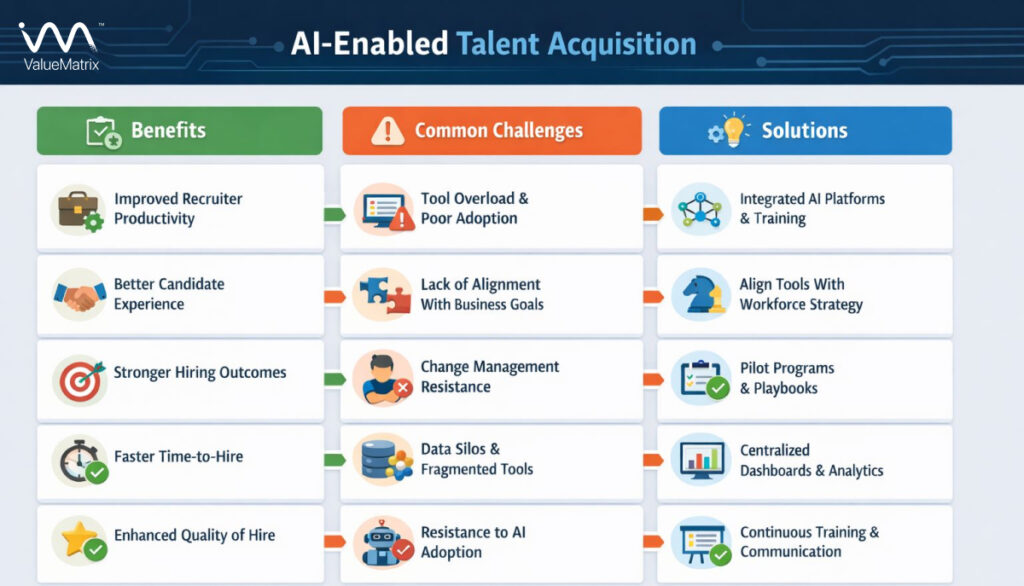
The chart above provides a clear, visual summary of the critical aspects of AI-enabled talent acquisition. By combining the benefits, common challenges, and practical solutions discussed in Sections 6 and 7, it allows recruiters, HR leaders, and stakeholders to quickly grasp the impact of enablement initiatives. This visual representation makes complex information easier to understand, highlights areas requiring attention, and reinforces the connection between AI adoption, productivity gains, and improved hiring outcomes.
8. How to Build a Talent Acquisition Enablement Strategy
Assess Current Maturity
Organizations should begin by evaluating their current talent acquisition processes, tools, and recruiter capabilities. This includes identifying gaps in workflow, technology adoption, and skill levels. Understanding the existing maturity helps pinpoint where Talent Acquisition Enablement initiatives can deliver the most impact. AI Talent Acquisition platforms and analytics dashboards can also be assessed for effectiveness in driving productivity and candidate engagement.
Define Clear Objectives
Next, define specific, measurable goals for enablement. Objectives might include reducing time-to-hire, increasing the quality of hires, improving recruiter efficiency, or enhancing candidate satisfaction. Linking goals to measurable outcomes ensures accountability and allows teams to track progress, demonstrating tangible ROI from AI-Enabled Talent Acquisition initiatives.
Enable Hiring Managers Alongside Recruiters
True enablement extends beyond recruiters. Training and equipping hiring managers with guidance, data insights, and standardized processes improves collaboration and decision-making. This alignment ensures that both recruiters and hiring managers work cohesively to achieve a Scalable Talent Acquisition Strategy and deliver consistent, high-quality hiring outcomes.
Real-Life Scenario
Chipotle Mexican Grill used AI to build a more strategic hiring process at scale. During its busiest hiring season, Chipotle deployed an AI-powered virtual assistant named Ava Cado to interact with candidates, answer questions, collect information, schedule interviews, and expedite offers. As a result, the average hiring timeline dropped from 12 days to just four days, while application completion rates jumped from 50% to over 85%. This reflects an organization assessing existing hiring challenges, defining clear goals around speed and experience, and leveraging AI tools strategically rather than just adopting them. The case illustrates how aligning enablement strategy with measurable hiring outcomes can dramatically improve operational performance.
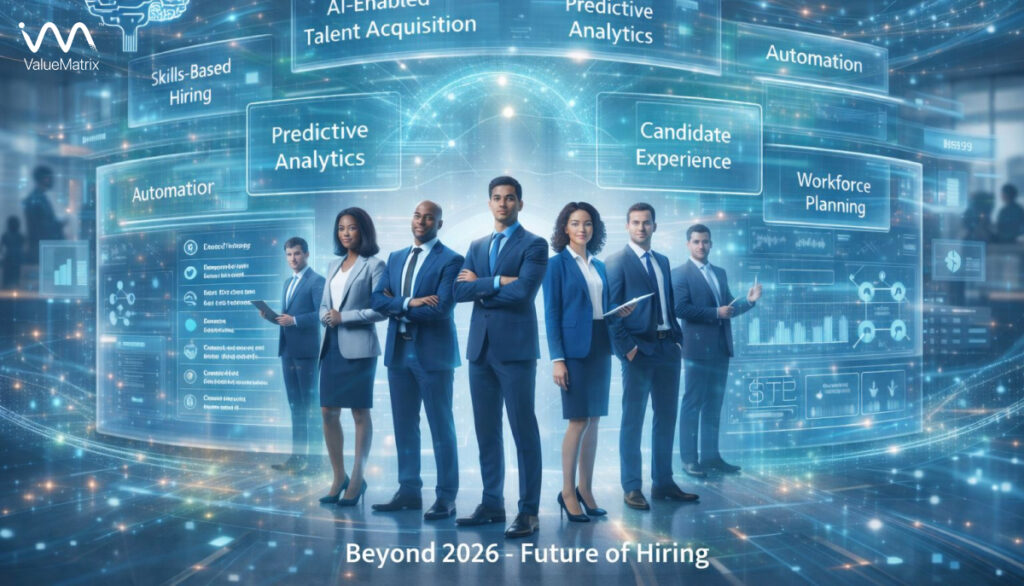
9. Future of Talent Acquisition Enablement Beyond 2026
Shift Toward Skills Based Hiring
Beyond 2026, Talent Acquisition Enablement will increasingly move away from role based hiring toward skills based models. Organizations will focus more on identifying transferable skills, adjacent capabilities, and internal talent potential rather than rigid job titles. Enablement platforms will support this shift by mapping skills across roles, enbling internal mobility, and helping recruiters match candidates to opportunities based on capability rather than pedigree.
Greater Focus on Internal Mobility
As external talent markets become more competitive, enablement will play a key role in unlocking internal talent. AI TALENT ACQUISITION tools will surface reskilling opportunities, recommend internal candidates for open roles, and support career pathing. This reduces hiring costs while improving retention and employee engagement.
Greater Use of Automation and Intelligence
Automation and intelligence will become central to enablement strategies. AI driven analytics will provide real time insights into talent availability, hiring risks, and workforce gaps. Machine Learning in Hiring will enable continuous optimization of sourcing, screening, and decision making without increasing recruiter workload.
From Hiring Function to Talent Ecosystem
Talent acquisition will evolve into a broader talent enablement ecosystem. Instead of operating as a standalone hiring function, it will integrate hiring, development, and workforce planning into a unified system. This shift will allow organizations to build a truly Scalable Talent Acquisition Strategy aligned with long term business goals.
Conclusion
In 2026, Talent Acquisition is no longer a supporting initiative, it is a core business capability. As organizations rethink What is Talent Acquisition, the focus is shifting from task based execution to long term capability building. Modern hiring demands a clear Talent Acquisition Strategy that combines technology, people, and processes into a unified system. This is where AI Talent Acquisition and AI-Enabled Talent Acquisition play a defining role.
Throughout this guide, we explored how enablement drives Talent Acquisition Transformation by improving recruiter productivity, elevating candidate experience, and delivering stronger hiring outcomes. From integrated Talent Acquisition Platforms and AI Recruting Technology to standardized processes, data driven insights, and continuous training, enablement removes friction from hiring. The use of Machine Learning in Hiring and Automation in Talent Acquisition enables faster decisions, predictive insights, and scalable execution without compromising quality.
We also examined how enablement differs from recruitment operations, the role of AI in sourcing and engagement, common implementation challenges, and the future shift toward skills based hiring and internal mobility. When aligned with business goals and supported by the right Talent Acquisition Services, enablement evolves recruitment into a connected talent ecosystem. Organizations that invest in a Scalable Talent Acquisition Strategy today will be best positioned to compete, adapt, and grow in the years ahead.
Frequently Asked Questions
1. What is Talent Acquisition Enablement?
Talent Acquisition Enablement is a strategic approach that equips recruiters and hiring managers with the right tools, data, processes, and skills to hire effectively. It focuses not just on execution, but on empowering people to perform better throughout the hiring lifecycle.
2. How is Talent Acquisition Enablement different from traditional recruitment?
Traditional recruitment focuses on efficiently filling roles. Enablement goes beyond this by improving recruiter capability, decision quality, candidate experience, and long-term hiring outcomes through technology, insights, and training.
3. What role does AI play in Talent Acquisition Enablement?
AI supports enablement by improving sourcing accuracy, automating screening, providing predictive hiring insights, and enabling personalized candidate engagement. It helps teams move from reactive hiring to proactive, data-driven decision making.
4. What are the key benefits of Talent Acquisition Enablement?
The main benefits include improved recruiter productivity, better candidate experience, stronger quality of hire, and scalable hiring processes that remain consistent as organizations grow.
5. What challenges do organizations face while implementing enablement?
Common challenges include tool overload, poor adoption, lack of alignment with business goals, and resistance to change from recruiters or hiring managers when value is not clearly communicated.
6. How can organizations start building a Talent Acquisition Enablement strategy?
Organizations should begin by assessing current maturity, defining clear and measurable objectives, and enabling hiring managers alongside recruiters through training, guidance, and shared data.
7. What does the future of Talent Acquisition Enablement look like beyond 2026?
Beyond 2026, enablement will increasingly support skills-based hiring, deeper automation, predictive analytics, and a shift from isolated hiring functions to integrated talent ecosystems covering hiring, development, and workforce planning.