
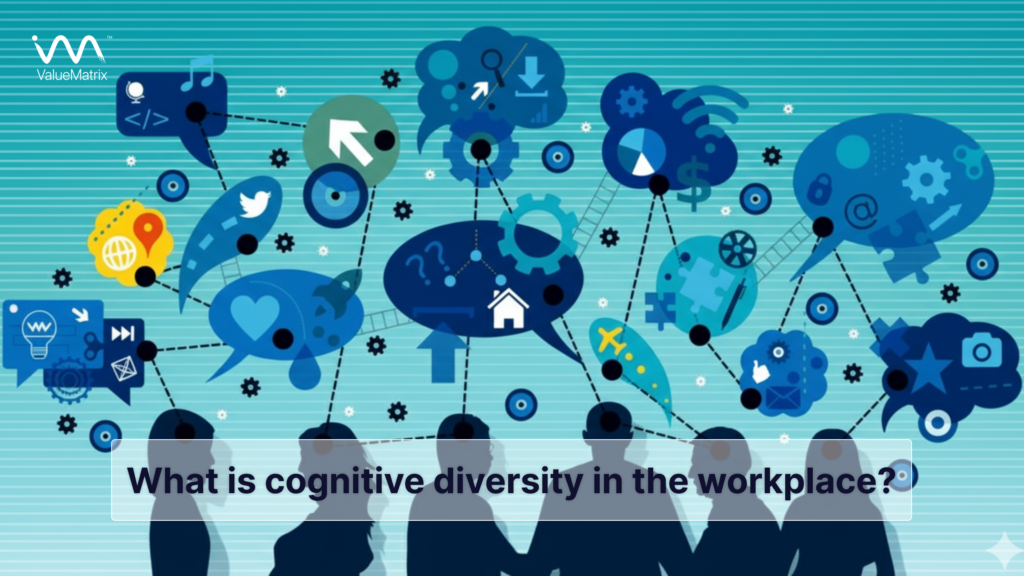
Often the least talked about form of diversity, Cognitive diversity, also known as diversity of thought, refers to the variety of ways people think. People have divergent perspectives, opinions, and approaches to solving problems. Cognitive Diversity acknowledges the fact that no two brains are wired the same, and like snowflakes, we are all different.
Cognitive Diversity can stem from many factors, but the most influential are educational, cultural, and professional backgrounds.
For example, some Western societies promote an individualistic culture, while Eastern philosophy focuses on collectivist living. These cultural influences often impact the cognitive attitudes of the people.
Types of Cognitive Diversity
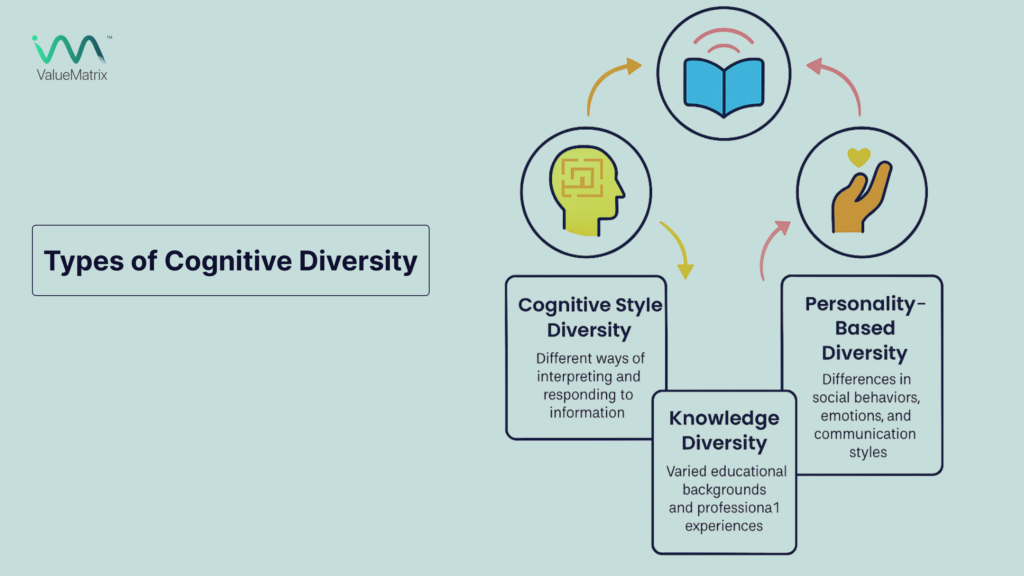
There are mainly 3 main types of Cognitive Diversity. Let’s discuss them at length.
Cognitive-style diversity(How people think)
Cognitive style refers to your thinking pattern, or your preferred mode of thinking. We all process information differently, which means every single person connects dots between two data points in their own unique way. This is called cognitive diversity. There are various types of cognitive style diversity.
Analytical vs Intuitive
Analytical thinkers are ‘numbers’ people. They rely on logic, statistics, and structure, not on hearsay, to form their opinions and like to verify people’s views with stats.
These people are huge on data, number crunching, and split-testing. They don’t like to leave anything to chance.
Intuitive thinkers are ‘pattern recognition’ people. They do not view the world through a mathematical lens but rely on their instincts and experience.
They are gut-based and draw inspiration from their surroundings as opposed to looking at data sheets before forming an opinion.
Convergent vs Divergent Thinkers
Convergent thinkers focus on finding one solution to the problem through iterations. They are logic-oriented and analytical in their approach. They look for a single best solution to a problem with no room for ambiguity.
Divergent thinkers fall on the creative side of the spectrum. They like to think out of the box and believe there could be many possible solutions to a problem.
Holistic vs. Detail-Oriented Thinkers
Holistic thinkers are the people who look at the big picture. They like to see the entire maze rather than fritter away their attention on minutiae. They like to see how the entire machine is working and worry about each cog.
Detail-oriented people are also called pixel thinkers. They focus on finer aspects of a project and spend their time and energy perfecting systems down to the smallest detail.
Knowledge diversity(What people know)
Knowledge diversity entails a person’s domain knowledge. For example, ValueMatrix has a heterogeneous team of psychologists, data engineers, and marketers, all experts in their respective domains.
This form of diversity has little to do with a person’s natural proclivities and more to do with his education, training, and experience.
A product requires a collaboration of a multitude of domain-specific experts coming together and working on it. A talent piece company like ValueMatrix will require engineers who will work in the backend, marketers who’ll spread awareness about the product, and psychologists whose surveys and clinical trials would be incorporated into our products.
Knowledge diversity ensures that a project is covered from all possible angles and no facet is left untouched.
Personality-based diversity(How people collaborate)
Personality-based diversity tells you how people behave with each other in a collaborative environment. A workplace is a dense forest of different personalities. It is a dance of personality types gathering under one big umbrella, working towards a common goal.
You have your introverts, extroverts, risk-averse, to stress-tolerant people in any organization. Having an assortment of personalities prevents the organisation from becoming an eco chamber with a top-to-bottom information flow.
Personality-based diversity engenders tolerance and empathy towards a wide variety of people and exposes you to personality types you may not have been familiar with. This creates a conducive environment for personal growth.
The trick is to make them work together as a monolith, and not let the company turn into a disarrayed group of ragtag, where each person is doing their own thing.
Here are some ways to bring together different personality types to work as a cohesive team.
Personality Assessments
It can help you build your team around these assessment results. You’d know who to pair together, which people to separate, and also assign roles according to their traits.
Personalised Training and feedback loops
AI-Driven personalized training uses data points like past employment history, past interactions, learning behaviour, skill gaps, and cognitive style to devise a learning map tailored for you.
AI modifies the learning modules according to your abilities and preferred learning modes, rather than forcing a uniform template that is indifferent to your personality types..
This approach is helpful for two reasons: it sharpens your skills on the job while amplifying the cognitive diversity of the organization.
Assigning Tasks based on natural strengths
This is where managers and team leaders come into play. If team leaders are aware of every individual’s cognitive strengths, they can allocate tasks in a way that complements those strengths and does not hinder them.
Can Cognitive Diversity and Culture Fit Go Hand In Hand?

It is often misunderstood that having too much cognitive diversity can erode the culture fit of the company because each person will pull the company towards their own way of doing things and thereby yanking the company away from its core ethos.
But that is not true; cognitive diversity doesn’t mean diversity of ethos. We can have diverse ways of working or thinking, but still believe in the same ideals. Cognitive Diversity doesn’t mean diversity of principles or core tenets.
For example, a holistic approach person and a detail-oriented person can both collaborate while agreeing on workplace principles like integrity, honesty, and honouring deadlines.
Therefore, both these frameworks need not be at loggerheads with each other. The problem only arises when an organization is confused about its culture..
Cognitive Diversity and Psychological Safety
A research paper on cognitive diversity reveals a direct relationship between Cognitive Diversity and Psychological Safety. If the psychological safety is low, cognitive diversity could be harmful. If the team suffers from poor coordination and distrust, it is better to bury your differing opinions for the sake of functionality.
On the contrary, cognitive diversity enhances performance when the psychological safety is high. This research paper mentions a study in which 736 Master’s students were measured on their team performance in a semester-long IT project. The study revealed that groups with a positive link between cognitive diversity and psychological safety performed better.
Disagreements might be good.
This research paper also shows that disagreements in group project meetings led to more creative and out of box solutions.
But here’s an interesting caveat: the research paper also says that companies shouldn’t force disagreements among teams.
Many companies, to encourage a variety of opinions, divide their employees into two groups and assign one group to speak for and the other group to speak against the topic.
This is often a waste of time because the dissent is not organic. Team members on both sides recognise that the dissenting group is merely playing ‘devil’s advocate’ and do not truly believe in their opinion.
This causes the people partaking in the discussion to dismiss their opinions as ‘roleplay.’
Hence, it’s much better to have natural dissenting views rather than playing “blue team” vs “red team” during such discussions.
Cognitive Diversity and Neurodiversity
A lot of people use cognitive diversity and neurodiversity interchangeably, but they are not the same thing.
While cognitive diversity refers to the variety of thought patterns, focusing on the assortment of knowledge, skills, beliefs, and preferences an individual might have, Neurodiversity addresses fundamental differences in the brain wiring itself.
Cognitive Diversity types are extraversion, introversion, holistic thinking, and detail-oriented thinking. Meanwhile, Neurodiversity types are ADHD, Autism, Dyslexia, etc.
A neurodivergent person may suffer more bias in the job market because neurodivergence is still perceived as a disability by many. A common trope about them is that they have difficulty taking orders or understanding complicated tasks. A study revealed that 85% of neurodivergent people are unemployed, despite having average to high intelligence.
But the change is happening as we speak. Companies like Forbes and JPMorgan Chase are trying to change the stigma attached to Neurodiversity with initiatives like the Neurodiversity Hiring program and Autism at Work.
Why does Cognitive Diversity Matter in the Workplace?
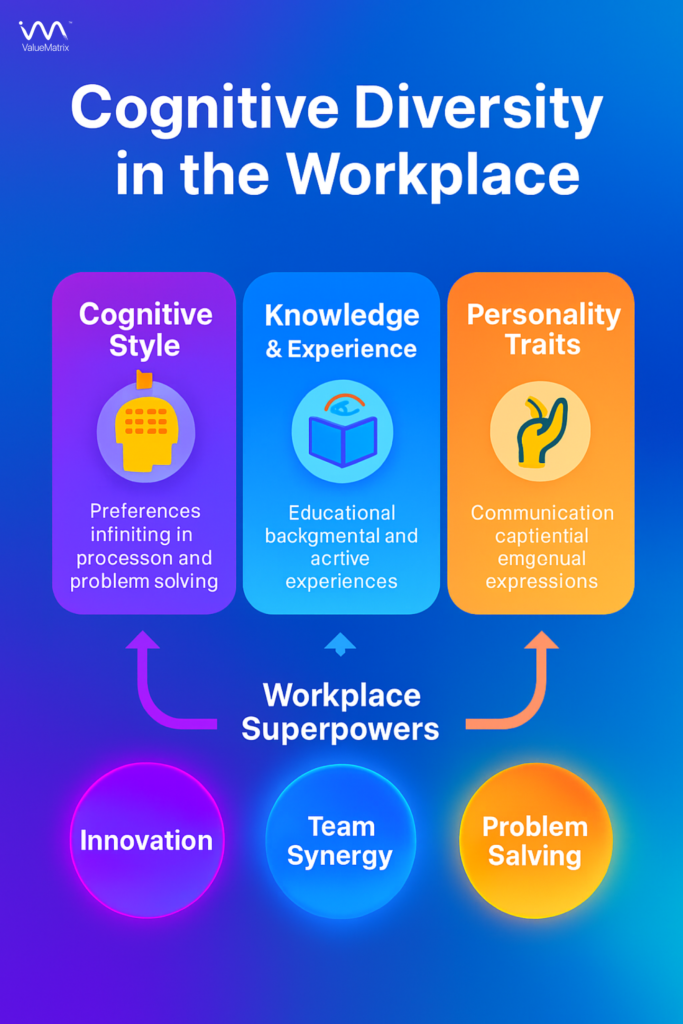
Cognitive diversity is just as important, if not more important, than ethnic, cultural, or gender diversity. It breaks the mold and droid-like thinking patterns of an organization.
Cognitive Diversity is the kill switch to breaking thought silos forming within your company. Any company not actively pushing cognitive diversity runs the risk of calcifying its ideation process and therefore stunting its growth.
Here’s why thought diversity matters
Ideation phase
Thought diversity matters the most in the ideation phase. The research paper (Pg28) states that brainstorming sessions are where cognitive diversity should be amplified the most, as you need as many creative solutions to attack a problem.
A study mentioned in the paper showed that teams that were able to display high cognitive diversity during the ideation process and tweak it down during the execution phase performed the best.
The study concluded that high cognitive diversity during the idea generation phase and low cognitive diversity during the execution phase deliver the highest output since execution requires people to hunker down and coordinate with each other.
Interdependent teams
Some tasks are collaborative in nature. For example, engineers and product designers at ValueMatrix might have to collaborate to design a new talent piece of software.Task-oriented diversity(based on education, profession, and tenure) is essential for the overall development of the product.
Emergent interdependence
This is a new kind of dependence that is making rounds in the corporate circles. It basically means that rather than forcing interaction among colleagues, it is better to create an environment where dialogues and collaborations happen organically.
An important observation
Teams that have a low-trust score deliver even fewer solutions than individuals who work alone. So if the people in your team are unsure of their place, they tend to resort to conformity and not share their ideas.
This proves that trust is a very important factor for fostering the right environment for cognitive diversity.
Barriers to Cognitive Diversity?
Groupthink
Groupthink is a practice of making decisions as a group. Here are some of the reasons why groupthink creeps into the work environment.
Many new joinees just don’t feel like ruffling any feathers at their new workplace. They are still assessing their new environment, and they are unsure of how they’ll be received. They are simply trying to blend in and not get noticed as opinionated individuals.
Hence, in many meetings, they remain quiet or nod along to ideas already shared as they don’t think it’ worthwhile to stick their neck out. Many young joinees also believe that the risk-reward ratio is not skewed in their favour. Their seniors will simply absorb any brilliant input shared by them and take credit for it, whereas they will be blamed if the idea turns out to be a dud.
Also, blending in is an evolutionary trait. Humans have always worked together as groups. Thousands of years ago, when we were hunter-gatherers, we had to work in unison. Any person who strayed from his tribe didn’t make it alive, so it’s hard to fight our evolutionary instincts.
Confirmation Bias Of The Seniors
Pressure to conform might also arise from the top. Many senior managers can be set in their ways. They have been a part of the firm for far too long and think they know everything about how the company functions. So when the time comes to ideate during meetings, they already have a plan in mind and are just waiting for the others to accept it without resistance.
When this top-down ideation happens, meetings become merely performative.
Large Meetings
Meetings are intimidating, especially as a newcomer. They can be even more intimidating when they happen in large conference halls as opposed to an intimate setting.
All the above-discussed factors are amplified in a large meeting. Some managers do not wish to be challenged in front of their colleagues. Similarly, large meetings rarely give juniors a platform to voice their opinions freely. As there are many seniors seated there, juniors do not get a chance to express their opinions in detail.
How to effectively implement Cognitive Diversity in the workplace?
Make Expectations Clear
Set the expectations right from the onset that all views are welcome, including contrarian ones. As a manager, you might think that is stating the obvious, but it is very important for your team to hear that from the horse’s mouth.
Most employees will not assume that you like to hear dissenting views. They’ll play it safe and confine themselves to a corner.
It is also important to set boundaries. This will ensure that no inappropriate behaviour is tolerated in the name of cognitive diversity.
Actively Seek View Points
Treat juniors as your equals during the ideation process. You can be a hard taskmaster during the execution phase. Make sure you’re genuinely soliciting their opinions and not merely ticking a check box.
This may seem very obvious, but it is barely commonplace.
Reward Dissent
Showing that you value opposing views will go a long way towards encouraging cognitive diversity and psychological safety of your juniors. And always remember, actions speak louder than words.
If you constantly ask for dissenting opinions, but never act on them, the person giving the opinion might think it is a futile endeavour. Thereby, give due weightage to his concerns in the implementation phase as well.
For example, if an employee suggests against an investment, and you still go ahead with the investment. Let him know that his concerns will be closely monitored while undergoing the process.
Share own mistakes
Leaders who are very candid about their mistakes are more successful at disarming their employees and making them feel at ease.
Sharing your own mistakes as a senior also conveys that you don’t take yourself too seriously. It tells them it’s okay to stumble. A very senior hedge fund manager often used to ask his employees to explain the market trends to him as if he were a little child or a very smart golden retriever! This often brought much-needed levity to the otherwise serious environment of finance.
Ray Dalio, co-CEO of Bridgewater, shared a letter he got from one of his colleagues who gave him a “D” after one of his speeches. The colleague wrote to Ray Dalio that he ‘rambled’ on for 50 minutes without any insight or structure, and that he looked disorganized.
Ray Dalio’s willingness to share this letter with everyone conveyed to his employees that no one is infallible and that we can all make mistakes.
Tolerate others’ mistakes
“It is better to have tried and failed than not have tried at all.”
As a leader, you should instill a sense of safety around making mistakes. Some companies go as far as rewarding employees for making mistakes. If the failure succeeds in providing a valuable takeaway, that failure might achieve what success might not have.
The famous animation company PIXAR has a “Failure Gallery” consisting of characters, scenes, and gags that never made it to the final cut.
Do not create an environment of fear around failures. It is a sure-shot way of stifling the creativity of your team, making them afraid of raising their hand ever again.
Be Decisive
As a leader, you must invite everyone to voice their opinions, give their input, and share their perspectives openly and freely, but also know when it’s time to end all discussions and make a decision.
Resoluteness is your prerogative, as no one else can do it for you.
As General George Patton used to say, “A good plan executed now is better than a perfect plan executed next week.”
Also note that decision-making is effective when one person is entrusted to make the final call, as it removes any confusion and clutter.
Conclusion
Cognitive diversity as a concept is relatively new to its more popular cousin, DEI, but it is quickly gaining acceptance in the workplace. There has never been a better time for people to express their cognitive diversity at the workplace as more and more emphasis is being laid on personalized assessments, training, to coaching. But as discussed earlier, achieving cognitive diversity is not the goal of an organization, but rather tweaking and modulating cognitive diversity to achieve maximum performance from the teams.
The end goal is a thriving workplace environment and not cognitive diversity. We also dispelled some myths about neurodiversity and made a clear distinction between cognitive diversity and neurodiversity.
Cognitive diversity doesn’t thrive in an isolated environment and requires the supporting life force of psychological safety.
The ultimate responsibility of fostering a conducive, cognitively diverse environment lies with the higher-ups of the organizations. They are the culture arbiters of a company, as employees look to them to discern what’s acceptable behavior and what’s not.
FAQs
Always look at their intent and notice their tone. Ask yourself, “Is the person dissenting respectfully or simply being curt?” Cognitive Diversity is no excuse for rude behaviour.
If someone is being dismissive of his team leader’s requests and not honouring deadlines without any valid reason, then it’s a behavioral issue that has to be addressed. It can’t be dismissed as his “preferred way of working.”
Not entirely, but it should be turned down a notch. Execution requires coordination and collaboration. Execution is where all the roles and responsibilities are clearly assigned to each team member based on their traits. Now is not the time for individualism but for working as a close-knit team to achieve a common goal.
AI has been quite complimentary of cognitive diversity. With personalized assessments, modules, and even training recommendations for individuals based on their learning curve, skill gaps, and past work experience, AI has been instrumental in making this pivot from forced uniformity to a highly tailored employee experience.
About Us
ValueMatrix is an AI-powered talent intelligence platform that helps companies hire better, faster, and without bias. We go beyond resumes to assess skills, behavioral traits, and cultural fit using advanced AI and proven psychological frameworks. Our platform delivers data-driven insights that improve hiring accuracy, reduce time-to-hire, and elevate candidate quality.
ValueMatrix AI enables hiring teams to make confident hiring decisions and build high-performing teams at scale.