
AI isn’t here to take your job. It’s here to make it smarter. AI is here to unlock potential and empower HR professionals.
HR has always been about people – but let’s be honest, people management has never been more complex. You’re balancing hiring, retention, engagement, culture, compliance, DEI, and performance – all while being expected to deliver results that tie back to business growth. That’s a lot.
Here’s the thing: AI isn’t a magic wand. But when used right, it becomes a kind of strategic partner – quietly taking over the repetitive work, surfacing insights you wouldn’t catch on your own, and freeing up your time to focus on what matters: making better decisions for your people.
This article unpacks how AI is reshaping HR from the ground up. Not just the tech, but the mindset shift. We’ll break down where it’s already working, what to watch out for, and what you, as a CHRO, need to be thinking about next.
How the Role of HR has Evolved in the Age of AI?
HR used to be mostly transactional – focusing on forms, policies, and checklists. Necessary, but not exactly strategic. The real problem? Too much time spent on repetitive admin work and not enough on solving people’s challenges.
Take Hiring, for instance. Screening resumes manually, coordinating interviews, chasing feedback – it’s time-consuming and full of bias traps. Performance management? Often subjective, inconsistent, and disconnected from actual growth. And when it comes to retaining talent, HR is often left reacting to problems rather than predicting them.
That’s where AI comes as a game-changer. It doesn’t just automate busywork – it brings clarity. Imagine being able to identify risks of burnout or engagement dips even before they become real problems. AI can help by sifting through vast data sets and pulling out what matters. It gives out clear, useful insights that enable you to respond quickly and make better decisions.
This means HR is no longer just a support function. It’s becoming a core driver of business value – strategic, proactive, and data-informed.
But here’s the catch: this shift won’t happen on its own. Leaders at the top have to lead it. They are the bridge between people and technology. You decide how AI fits your culture, which tools solve problems, and how to bring your teams along for the ride. This is more than digitization. It’s a mindset shift – from reacting to leading, from gutfeel to evidence-based, from siloed tasks to connected strategy. And AI is the lever that makes it possible.
The Key Areas where AI is empowering HR
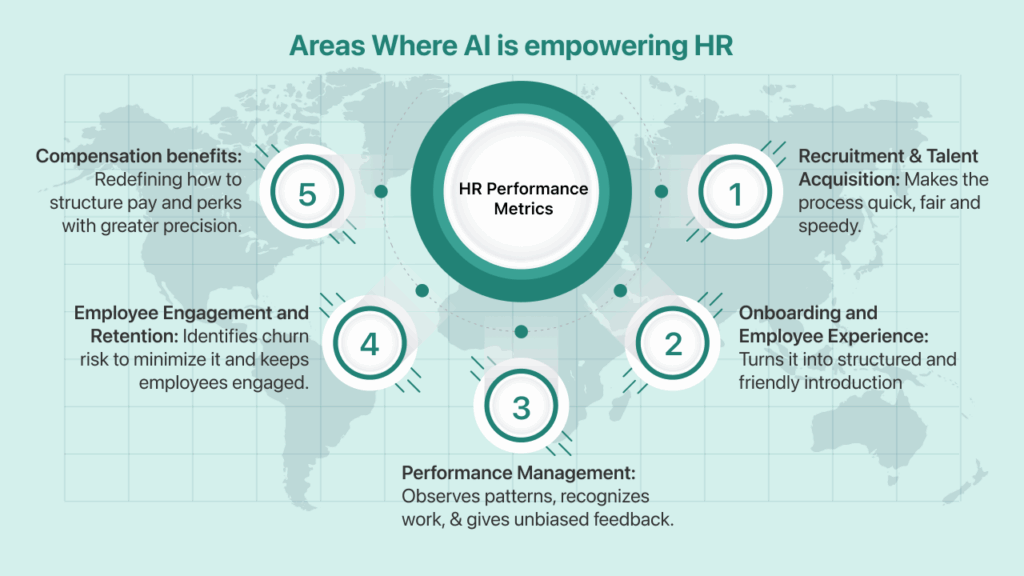
1.Getting the Right Recruitment and Talent
Generally, hiring is the most visible part of HR. However, it can also be the most inefficient one. AI can make a real difference by injecting speed, precision, responsiveness, and fairness into the process.
Intelligent Sourcing & Screening
AI helps you find the right people early. A few platforms use advanced AI to look at profiles across different sources and match their preferred candidates based on skills, experience, and cultural alignment. It ranks them, filters them automatically, and allows your team to focus only on the most promising people. The result? Hiring processes become three times faster and half the cost. It’s not just automation – it’s precision.
Chatbots & Virtual Assistants
Ever wish candidates didn’t have to wait for a recruiter to answer basic questions or schedule interviews? Conversational AI assistants can handle FAQs and schedule interviews. They can also send reminders and engage candidates 24/7. Such a smooth and responsive experience reduces drop-offs. It helps recruiters to have higher‑value conversations.
Bias Reduction in Hiring
Bias creeps into hiring in subtle ways. It can come in through phrasing in job ads and unconscious preferences when scanning resumes. AI helps by analysing job descriptions and highlighting biased language. It can suggest edits to make roles more inclusive, increasing your chances of reaching diverse applicants. Anonymized screening also supports this – letting you judge candidates by capability, not background.
2. Onboarding & Employee Experience
Onboarding shouldn’t feel like a paperwork relay. AI can turn it into a structured, friendly, and personalized introduction to your organization without adding HR hours.
Personalized Onboarding Journeys
AI can create custom onboarding plans for every job and department. It delivers just what each new hire needs, when they need it. This could include important compliance forms, training videos, or introductions to their team. By adapting the order and content, AI helps new employees settle in smoothly, right from day one. It learns what content different roles need and can adapt timing for each new hire. That means new employees get a journey that feels intentionally curated—not one-size-fits-all. Every step, from welcome messages to checklists, feels relevant and useful.
Virtual assistants—embedded into company portals or apps—guide new hires through the essentials in plain language. You don’t wait for someone to reply; you ask and you get a clear answer immediately. The system can confirm completion of forms, schedule IT setups, and send reminders about tasks still pending.
Continuous Employee Support
Once onboarding is over, the same conversational interface stays handy. Employees can ask policy questions, check benefit eligibility, or trigger payroll updates around the clock. It handles multiple inquiries at once, routing complex ones to the HR team. No more email queues or delays.
Employee Sentiment Analysis
AI does more than reply – it pays attention. It studies feedback from surveys and internal messages. It then performs pulse checks to flag trends in morale, identify disengagement early, or reveal patterns of friction. Thus, HR can proactively reach out where it matters instead of reacting to crises. Trends in dropout risks or negative sentiment show up before they become problems.
3. Performance Management
Continuous Feedback & Coaching
Imagine systems that observe communication patterns – written or collaborative – and offer real-time coaching prompts. These tools can give people useful tips on how to run better meetings, communicate more clearly, or run operations smoothly with others. Instead of waiting for a performance review, they get quick feedback along the way. That means managers can step in sooner, with the right support, at the right moment.
Skill Gap Identification & Personalized Learning Paths
AI looks at each employee’s current skill set and what they’ll need to succeed down the line. Then it suggests steps – whether trainings, mentoring, or stretch assignments. Learning becomes precise and meaningful, tailored to performance history and career goals. That means HR programs support growth not generically, but with nuance and direction.
Predictive Performance Indicators
This isn’t guesswork. AI looks at things like engagement levels, project results, and day-to-day patterns. It can spot when someone’s losing steam or when a team’s starting to stall, before it turns into a bigger issue. On the flip side, it can also catch early signs of someone on the rise. HR leaders can step in proactively with retention plans, coaching interventions, or advanced career options—turning data into timely, strategic action.
4. Employee Engagement & Retention
When we talk about talent retention: good pay helps, but it’s not enough to keep people around. What matters is spotting the early signs when something isn’t right – and stepping in before it leads to a resignation. In such cases, AI can make a real difference.
AI tools can now study patterns across large data sets, including compensation history, tenure, feedback trends, and team dynamics. The results can reveal employees who are thinking of a switch. These aren’t hunches. The system identifies subtle shifts—such as a drop in engagement scores or changes in manager interactions—and helps HR take action early. Whether it’s a conversation, a role adjustment, or extra support, the point is to step in before the exit letter lands.
Apart from predicting risk, AI also helps keep people engaged in the first place. It personalizes generic communications, tailors recognition programs, wellness offerings, and internal messaging based on employee responses. Some teams might value public praise, others might lean toward quiet flexibility. The tools adjust accordingly.
For CHROs, it’s not just about stepping in when problems show up. It’s about developing plans that truly engage with employees and what they care about. Moreover, it will allow them to be ready to shift gears early, before small issues turn into bigger ones.
5. Compensation and Benefits
Attractive compensation and benefits is the foundation of efficient employee recruitment and retention. Done well, it helps companies attract top talent and build loyalty over time. AI is starting to reshape how HR teams approach both pay and perks with a lot more precision.
Smarter Market Benchmarking
Markets evolve quickly. What felt competitive a year ago might not hold up today. AI can process large volumes of salary data in real time, helping HR teams see where they stand. It can highlight roles where pay lags behind industry trends or flag areas where adjustments might not be delivering value. The result is a more grounded, current view of compensation strategy.
Benefits that fit
Benefits only work if they’re relevant. Compensation package for a mid-career professional cannot be the same as what you are offering to a fresh graduate or, say, someone nearing retirement. In such cases, AI identifies age and preference patterns to suggest the right benefits to the right audience.
When your pay and perks reflect the market trends as well as people’s personalities, your employees are more likely to stick around.
How AI Is Transforming HR on the Ground
This shift to AI in HR isn’t just theoretical; it’s happening now. Here’s what it looks like when companies apply them to solve problems.
Trimming Admin Load
Unilever faced the challenge of reviewing over a million job applications annually. They cut down the hiring time by a whopping 75%. How? They deployed AI to review candidate videos and written answers. This also led to a surprising observation. The company saw increased candidate diversity. It means automation can help with faster decision-making and better hiring practices.
Improving Onboarding
A global consulting firm automated most of its processes. It tasked around 80% of the general work to AI and saw great results. The onboarding was quicker and personalized for recruits. It thus allowed the HR to focus on “human resources” instead of paperwork.
Help in Cutting Costs
Manipal Health Enterprises brought in a virtual assistant to manage common employee questions—like those about leave, salaries, and HR policies. It saved them over 60,000 work hours. New hire turnover also dropped by 5% every year. The result? Less work pressure on the HR team and considerable cost savings.
Advancing Diversity and Inclusion
RingCentral deployed AI to improve the finding and connecting with potential candidates. It pulled insights from their data and external sources. As a result, their talent pool grew by 40%. The quality of candidates also went up by 22%. Even better, interest from underrepresented groups rose by 40%. It’s a step forward in making hiring fairer and inclusive.
Boosting Productivity
General Electric introduced an AI assistant to help employees with everyday tasks. It supports tasks like summarizing manuals, fixing technical issues, and writing messages. In just three months, the tool was used more than half a million times. That kind of use shows strong interest and a real boost in day-to-day productivity.
How to use GenAI in Everyday HR Work?
Generative AI is quietly shifting things. It makes repetitive tasks quicker and offers real-time writing help. This saves your HR’s time and makes communication clearer. It allows the team to focus on strategic work. AI can take care of a lot of activities, such as ideating or data summarizing.
Here’s how you can use generative AI tools (ChatGPT, Gemini, Claude, Perplexity, etc.) in your daily HR tasks:
- Writing and Communicating: AI can take simple tasks such as drafting an internal update or a basic job description. It doesn’t write for you, but it gives you something solid to work with.
- Recruitment tasks: Resumes can be long and overwhelming. These tools can quickly scan and extract key information. They can even help suggest interview questions or shape thoughtful replies to candidates.
- Onboarding content: From welcome emails to checklists, AI can put together helpful content that feels personalized to each role or department. It makes day one smoother—for everyone.
- Performance reviews: Managers often struggle to find the right words. AI can help frame feedback clearly and respectfully. It also assists with setting goals that feel realistic and well thought-out.
- Employee feedback and engagement: AI reads between the lines. It can flag common themes from surveys or messages and highlight where attention is needed.
- Strategic Thinking: AI can also be your brainstorm buddy. It can spark ideas for learning programs, inclusion efforts, or wellness plans that align with what your workplace needs.
With AI Adoption, Are We Losing the ‘Human’ in Human Resources?
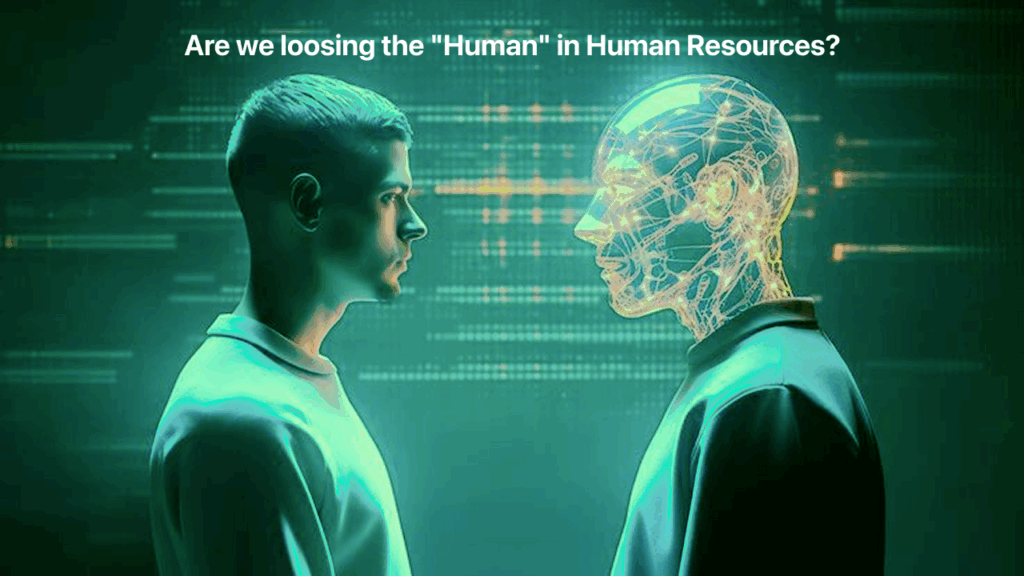
Bringing artificial intelligence into HR shifts how you make choices, how your teams communicate, and how trust is built and maintained. Hence, it should be a cautious as well as conscious effort. No need to rush.
Let’s start with privacy. HR handles deeply personal data. The team knows compensation, health records, and personal histories of the employees. If this data falls into the wrong hands or is mishandled, the consequences can go beyond legal issues. It’s personal. So, before any AI system is turned on, data security must be airtight.
Then there’s bias. AI learns from old patterns. If those patterns carry prejudice, the AI will not be any better. It will mirror those biases. That’s a real risk, especially in hiring and performance reviews. If decisions can’t be explained clearly, people will lose confidence. Transparency isn’t optional. It’s foundational.
Integration brings its own set of complications. Many HR teams use systems that don’t talk well to each other. Plugging a new AI into this setup can slow things down instead of speeding them up. It’s not just about what the tool can do—it’s about how it fits.
Skills are another hurdle. Most HR professionals don’t read data models correctly or question how algorithms work. It will take time to build that skill.
And finally – trust. People worry when they hear “automation.” They wonder if their roles will change or disappear. That fear needs to be addressed early and honestly. AI should support people, not replace them. If that’s not made clear, resistance is inevitable.
It asks hard questions about fairness, ethics, and how we treat people. Those questions need thoughtful answers. Not just from tech people, but from everyone.
Will AI Redefine What It Means to Be a ‘Human Resource’?
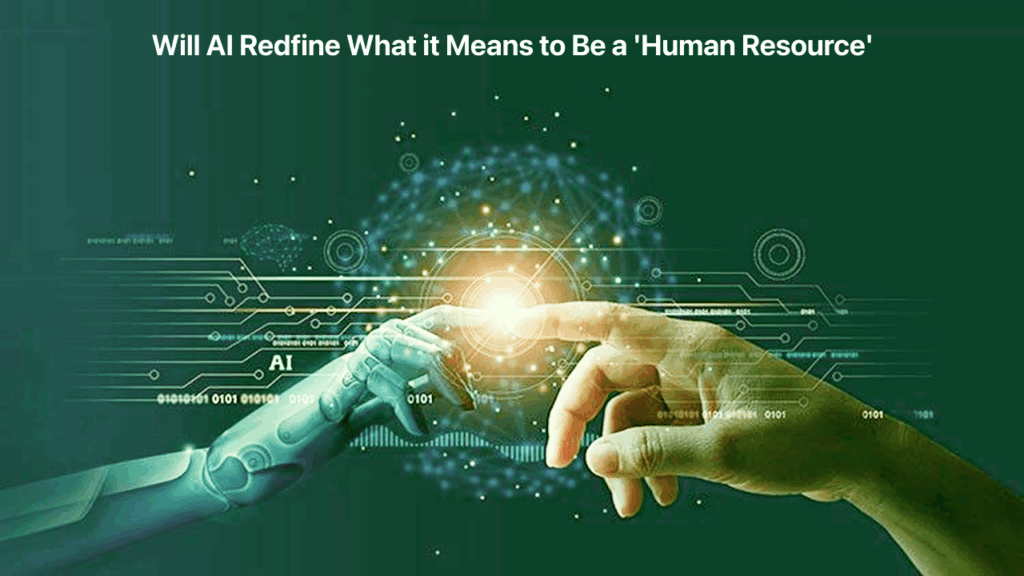
Let’s look ahead. The future of AI in HR isn’t about disruption. It’s about partnership. We’re not talking about AI replacing people. Instead, think of it as ushering in the age of the “augmented HR professional.” Your team won’t be replaced; they’ll be empowered. AI becomes their intelligent assistant, making them incredibly effective.
So, what should we watch for? Generative AI is a big one. These tools, the ones that create content or summarize data, will continue to become more efficient. They’ll do the heavy lifting and free up your human resources for actual human interactions. Then there’s hyper-personalization. AI will deliver truly unique experiences to every employee. Think tailored learning paths, benefits, or career guidance. This isn’t just efficient; it builds real connections. Primarily, the argument is about AI ethics and its fair use. Ensuring fairness, transparency, and data privacy isn’t just a compliance issue. It’s about liberating AI from unjust biases and building trust.
In closing, let’s talk about what this means for you, as a CHRO. AI is slowly becoming your strategic co-pilot. It will help you with complex decisions. It will run countless scenarios. You’ll gain insights that were impossible before.
This isn’t just about cutting through the clutter. It’s about HR becoming even more central to your overall business strategy. The lines between people strategy and business success will blur further. AI will enable HR to drive bottom-line results in ways we’re just beginning to grasp fully.
The future is about smarter, more human HR.ValueMatrix.ai fits right into this future using AI and psychology to help HR teams hire smarter, build stronger cultures, and turn people strategy into business results.
About Us
ValueMatrix helps organizations build culturally cohesive teams with AI-powered recruitment and retention strategies. We educate corporate leaders on the importance of involving and encouraging all generations to adopt enterprise values and participate actively to achieve excellence.
Our AI-powered platform transforms talent acquisition with intelligent hiring techniques backed by established psychological frameworks. We partner with HR professionals to conduct unbiased and holistic assessments for aspiring candidates.