
Key Takeaways:
- 70% of the global workforce are passive candidates.
- The recruitment marketing platform market is rising at an 8.4% CAGR.
- Over 45% of employers struggle to find talent in 2026.
- 98% of hiring teams use social media for recruitment.
- ValueMatrix uses the “Big Five” (OCEAN) model to ensure culture fit.
In modern hiring, recruitment marketing has become an essential cornerstone. Employers who use recruitment marketing strategies tend to attract better talent while reducing delays and improving long-term quality. However, hiring has become more complex than before as more than 45% employers struggle to source the right candidate for the right job. This is because hiring activity has slowed despite an increase in applications.
Nonetheless, the recruitment marketing platforms market is growing rapidly, projected to exceed USD 1.82 billion by 2035, underscoring the need for a major shift in how employers approach the entire hiring process. The traditional hiring process just does not cut it anymore; what employers need is a robust recruitment marketing guide.
What Is Recruitment Marketing? (And Why Does It Matter Now?)
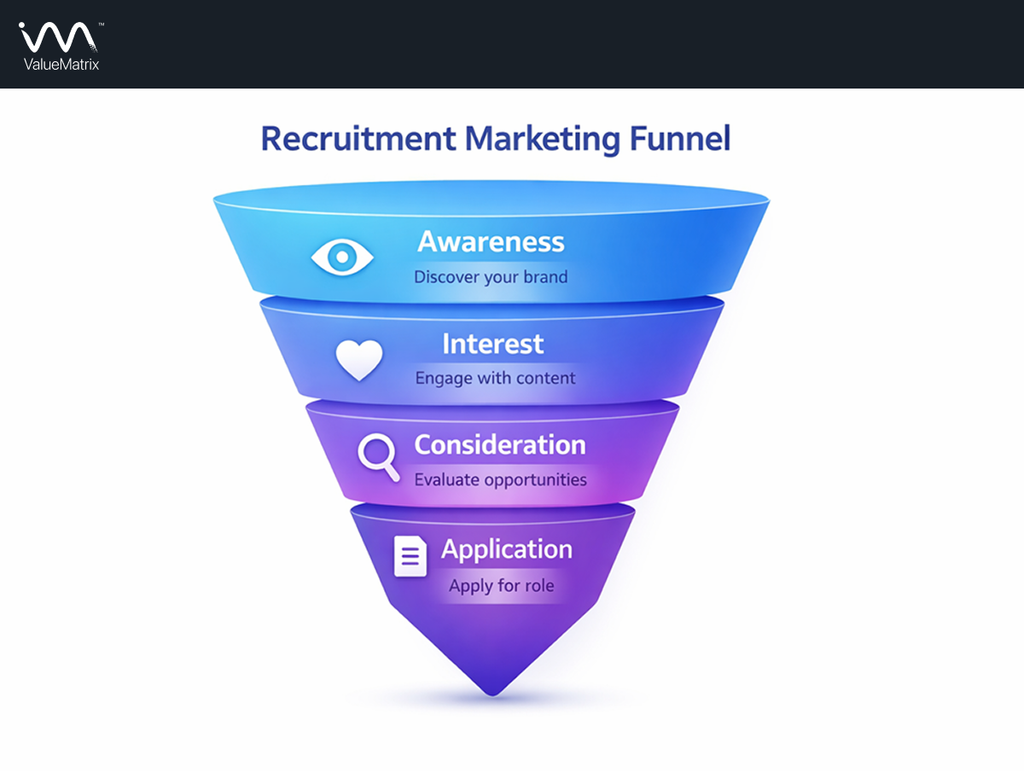
Recruitment marketing is the practice of using marketing strategies such as branding, content, and targeted outreach to attract and engage candidates before jobs open. Under this type of marketing, candidates are treated like customers, and the goal is to create long-term talent pipelines rather than relying on reactive hiring.
Instead of the traditional “vacancy-to-hire” process, this approach considers the candidates as customers. It is not about filling the open positions traditionally. It primarily focuses on promoting workplace culture and values.
What Are the Best Recruitment Marketing Channels?
Recruitment marketing channels are the platforms and methods businesses use to attract, engage, and nurture candidates. A mix of channels ensures wider reach, better targeting, and higher-quality hires by connecting with both active job seekers and passive candidates across different touchpoints.
Here are the different recruitment marketing channels:
● Career Page on Website
This is your central hub where candidates explore job openings, understand your company culture, and take action. A well-optimized career page directly impacts application rates.
● Social Media Platforms
Platforms like LinkedIn, Instagram, and Facebook help you showcase real workplace experiences and engage candidates through authentic, ongoing content.
● Job Boards
Sites such as Indeed and Naukri are effective for quickly reaching active job seekers who are already looking for opportunities.
● Employee Referral Programs
Leveraging your existing team to refer candidates often results in better cultural fit and higher retention rates.
● Email Campaigns
Email helps you stay connected with potential candidates over time by sharing updates, job openings, and relevant company news.
Employer Branding vs Recruitment Marketing: What Is the Difference?
Employer branding defines your company’s identity as an employer, while recruitment marketing is how you promote that identity to attract candidates. In a way, branding is the message while marketing is the delivery system.
In fact, about 94% of candidates will apply for a job opening if a company actively manages its employer brand. So, employer branding is the foundation for creating recruitment marketing channels.
Many people confuse employer branding with recruitment marketing. Yet, they are actually two completely different parts of the same process. An employer’s brand is their reputation as an employer (i.e., their “why”). It’s the story of your culture, your mission, and your employee experience.
Marketing for recruitment, on the other hand, is the “how.” It is the distribution mechanism. If employer branding is the product, recruitment marketing is the advertising campaign that puts that product in front of the right audience at the right time.
Why the “Post and Pray” Method is Dead?
The “post and pray” approach tends to fail since it only reaches active job seekers (a small portion of the talent market). Modern hiring requires engaging passive candidates through ongoing marketing efforts.
When recruiters rely solely on active job seekers, it can limit the talent pool to 15-20% of the job seeker market, as 70-80% of candidates are passive. True hidden gems. Passive candidates are the candidates who are working and not actively seeking a switch.
Furthermore, about 83% of talent acquisition professionals now know that high-quality hires are mostly among the passive candidates. Additionally, hiring activity has dropped 3.5% year-on-year, meaning competition for quality candidates is tougher than ever,r and employers need to come up with result-oriented recruitment marketing strategies.
What Are the 5 Steps to Build a Scalable Recruitment Marketing Plan?
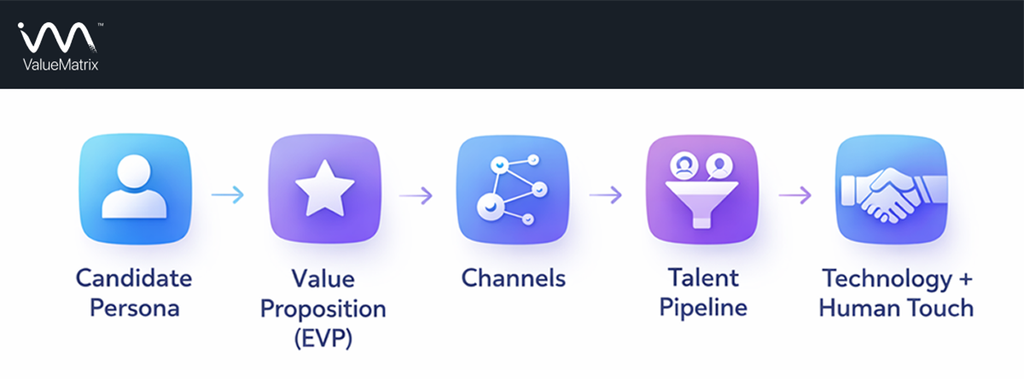
For a recruitment marketing plan to be scalable, it needs to shift from reactive hiring to proactive hiring. The primary steps involve defining your ideal candidate, solidifying your value proposition, selecting the right channels, nurturing leads, and leveraging AI to improve efficiency.
Recruiters can stop chasing candidates and start attracting them skillfully with a well-documented recruitment marketing plan. It is important to know that a hastily created approach will lead to wasted budget and inconsistent talent quality.
Now, let us see the steps that recruiters need to take to develop a scalable recruitment strategy:
Step 1: Build Your Candidate Personas (Look Beyond Just the Resume)
It is important to go over and beyond standard job descriptions and define the “Ideal Candidate Persona.” What are their behavioral traits? What psychographic profiles thrive in your specific culture?
This is where modern tech changes the game. Tools like ValueMatrix can identify candidates based on culture fit and soft skills, rather than just keyword-matching in a PDF.
Step 2: Solidify Your Value Proposition
You need to work on what “Peace of Mind” you are offering to the candidate. Ask yourself: What is it that makes you different from other employers in the same field?
Your Employee Value Proposition (EVP) needs to answer questions a passive candidate often has, such as: “Why should I leave my comfortable job to become a part of a new organisation?”
Is the company committed to transparency, believes in industry-leading professional development, employee-centric work culture, or has a unique approach to work-life harmony?
Step 3: Choose the Right Recruitment Marketing Channels
Not all platforms perform in the same way. While LinkedIn is well-known, niche communities (such as GitHub for developers or Behance for creatives) often yield higher-quality leads when used effectively. So, it is not always the well-known channels you should use to source candidates. Instead, opt for multiple channels, regardless of ranking, to get the best candidates.
Also, about 98% of hiring and employer branding teams use social media for recruitment, as traditional job boards are no longer the primary channel for candidate discovery.
Track which channels provide the highest quality of hire, not just the highest volume of applicants. Once you know which channel gives the best results, you can prioritise searching in those channels.
Step 4: Implement a Proactive Recruitment Marketing Strategy
It is best to have a talent pool before you actually need it, so you are not scrambling for new talent the minute an employee resigns. Nurture leads regularly through a call-to-action option on your website.
It will keep your talent pool warm and ready to go whenever required.
Step 5: Leverage Technology Without Losing the Human Touch
Automation needs to be used to remove “friction,” not “feeling.” You can utilize AI to handle scheduling and initial screenings. This will free up your recruiters to do what they do best: build real human connections and sell the company’s vision.
AI automation is set to allow recruiters to scale administrative tasks as needed. A hiring survey found that businesses using AI report 89.6% greater hiring efficiency and 77.9% cost savings.
What Are the Most Effective Recruitment Marketing Strategies & Ideas for 2026
The most effective strategies include optimizing career sites, using authentic social media storytelling, personalizing outreach, and demonstrating real commitment to diversity and inclusion.
If you are looking for actionable recruitment marketing tips, the following strategies are currently delivering the highest ROI for enterprise-level brands.
1. Transform Your Career Site into a Talent Magnet
Candidates looking to switch careers or seeking a new opportunity often check the career section on your organisation’s website. Also, since most people will use their mobile phones to apply via the career section, your website must be mobile-optimised.
It should be fully accessible and easy to navigate. It is also a good practice to avoid stock images. Display job openings clearly, including all required information. You can set up a form where the candidate can quickly fill in their details, and it will be sent to you directly within minutes. It will allow you to take action while the candidate is very much interested.
Moreover, if you also include video on your website’s career page, it can result in a 157% increase in organic traffic. Show real employee stories and simplify applications to reduce friction.
2. Use Social Media for Authentic Storytelling
It’s 2026, and the boring job links don’t do the trick anymore. Today, the candidates need to feel it to believe it. People scroll away from the autonomous corporate speak. So you need something that catches their attention.
The importance of using social media becomes clearer when considering that 98% of hiring and employer branding teams conduct most of their recruitment there. This strategy outperforms traditional job boards. Additionally, candidates research companies online on social media before applying, making social media one of the best places to showcase your brand image.
Share “day in the life” videos, celebrate team wins, and post behind-the-scenes content that shows your culture in action. Authenticity is the ultimate currency in marketing for recruitment these days.
3. Deploy Targeted Email & SMS Campaigns
You need to think of your candidate database like a lead list. Use drip campaigns to keep passive candidates “warm.” Just because a candidate was not the right fit six months ago does not mean they have not upskilled, or that there is not a position they can fill now.
Moreover, employers need to know that sending personalised emails rather than bulk messages is likely to yield a 15% higher response rate.
Sending an out SMS or emailing them about a new project or company milestone can re-engage them. You can also discreetly ask them to check out the new openings at your firm, or ask whether they are looking to grow with your organisation.
4. Highlight Diversity, Equity, and Inclusion (DEI)
The Gen Z and Millennials workforce does not just get excited about a job based on how much it pays. They are looking for additional non-negotiable benefits. They want to see a tangible commitment to fairness.
They don’t want a DEI statement; they want to see diverse leadership and inclusive policies. In fact, more than 73% of employers now opt for skill-based hiring to remove bias and improve diversity.
Use AI to remove unconscious human bias from the initial screening process with ValueMatrix. By focusing on objective behavioral data rather than names or zip codes, you ensure a fairer playing field from day one.
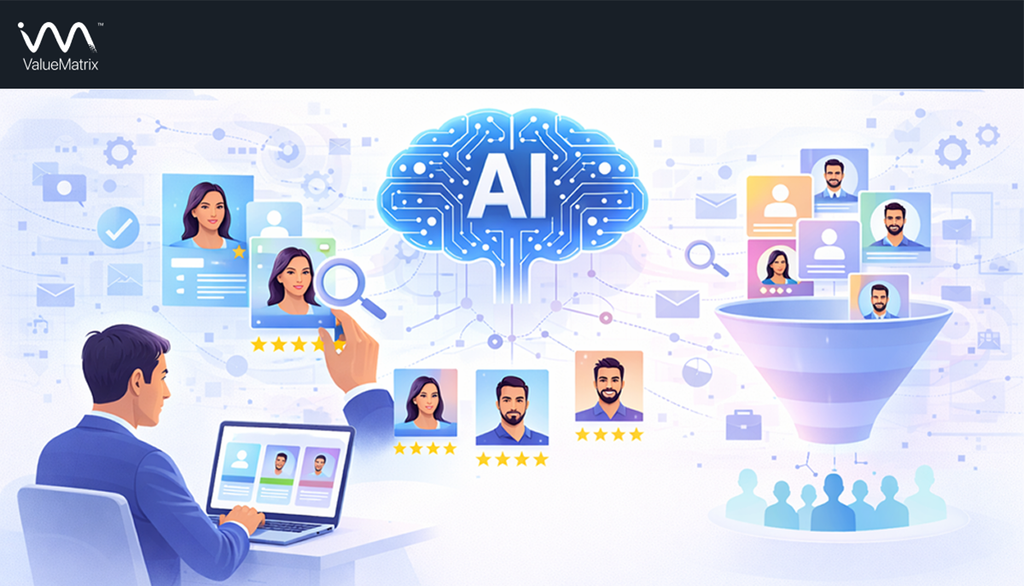
See how ValueMatrix helps build smarter AI hiring funnels
What Are the Common Recruitment Marketing Myths That Are Holding You Back?
Many companies fail because they treat recruitment marketing as a short-term activity, focus only on salary, or misunderstand how AI supports hiring.
If you are wondering how to improve recruitment marketing, start by unlearning these three common misconceptions.
Myth 1: You only need to market when you have open roles.
Reality: Recruitment never really stops. It is a 365-day job. You need to review your recruitment strategy regularly. If you only start talking when you’re hiring, you’re already behind the curve.
You have to be proactive in the hiring process. Having a talent pool is necessary to attract the right candidates without wasting time. A consistent brand presence is necessary so that when a candidate is ready to move, your name is at the top of their mind.
Myth 2: Job seekers only care about salary.
Reality: The primary requirement is indeed salary, but candidates are also looking at the culture, professional growth and the company’s reputation.
Candidates today can settle for a little less pay but still want additional benefits. Today, candidates are looking for stability, strong leadership, a good company culture, and want to be aware of employer financial health, as well as potential for layoffs, more than they did a few years ago.
Companies that can offer these intangible benefits along with a competitive salary attract the best candidates.
Myth 3: Another myth about AI recruitment is that it makes hiring cold and robotic.
Reality: If AI is used carefully and wisely, it can bring great results by removing the administrative burden of sorting through thousands of resumes. It helps save time and effort.
The recruiter can now focus on having deep, meaningful conversations with the right candidate to better understand how the candidate can further help the organisation.
What Are the Pros and Cons of Recruitment Marketing?
Recruitment marketing helps businesses attract better talent by building relationships before hiring begins, but it requires consistent effort, investment, and coordination. While it improves hiring quality and speed, it is most effective as a long-term strategy rather than a quick fix.
Here are the pros and cons of recruitment marketing:
| Pros | Cons |
| Helps you reach passive candidates who are not actively job hunting but are open to better opportunities | Requires consistent effort over time and cannot be treated as a one-time activity |
| Builds a ready talent pipeline, reducing urgency and last-minute hiring pressure when roles open | Needs upfront investment in employer branding, recruitment tools, and content creation |
| Improves quality of hire by attracting candidates aligned with your culture, values, and long-term goals | Requires strong coordination between HR, marketing, and leadership teams to work effectively |
| Strengthens employer brand and makes your company more attractive and trustworthy to potential candidates | Measuring ROI can be challenging without proper analytics tools and structured tracking systems |
| Enables personalized communication at scale using modern technology, like people analytics solutions | Overuse of automation can make the candidate experience feel less human if not handled carefully |
Companies with a strong recruitment marketing programme in place tend to find candidates more quickly and at lower cost. Research shows that structured hiring strategies significantly reduce time-to-fill, with up to 70% of roles being filled from pre-existing talent pipelines.
What Are the Essential Recruitment Marketing Metrics that Businesses Must Track?
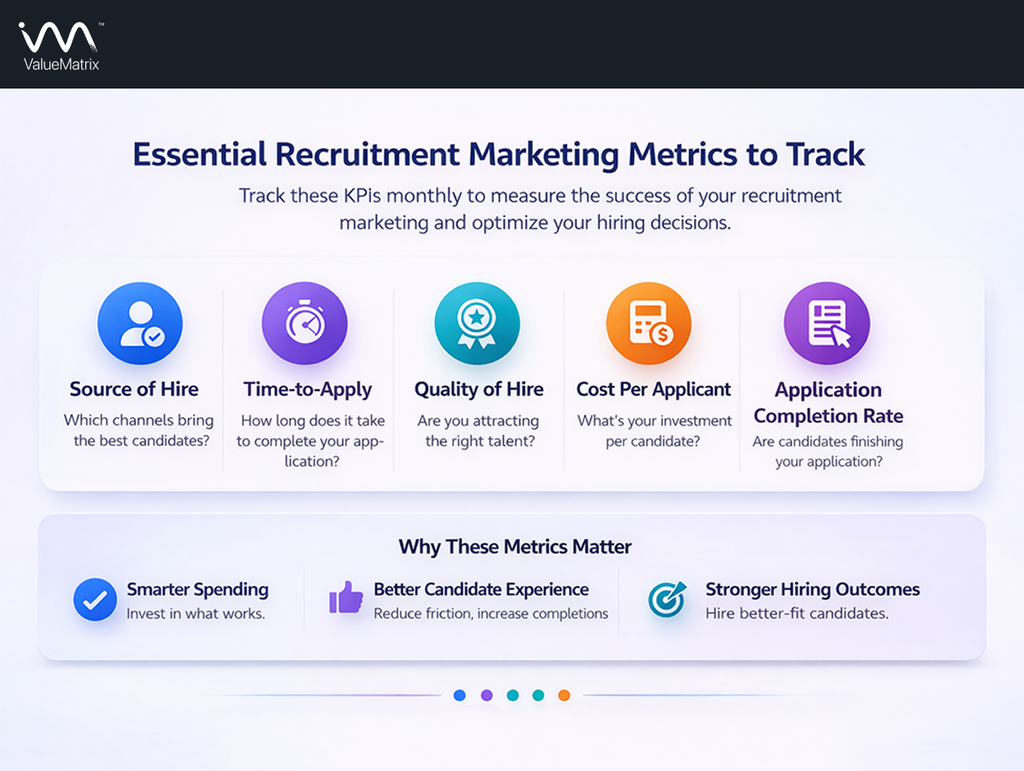
Recruitment marketing success is measured by metrics such as source of hire, time to apply, the quality of hire, conversion rates, and cost efficiency to ensure your strategy attracts the right candidates, not just more candidates.
The key to improvement lies in the timely measurement of different metrics. To evaluate your recruitment and marketing strategies, consistently track Key Performance Indicators (KPIs).
Here are the metrics that recruiters must track religiously:
| Metric | What It Measures | Why It Matters |
| Source of Hire | Tracking this metric is necessary as it helps to understand which channels bring in the most successful hires over time. | Based on the results, the recruiters can easily allocate the hiring budget to the platforms from which they source the majority of candidates. |
| Time-to-Apply | The metric helps understand the average application time for candidates, i.e., how long it takes them to complete your application. | When application forms are very elaborate, it can cause a high drop-off rate. Friction is the enemy of conversion. |
| Quality of Hire | Employee retention metrics and performance after 6-12 months help determine which categories of candidates leave and which types of candidates stay. | This is the ultimate test of whether your marketing attracted the right fit or you have just hired candidates to fill the positions. |
| Cost Per Applicant | Total marketing spend divided by total applicants. | Ensures your strategy is financially sustainable and scalable. |
| Cost Per Qualified Applicant | What do you spend to attract candidates who actually meet your initial screening requirements | Gives you a clearer picture of real hiring efficiency by focusing on quality, not just the number of applications |
| Offer Acceptance Rate | The percentage of candidates who accept your job offer after receiving it | Helps you understand if your employer brand, compensation, and expectations truly match what candidates are looking for |
Which Platforms Offer Talent Marketing in a Recruiting Suite?
Recruitment marketing platforms aim to help manage branding, candidate engagement, analytics, and hiring workflows within a single integrated system.
While hiring has become a hassle today due to several reasons, the saving grace is that recruiters no longer have to jump between five different tools to manage their brand.
Today, recruiters are aiming for efficiency through consolidation. The recruitment world is now moving toward platforms that excel at talent analytics for hiring within a recruiting site setup. It helps reduce the friction caused by disjointed tools.
ValueMatrix: The Future of Talent Matching
As recruitment marketing evolves, organizations increasingly rely on integrated technology platforms to manage hiring workflows. It is where ValueMatrix, an AI-based talent intelligence platform, works wonders and can be especially helpful to recruiters of this age. ValueMatrix isn’t just another tool or platform; it is a smart, all-in-one partner for the modern talent landscape. This platform can make talent acquisition much more efficient and effortless.
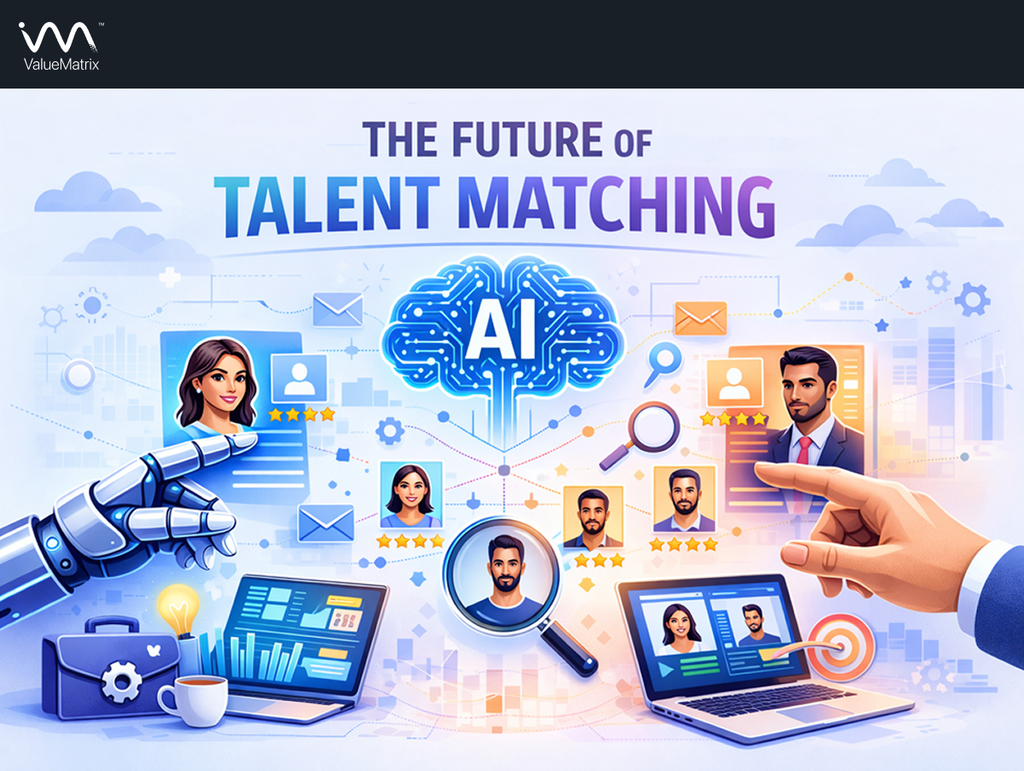
ValueMatrix is a sophisticated behavioural and cultural filter. This talent-matching platform uses AI to look beyond the words on a resume. It aims to match the right person to the right recruiter based on their deep-seated values and potential.
It is an integrated platform that allows recruiters to:
- Build long-term talent pipelines
- Automate candidate nurturing campaigns
- Track recruitment analytics in real time
- Deliver consistent candidate experiences
Instead of focusing solely on resume keywords, ValueMatrix identifies candidates who are a perfect fit with a company’s culture and team dynamics.
It is important to choose the right tool, as it will help you scale your hiring, create a good team structure, and enhance the sophistication of your recruitment strategy. Here’s a practical comparison to help you evaluate:
| Tool | Best For | Key Features | Limitations |
| ValueMatrix | Behavioral hiring & culture fit | AI-driven talent matching, candidate insights, pipeline automation, and real-time analytics | May require onboarding to leverage behavioral models fully |
| Phenom | Enterprise career site optimization | AI-powered career sites, chatbot engagement, CRM features | Higher cost, better suited for large organizations |
| Beamery | Talent relationship management | Talent CRM, pipeline nurturing, workforce planning | It can be complex to implement for smaller teams |
| SmartRecruiters | End-to-end hiring platform | ATS + recruitment marketing tools, collaboration features | Marketing features are not as deep as specialized tools |
| Avature | Custom enterprise solutions | Highly configurable CRM, automation workflows, and personalization | Requires technical setup and customization effort |
Summary
Recruitment marketing is not optional anymore. It is the key foundation of modern hiring. Companies that build strong employer brands, nurture talent pipelines, and use data-driven strategies consistently outperform competitors in hiring quality and speed. The shift is clear. Hiring is no longer about filling roles. It is about building relationships.
Conclusion: Your Next Steps
Recruitment has evolved far beyond posting job ads and waiting for applications in the past decade. It is now more about building a brand that top talent trusts. By following this recruitment marketing guide, you shift from a reactive action to a proactive strategy. You stop being a hunter and start being a destination for the right talent.
If your hiring process feels overwhelmed by endless resumes and slow screening, it may be time to rethink your approach.
Book a demo with ValueMatrix today. Connect with us to talk to our experts.
Frequently Asked Questions
How does recruitment marketing differ from traditional recruiting?
Traditional recruiting is often reactive: a role opens, you post it, and you wait. Recruitment marketing is proactive. It is about having a talent pipeline 365 days a year so that when a role opens, you already have a pool of engaged candidates who know your brand.
What are the best recruitment marketing strategies for 2026?
Hyper-personalization is king. Instead of mass emails, use targeted campaigns based on candidate personas. Additionally, integrating AI to handle administrative tasks allows your team to focus on “human-centric” marketing, like one-on-one networking and community building.
How can AI improve my recruitment marketing strategy?
AI can help you personalize outreach at scale, understand which job descriptions are putting off candidates, and even remove bias from the screening process. AI does not aim to replace the recruiter; it simply gives them better tools.
Why is candidate experience considered part of marketing?
Every touchpoint, from the first ad they see to the rejection email, is a marketing moment. A poor experience leads to bad reviews on Glassdoor, which can tank your employer brand and make future marketing much harder.
What are recruitment marketing channels?
Recruitment marketing channels include platforms like LinkedIn, career websites, social media, job boards, email campaigns, and employee referrals. Choosing the right mix of channels ensures that companies reach candidates where they are most active.
How can social media be used for recruitment marketing?
Social media is a very helpful tool for sharing company culture, employee stories, job openings, and industry insights. It helps build brand awareness and engage potential candidates in a more authentic and interactive way.
What are common recruitment marketing mistakes?
Some common mistakes in recruitment marketing include ignoring employer branding, relying solely on job boards or any single recruitment channel, not nurturing a pre-existing candidate pool, and failing to track performance metrics. These mistakes can limit hiring success.
How long does recruitment marketing take to show results?
Recruitment marketing is a long-term strategy, not a quick fix. While some improvements, like better engagement or application rates, can appear within weeks, building a strong talent pipeline and employer brand typically takes a few months of consistent effort and content.
How does employer branding impact recruitment marketing success?
Employer branding directly affects how candidates perceive your company. A strong, positive brand builds trust and makes candidates more likely to apply and accept offers, while a weak or unclear brand can reduce interest even if the role is attractive.