
Table of contents
Who are I/O Psychologists?
Industrial/organizational psychology, also known as I/O psychology, refers to the scientific analysis of an individual’s behavior in their place of work. These psychologists are not clinicians, but scientists or practitioners who are well-versed in the execution and understanding of psychology research.
They enable organizations to develop more productive, prospective, and safe practices for employees and efficient processes to enhance profitability and productivity. Besides, psychology-driven HR tech can motivate staff in improving their work, negotiating higher salaries and working conditions as well as creating better work environments or settling workplace conflicts. Simply put,this behavioral science in hiring can enable businesses to increase efficiency in strategies, employee motivation programs, and training and development. Moreover, I/O psychology in hiring helps companies in recruiting the right talent, developing incentives and organizational structures in order to enable employees to increase their work productivity and also sustain their work-life balance.
Understanding AI and I/O Psychology
Before we talk about the role of I/O psychologists in greater detail and what do they do in an organization, we also need to understand how AI is reshaping the current HR dynamics right from automating recruitment processes to the integration of artificial intelligence in day-to-day systems and processes.
Growing presence of AI in hiring activities
In recent times, companies are laying greater emphasis on hiring speed, efficiency, and perfection. As a result, they are moving towardAI for resume screening and sourcing applications, among others. Through the use of large datasets, predictive analytics can help in the selection of candidates based on experience, cultural alignment, and skills, thus lowering the actual time to hire best-fit personnel. As per the recruitment trends for 2025, there is no longer the question of if AI has to be used in hiring, but how best can it be used strategically.
Benefits and challenges of AI-driven hiring
| AI’s Benefits and Challenges | |
|---|---|
| Pros | Cons |
| Time saver | Susceptible to replicating human biases |
| Enhanced communication | Requires vast amount of data for talent screening |
| Decreases bias in the recruitment cycle | Can be inaccurate at times |
Although there are pros and cons to everything in this world, we also need to speak about the benefits and challenges of AI-based hiring, so as to understand where and how I/O psychologists may help in improving these systems.
Importance of Psychologists in AI Recruitment
The main focus of I/O psychology is on how people behave and interact in their workplaces. However, there is an underlying fear among I/O psychologists that AI-based hiring may replace their jobs and they may have to look for alternative careers instead. Though they have good reasons to think so, it is not necessarily so. Though machine learning, AI tools, and predictive analytics are all reshaping almost all sectors, there is still scope for I/O psychologists to contribute to this trend. And here’s why:
Automation is not a bad thing
Technological development in I/O is lowering administrative burdens, offering new options for psychologists to enhance their research through AI. For example:
- Prior to the introduction of internet, providing 360⁰ feedback was good on paper; and
- Initial assessments were manually scored and entered into spreadsheets, significantly increasing time, effort, and money.
I/O psychologists are trusted to reliably gauge human characteristics. Expanding the capability of organizational psychology AI requires appropriate direction and partnership. That said,these psychologists will always have greater ability to recognize individual differences, thereby becoming the much-needed instructors and mentors in the field of tech advancements.
Assist business leaders in saying “yes”
Industrial psychology can work on each side of the risk-reward equation. Foundational techniques like bias mitigation and job analysis need to reduce risk and allow businesses to adopt advanced technologies. As organizational psychologists are well-versed in this risk-reward profile, they are actually enabling companies to select more innovative tech systems and thereby adding higher value.
It is interesting to note that companies like Facebook, Google, and Amazon are leading the race for hiring I/O psychologists and AI. In fact, organizations that are foremost in the adoption of digital machines are significantly competing for the best I/O psychologists.
Hence, it is important for psychologists to discover novel ways to coexist and partner with AI. Besides, organizational psychologists offering their advice need to be up-to-date with the tools and know-how to enable companies to accurately decide how they would be using AI across their work environment.
How can ValueMatrix help your organization in this transformation?
ValueMatrix enables companies to build winning teams through AI-based hiring.The company’s product suite is a powerful blend of established psychological approaches powered by machine learning, data science, and AI. ValueMatrix also offers psycholinguistics and computational psychometrics as well as cognitive gamification techniques to assess a candidate’s: (i) language patterns; (ii) problem-solving, critical thinking, and decision-making skills; and (iii) true emotions during interviews.
Are human recruiters at risk with growing AI-based hiring?
Though artificial intelligence is good in automating recurring tasks, it cannot forge relationships with candidates like human beings do. That definitely requires individuals. Also, AI-based hiring cannot imitate the sensitivity or empathy of humans.A qualified hiring expert is still needed for validating AI tools’ recommendations. So, what’s the winning strategy then? It is to use AI to expand the human touch and not replace it.
Core Expertise of I/O Psychologists: An Overview
Due to the fact-paced business ecosystem, companies are increasingly recognizing that there needs to be an appropriate connection between an employee’s well-being and their overall success. Hence, the growing importance of industrial psychology cannot be overplayed.
Several organizations face difficulties in turning psychological theory into effective strategies. Nevertheless, I/O psychologists are sufficiently trained to present evidence-based approaches to HR teams. They can transform research into real-world impact and also highlight the requisite credentials and educational background a company needs to screen for this.
Discussing I/O Psychologists in this Landscape
HR practices are gradually leaning toward the use of machine learning and AI practices for their core functions due to technological advancements, rising expectations, and adjustments in the workplace dynamics. However, we also need to understand how industrial psychologists can help in the automation of people processes and render them more inclusive and effective.
That said, I/O psychology concepts could be used for developing a well-balanced multidisciplinary method that highlights human-centered design, transparent methodology, and ethical considerations. This combination will enable companies to undertake ethics-based decisions across all spheres of their operations.
Practical applications of I/O psychology
Fostering a positive company culture – Important for employee morale and productivity through the development of actions that enhance respect, inclusivity, and collaborations.
Initiatives to expand team dynamics – Effective teamwork for the achievement of organizational goals, higher collaboration, and reducing conflicts by analyzing team interactions and behaviors, and thereby boost interpersonal relationships within the workplace.
Effective handling of change management strategies – Utilize change management theories such as Lewin’s Change Model to guide company transitions so as to decrease resistance and increase acceptance by understanding the psychological impact of the shift on employees.
Customize employee experience –Help companies create individual development strategies, training, and personalized feedback that maximize employee potential through advanced technologies.
Employee safety and well-being – Supervise and offer solutions for issues like stress, burnout, and fatigue arising from technology; design dashboards to examine employee sentiment or help implement flexible work schedules.
Role of Organizational Psychologists in an AI-Enabled World
With the rising acceptance of AI for HR practices, I/O psychologists must develop their expertise along the lines of such tools by educating themselves about its fundamentals. They also need to ensure the tools are fit for purpose. Psychologists need to focus on the development of systems that provide actual value to both companies and staff. There are three core areas where I/O psychologists play a pivotal role.
1. Advocate ethical AI practices
As conventional tests and assessments were developed to be responsible and ethical, applications of AI solutions also need to ensure fairness and eliminate bias.
2. Improve employee experience
They need to have up-to-date information on tech tools that can help organizations set up accommodative workplaces to attract top talent.
3. Assist in human-AI collaboration
Organizational psychologists must enhance their expertise in designing human-AI processes to boost productivity and decision-making without completely eliminating the human element.
Enhancing AI Systems With Psychological Insights
Industrial psychologists are important in the process of introducing and ensuring the efficacy of AI-based HR technology. For applying psychological principles to the designing of data systems, I/O practitioners first understand how data is gathered and confirm it is relevant for the workplace outcomes and employee interaction as well as is accurate and informative.
Human expertise still matters in an AI-driven process
Though the foremost task of I/O psychologists is to understand and enhance employee behavior within businesses, it is also important for them to focus on staff productivity, their well-being, change management as well as leadership development. On the other hand, artificial intelligence is already making great strides across industries such as finance, education, and healthcare. I/O psychologists in these sectors consider it a powerful tool that can enhance decision-making, streamline processes, and also offer real-time insights.
Industrial psychology is used in AI to design algorithms that evaluate psychological data, imitate our cognitive processes, and develop applications that interact with users on a more individual level. For example, psychology can be used for creating AI tools that assess emotions and virtual reality therapy, and construct systems for mental health assessment and support. I/O psychology also provides the theoretical basis for interpreting learning, reasoning, and decision-making – the main AI challenges.
Building AI from an I/O psychologist’s perspective
Interestingly, understandings from psychological theories on decision-making uncertainty is instrumental in developing more effective and transparent algorithms for various issues. Industrial psychology offers models for human cognition like memory, attention, and reasoning which have influenced system architecture and core AI concepts. Besides, studying emotions in psychology allows for the development of affective computing, which is defined as the use of AI to evaluate and understand as well as generate human emotions, as evinced in facial recognition software.
Collaboration Between I/O Psychologists and Data Scientists
Data science enables businesses to move ahead, adapt to market shifts, and develop innovative products and services. It also helps organizations to scout for newer trends, customer preferences, and novel methods to conduct their operations.
https://valuematrix.ai/blog/workplace-personas-that-drive-or-deter-team-success/I/O psychology is defined as a science that improves workplace dynamics by applying psychological principles to assess human behavior. With evolving technological advancements and increasing employee demand, there is an urgent need for effective industrial psychology solutions.
Though this field’s inception can be traced to the 20th century, it has now grown to include employees’ psychological and emotional needs as well as leadership styles, team dynamics, and organizational culture. Let’s now discuss the combination of data science and psychology for people-based decisions across organizations.
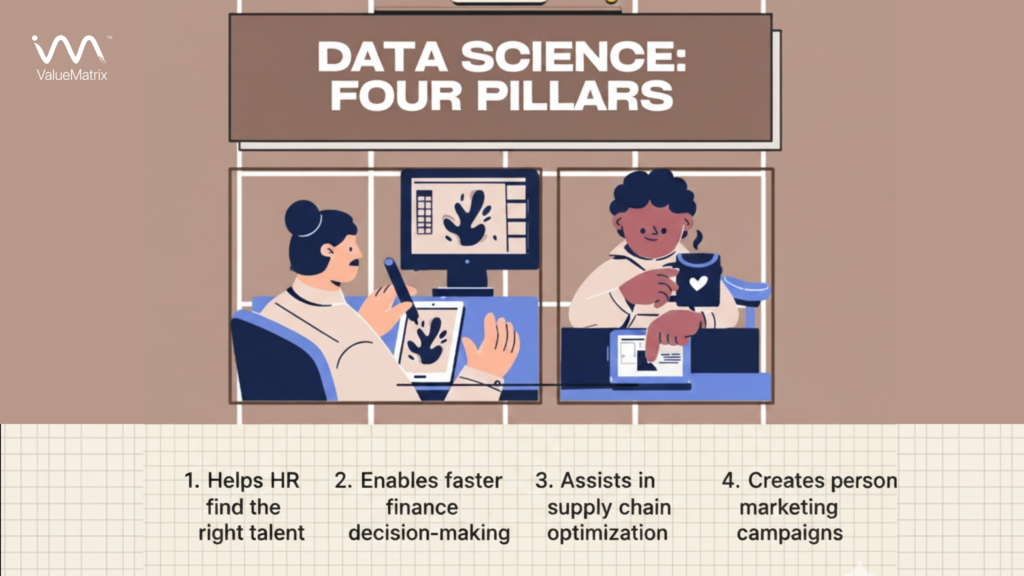
Bridging psychology and data science
Decision-making through data is rising exponentially. Although technical skills are important for a data scientist, it is also necessary to have psychological skills. While data scientists have excellent knowledge of the technical aspects, it does not always warrant that their expertise is great. Organizational psychology refers to the application of human behavior to truly allow for ethical and effective changes across a company. Why I/O psychologists matter to data scientists can be explained through the three reasons below.
A. Similar goals of both psychologists and data scientists
While the work of data scientists is complex, one of their most primary goals is to use data for making conclusions and decisions pertaining to optimization or problem-solving in an industry or organization. Industrial psychologists usually find solutions for employees and organizations by researching just about every aspect of a workplace that relates to an individual’s behavior.
As it is clear, there is an overlap between these two fields, where both sets of professionals are trying to improve or resolve workplace issues. Though they may have varied processes to find solutions, data scientists can largely gain from an I/O psychologist’s skills for optimizing actionable findings.
B. Psychology can help a data scientist’s work become better
Secondly, while industrial psychologists have vast expertise and knowledge across organizational development, employee performance, and workplace behavior, their roles can easily complement data scientists who are technically sound thus becoming extremely effective.
C. I/O psychologists for good team work and leadership
And lastly, leadership and workplace interaction are important areas of research within I/O psychology. In fact, by understanding the most efficient ways of working in teams, dealing with conflict, and adapting leadership styles, data scientists can be more effective leaders and teammates, and, in return, create a lasting impact in their fields.
Future of Industrial/Organizational Psychology in HR
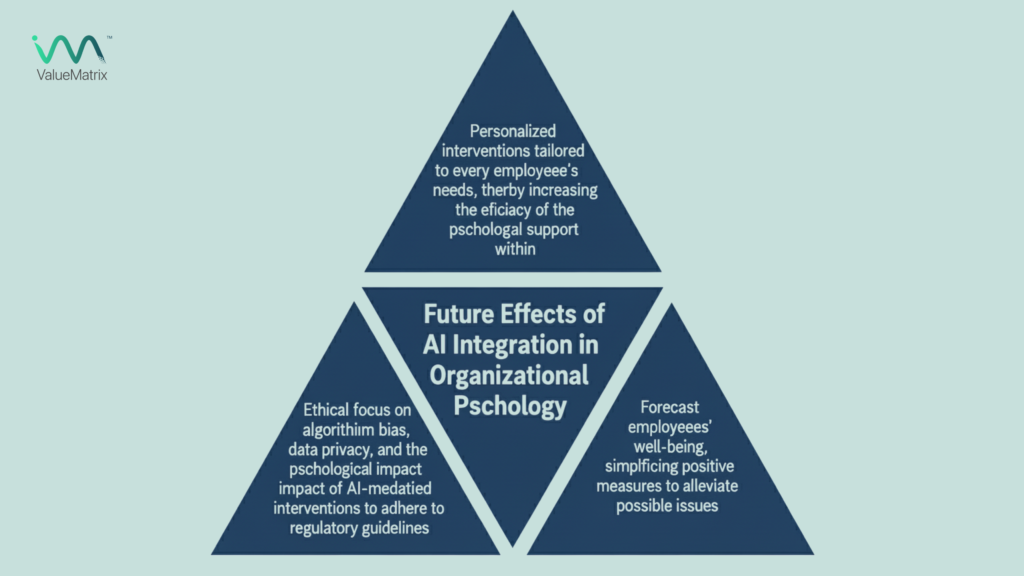
With AI continuing to encompass most aspects of our professional lives, its role in developing organizational psychology for HR is increasing in prominence. AI and industrial psychology go hand-in-hand right from the transformation of hiring processes to supporting performance management. Once businesses start expanding their operations amid challenging times, they also need to realize that AI in I/O psychology is not just a matter of curiosity, but a requirement for improving decision-making. With the gradual shift to I/O psychology and conversational AI, it is necessary to understand their potential future impact.
Upgrading I/O psychologists’ digital skills
In the digital era, industrial psychologists need to have novel skills and attributes if they have to support workplaces in the transition to a technology-driven environment.According to research by McKinsey and Company, many of the future-fit diverse elements of an industrial psychologist’s talent need to have:
(i) interpersonal (mobilizing systems, developing relationships, and teamwork effectiveness)
(ii) cognitive (critical thinking, planning of work, communication, and mental flexibility)
(iii) self-leadership (self-awareness/self-management, entrepreneurship, and goals achievement); and
(iv) digital (digital fluency, and software use and development) skills and attributes.
Ongoing Role of I/O Psychologists as Ethical and Strategic Partners
I/O psychologists faced ethical challenges as they cater to multiple stakeholders with potentially competing interests. While on one hand some companies want to enhance performance, lower costs, and expand profitability, there are employees demanding equal growth opportunities, acceptable working conditions, and significant work on the other. Though these tools’ potential is immense, I/O psychologists must also be aware of their limitations and ethical considerations. Therefore, in order to boost well-being, accuracy, and fairness at the workplace, regulations are important for supervising the dependence on AI.
Monitoring righteous use of technology
Eliminating algorithmic bias: Industrial psychologists and data scientists need to check algorithms for bias, to ensure performance-assessment or hiring tools do not underpin historical human biases or bias among categories.
Ensuring fairness in selection: I/O psychologists should validate if a company’s cognitive hiring practices and assessment procedures are job-relevant and fair for all applicants. The psychologists may need to use datasets to train the AI models in order to help them recognize competence across categories.
Verifying ethical standards: Industrial psychologists can assist in the creation of transparent guidelines for the ethical use of technologies, data collection, and also specify acceptable practices.
Leveraging ValueMatrix’s Expertise to Intertwine the Roles of AI and I/O Psychologists
Going forward, the roles of HR and industrial psychologists are going to become more connected due to technological advancements, particularly in Gen AI, machine learning, and predictive analytics. Consequently, the development of more sophisticated HR technology tools, employee engagement applications, and personalized employee development pathways are likely to increase. The challenge for I/O psychologists and HR managers is to guarantee such innovations enhance the workplace environment without compromising on our human capabilities.
ValueMatrix can support this process as it combines validated psychological principles into its algorithms, thereby decreasing bias and increasing predictive accuracy. With the need for I/O psychologists to formulate ethical standards and constant feedback loops, ValueMatrix becomes more than a hiring tool—it transforms into a strategic partner in building diverse, high-performing teams while maintaining transparency and trust in AI-driven recruitment. Moreover, the company also undertakes personality-organization fit with proven psychological frameworks.
FAQs
One of the main tasks of industrial or organizational psychologists is recognizing work behavior and developing novel ways to evaluate top candidates. Through their expertise, they help organizations formulate ethical and reliable assessments. They also try to ensure recruitment initiatives are based on effective and measurable job-related factors and not current trends or gut feelings.
Fairness is what matters the most to organizational psychologists. They assess bias in recruitment tools through the use of evidence-based strategies. By establishing ethics and research in every step of the hiring process, these psychologists monitor all of the potential candidates for their skills and experience, and not on inappropriate characteristics.
I/O psychologists can help in validating that a company’s employment tool can really forecast job performance. These psychoanalysts undertake job analysis and evaluate performance data to test whether or not assessments can actually showcase the best-fit candidates. This, in turn, enhances hiring outcomes and confirms processes adhere to all types of regulations.
The key role of organizational psychologists is to ensure healthier, supportive workplaces. They factor in key parameters like team dynamics, workloads, and leadership style to understand what is helping or deterring an employee’s well-being. Through these findings, I/O psychologists create programs to boost motivation and strengthen collaborations. Their fundamental goal is to align company success with employees’ growth and satisfaction.
About Us
ValueMatrix is an AI-powered talent intelligence platform that helps companies hire better, faster, and without bias. We go beyond resumes to assess skills, behavioral traits, and cultural fit using advanced AI and proven psychological frameworks. Our platform delivers data-driven insights that improve hiring accuracy, reduce time-to-hire, and elevate candidate quality.
ValueMatrix AI enables hiring teams to make confident hiring decisions and build high-performing teams at scale.