

Table of contents
Who is a CHRO?
A CHRO(Chief Human Resources Officer) is a C-suite executive who oversees everything that concerns the people of an organization. He heads the human resources department and is responsible for strategizing the entire hiring funnel. He also overlooks the complete life cycle of an employee, right from when he joins to when he exits.
A CHRO is often second only to the CEO, and is on par with the CFO in terms of hierarchy in the organization.
Why is it important?
CHRO was once considered a junior executive amongst the C-suites, but times have changed. Now, he may be the most important of all because organizations realized he deals with the very essential life-sustaining force of an organization, human capital.
CHRO is the head of HR, but that’s not all he is. He is the architect of the work culture. It is a never-ending job because the inflow-outflow of people never stops in an organization.
So a CHRO has to keep his fingers on the pulse. A CHRO also works in tandem with the CEO to strategize expansion in the overseas market. That’s because the human capital is the most seminal part in any expansion move. Office spaces, and local government compliance come later.
In the current landscape of new technologies and the dynamic labor market, companies are realizing the importance of the CHRO’s work and placing more and more responsibilities on their shoulders.
“The CHRO role has evolved from being a functional expert to being a strategic partner who sits at the table where the most important decisions are made.”
– Ram Charan, business advisor and author
What are the Key Responsibilities of a CHRO?
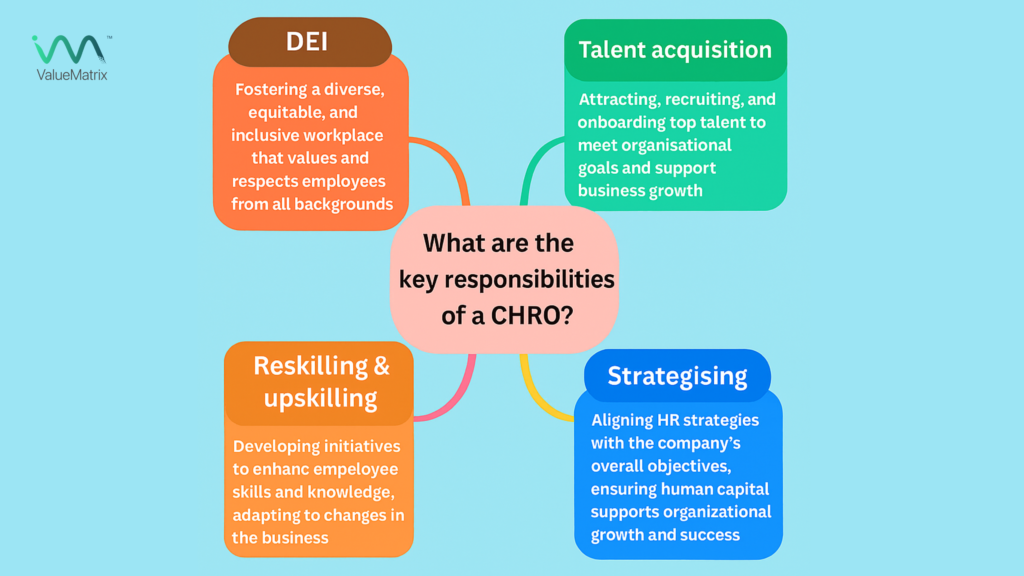
Talent acquisition
As mentioned earlier, people are the life-sustaining force of an organization. People create culture, not fancy offices, that’s why it’s important to hire and retain the right kind of people.
CHRO’s primary responsibility is to ensure the hiring strategy hits the bullseye; right from the job description messaging, screening, to onboarding.
AI brings a layer of complexity to the hiring process. As a CHRO, you’re responsible for seamlessly integrating AI into your existing ATS systems.
Diversity, Equity & Inclusion(DEI)
DEI was a metric companies used to show their allegiance to social justice, but that’s no longer the case.. Research shows a diverse workforce boosts innovation, creativity, and productivity.
So, it’s not just an ethical consideration, but a smart business decision for the organizations to give DEI its due weightage. And a CHRO’s job is to make smart business decisions for his company. Therefore, it becomes an important part of his job to ensure that a solid DEI hiring policy is being implemented.
This requires the CHRO to work in close quarters with the CEO. A later-stage DEI proposal is often discussed with the CEO, keeping in mind the company’s long-term strategic business planning and finances.
Since the advent of AI-based hiring, CHROs are required to coordinate with the backend teams to ensure bias-free hiring is taking place.
Reskilling and upskilling
ManpowerGroup’s “Global Talent Shortage” Survey revealed that employers are suffering from an acute scarcity of skilled workforce. The global average is 75% with some regions like Japan reaching as high as 81%.
This tells you the importance of not only retaining employees with the right skills, but also making the existing employees undergo necessary training programs to bring their skill set up to speed with current market trends.
As we know, hiring new skilled talent is a lot harder than upskilling the existing crop of talent.
Identifying skill gaps in the present workforce and training them for skills required in the future becomes an essential aspect of the CHRO’s job profile.And for that, he needs to discern where the market and technology trends are going, which skills will be desirable in the future, and which ones will be obsolete.
A CHRO needs to have great intuition and deep market knowledge to make these judgment calls.
Strategizing
A CHRO’s role goes beyond transaction duties. He is not your typical HR manager keeping a ledger of all the hiring and firing going on in the company. His role is to look at the big picture. Remember, he is a business partner, and he influences business decisions as well.
He architects the company’s work culture, productivity, and human capital and delivers performance.
Here’s how he impacts the business side of things in a company:
- By curating a positive work culture that is tailored to employees’ skills, he ensures his workforce has that ‘productivity edge’ over his competitors.
- By synchronizing the workforce with the long-term vision of the company, he ensures the long-term success of the company.
As seasoned HR leader Pratap G says in a talk with ValueMatrix:
“Companies write mission/vision statements then abandon them, losing employee connection within 2 years. Vision must be a living horizon—constantly updated and internalized through employee conversations, not static posters. Without this, normal employees cannot connect to organizational purpose.”
If the CEO designs the layout of where the company ought to be in the next 5-10 years, then the CHRO is a person who enforces that plan and makes necessary market-sensitive changes if required.
What are the Challenges of the role?
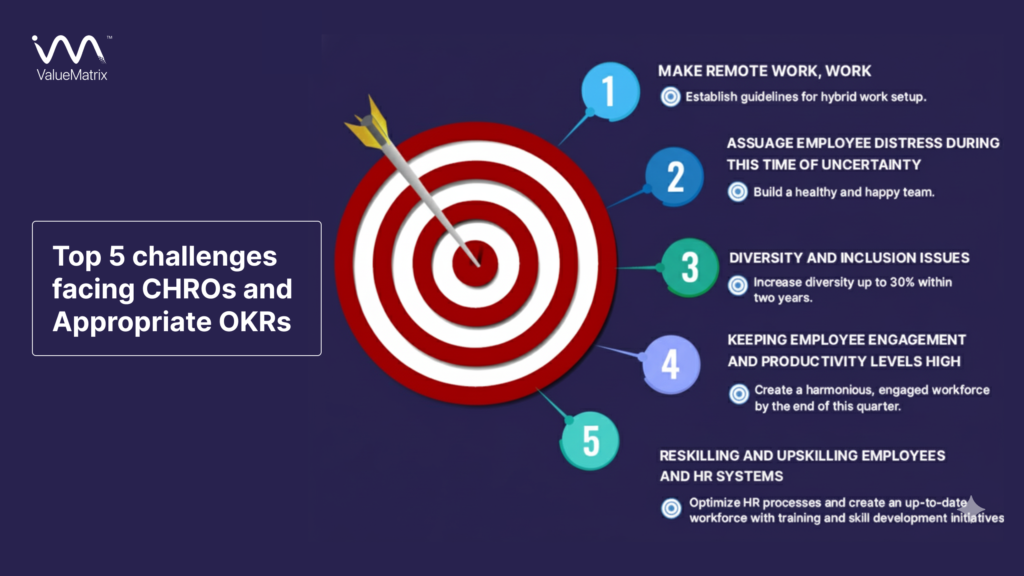
The role of CHRO comes with a tremendous amount of challenges. As we have discussed, a CHRO doesn’t keep a daily ledger of hiring and firing. His role also includes overseeing expansion, compliance issues, and implementing long-term vision.
Here are some of the challenges of the role.
Anticipating an ever-changing labour market.
The job market never stays static; it always ebbs and flows. There are times you’re drowning in resumes, and there are times there is a complete drought of worthy applicants for a position.
Gen Z has popularized the term ‘job hopping’, which means not being committed to a single company for your career growth. And looking at all the layoffs happening in the tech industry, it’s hard to blame them. Gen Zs think that if the company doesn’t show loyalty and drops them at the first sign of inconvenience, why should they be loyal to their employer?
Then you have certain events, trends, and zeitgeist-shifting movements that change the job market. People tend to hold on to their jobs during a downward market event like a recession or a pandemic, but people feel a little more adventurous during an economic boom.
So a CHRO has to feel the pulse of not just the market trends but the culture and zeitgeist, predict the upswings and downswings of the job market to plan his hiring strategy accordingly.
Oversees Expansion (Hiring culture-fit employees abroad)
Overseeing expansion is a very tricky thing to get right. It requires uncompromising coordination across C-suites. A CHRO becomes the most important piece of the puzzle. He has to factor in local labor practices like working hours and overtime rules, average industry salaries, leave policies, etc.
He also has a say in the locations for offices, selects cities for recruitment drives, and addresses a multitude of compliance issues that may arise.
Reworking The Hiring Pipeline
The hiring funnel needs constant monitoring and updates. The job market is dynamic; your funnel can’t be stagnant. It needs constant leak fixes and market-appropriate revisions. Sometimes you need to adapt to a new technology introduced in the hiring space, or there’s a new skill you need to recruit for. Your funnel needs to be sensitive to these shifts.
A CHRO’s job is to constantly examine the funnel for chinks and keep it up to speed with market trends and their own requirements.
Here are some of the ways a CHRO oversees a hiring funnel:
A CHRO examines drop-off points in a funnel, identifying which part of the funnel has the highest candidate bounce rate.
He convenes meetings with his HR manager and tries to figure out the reason behind it.
Builds and develops a robust internal pipeline. This does two things: boosts the loyalty of existing employees and saves a ton of money on training and onboarding/familiarization.
Coordinates closely with the backend to ensure that no bias has crept into the hiring funnel.
Hybrid/remote work
The 2020 pandemic ushered in a new reality for us: remote work.
When COVID hit the world in 2020, companies had no choice but to send employees home. We saw the remote work culture burgeon overnight. Before COVID-19, only 5-7% of the workforce worked remotely. That number shot up to 80% after the lockdown.
The big surprise was that it didn’t dampen the productivity of employees, but enhanced it. People actually enjoyed logging into work from their living rooms, avoiding the daily grind of commuting and dressing up. One more perk of remote work is that it saves companies a lot of money in rent and office setups
But this was a paradigm shift for CHROs as well; they now had to manage employees in a setting that was completely alien to them. And it was not a one-time adjustment, as remote work is here to stay.
Here are a few challenges that remote work has added to a CHRO’s roster:
He has to set up systems of technologies that enable remote workers to work and coordinate seamlessly with the main office, without any hindrance.
A CHRO has to ensure that the systems are robust and bug-free so that no sensitive data is leaked.
He has to maintain the work culture and ensure no in-group vs out-group sentiments arise due to this new arrangement.
Devise clear-cut remote work policies like clock-in in clock-out time, leaves for a smooth functioning.
What makes a good CHRO?
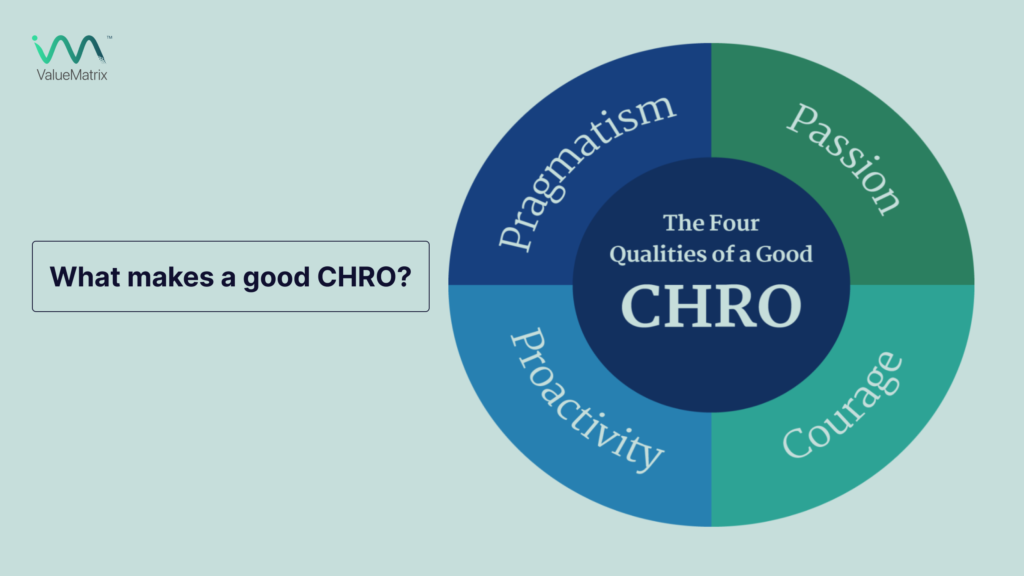
Now the question arises, who is considered a good CHRO? Someone who is hands-on, or someone who is a good delegator? Well, it depends on the type of industry you’re in and what your workforce responds to the best.
But one thing that’s indisputable is that a CHRO has to be an expert across domains to carry out his duties. That doesn’t mean he needs to hold degrees in these domains, but he must possess deep knowledge of different verticals that are relevant to his job.
A legal expert
A CHRO must understand laws around compliance, contracts, discrimination statutes, and working hours. Any kind of discrimination faced by candidates during the hiring process or post-onboarding can trigger lawsuits and tarnish reputations.
He also needs to constantly update the HR policies to accommodate any changes in the workplace regulations.
Misgendering an employee, exhibiting bias against a certain kind of disability, or excluding a community from your hiring process are solid grounds for class action lawsuits.
Google, Facebook/Meta, and Amazon have all faced discriminatory lawsuits in recent history. A CHRO’s job is to avoid that quagmire for his company.
A CHRO’s job isn’t to act as a legal attorney, but to be literate enough to recognize risks before they materialize.
Technology expert
Nobody expects him to be a technocrat, but he must have a keen eye for the latest technologies emerging in the HR world.
There has been a seismic shift in HR. It has gone from a form-filling administrative function to a data-driven system that deals with complex AI applications like predictive analytics and Applicant Tracking Systems(ATS).
He must have discerning eyes to know which aspects of HR work to automate and which ones to reserve for human expertise. The market is facing a slew of new technologies, and he must know which ones are game-changers and which ones are fads.
His job is not to be a software engineer, but to see the whole picture and decide which tools and applications will actually complement the organization and which ones will slow it down.
Human expert
Last but not least, he should be an ardent student of human psychology. He should learn what incentivizes his employees, and what dampens their spirit. He should indeed be fixated on upping the happiness quotient of the workplace, because happiness equals productivity.
A CHRO must have an empathy-driven, flexible approach to handling the human capital. He must realise that people are not inventory or equipment, they are complex individuals whose incentives aren’t always straightforward.
For example, salary might not be the reason for the high attrition rates of a company.
Amazon offers the best case study for this situation. During 2018-2022, Amazon suffered extremely high bounce rates among its warehouse employees. The company responded by increasing the hourly pay above the industry standards. They expected to put a lid on the situation, but the result was that bounce rates still remained high.
Money wasn’t the problem; low psychological safety, low workforce morale, and workplace toxicity were.
Now the question arises, who is considered a good CHRO? Someone who is hands-on, or someone who is a good delegator? Well, it depends on the type of industry you’re in and what your workforce responds to the best.
But one thing that’s indisputable is that a CHRO has to be an expert across domains to carry out his duties. That doesn’t mean he needs to hold degrees in these domains, but he must possess deep knowledge of different verticals that are relevant to his job.
What are some myths about the role?
- CHRO is the head of HR, and not an executive
CHRO is absolutely an executive-level employee. The “C” stands for chief.
He sits at the big table, along with the CEO, CFO, and COO. He is very much involved in high-level strategizing and planning.
Why this myth persists?
CEO and CFO positions were defined in the early to mid-20th century, with emerging conglomerates like General Electric, Ford Motor Company, and IBM.
Comparatively, the position of CHRO is a late arrival. In the 1980s, you had an HR manager at the helm of affairs, who mostly looked over administrative affairs.
It was only in the 2000s that the CHRO role was introduced. When more and more companies started embracing culture-fit as a concept and started taking high attrition rates very seriously..
So modern CHROs are strategic business partners, and they exert influence in every executive-level decision from mergers, acquisitions, expansions, to new technology assimilation.
- CHRO is always an internal hire
This is far from the case. Due to the position being fairly new, many companies haven’t built a strong internal pipeline for succession of CHROs. This is reflected in the fact 84% of CHROs are external hires.
But there could be other reasons for companies opting for external hires:
During major business transformations
When your organization is going through some major business model changes, you might need a CHRO who has a track record of heading organizations through similar transformations. If it’s an entirely new space your company is moving to, chances are your existing team might not have the requisite experience.
When leapfrogging is required
If you want to implement a new paradigm, let’s say AI, it’s better to recruit a person who has expertise in executing these changes in organizations rather than wasting years trying to build homegrown talent.
- If your company is going public
A growing number of companies that are filing for IPO are also jettisoning CHROs from outside. They want people who have experience in preparing companies for the public listing.
- CHRO usually comes from an HR background.
You’d think that because CHRO is the director of HR, he’d be required to have a major in HR. That’s not the case; only 15% of the CHROs come from HR majors.
CHROs come from a wide range of fields, like business, psychology, finance, marketing, political science, etc.
A report published by the joshbersin company revealed that Political science majors make the most impactful CHROs, while language and business majors make the least impactful ones.
A case for NON-HR business CHROs.
A CHRO is a business executive first and an HR leader second. That is why you see people from consulting or IT backgrounds having such massive impacts in their roles as CHROs. That is because they bring their domain expertise to the CHRO role and can bring out-of-the-box solutions to problems like talent acquisitions, AI adoption, or mergers.
Conclusion
A CHRO is now among the top 5 highest-earning executives, and it is not without reason. CHROs have a lot on their plate; they are responsible for the adoption of new HR technologies, purveyors of work culture, and arbiters of human conflict.
The elevation of their role to C-suites tells us how important their role has become. Any business decision you make, whether it’s expansion, mergers, or acquisitions, you’re ultimately talking about people and their movement. There is no greater capital to a business than human beings; that’s what makes their job so important.
As perfectly summed up in this quote: “I am convinced that nothing we do is more important than hiring and developing people. At the end of the day, you bet on people, not on strategies.” – Lawrence Bossidy
FAQs
Yes, an increasing number of companies are blending rigid roles and recruiting people for their cross-departmental expertise. For example, the CHRO of Australian real estate giant REA Group also oversees employee communication and environmental, social, and governance (ESG) responsibilities.
Loren Shuster, CHRO of the LEGO Group, also helms the company’s corporate affairs, including public relations, government affairs, ESG, and communications.
Yes, CHRO works closely with the HR manager. He tracks the workforce morale through indicators such as attrition rates, engagement with training modules, or new policies. His ears are a little closer to the beating heart of the organization than a CEO’s.
GENZ constitutes 27% of the workforce, and they are a little different from their predecessors, the Millennials. Gen Zs value personal growth over loyalty to a company, which means that the retention rates might be on the higher side with this generation.
Also, companies all over the world are pushing for better candidate experience in their hiring funnel was a direct result of GEN Z’s presence in the workforce. A report suggested that approximately 75% of Gen Z job applicants abandon their job application if the hiring process is too slow.
About Us
ValueMatrix is an AI-powered talent intelligence platform that helps companies hire better, faster, and without bias. We go beyond resumes to assess skills, behavioral traits, and cultural fit using advanced AI and proven psychological frameworks. Our platform delivers data-driven insights that improve hiring accuracy, reduce time-to-hire, and elevate candidate quality.
ValueMatrix AI enables hiring teams to make confident hiring decisions and build high-performing teams at scale.