
Table of contents
- Beyond the 9-Box Grid
- 1. From Gut Feeling to Data-Driven Precision: The AI Identification Shift
- 2. Skills-Based Succession: Mapping Capability over Tenure
- 3. Predictive Pipeline Analytics: Foreseeing Leadership Gaps
- 4. Hyper-Personalized Leadership Journeys: Developing the Next Gen
- 5. Bias Mitigation: Surfacing the “Quiet” Future Leaders
- 6. Strategic Workforce Simulation: Testing Your Bench Strength
- 7. The Agentic Impact: Succession Planning for Human-AI Teams
- 8. Knowledge Transfer 2.0: AI-Powered Institutional Memory
- 9. Horizontal Succession: Cross-Functional Agility as a Shield
- 10. The Chief AI Officer (CAIO) Pipeline: A New Executive Frontier
- 11. Real-Time Bench Strength: Monitoring the “Ready Now” Pulse
- 12. Cultural Continuity: AI Analysis of Leadership DNA
- 13. Fractional Successors: Integrating External Elite Talent
- 14. Succession for the “Hollow Middle”: Solving the Junior Gap
- 15. Intergenerational Reverse Mentorship: Bridging the Digital Divid
- 16. AI-Augmented Board Governance: Testing Management Assumptions
- 17. The Ethical Audit: Ensuring Algorithmic Fairness in Leadership
- Summary Table: AI Succession Planning Roadmap 2026
- Statistics: The Power of AI-Driven Pipelines
- FAQs
Beyond the 9-Box Grid
The year 2026 will witness the introduction of a data-driven Skills-First architectural system. This will replace the conventional leadership development approach that is based on manual spreadsheet operations and its vulnerability to personal bias. Succession planning with AI functions is the essential mechanism that enables organizations to maintain their operations. Because it transforms from scheduled annual procedures to continuous organizational processes. Organizations can now use predictive analytics together with talent intelligence to discover high-potential candidates who meet objective competency standards. Together with learning agility requirements that exceed their basic work experience and professional connections.
The primary reason for this transformation is that enterprises use AI to help in succession planning to discover hidden talent across all organizational positions. Autonomous systems use their capability to assess performance data and project results together with skill connections to identify diverse leaders who would typically remain hidden from view. Succession planning AI enables Growth Managers to create organizational orchestration roles that automatically identify missing skills through gap analysis to develop individual development paths. The organization maintains its leadership pipeline, which will succeed in supporting its operations through both autonomous and hybrid work environments, which will emerge in 2027 and later.
1. From Gut Feeling to Data-Driven Precision: The AI Identification Shift
Succession planning has not always been spared from proximity bias, with leaders choosing successors who look and act exactly like themselves. Talent intelligence platforms with AI capabilities now evaluate employees based on objective “Success Profiles.” AI is finding high-potential people who may have been ignored by traditional management hierarchies by analyzing data from project successes, peer reviews, and even cross-functional collaborations.
In 2026, by using Natural Language Processing (NLP), HR could find successors in seconds just by searching on terms like “strategic orchestrators” or “crisis-ready managers”, rather than simply filtering by job title. It removes the “visibility trap, which considers only the most visible employees for promotion. Evidence says the provision of AI-skills-mapped profiles could save up to 95% on the time to set up profiles manually, allowing HR to devote time to the human side of leadership development.
2. Skills-Based Succession: Mapping Capability over Tenure
The most critical trend by 2026 is the move from a Job-Titling way of succession to “Skills-First” succession.
According to Deloitte, organizations that focus on skills-based transitions are 63% more likely to achieve successful leadership shifts. AI tools create dynamic “Skill Graphs” for every employee, allowing HR to see who possesses the raw competencies (like strategic thinking or change management) required for a C-suite role, even if they currently work in a completely different department.
This would help keep down “Talent Hoarding,” the tendency of managers to block the brightest employees so that they get an opportunity. AI schemes create an open marketplace for skills across the organization and increase Internal Mobility. By 2026, the best-performing firms are using AI to identify “Skill Adjacencies”: for example, recognizing that a leading software architect may already possess most of the leadership attributes required of a Head of Product.
3. Predictive Pipeline Analytics: Foreseeing Leadership Gaps
AI does not only tell who is ready now; it also predicts who may be ready in 24 months and who is most likely to leave.
“Flight Risk” scoring has become an essential component of AI succession planning. By analyzing patterns of engagement, sentiment in a 360-degree view, and market demand for certain skills, AI alerts HR to a prospective leadership gap well before it occurs. This allows Growth Managers to put in extra momentum to prepare a successor or to implement a “Stay Strategy” for the current leader
The predictive models enjoy an accuracy rate of 85% in assessing the probability of departure months in advance. 2026 will also see the simulation of the impact, or the “ripple effect,” of such a departure: choosing how one’s exit could destabilize three other departments. That leads to strategizing interventions with trimming of the risks.
4. Hyper-Personalized Leadership Journeys: Developing the Next Gen
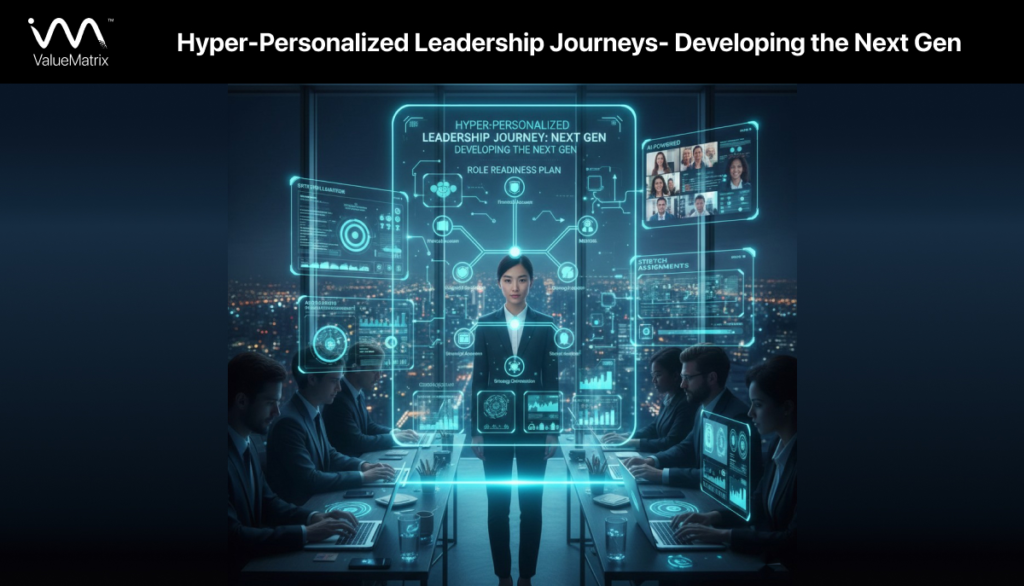
AI-driven platforms now build Role Readiness plans. If an AI detects that a candidate lacks Financial Acumen, it schedules micro-learning modules, matches the candidate with a mentor strong in that area, and assigns “stretch assignments” that will enable the candidate to develop that skill through work experiences.
By 2026, AI-powered Mentorship (such as that from Qooper) would be using matching algorithms to find suitable matches between aspiring leaders and mentors worldwide. These platforms not only track mentorship pairs’ progress but also track skills acquired to ensure that the successor’s journey is not just a chance but a measurable and data-backed step toward “Ready Now.”
5. Bias Mitigation: Surfacing the “Quiet” Future Leaders
Unconscious bias is a silent killer of diverse leadership pipelines flowing through the veins of organizations.
AI in succession planning creates an even playing field, giving little mind to pedigree, where someone went to school, and more focus on potential. AI uses certain objective assessment criteria to surface someone the industry would work within contextual parameters as a “Quiet Leader”. This means an individual having astoundingly high competence for the organizational culture that the person chooses to remain under the carpet, yet actually carries the conduct of leadership traits apt for a decentralized workforce of the modern world.
2026 Ethical Governance offers an impartial assessment. As organizations try to comply with laws, for instance, the EU AI Act, they need to prove that their leadership selections are based on verified competencies rather than demographic parameters. AI helps well in standardizing that evaluation, bringing about a “Candidate Bill of Rights” that makes it easier for any high performer who has a good shot at the C-suite.
6. Strategic Workforce Simulation: Testing Your Bench Strength
What’s important in the world of HR in 2026 is that they will be able to stress-test their succession plans using such technology as Work Force Digital Twins. Suppose, for example, that your CEO took early retirement and the top 3 successors were headhunted by a competitor. You can execute an AI simulation of what-if scenarios, narrowing down exactly where your pipeline is brittle and where you need to build more bench depth. Thus, your organization can withstand the extremes of volatile market conditions.
80+ realistic scenarios can be done in less than 48 hours by these simulations, while human teams would spend months trudging through the work. By modeling the effect of external conditions, in this case, an economic downturn or competitor’s aggressive hiring, HR could ensure that its ”Leadership Bench” could survive the worst storm through simulations.
7. The Agentic Impact: Succession Planning for Human-AI Teams
The leaders of 2026 are not just managing people but are also managing “Human-AI Hybrid Teams.”
AI identifies candidates with “AI Fluency,” the ability to conduct an autonomous agent and decide ethically in the times of technology saturation. Where succession planning formerly involved finding the right “manager,” it has now become finding the right “orchestrator,” the one who is capable of directing a workforce in which 30 per cent is realized through digital labor.
Traditional assessments of leadership often do not pick this up. By 2026, succession planning tools will use Leadership Simulations, gamified environments wherein candidates must manage a crisis involving both human team members and AI agents. This provides a real-world look at how a future leader balances technical logic with human empathy.
8. Knowledge Transfer 2.0: AI-Powered Institutional Memory
Leadership transitions risk losing the institutional ”tribal knowledge,” the biggest risk in leadership transitions.
AI has made it the norm in 2026. It forms a ”Knowledge Persona,” which can then be queried by the successor in the first 90 days, just by capturing the decision-making patterns, summarizing the meetings, and putting together the notes for what’s being worked on by a departing leader. Summarizing both prior and reflective times gone by in this ”Digital Shadowing” smooth transition. Instead, with AI, the new leader can instantly uncover the context of previous significant strategic pivots or key client relationships. This reduction in ”Time-to-Value” for new executives means an impact on the organization starting the first week in office.
9. Horizontal Succession: Cross-Functional Agility as a Shield
Instead of vertical pipelines, organizations are now building connections through “Horizontal Succession Networks” to increase flexibility.
By 2026, AI models will be capable of identifying leaders capable of stepping comfortably into more than one department. For example, the AI might indicate that your Head of Marketing has the operational and data skills to serve as a successor for the COO. This type of cross-pollination removes siloed leadership to form a much more versatile executive team.
By encouraging the job rotations identified by AI, companies build ”Change Fitness.” One study claims that cross-functional leaders are about 30-40% more effective than their counterparts brought up in silos in complex operations. AI facilitates this through the suggestions of “lateral leaps” that “future leaders” undergo to prepare them for the larger context in which steering a global enterprise in 2026 will be required.
10. The Chief AI Officer (CAIO) Pipeline: A New Executive Frontier
It’s one of the newest critical roles that emerged in 2026, the Chief AI Officer.
Succession planning will have to include this role because of its specific focus within the C-suite. Tools will help companies identify individuals internally who have that rare combination of deep technical knowledge in data science and credibility at high levels in business strategy, in identifying internal candidates for this extremely competitive role of CAIO. With the hyper-competitive CAIO market, identifying and grooming internal talent for this role 18 to 24 months in advance is now a board-level priority.
Currently,78% of AI-leading organizations have already established a formal CAIO position or a dedicated AI governance committee. Talent intelligence should help HR find the ”All-Around Athletes,” those who are AI-forward enough to manage agents but grounded enough to lead a diverse human workforce.
11. Real-Time Bench Strength: Monitoring the “Ready Now” Pulse
Quarterly reviews, earlier time-consuming and static, have now been replaced by a “Ready Now Pulse” dashboard.
In 2026, Growth Managers will be able to monitor in real time the ”Bench Strength” for the whole organization. In cases where an underperforming key successor has decreased engagement, the AI triggers an immediate ”Retention Alert” to alert the leadership about a pattern that is flagged for mentorship or a new challenge before it damages the pipeline.
Real-time has shifted the succession from defense to attack. Now, organizations can bet on megaprojects or new market entry without worrying that the leadership bench is not ready because they have data-backed assurance that they are ready. By 2026, “Bench Utilization” will be as important a metric as revenue or profit margin.
12. Cultural Continuity: AI Analysis of Leadership DNA
Succession planning concerns not just competencies, but the process of passing on “the Cultural DNA” of the organization through transitions.
In 2026, AI sentiment engines will analyze the soft signals about contemplated leaders-how they talk, how they resolve conflicts, how they embody core values in Slack or Teams. This ensures that the anointed successor will truly align with the unique culture of the company, thereby preventing the organ rejection that so often occurs due to discrepancies in the style of the new leader and the well-established team.
It requires much to go beyond some errant buzzwords: What it shows is that AI can pick up distortions of “Psychological Safety” in the leader’s department, proving thereby that he/she achieves results not with the sword but by empowering his/her people. Thus, in 2026, “Cultural Fit” is no longer just a fuzzy feeling but a measurable data point that ensures long-term stability of leadership.
13. Fractional Successors: Integrating External Elite Talent
The development of the Fractional Executive has, in turn, created a new category: The Fractional Successor.
In 2026, Growth Managers utilize AI to identify specialized external consultants who could operate as Emergency Successors on a fractional basis. If suddenly a critical C-suite leader exits, a fractional expert can join within 48 hours to create strategic momentum while their internal successor completes his/her readiness track.
This model serves as a safety net for the internal pipeline. AI marketplaces will match your organization with fractional leaders who have dealt with similar crises in your specific industry. This protects the internal successor from being thrust into a role before they are prepared, thus safeguarding both the individual and the organization from poor performance.
14. Succession for the “Hollow Middle”: Solving the Junior Gap
While AI is automating the lower end, the HR department must promote AI to take early detection of the “Hidden Leaders” to avoid the collapse of the middle management.
With many of the middle management positions expected to be eliminated by robot automation by the latest 2026, the succession plan must be drawn from higher levels of the organization. AI should seek out high-potential Individual Contributors early in their careers, fast-tracking them into leadership labs in order to avert the complete hollowing-out of the executive bench in the next ten years.
By “deep-bench” succession, every employee of the organization has an equal chance of working as a leader from day one. By 2026, AI is being tapped to simulate the leadership requirements of the firm over a period of ten years to push HR to be, from the onset of anybody’s career. This helps in targeting “Leadership Agility,” irrespective of the position.
15. Intergenerational Reverse Mentorship: Bridging the Digital Divid
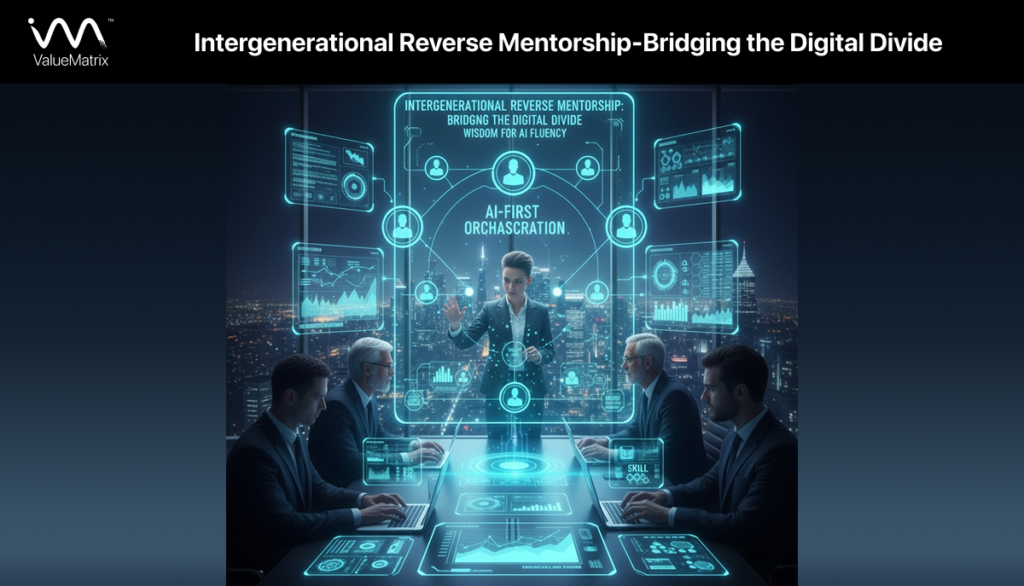
As the Baby Boomers and Gen Xers rotate out of senior roles, AI facilitates the bi-directional knowledge flow. AI matching algorithms pair senior executives with Gen Z and Millennial “digital natives” to trade institutional wisdom for AI-first technical orchestration. This allows the successors not only to learn “how things are done,” but also for the current leaders to learn “how things will be done.”
That intergenerational bridge eases friction in the succession process. By 2026, AI platforms will be tracking how effective these pairs are, while also nudging the two toward specific growth goals. This dynamic of reciprocal learning not only prepares the successor but keeps the senior leader engaged and valued in their last years at the company, preventing further establishment of knowledge silos before retirement.
16. AI-Augmented Board Governance: Testing Management Assumptions
In 2026, Boards of Directors use AI “Directors” to question management’s proposal for succession.
In 2026, board governance advanced from passive oversight to active stress-testing. The Board, using autonomous agents, is able to independently verify the readiness of a CEO’s proposed successor against external market benchmarks and internal-performance metrics. This adds an extra layer of impartiality against favoritism or bias while meeting shareholders with data objectivity.
Boardroom AI works tirelessly as an analyst to prompt follow-up actions and highlight potential risks in the pipeline that management may tend to downplay. By 2026, the conduct of a Directors’ Audit of the succession plan would be just as routine as the satisfaction of an annual financial audit. This is developing a culture of transparency, where every leadership decision is seconded by a validated simulated success model.
17. The Ethical Audit: Ensuring Algorithmic Fairness in Leadership
As the EU AI Act is in full enforcement, the year 2026 succession planning does anticipate a rigorous Ethical Audit.
Now organizations must prove that their AI-powered leadership pipelines do not perpetuate historical biases and do not exclude protected groups. Fairness Guardrails are the measures established by companies to defend their ethical code of conduct and their algorithms from unethical practices, while assessing potential candidates without creating undue favoritism toward a demographic group. This is not just a legal necessity; it’s part of tactical thinking in bringing together a diverse and robust C-suite.
It is a fact that Explainable AI is going to be the norm in human resources technology by 2026. If a candidate is found to be in the status of Not Ready, the system should describe to that candidate the reasons, data-backed, that can be used to improve illumination. This is building a feedback loop, which is growth-focused and cultivates systemic trust. Leaders who have ethical, transparent values in their work find their teams more engaged and believe that the promotion processes are fair.
Summary Table: AI Succession Planning Roadmap 2026
| Phase | AI Capability | Strategic Outcome | Primary Source |
| Identification | Talent Intelligence & Skill Graphs | 8.2x increase in candidate pool visibility. | Phenom 2026 |
| Development | Personalized Mentorship & Nudges | 30% reduction in manual development planning. | Qooper AI |
| Risk Mgmt | Flight Risk & Bench Depth Scoring | 85% accuracy in predicting leadership gaps. | Gartner 2026 |
| Cultural Fit | Behavioral Sentiment Analysis | 40% lower leader turnover post-transition. | Darwinbox 2026 |
| Governance | Board-Level Risk Simulation | 100% verification of successor readiness. | Korn Ferry 2026 |
Statistics: The Power of AI-Driven Pipelines
- Accuracy: AI-powered identification of high-potential individuals is 95% accurate, compared to only 52% for human-only processes. (Source: Bernard Marr)
- Revenue Impact: Tech-savvy leaders—identified and groomed by AI—drive firms with 8.7% annual revenue growth, versus 3.2% for others. (Source: Korn Ferry)
- Efficiency: AI can reduce implementation time for succession systems from weeks to mere hours through auto-mapping. (Source: Darwinbox)
- The Readiness Gap: While 78% of firms have a process, only 9-22% have integrated AI for real-time succession readiness. (Source: HRKatha / Korn Ferry)
FAQs
It measures “Development Velocity,” or the speed with which an employee learns and applies skills, considered a much stronger predictor for the success of leaders as compared to tenure.
Definitely! The AI dashboard gives an instant scoring of your ‘Emergency Fitness’, which shows up the roles for which one has very little depth, and allows planning for mitigation before a crisis strikes.
The leading tools in 2026 will be using the Fairness Auditing Metrics. They routinely test the algorithm against Demographic Parity: It checks whether it favors certain groups against others as per historical data.