

Key Takeaways
- Companies that maximize ROI on workforce earn 300% more revenue per employee than others (McKinsey Research, 2024).
- Amid massive technological changes, 35% of global employees need reskilling.
- AI-driven workforce planning enables companies to stay ahead in the talent market.
- AI tools support planners with real-time data, predictive analytics, and scenario planning.
- Companies must choose AI platforms that align with their business objectives.
Korn Ferry projects the global skilled workforce shortage to cross 85 million by 2030. Workforce shortage of this scale means organizations need to plan their requirements years in advance: strategic workforce planning (SWP), spanning three to five years, enables them to stay ahead. Indeed, a McKinsey report shows that most companies ahead in the talent race are using SWP. Yet, McKinsey’s HR Monitor 2025 found that while 73% of organizations conduct operational workforce planning, only a small percentage (such as 12% in the US) are doing multi-year planning — a gap that AI-driven workforce planning tools can close.
What Are Workforce Planning Tools?
Workforce planning tools are software platforms that align talent with business objectives. They enable organizations to predict future talent requirements and prepare a long-term strategic hiring, skilling, and reskilling plan. In short, these tools support HR teams in workforce planning with data and insights. But what is workforce planning?
Workforce planning is a long-term (typically three to five years) strategic plan to place the right people in the right positions, and at the right time. Businesses use forecasting and analytics tools to foresee future skill requirements and identify gaps.
Typically, workforce planning tools include:
- Spreadsheets and manual planning tools, such as Microsoft Excel, for forecasting and headcount planning. HRs manually collect and feed historical data into these spreadsheets.
- Human resource information systems (HRIS) are centralized databases of employee information, such as job roles, compensation, and experience.
- Enterprise resource planning (ERP) systems integrate workforce information with finance, operations, and business planning.
- Workforce management software focuses on scheduling, attendance tracking, and utilization.
Traditionally, workforce management focused on day-to-day operations, without much emphasis on future requirements. However, technological advancements have necessitated organizations to shift their approach from reactive hiring to proactive skill development. In this scenario, AI workforce planning tools gained traction.
AI-driven workforce planning tools
AI platforms like ValueMatrix support workforce planning by providing insights. They combine historical and real-time data, predictive analytics, market demand, and workforce shortages to forecast talent requirements.
- Machine learning (ML) algorithms process large datasets to predict future trends.
- Natural learning processing (NLP) analyzes job descriptions and resumes, thus automating resume screening and candidate shortlisting.
- Generative AI supports employee skill development by designing personalized training programs based on each individual’s skill gaps and career goals.
A study, Leveraging Predictive Analytics for Workforce Planning, Succession Planning, And Organizational Development, observes that companies can achieve significant improvement in workforce behavior through AI planning strategies. It states, “Through the application of these methodologies (historical data, algorithms, and machine learning) in human resources, firms can discern trends, foresee potential dangers, and execute proactive measures to enhance personnel management.”
What Are The Drawbacks Of Traditional Tools?
The traditional workforce tools were largely based on historical data. Moreover, they depended on manual inputs and time-consuming processes with limited predictive capabilities. In short, the tools were surely an upgrade from the previous paper-and-pen system, but are inadequate to meet modern workforce requirements.
Traditional tools rely on historical workforce data, which enables them to make reactive decisions, but don’t support proactive planning. Limited predictive capabilities identify workforce trends but cannot foresee talent gaps and skill requirements.
Data collection, consolidation, and analysis require manual effort, with HR teams spending more time on preparing reports than on strategic initiatives. Manual work usually poses an increased risk of human error.
According to the IBM Institute for Business Value, historically, 6% of the workforce needed reskilling, but that has increased to 35%, or over one billion employees worldwide, in 2024. Reactive training and HR practices cannot meet such large-scale reskilling requirements, making it necessary for organizations to adopt a predictive approach. Companies implementing AI-powered tools have an edge over others. Let’s see how:
| Area | Traditional Workforce Planning Tools | AI-powered Tools |
| Data analysis | Historical | Real-time and predictive |
| Forecast | Manual estimates | AI-driven forecasting |
| Skill analysis | Limited | Automated identification of gaps |
| Decision support | Descriptive reports | Data-based insights |
| Efficiency | Time-consuming | Highly automated |
| Workforce insights | Reactive | Proactive |
What Are Some Key Features Of AI-Enabled Workforce Planning Tools?
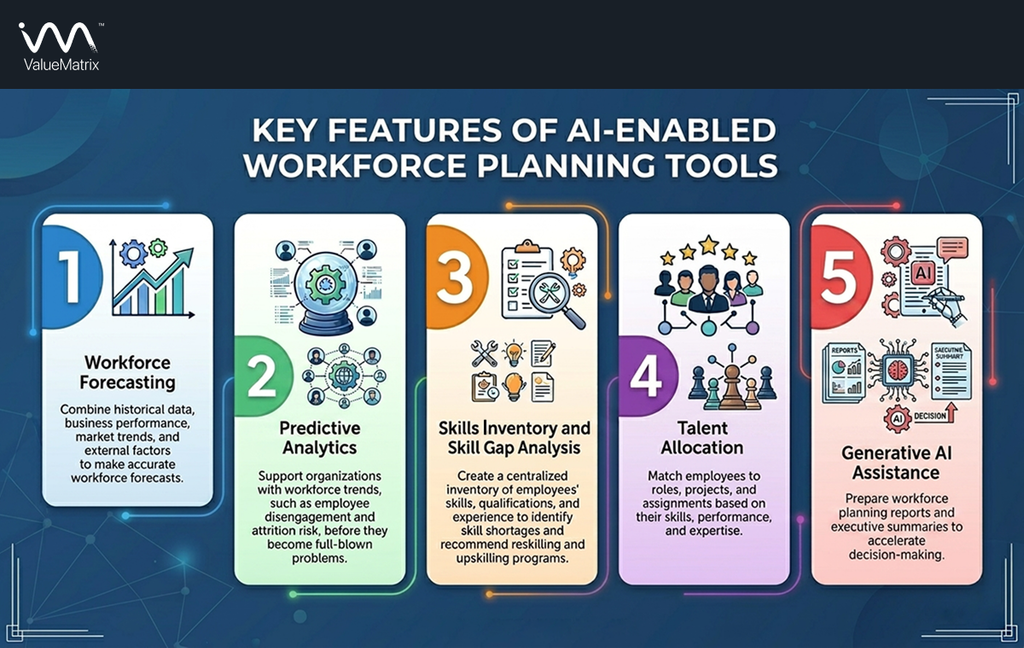
Predictive analytics, machine learning, real-time data, and skill gap analysis are some of the prominent AI features. These critical features help organizations build an agile and future-ready workforce.
Workforce forecasting
AI-powered tools combine historical data, business performance, market trends, and external factors to make more accurate workforce forecasting than traditional tools. It accounts for fluctuations and shortages in workforce demand.
Example: In a retail company with multiple branches, a traditional workforce tool may recommend staff hiring based on past trends. But AI tools consider factors, such as historical sales performance, local market trends, e-commerce behavior, and seasonal shopping patterns, to estimate the workforce needed in a given branch and whether staff members can be deputed from a low-demand store to a high-footfall branch.
Predictive analytics
Organizations can identify workforce trends, such as employee disengagement and attrition risk, before they become full-blown problems. Businesses can be proactive in workforce optimization through data-driven recommendations.
Example: A tech company uses predictive analytics to identify employee engagement and performance trends. The system flags that software engineers with certain characteristics are more likely to leave within a year, enabling the HR teams to take timely measures to retain those employees.
Skills inventory and skill gap analysis
AI tools create a centralized inventory of employees’ skills, qualifications, and experience, providing visibility into workforce capabilities. The systems compare the existing capabilities with future business needs to identify skill shortages and recommend reskilling and upskilling programs.
Example: A manufacturing company plans to adopt automation technologies. Its AI-enabled workforce planning tool assesses the current workforce capabilities vis-à-vis the tech skills needed for future advancements. The analysis reveals a shortage of robotics and automation experts, enabling the company to launch training programs.
Talent allocation
AI matches employees to roles, projects, and assignments based on their skills, performance, and expertise, enabling businesses to optimize workforce allocation across teams and locations. This improves productivity while reducing worker shortage.
Example: A consulting firm receives a new project that requires experts in cloud computing, data analytics, and cybersecurity. The AI workforce planning tool analyzes employee skills, qualifications, and experience to allocate the right employees to the new project.
Generative AI assistance
Gen AI can assist HR teams by preparing workforce planning reports and executive summaries, thereby accelerating the decision-making process. It can also be used to create an interactive interface to answer common employee queries on HR policies and facilities.
Example: An HR team wants to know the biggest workforce risks for next year. Gen AI assistant analyzes workforce data and prepares a summary of projected skill shortages, high turnover risks, and recommended actions.
In addition to these features, AI-driven workforce planning tools support various workforce-related functions, such as:
- Scenario planning by simulating different business scenarios and workforce outcomes.
- Real-time workforce analytics through live dashboards and intelligent reports.
- Balance workforce demand and supply effectively.
- Detect patterns that may indicate attrition and recommend retention strategies.
- Integrate HR and business systems, such as HRIS, ERP, payroll, recruitment, learning management, and performance management systems.
Benefits Of These Features
Research published in the Journal of Work-Applied Management has found that AI is predominantly useful in “five dominant themes: demand forecasting, workforce scheduling, skill gap analysis, recruitment and employee retention.” The study says, “Across these areas, AI enhances predictive accuracy, resource allocation and organizational flexibility.”
| Feature | Business Benefit |
| Predictive analytics | Early risk identification |
| Skills gap analysis | Better workforce readiness |
| Scenario planning | Improved strategic planning |
| Real-time analytics | Faster decision-making |
| Talent allocation | Higher productivity |
| Generative AI | Faster planning and insights |
How To Choose And Implement AI-driven Workforce Planning Tools?
Organizations must choose workplace planning tools that align with their long-term business objectives. Business alignment, data quality, integration readiness, and user acceptance are a few features companies consider when choosing the tools. The right tools implemented in a planned manner will yield the expected result.
Identify the need for workforce planning tools
Why do you need the tools? What challenges do you want to solve using AI functions? Understand the requirements before going further with the selection process. Establish measurable goals before evaluating the tools, such as their capability in workforce forecasting and succession planning.
Assess current workforce systems
Review the current HR, payroll, and learning & development tools. Assess the quality and completeness of employee data, and analyze whether data gaps can impact the accuracy of the AI tools.
Evaluate AI tools
Compare the capabilities of different tools. Choose a tool that closely aligns with your business objectives.
- Check for features such as predictive analytics, skill gap analysis, and scenario planning.
- Ensure the tools can be integrated with HRIS, payroll, and other existing systems.
- Evaluate the tools’ flexibility and scalability features that support future expansions.
ValueMatrix’s advanced algorithms provide accurate forecasts, and personalized technology ensures detailed data-driven insights. The AI-ML solution can be seamlessly integrated with the existing HR systems.
Prepare workforce data for AI implementation
Set data quality standards for deployment. Clean up the existing data by eliminating outdated, biased, and inaccurate information. Establish practices to maintain data accuracy and authenticity.
Conduct a pilot program
Before scaling the tools across the company, try them in a department or a business unit. Test whether the tools’ capabilities are meeting your requirements. Take feedback from employees, managers, and the HR team on forecasting usability, accuracy, and AI recommendations.
Establish data governance and AI policies
Define standards for data collection, storage, access control, and usage. The policy must be transparent about what data is collected and how it is used to gain employee trust. It should explain what role AI will play in workforce planning and how AI-generated recommendations will undergo human review.
Train HR teams and business leaders
Provide training on interpreting AI forecasts and workforce planning analysis, and understanding AI recommendations. The stakeholders need to know the AI tools’ capabilities and limitations so that they can optimize their use.
Once AI-driven workforce planning tools are implemented, monitor their accuracy, quality of recommendations, and efficiency. Continuously upgrade the data quality and work with the vendor on AI updates.
Going the AI way is the next step in workforce planning, with adopters reaping higher benefits than the organizations that stick to traditional methods. However, businesses must note the likely challenges posed by AI. Algorithmic bias, data privacy, and employee trust are a few concerns that business leaders must address while implementing AI.
Companies need to design an AI governance policy that ensures early and continuous employee involvement, investment in reskilling and continuous learning, and transparent communication about AI use, to enable the harmonious integration of these systems.
FAQs
- Why are workforce planning tools important?
Workforce planning tools enable organizations to forecast future requirements by identifying skill gaps and business objectives. They optimize resource allocation and enable the management to make informed decisions.
- How are AI-powered workforce planning tools different from traditional tools?
Whereas traditional tools primarily use historical data and manual comparison and analysis, AI-driven tools have capabilities such as predictive analytics and scenario planning, talent integration, and skill gap analysis. Such features make AI tools more competent and accurate than traditional ones.
- How does AI improve workforce forecasting?
In addition to historical data, AI analyzes business trends, organizational goals, employee turnover trends, and market conditions to predict future staffing needs.
- How do AI workforce planning tools identify skill gaps?
AI-enabled tools maintain a skill inventory. They use the inventory to compare the current workforce capabilities with future business requirements to identify skill gaps. They don’t just identify the gaps but also make recommendations to upskill employees to fill them.
- What is scenario planning in workforce planning?
Scenario planning involves visualizing workforce requirements in business situations, such as expansion, merger, or economic downturn. It allows organizations to plan their hiring, skilling, and learning & development programs based on future needs.
- Do workforce planning tools help in employee retention?
Yes, AI tools can identify the employees at risk of leaving, triggering the HR team and managers to take proactive retention or succession planning measures.
- Are AI workforce planning tools suitable for small businesses?
Yes, the tools help avoid excessive hiring and ensure optimal utilization of the existing resources. At the same time, they provide insights into future workforce and skill requirements for small and medium businesses to expand.
- What data do workforce planning tools use?
AI tools typically use data from HRIS, payroll systems, recruitment platforms, performance management software, learning systems, and workforce analytics platforms.
- What are the challenges in implementing workforce planning tools?
One of the biggest challenges is gaining employee trust as the AI tools collect large amounts of data. Employees may raise privacy and data security concerns. Additionally, systems integration, poor data quality, and inadequate training can be challenging.
- How long does it take to implement workforce planning tools?
Implementation depends on the organization’s size and the scale of HR operations. It can take from a few weeks to several months, including integration and training.