
Table of contents
Talent Intelligence in Hiring
2025 was a gear-shift moment for Talent Intelligence in the hiring space. We saw companies implementing advanced forms of predictive analytics, an aggressive push towards end-to-end automation, and recruiters talking about enhancing candidate experience.
But it didn’t start that way; in fact, the early stages of AI were virtual file cabinets. They were so rudimentary in their application that, in many cases, it was unfair to call them AI.
For example, the resume parsing technology, circa 2018, could read only a narrow lane of words and formats. So if a poor job applicant worded his resume differently, it would be tossed in the virtual bin by these AI bots. These systems scorned diversity because it made their job tougher.
Then came the age of accessible Artificial Intelligence.
In the latter half of 2022, OpenAI opened ChatGPT 3.5 to the world, and that changed…well, everything.
For the first time, the doors to experiencing AI firsthand swung open for the general public who, till then, had only heard about it in the news. In a short span of time, folks from around the world were using it for everything, from creating their resumes to drafting emails.
It became the fastest consumer software application to reach 100 million users, beating the previously held record of TikTok, but you don’t get to 100 million users without making a few enemies.
In 2023, The NewYork Times sued OpenAI for stealing their copyrighted articles. The same year, Italy banned it for privacy infringement and for giving harmful output.
Despite hitting troubled waters, OpenAI had democratized AI. People got a whiff of it, and they liked it. It’s probably the reason why people aren’t afraid of AI’s breakneck expansion in different fields, like hiring, for example.
Human resources has seen the adoption of AI like no other vector. What started as a small-scale experiment has blown into a billion-dollar industry
Some of the Factors that affected the Growth Of AI.
For better or for worse.
Geopolitical factors:
Trump Tariffs and AI in hiring.
Trump had this vision to make the US the “World Capital” of AI, but his execution was unconventional to say the least. Trump’s trade tariffs have driven up the costs of raw materials needed to build data centers for an AI revolution, like construction materials, cooling equipment, and backup generators.
This could drive the costs of building data centers by 15 to 20%. AI-centric companies like OpenAI and GoogleLabs are scrambling to find alternatives.
What does this mean for Talent Intelligence in hiring?
This is bad news for the Talent Intelligence push in the hiring sector. Most AI hiring platforms use cloud computing to store their huge swathes of data. And data centers getting more expensive to build means subscription-based models getting costlier, and the monthly bill for companies getting fatter.
The side effects are already showing.
Recent trends show that this move has scared many companies into scaling back their recruitment drives. A Duke University survey found that one in four executives has lowered their hiring expectations due to mounting tariffs.
Does Trump’s war on DEI mean it’s the last ride for Diversity in the workplace?
A press release by the White House on 23 July 2025 rang alarm bells across the corporate world. White House termed DEI as an ideological dogma that is discriminatory in nature, and demanded that companies should wipe away any trace of DEI from their AI. That means no inclusivity or diversity-affirming algorithms in your onboarding funnel.
Trump seems to hold a grudge against DEI in AI. In his own words, “People do not want woke Marxist lunacy in their AI models.”
The Fact Sheet published by the White House cites an incident where Gemini Image Creator changed the race and genders of historical figures like Pope and the Founding Fathers because they were trained to prioritize DEI requirements.
Although the document reads like a laundry list of grievances the Trump administration seems to have with DEI policies, its instructions on what the companies need to do specifically are clear as mud.
This letter may be the first of its kind, but it’s not his first attempt to muzzle DEI initiatives. In 2023, Trump signed an executive order that directed his departments to take strong action against DEI in the private sector.
The tech giants have already started falling in line. Companies like Accenture, Google, Meta, and Amazon have rolled back their DEI policies as these companies have lucrative contracts with the government. All these companies use some form of AI onboarding platform, which means they’ll have to “neutralize” some of the algorithms that were focusing on hiring from a diverse pool of talent.
Is this the end of diversity in the private sector?
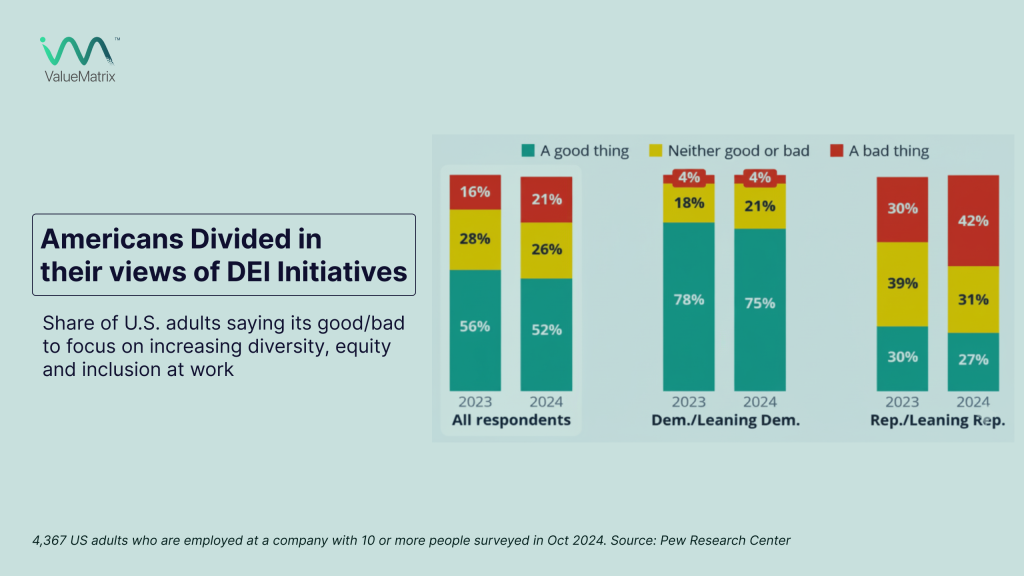
All’s not lost. These tech giants might be retreating for now to comply with Trump’s rigid stance on DEI, but according to experts, this could be strategic. Many companies are masking their DEI efforts under much safer umbrella terms like ‘learning,’ deliberately avoiding words like ‘equity’ or ‘equal opportunity. ’
JP Morgan recently announced that it’ll replace the word “equity” in its diversity program with “opportunity.” Walmart has rebranded its DEI efforts as “Walmart For Everyone.”
According to Paradigm, there has been a 22% decrease in terms like “Diversity” and 59% increase in terms like “Belonging” among Fortune 100 companies.
All this goes on to show that there’s still light at the end of the tunnel. The private sector isn’t giving up its commitment to having a more inclusive workforce; it just doesn’t want to stir the pot.
Gen Z and their attitude towards AI(People born after 1998):
In a conversation with ValueMatrix :
Global HR Leader Jayesh Menon notes Gen Z’s savvy skepticism demands AI-driven transparency and feedback in hiring, alongside a human touch. 68% expect AI while 71% want personal interaction. This hybrid high-tech, high-touch model creates a cost-effective recruitment edge over pure extremes. Organizations mastering this balance will attract the next workforce generation.
Gen Z, also known as Zoomers, is the first digitally native generation of our time. They are more inclusive-conscious than millennials and are not merely driven by paychecks.
According to a survey titled “Gen Z at workplace”, Baby Boomers valued job satisfaction and employee experience over salary.
They understand the importance of being AI literate and consider AI an important fixture of their lives. Even though AI wasn’t around when they were kids, owing to their tech-saviness, it hasn’t been difficult for them to adapt.
70% Gen Z professionals believe that acquiring AI skills could accelerate their career. They were the first ones to use generative AI for writing their resumes and drafting emails. But when it comes to recruitment platforms, there is a schism from the regular optimism we witness from them towards AI.
Gen Z loves transparency. They do not like the closedness AI platforms bring to hiring. Some AI models have been criticized for their opaqueness when it comes to making a final decision on hiring somebody or letting someone go. This opaqueness has been termed as Black Box. Therefore, Gen Z is not far off when they say that they will be able to express themselves better in front of a real person.
So, to gain the trust of baby boomers, AI models will have to satisfy their curiosity by revealing that their algorithms are free from any kind of bias.
Six Changes in Talent Intelligence
AI has brought some sweeping changes in the Talent Acquisition space. It has challenged old attitudes, introduced new perspectives, and shaken down the big old tree of HR.
Here’s how.
1. Skill is the New Currency
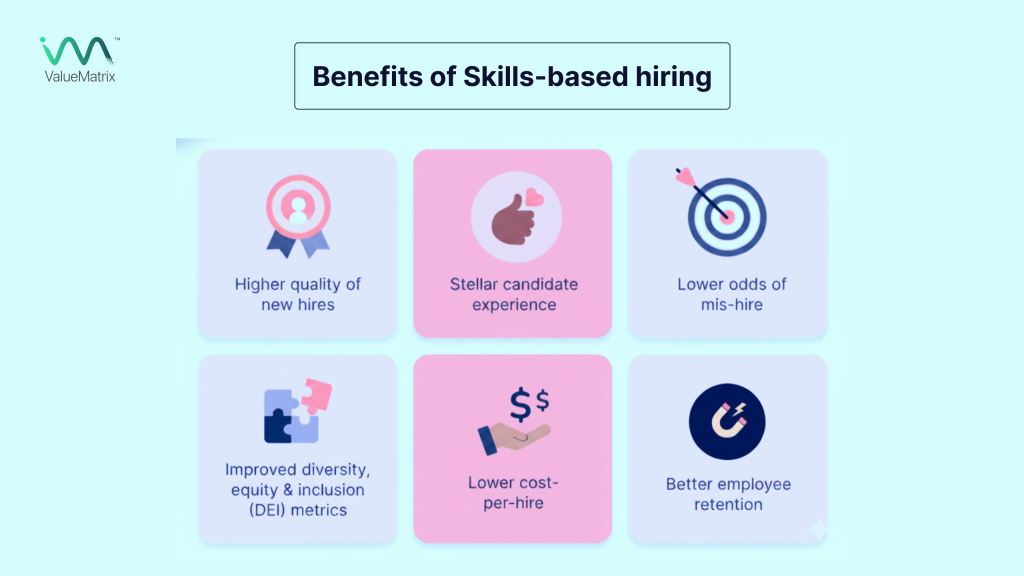
Firms have started valuing skills and technical competencies relevant to the job rather than proxies like degrees or previous job titles. This shift was a response to the changing market needs. When AI came along, it was evident that companies that have a skill-centric hiring approach will have an edge over others. Here are some factors that contributed to hiring managers going the skill route in the age of AI-powered Talent Intelligence in hiring.
Netting non-conventional hires– Hiring managers realized that not everyone has had a linear path to education. Some people are self-taught, some may have apprenticed under a master of their craft and gained valuable experience, and a few might have learned via online courses. Skill-based hiring is based on the notion that everyone’s learning tree looks different. You can lose out on some serious talent if you follow the age-old model of chasing degrees.
Degrees are static, skill is dynamic– In the post-internet age of AI-powered Talent Intelligence, where things are moving at light-year speed, degrees have become ancient scrolls. Companies are realizing that no degree can withstand the pace at which the work culture is evolving, and a degree doesn’t evolve.
Skills, on the other hand, can be updated and tweaked. Old skills can be unlearned and new skills can be learned to match the changing workplace dynamics, a luxury degree can’t afford.
Degrees don’t bridge the skill gap– Skill gaps are widening in logistics, healthcare, and tech. Degrees have failed to bridge that gap. The reason is similar to the previous point we discussed; a degree acquired in 2022 might not have a lot of relevance in the coming years. Degrees have lost their shelf life.
It’s a faster-spinning planet; tech degrees that could hold their relevance for decades in the eighties and nineties can’t guarantee to keep you employed in the future. And companies realize that.
That’s why conglomerates like Google, Apple, and Tesla are moving towards skill-based hiring and are less and less interested in the piece of paper you got after 2 years of frat parties.
“I don’t care where you went to school, just show us you can code.” -Elon Musk
2. Candidate Sourcing
This is probably one hiring vector where Talent Intelligence has moved the fastest.
Candidate sourcing is the art of identifying and attracting talent that has the potential to change the course of your company. Also known as “headhunting” or “Talent Acquisition”, candidate sourcing is not as simple as publishing a job posting on job portals and waiting for the resumes to flow in. It’s methodical, like a game of chess.
It requires anticipating your hiring needs, making proactive moves to hire top talent (so you’re not scrambling for leftovers), and building hiring pipelines around the needs of your organization. It’s a lot of work!
In the early days, a headhunter would sit at his desk, roll his fingers over his Rolodex of names, pick up his receiver, and start calling.
Needless to say, things have moved on quite a bit. Here’s how AI has changed the world of Candidate sourcing-
Resume Parsing
AI can screen reams of resumes, extract useful information, and condense it for human eyes. The recruiter only sees the final, condensed version and can make a quick judgment call on the candidate. Compare it to when the recruiter had to go through bundles of resumes manually, leaving them no room for strategizing and building a hiring funnel strategy, keeping in mind the requirements of the organization.
Data Analytics
AI models can now scout talent that is not even actively applying for jobs. These models use a technology called web scraping, where the algorithms scan publicly available data from sites like LinkedIn, GitHub, etc. AI looks for activities on their account, like adding a skill, liking a company’s page, or changing their “About me” section. It then matches it with broader company data.
Intelligent job matching
AI’s job fit talent solutions have moved beyond simple keyword searches. Natural Language Processing and Semantic analysis tools are far more sophisticated. They can parse the language in the resume and decode the intent and emotion behind it to figure out whether the person is a culture fit or not.
3. Culture fit has become a deep science.
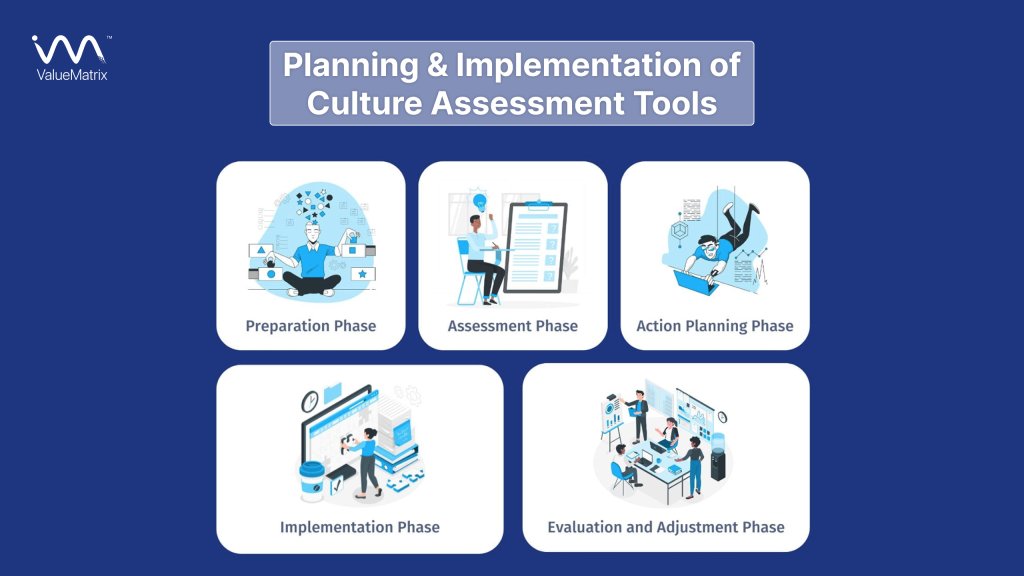
This is another aspect of hiring where Talent Intelligence in hiring has taken a quantum leap. Earlier, assessing the culture fit of an employee was reduced to guesswork and a standard questionnaire.
The interviewer would ask basic questions like, “How do you handle disagreements at work?” and stare at the candidate’s face.
It has moved beyond a checklist item that has to be ticked. Companies understand that this metric is more important than embellishments like degrees or previous job titles, because culture fit determines whether the candidate will stay for a long time, or if he is just using your company as a pit stop.
Here’s how Talent Intelligence in hiring has cultivated Culture Fit in deep science.
AI-driven Psychometric Tests
AI reads your subconscious psychological ticks, like eye movements or frequency
of mouse clicks, while you are answering a question. AI gauges your aptitude, intent, and confidence. These tests work on the principle that it is very difficult to fake your neurological responses. So when a candidate is focused on a personality assessment question, it becomes impossible for him to control his involuntary ticks, like eyeball movement or the rate of mouse clicks.
Gamified Assessments
These are also another type of psychological assessment that tests your subconscious mind. These are also very hard to prepare for. Gamified assessments judge you on markers like problem-solving ability, risk tolerance, collaboration, etc.
It reads your mouse click speed, decision patterns(risky vs safe), and attention lapses, and creates your behavioral blueprint to determine whether these traits match the company’s ethos or not.
4. Better Job matching
Not all job seekers are created equal. Some are impostors who are only there to clog your emails and waste your time. AI has also enabled job seekers to cast a wide net and apply to multiple job postings with a mouse click.
Job seekers are very tech savvy now; they have learned the art of “seo adjusting” their resumes to the companies they’re applying to. Although AI can parse hundreds of resumes at lightning speed, the volume of resumes in the HR’s inbox has also increased.
Because it’s so convenient to apply, most people apply to even irrelevant job postings to increase their chances of getting hired, creating a new challenge for HR.
Enter Predictive Analytics, it is a strain of Talent Intelligence in hiring that analyzes millions of data points from a candidate’s LinkedIn activity to their responses in their pre-screening assessments, and predicts whether the candidate is a serious applicant or a wanderer..
5. The Job Market has changed: The good and bad and mad-ly.
The job market is cooling down
It has become increasingly hard to get a job. U.S. job openings have fallen to their lowest since 2021, according to data released by the Department of Labor.
A huge chunk of this job loss can be attributed to AI. Roughly 40% of employers have said that they’d rather adopt AI for entry-level jobs than hire Gen Z. The reason is simple: AI is more consistent, reliable, and cheaper than Gen Z, although some of it is their own doing.
This is grim news, especially when you consider that Gen Z makes up 27% of the entire workforce; one can imagine how many of them must be waiting on the sidelines to get a shot.
Way Ahead
Upskilling and patience.
Now is not the time to sit back and kick your feet up. Gen Z should focus on AI reskilling. The job market is going through a turbulent patch, but there is still hope.
World Economic Forum’s “Future Of Jobs” report predicts that AI will displace 92 million jobs but create 170 million new ones, giving the job market a net gain of
78 million jobs. So one doesn’t need to lose heart because of the current morose landscape.
6. A recruiter’s role: Is it headed for extinction or metamorphosis?
HR is having its “deep reflection” moment. A lot has changed since the full-throttle implementation of Talent Intelligence in the hiring space. Some say it’ll replace human recruiters, while others think it’s too early to tell.
But what’s the reality?
World War I saw the widespread deployment of fighter planes. Every top general and military expert believed this change would render human soldiers obsolete. The logic was flawless. Why would you require boots on the ground when you can bomb your enemies from 10,000 feet in the air?
More than a hundred years later, we’re still sending boots on the ground. Many inventions have occurred since, including bomb-defusing robots and drones, but they have not replaced human experience on the battlefield.
So, much of the frenzy around AI replacing human recruits is just over excitement that’ll fade away with time as reality sets in. However, it’s not to say that there won’t be any lasting changes.
End of Gut-Based hiring- The recruitment landscape has moved from Gut-Based to data-driven. In the pre-AI era, recruiters would flick through your resume for a minute and ask you some questions based on what you’ve written.
What followed was essentially a “warming-up” drill where the recruiter would assess not your skills, but your likability. He’d be more interested in finding out whether you are a good after-hours compadre or not, rather than judging your skills or work-culture compatibility.
All that has changed. With the ingress of Talent Intelligence-based NLP and Predictive Analytics models, things have taken a sharp turn towards data-driven hiring. Facial Analysis, Digital Behavior, and Sentiment Analysis can dig deep into your subconscious and reveal the real you to the recruiter.
End of Front-loading manual work- AI has opened up HR’s schedule in a big way. In earlier times, a lot of preparation went into the hiring process. Every resume had to be manually vetted, and the shortlisting took forever.
AI-driven Talent Intelligence in hiring is speedrunning the entire screening process in a matter of minutes. That leaves a lot of time for the recruiters to focus on the big picture, which involves planning and strategizing, looking at the bigger picture, ie, their future requirements, skills they want to target, etc.
Candidate-First approach- Talent Intelligence has put candidates in the driver’s seat as companies are scrambling to improve their candidate experience to attract top-tier talent.
Earlier, job seekers were fighting a multitude of invisible enemies, from affinity/in-group bias to the halo effect; a lot of interplay was happening behind the scenes, which they were unaware of.
But Talent Intelligence-powered psychometric tests and gamified assessments have changed the equation in their favor.
Candidates do not have to worry about their background, accent, or zip code. They don’t have to worry about being “liked” by the recruiters; all they need to do is focus on performing well in these assessments.
Furthermore, the screening process is also a lot more transparent. You get instant feedback on your performance, and not weeks later via an email or phone call.
Where does a recruiter fit into all of this?
As I mentioned earlier, a recruiter is essentially the ‘boots on the ground’ for their companies. You can deploy all the AI razzmatazz, but you still need the experience of a grizzled veteran who has been in the trenches.
AI may have removed the stockpile of paperwork from their desks and cleared their schedule, but that doesn’t mean they have no part to play in this current hiring climate.
A recruiter is still an important link between the man and the machine.
Conclusion
AI, with all its capabilities, still feels cold and impersonal. It’s a human who truly represents a company and its ethos. Also, a circumstantial nuance can’t be picked up by algorithmic calculations; it requires human experience of dealing with people. For example, a candidate with a 2-year work gap might be flagged by the AI as “inconsistent”; only an experienced human will have the emotional bandwidth to get to the truth of the matter.
More than that, a recruiter is still the captain of the onboarding process. Long-term talent planning, targeting future-proof skills in hiring, and assessing the culture-fit of the candidate through a human lens are some of the tasks that a recruiter will have to do.
So, even in the scenarios of the AI revolution driven by Talent Intelligence in hiring, recruiters will have a lot on their plates.
FAQs
Two words. Reading and testing.
There are some great publications available for CHROs, like SHRM, Forbes AI in HR, and TechCrunch in HR, that deliver great insights about Talent Intelligence in HR.
If a major change comes along, CHROs must undergo relevant training.
Not completely. Degrees are surely losing their dominance, but they will disappear entirely. In a tight contest, where the candidates seem neck to neck in skills and other variables, the degree might nudge you over the finishing line.
Although it’s safe to say it’s no longer the golden ticket it once was.
The algorithms should be audited continuously for data bias. AI is not a sentient being; the bias it displays is either due to humans or previous biased hiring data.
Constant algorithm cleaning and sanitizing should be done. Programmers must deploy objective frameworks and apply bias constraints.
About Us
ValueMatrix is an AI-powered talent intelligence platform that helps companies hire better, faster, and without bias. We go beyond resumes to assess skills, behavioral traits, and cultural fit using advanced AI and proven psychological frameworks. Our platform delivers data-driven insights that improve hiring accuracy, reduce time-to-hire, and elevate candidate quality.
ValueMatrix AI enables hiring teams to make confident hiring decisions and build high-performing teams at scale.