

Table of contents
The Speed Trap in Talent Acquisition
The aura of ‘time to fill’ prevails over that of ‘quality of hire’ in today’s market, sometimes compelling teams under relentless, occasionally impossible, pressure to fill vacancies immediately. What remains a nightmare for every organization, above all, is the high-speed trap of faster hiring speed. What is rapid-quick-hires is recorded as quick-exits: A tiny fallibility on the hiring frontier will mean the wiping of huge money, time, and massive havoc on the morale of that rare employee already in the organization. A fast hire becomes a fast exit to impair resources, primarily time and morale that were once the best recruitments outshining subsistence hiring.
A direct consequence of the intrinsic fast: the system disregards essential, immutable, and unmissably critical candidate assessment and organizational assimilation processes. This huge article caters to discriminating CHROs and CEOs for systematically identifying those underlying six systemic failures that account for the high cost of bad hires. This article provides an actionable way to deal with and possibly nix the high inherent risk that surrounds fast hiring.
Why Does Rushing the Hiring Risk Lead To An Early Exit?
High turnover, the root cause of associated what could be energy-draining expenses, repeatedly stems not necessarily from a slow recruitment function but, more importantly, the quality assurance steps that are always cut out or eliminated because of an obsession with speed. When an essential leadership or technical chair is left empty, this position puts enormous pressure on executive leadership: ‘Just get someone in the seat,’ and then drives the recruiter and hiring manager to cut essential, performance-critical areas of the recruitment process.
These are great fast hiring risks that are held outside immediate detection, and most of the time will show long-term effects. What usually happens is that in trying to fit everything into a small time frame, the focus shifts from even searching for the perfect cultural and functional fit to only the readily available candidates with the minimum viable skills. It produces either a person who soon becomes disillusioned with the reality of the role or one who is just not capable of thriving in the existing organizational structure; thus, the cycle inevitably starts to create a really damaging cycle that explains why employees leave early.
Skipping Critical Due Diligence
Psychological evaluation in pre-employment settings does not merely involve the proforma verification of employment or academic dates. It also entails an exhaustive examination of the inherent. Deep motivational behaviour patterns and career trajectory harmony over the future alignment of an individual with that of the organisation to determine whether or not to accept him or her.
Unfortunately, time and deadlines tend to inspire neglect among leaders of all-important, predictive steps of assessment. This could mean necessarily omitting the required behavior-based interviews. Thus, shortening the entire process to merely one hurried discussion with the hiring manager, or relying solely on the often overblown claims of a resume. That critical failure to deeply validate the fit-the alignment of the person with the organization’s needs, rather than just the skill ability to perform a task-means the company is making a major talent investment decision. A decision based upon dangerously incomplete and surface-level data. The recruit is a high-risk gamble with great potential for bad hires. The new hire, in this scenario, is nothing more than a high-risk gamble, dramatically increasing the potential for bad hires.
Ignoring Cultural Fit Indicators
Cultural fit is all about nuances and emphatically not copying the existing demographics or hiring clones. What it essentially means is that the candidate possesses core professional value systems, a preferred working style, and an ethical compass that align with the articulated mission of the company, along with established organizational operating procedures. The rushes of hiring processes tend to make culture seem just a ‘formality’, art a fly-by mention of values on the website. These, then, end up ignoring critical behavioural red flags that raise the future chance of friction.
For instance, a fast hire may possess exceptional technical skills but fundamentally despise a highly collaborative team structure or find the company’s aggressive pace of 24/7 time span impossible to deal with. Eventually, that inevitable misfit arises, and when the new employee begins to feel isolated, misunderstood, or driven by ethical issues, it really becomes the single most powerful, predictable reason for the employee’s leaving the company early. It bears out the adage that while great technically, these individuals would prove totally useless because they could not thrive in the unique ecosystem of your organization.
Was the Job Description Accurate in the First Place?
An enormously important, though largely preventable, systemic drive behind the fast hires becoming fast exits is the fundamental mismatch. A mismatch between the very attractive role described during recruitment and the hard realities of performing that role once employment starts. It is too often the case that a job description (JD) is rapidly and sometimes even frivolously drafted in response to a very basic, immediate need: filling a position that needs to be filled right away.
Very rarely is any serious scrutiny made of the actual responsibilities in the day-to-day work. The existence of the position desired, the expected output, or any strategic priorities that may be subsumed within a longer-term planning outlook for a corporate environment. This hurried, inexact process hence creates a huge credibility gap that the talented recruit identifies and reacts to pretty much within the first week of their joining.
The Reality vs. The Promise Gap
The promise gap is the time when a new employee quickly realizes, in disillusionment, that he was “sold” an attractive, compelling vision during interviews of leading strategic projects, innovating breakthrough ideas, or developing a specific, highly regarded skill set. The first 90 days are populated with boring administrative chores, routine data entry, or keeping legacy systems (none of which were discussed). This conscious or nonconscious misrepresentation of the real expectation immediately shatters any trust foundation laid by the company during the recruitment phase. This extinguishes the initial high engagement, thus quickly and decisively answering the question of why employees leave early and seek opportunities elsewhere.
Role Definition Drift
Inside a very dynamic and fast-changing corporate environment, the functional definition of a role seldom stays stable and usually drifts over time. It silently absorbs important but unpalatable responsibilities from other departments or towards less relevance in support of shifting priorities of the senior leadership. In many cases, the job description against which a replacement is hired is not updated and validated accordingly. Then, quite shockingly to the new hire, who his bosses expect to have built a good rapport with the previous role definition, he feels severely misled.
This realization that this set of expectations was never discussed during the recruitment. It leads to one becoming overwhelmed with duties never anticipated, and now actively looking for a position that fits the initial goals, exemplifying severe and avoidable fast-hiring risk.
How Does Bad Onboarding Guarantee Early Failure?
Undisturbed by any risk identification or mitigation tactics, a strategic onboarding program serves as the last defence against all fast-hiring risks. Everywhere we look, this process seems to be the first in line for cuts or whole elimination as hiring teams frantically struggle to fill a vacancy.
Onboarding is not just an HR paperwork exercise. But it is a critical process designed to transform a high-potential candidate into a fully productive, organizationally linked, and deeply engaged employee. Bad or nonexistent onboarding puts almost all of the investment, financial, and human capital invested in the hire at risk in a manner that loudly establishes the reality of bad-hire costs. Any employee who feels completely lost, materially unsupported, and essentially disengaged with everything within their first critical weeks is put onto a fast track of becoming an involuntary, costly fast exit.
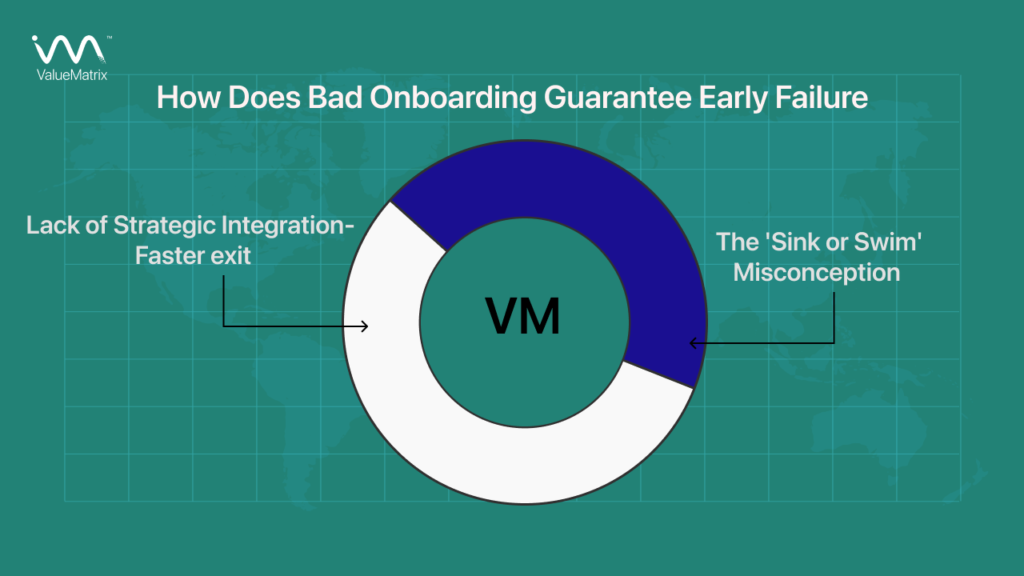
Lack of Strategic Integration
With strategic integration, you go beyond three dimensions. All your different executives are introduced; your email address and laptop are set up; and within the first 30 days, they are introduced to several key cross-functional partners alongside clear, contextual information. Inputs regarding the company’s long-term objectives paired with the specific, measurable contributions they would have to these objectives.
Without this major strategic framework, the new employee is forced into an unhelpful silo. He is unable to come to terms with the complex organizational ecosystem. He is confused as to who to look up to for necessary information, or which competing priorities hold the most strategic weight, guaranteeing a slow, frustrating start and, ultimately, a quick, costly disillusionment.
The ‘Sink or Swim’ Misconception
Many seasoned managers still believe that theantiquated and erroneous removal of an untried hiree at the deep end serves as an immediate assessment of essential resilience, competence, and ability for self-management. This may be a fact, but the high performers can demonstrate this all on their own. The misbelief of ‘sink or swim’ inference here carries heavy expenses for the organisation, leading to a maze of rejected culture. Perhaps even worse is the stench of high disrespect and abandonment of investment in the development of the employee.
By implication, it sends out signals that the new employee’s worth is so low that the business cannot be bothered to spare any time, energy, or mentorship. One that can help to set the candidate up for smooth and fast success. Negligent attitude towards them is often cited as a main motivation for employees to leave early. This is especially true for highly sought-after candidates who are bombarded by competing organisations that offer more supportive, structured, and deliberate environments.
What Are the Six Core Reasons for Fast Exits?
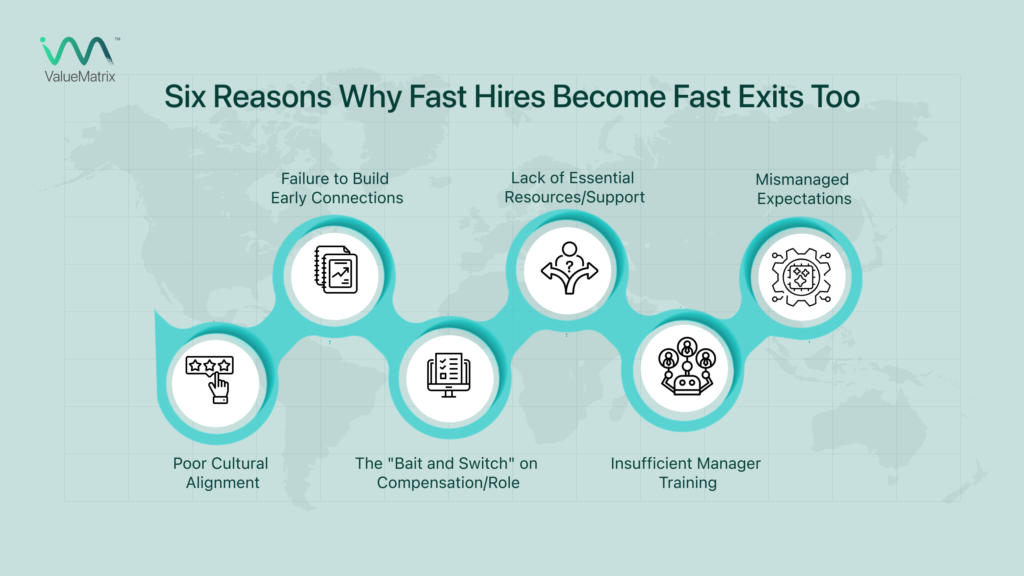
These six turning points are the core, most frequently observed underlying reasons that transform an expensive and rapid recruitment effort into immediate resignation. Thus, it firmly embeds the true organisational and financial measure of bad hire cost.
Reason 1: Poor Cultural Alignment
The culture of the existing teams or the larger corporate environment is fundamentally incompatible with the person’s own non-negotiable style of work or professional values. An example can be that a person used to working in focused environments finds themselves in a distracting and highly matrixed environment.
Reason 2: Mismanaged Expectations
The promise made in interviews and during the offer stage did not match what was offered. The daily design of the proper level of organisational authority granted, or even the core team structure, that the individual would be joining.
Reason 3: Lack of Essential Resources/Support
In this case, the person is being inducted into a high-profile position without the requisite resources being delivered in time. Onboarding a person with the right budgetary resources, specialised tools, critical training, or sufficient decision-making authority with whom to actually accomplish key objectives should be laid down during the first 90 days.
Reason 4: Insufficient Manager Training
The new employee’s direct manager plays a crucial role. The single most important predictor of an employee’s success is failing to effectively train or coach their recruit, provide vital feedback, or set clear, measurable, and achievable objectives specific to a new employee.
Reason 5: The “Bait and Switch” on Compensation/Role
The firm makes very subtle yet material changes just after the signing of the contract on all fronts. Be it ranging from stock options to bonus structure, from career development path to even a changed role definition, these actions severely erode the trust of the employee.
Reason 6: Failure to Build Early Connections
Without any successful effort to build informal social and professional relationships, the new hire finds herself feeling completely alone and isolated. One without any internal network support.
What is the Real Cost of Rapid Employee Turnover?
The actual monetary and intellectual capital effects of fast hiring risks tend to be grossly underestimated by most executive teams, often by a margin of two to three times. The financial implications go way beyond just the recruiter’s commission or negotiated sign-on bonus.
These include lost productivity of the individual, the administrative cost of separation, and the cost of new recruitment. Most importantly, a serious morale drain on existing good employees having to pick up the burden of covering yet another role left vacant. The astronomical cost of a bad hire justifies, in financial terms, the slow yet very purposeful approach to improving the hiring and integration process.
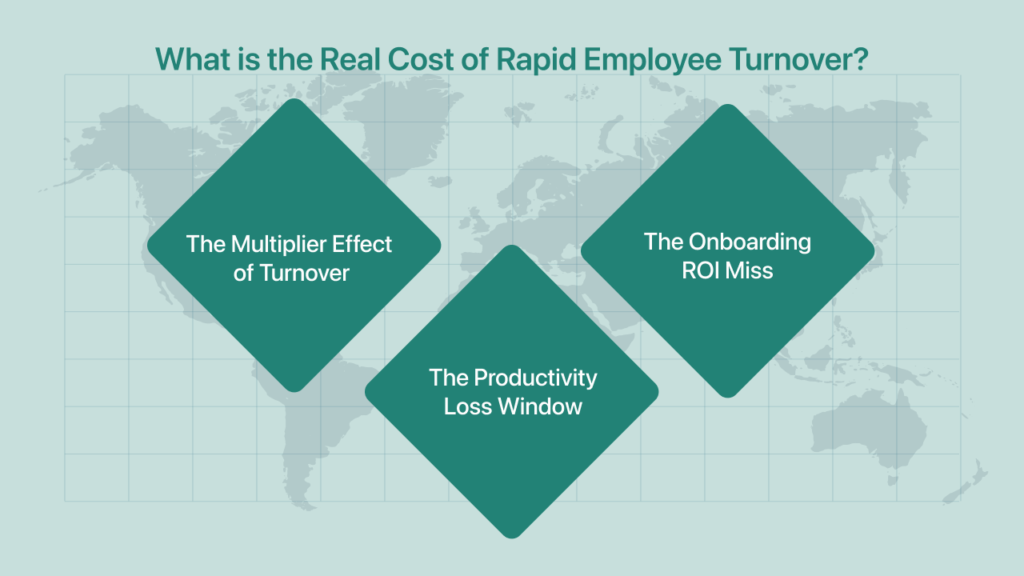
Statistic 1: The Multiplier Effect of Turnover (SHRM)
The Society for Human Resource Management (SHRM) assesses, quite conservatively, the overall replacement cost of a highly skilled salaried worker, taking into account all the factors, to be six to nine months of the salary of that worker. This means that for a senior executive whose salary is $200,000, the real covert cost of a swift exit could reach anywhere from $100,000 to $150,000, strongly reinforcing the notion that the real bad-hire cost is horrendous.
Statistic 2: The Onboarding ROI Miss (Gallup)
A quarter of the premier workplace consulting firms, Gallup has reported that only a mere 12% of employees across industries strongly agree that their organisation does “great work” in onboarding new employees effectively. This huge and chronic gap in the strategic integration of an organisation is said to be one of the main reasons why employees leave early. This outlines an important failure of the organisation in resource allocation and talent stewardship.
Statistic 3: The Productivity Loss Window (HR Executive)
Published research in HR Executive indicates that, on average, a newly hired white-collar professional takes at least 6 to 12 months to reach the full productivity level of a senior employee. A fast exit at the 3-month mark thus limits the company to just a tiny fraction of the actual productivity that a newly hired made at the same time, almost fully spending on all hiring and orientation costs. This certainly aggravates all latent fast hiring risks.
How Do Best-in-Class Companies Slow Down to Speed Up?
The big companies with severe hardships in talent acquisition have managed to orchestrate an entire turnaround by acting with great effectiveness. They are slow to hire, i.e, methodical and stringent in attitude, exemplified in not hiring for a long period or envisaging fast integration with extreme support as empowering. Every hiring of theirs is viewed for its costs and returns like a long-term, strategic investment. This thus directly negates the crippling fast-hiring risks and becomes a paradigm that shuns fast hiring.
Case Study 1: Google’s Structured Onboarding Strategy
Based on findings derived from years of collection and painstaking review of empirical evidence. Google has put in place a methodical, highly structured, science-based onboarding process with a clear focus on the direct manager.From the data, a remarkable finding was discovered: through accomplishing five specific, managerially defined actions (such as having a candid talk about the role, encouraging network building, and scheduling meeting times for check-ins) within the new hire’s first week, the new hire’s ramp-up time to complete productivity will be 30% shorter. This intentional, accelerated, and low-key information method greatly minimizes the abandonment and disorientation felt by many, which can lead to fast exits.
Case Study 2: Shopify’s Emphasis on Cultural Interviews
With deliberate care, e-commerce magnate Shopify designs an intricate, multi-layered hiring process. A process in which assessing cultural fit and alignment to core values takes precedence over any detailed analyses of technical skill. The company is known for conducting specific, structured, and strictly dedicated interviews. Interviews are devoted solely to understanding a candidate’s approach to resolving failures, their constructive contributions to collaborative teams, and their alignment with the core operational principles. Thus, by prioritizing this deep intertwining with behaviors, they are somehow ensuring that this “fast hire” is firmly grounded in the ethos and mission of the firm, thereby downgrading the factors or attributes underlying why such employees leave early.
Did You Know? The Power of the New Hires’ First Week
The initial days and weeks of employment possess a disproportionately high, often-overlooked, level of strategic importance. The new hire’s groundwork decision basically supersedes staying or covertly planning to exit in the first 30-odd days, with actual, formal exit taking quite some time.
The 90-Day Cliff
Statistically, churn peaks roughly between 90 days and a year. The first 90 days are, in essence, an incredibly important probation period for the new employee, but maybe just as important long probation period for the new hire in the eyes of the hiring organisation. If, during this period, the organisation has failed on the promise of its identity, its value proposition, and its propositions of support, chances are that the employee is already actively strategising an exit, confirming that the fast hiring risks were not worth the gamble.
The Halo Effect in Hiring
A shared cognitive deficit that tends to amplify the bad hire cost is the halo effect. Under time constraints to hire, most hiring managers may subconsciously endow a candidate with positive attributes in almost all areas. It is based solely on one particular strength (having a world-class school in his/her resume) or a major plus (great interview technique). By then, a candidate may escape from the watchful eyes of the hiring managers, having eliminated any major red flags in other critical frontiers from their consideration. This selective blindness tremendously increases the risk of incurring large bad-hire costs.
Employee Expectations: The New Rules of Retention
Psychologically speaking, the last few years have created a paradigm shift in the employer-employee contract. The career was a set linear path until recently, defined by corporate ladder climbing and an eventual financial reward. The highly sought-after professionals today demand nothing short of a fundamental recalibration of those priorities: choice rather than control, well-being rather than hustle, and purpose rather than profit. They do not accept anymore a static, lifelong contract in the form of a job description. Instead, it is rendered an evolving bilateral contract where the organization fails to deliver on promises related to flexibility, personal growth, or a clear ethical mission.
The ‘fast exit’ is not a failure of loyalty but rather a very rational, strategic move in the direction of preserving personal values and career momentum, where such failures exist. This far-reaching rewriting of the Employee Value Proposition (EVP) will ensure that EVP conversion matches the new search for meaningful work and a sustainable life.
The wave of evolution in employee expectations is directly giving rise to the phenomenon of fast exits. It is creating a signal intensity that is unforgiving of managerial and organizational inertia. This generation of talent is super aware in terms of market value. It wouldn’t easily tolerate all the administrative inefficiencies, toxic cultures, and infamous ‘quiet firing’ that is very entrenched in professional growth. This is why companies that do not invest deeply with visible and personalized development plans, psychological safety, and radical flexibility are fast punished by the increasingly mobile workforce.
CHROs should realize that retention is not simply by having a competitive salary but by means of continuous and proactive people development and real career mapping. By institutionalizing a culture of continuous dialogue, thereby tailoring career paths, the leaders can demonstrate the initial investment in the hire. So this is an ongoing commitment to their long-term success, which substantially addresses the core reason employees leave early: the feeling of stagnation or being taken for granted.
How Can the ValueMatrix Stop the Fast Exit Cycle?
Value Matrix offers a critical strategic tool that CHROs and CEOs need to use even before the hiring process begins. With the help of all tools to judge about a vacant role, organizations can objectively eliminate from the discussion all activities that lie in the Low-Value/High-Effort quadrant. That prevents a value audit from directly addressing Reason 2 (Mismanaged Expectations): ensuring that the role is focused on high-impact work enhances the job satisfaction of the incumbent from day one.
Equally, the Value Matrix provides an opportunity for leaders to define the strategic mandate of a new position-to-the-point. When a job is truly defined by high-value contributions-unlike an extensive list of low-value inherited tasks-it attracts top-tier talent who crave impact, not activity. By clearing away the busy work before the job description is even published, the company builds an opportunity for the alignment of the role’s reality with the high expectations of top talent. It helps in creating opportunities for retention instead of fast-hire risks.
Conclusion: Transforming Speed into Sustainable Strength
The endless cycle whereby fast hires become fast exits is a self-inflicted grievous wound inflicted by impatience on the organization that never prioritized long-term value. For CHROs and CEOs, nipping a financially draining problem in the bud requires an attitudinal transformation. It takes turning away from that immediate snare of pressure – to fill that empty seat – which is of paramount importance. It is important to focus on long-term strategic investments with a view to successfully forging a thriving, committed career. Fast hiring risks should be preemptively mitigated through a slower, standardized assessment process.
This will entail maintaining the highest standards for honest and laser-precise JDs and supportive strategic onboarding. The end objective will not be to eradicate speed but to consciously offset feverish speed with a balance of purpose and deliberation. It is a mechanism of converting the historically exorbitant bad-hire cost into a sustainable source of strength for the organization, in addition to talent retention.
Implementing a “Slow-to-Hire, Fast-to-Integrate” Philosophy
This Slow-to-Hire guarantees that an appropriate level of cultural alignment is ensured, thus decimating the long-term costs of hiring risks; the Fast-to-Integrate guarantees that, once the right person is found, this person is welcomed in, supported, strategically integrated into the organization at speed, and then empowered to become productive and stay engaged over the long haul.
FAQs
Employee exits within the first 12 months of employment are usually classified as fast exits. The first 90 days are critical indicators of deep flaws in hiring or onboarding processes.
Yes. Culturally, hiring is harder to judge for candidates, and finding organic social connections (Reason 6) is difficult to find virtually. Therefore, the onboarding of teams remotely requires a more careful structure and specific dedicated time to relationship building in order to succeed.
The ROI is garnered by tracking time-to-productivity (faster production of new hires) and dappling retention rates of employees who opt for the structured program with employees who receive little or no training. High retention and short time to productivity yield a good ROI- exemplified performance.
There are extenuating circumstances (like a better offer), but if a company sees the consistent turnover across other quick hires, it is the process at fault. Most likely, the brakeman is the company’s failure to fit or to offer the environment and the promised support.
No. Having the lowest criteria for urgent roles is because that is a fast hiring risk. Instead, keep the criteria high but change the process-fit in that very focused, competent hiring team runs solely on that role, or keeps a temporary contractor on board while doing an optimal search.
About Us
ValueMatrix is an AI-powered talent intelligence platform that helps companies hire better, faster, and without bias. We go beyond resumes to assess skills, behavioral traits, and cultural fit using advanced AI and proven psychological frameworks. Our platform delivers data-driven insights that improve hiring accuracy, reduce time-to-hire, and elevate candidate quality.
ValueMatrix AI enables hiring teams to make confident hiring decisions and build high-performing teams at scale.