
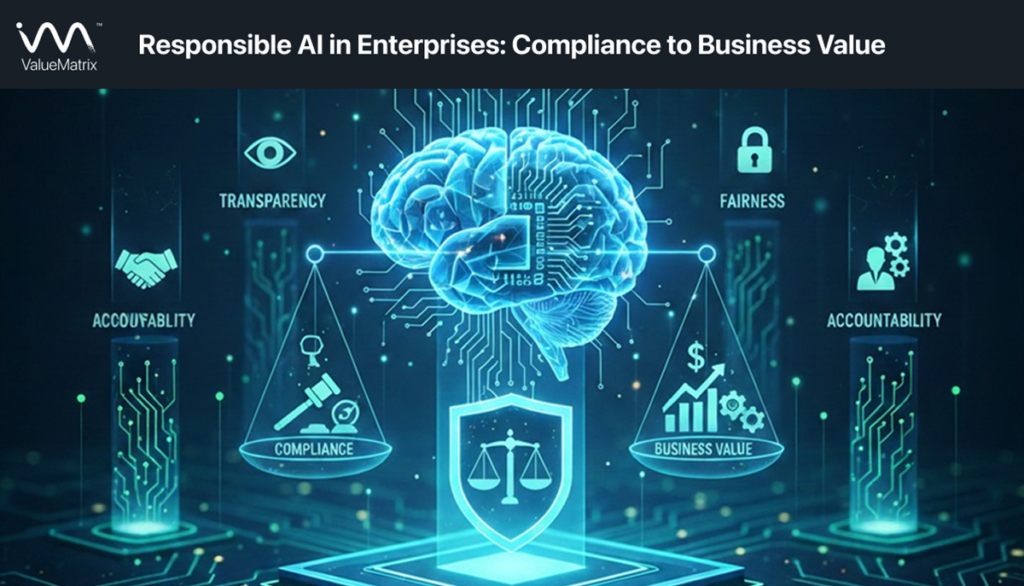
Building a value-driven framework for responsible AI has evolved from a peripheral ethical discussion to the central nervous system of high-growth enterprises in 2026. As we transition from simple chatbots to agentic AI systems that negotiate contracts and manage supply chains, the “black box” approach has become an unacceptable business risk.
By operationalizing trust, security, and transparency, Gartner estimates that organizations will achieve a 50% increase in business goal attainment by the end of this year (Source: Securiti).
1. How is the Strategic Pivot of 2026 Redefining Responsible AI?
Building a value-driven framework for responsible AI has evolved from a peripheral ethical discussion to the central nervous system of high-growth enterprises in 2026. As we transition from simple chatbots to agentic AI systems that negotiate contracts and manage supply chains, the “black box” approach has become an unacceptable business risk. By operationalizing trust, security, and transparency, organisations that operationalise AI transparency, trust, and security will see their AI models achieve a 50% improvement in terms of adoption, business goals, and user acceptance (Gartner AI TRiSM, September 2023). (Source: Securiti).
Executive Summary: The Strategic Pivot of 2026
The enterprise AI system advanced from its testing phase to its operational phase in the year 2026. According to recent benchmarks, 92% of C-suite executives express full confidence in AI impact, yet only 25% have fully implemented AI governance programmes (Larridin 2026 State of Enterprise AI Report, Business Wire, February 2026). The need for responsible AI emerges as a crucial requirement when organizations face situations that threaten their existence.
The current HR trends 2026 show that organizations now use responsible AI to establish operational boundaries for Agentic AI systems that execute their planning and execution duties. Growth Managers achieve organizational orchestration through responsible AI principles by creating a foundation that enables them to synchronize human talent and digital agents for their enterprise operations. The guide explains that responsible AI knowledge and AI implementation skills in HR create the only route to achieving sustainable productivity improvements worth several billion dollars. The executive suite now focuses on “Resilient AI” to achieve better results than basic operational efficiency.
The process requires organizations to construct systems that maintain their functioning throughout adversarial attacks and market shifts while operating within established ethical constraints. Organizations that treat AI as a core competency need continuous oversight because they must develop their AI capabilities through ongoing software enhancement rather than software acquisition. The 2026 transition will introduce “Trust by Design” as its central principle. Leading firms establish ethical business practices by integrating them into their model frameworks from their model framework development stage through operational business processes. The proactive approach decreases governance debt by enabling companies to expand their digital workforce operations beyond their former limitations.
2. What is Responsible AI? The Agentic Era Defined
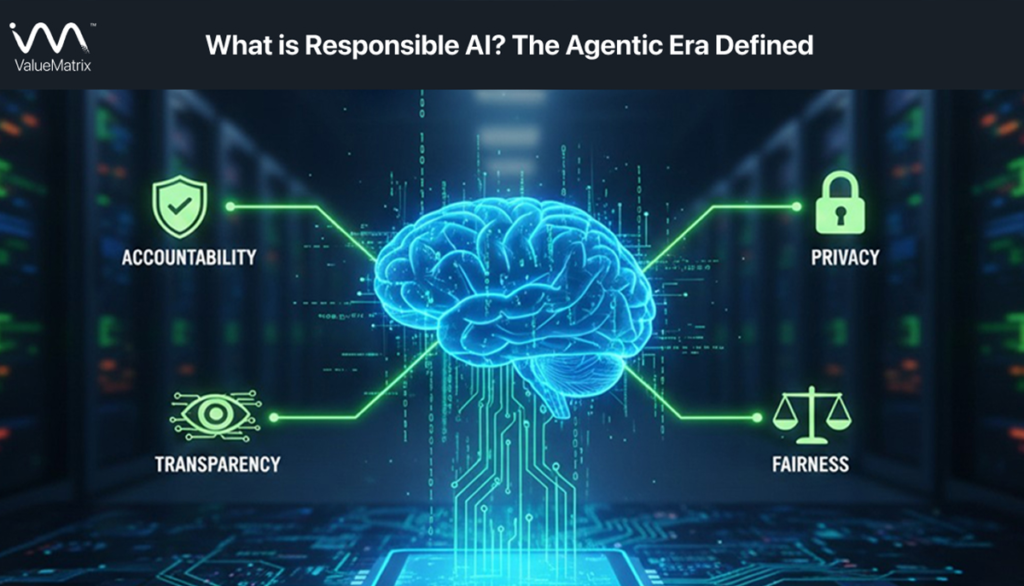
The answer to “what is responsible AI” today requires an understanding of Agentic Accountability. The 2024 era had AI as a tool you used, which became an agent for action in the 2026 period. A responsible system must meet the three transparency requirements, which include unbiased operation and total traceability of all its autonomous decision-making processes.
The 2026 enterprise AI strategy requires businesses to stop using separate experiments and start developing production-ready systems that meet their specific business requirements. Enterprises demand a complete long-term plan that integrates their business requirements with their data readiness and their ethical governance needs.
The alignment ensures that as agents gain more autonomy, they continue to follow the complete “commander’s intent” instructions. The modern responsible AI remains “Human-Led and Tech-Powered.” The system guarantees that all agentic AI activities, which include candidate screening and demand forecasting, can be tracked and undone. The absence of this framework leads organizations to experience “The AI Governance Paradox” because their AI adoption rate causes them to encounter more branding risks from systemic errors.
The current definition now incorporates “Sustainability and Well-being.” Responsible AI in 2026 requires organizations to assess all environmental consequences together with their effects on workplace psychological security. The current definition of “responsible” requires systems to meet two additional requirements: maintaining equity standards and producing environmentally friendly outcomes. The concept involves “Operational Clarity.” Organizations must define exactly who is responsible for an AI agent’s actions. The industry adopted the “Neck-to-Squeeze” principle in 2026, which establishes that every automated output requires a human owner to verify its accuracy and moral compliance.
3. What Are the Four Core Pillars of Responsible AI Principles?
To move beyond a cost-center mindset, your enterprise must build upon these four responsible AI principles:
Explainability (XAI): You must be able to “show the work.” The system requires a logical pathway to follow when an AI agent denies a credit application or shows a candidate ineligible for approval. Only 19% of data leaders always require AI agents to show their reasoning before approval, and 52% have delayed or blocked agent deployments specifically because of explainability concerns (Dataiku Global AI Confessions Report, August 2025).
Fairness & Non-Discrimination: This involves active “bias damping.” The AI system must use a selection of training data from different sources while conducting impact studies to demonstrate that it does not reinforce existing social inequalities. 74% of businesses using AI are making no efforts to reduce unintended biases in their systems (IBM Global AI Adoption Index). This issue will become the most significant operational challenge for organizations in 2026.
Accountability: Establishing clear ownership. Who will take responsibility for an autonomous agent’s mistake that costs the company 1 million dollars? The PwC 2025 Responsible AI Survey found that 56% of organisations now report first-line teams—IT, engineering, and data—leading responsible AI efforts (PwC, October 2025). Through 2027, manual AI compliance processes will expose 75% of regulated organisations to fines exceeding 5% of global revenue (Gartner, 2026).
Privacy-by-Design: The EU AI Act mandates all systems to handle sensitive IP through data minimization and “Zero-Copy” architecture design because this requirement becomes effective in 2026. The AI governance market, estimated at $308.3 million in 2025, is projected to surpass $1.42 billion by the end of the decade (Grand View Research, 2025).
The entire system gains strength through these pillars, which create a feedback loop that connects all existing system components. High explainability brings major advantages because it enables simple auditing processes that check for fairness in outcome distribution. Your team will identify potential bias in the model’s reasoning paths, which demonstrate how it arrives at its decisions. The principles establish common ground that allows different department teams to share information with one another.
The time required for committee reviews decreases by 30% when Legal, HR, and Engineering reach consensus on these four standards. The rubric provides organizations with decision-making criteria that accelerate their transition from prototype development to production implementation. Organizations will use these principles as the best way to reduce their regulatory risks arising from future compliance modifications. Fairness and transparency serve as fundamental values that remain unchanged despite evolving legal systems. Companies that establish their operations based on these pillars today will achieve compliance with all future regulations that apply to their business activities in every jurisdiction.
4. How Do You Implement Responsible AI in HR?
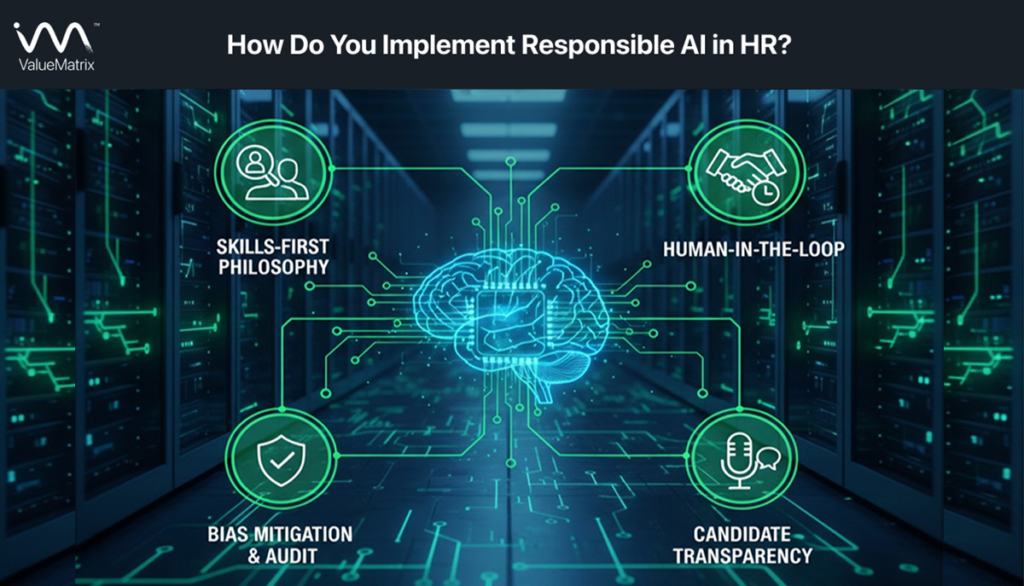
The HR department serves as a bridge between human interaction and machine-based operational processes. HR professionals need to know the right way to use AI when organizations shift from credential-based filtering to a skills-first approach. The transition allows AI to function as an “Inclusion Engine” while transforming the organization into a “Bias Amplifier”. Worker access to AI rose by 50% in 2025, and the number of companies with 40%+ of AI projects in production is set to double in six months (Deloitte State of AI in the Enterprise, 2026).
The sector needs responsible AI implementation, which requires organizations to evaluate AI systems through predictive validity testing that measures actual skill potential instead of using resume keywords related to previous biased hiring practices. The organization needs to change its training model by implementing psychometric data and performance data as the central training framework for recruitment processes. The organization needs to create candidate transparency as a fundamental requirement.
Only 67% of candidates are comfortable with AI screening when a human makes the final decision, and that comfort level drops sharply when AI makes the final call without human review (Glassdoor Economic Research, 2024). The organization requires organizations to implement “Human-in-the-loop” (HITL) as a mandatory requirement. The AI system handles administrative tasks, which include scheduling, initial screening, and skill verification. The experts must dedicate their entire time to understanding candidates’ emotional requirements and cultural compatibility.
The organization intends to use AI technology, which “Free the Human” capacity for high-value tasks while keeping humans in their work roles. HR leaders need to establish strict “Disparate Impact” documentation requirements. Every AI-driven hiring cycle should be followed by a statistical audit to ensure no protected group was disadvantaged. The audit should ensure selection rates for any protected group are not less than four-fifths of the highest-selecting group (EEOC Four-Fifths Rule). In India, organisations must comply with the Digital Personal Data Protection (DPDP) Act 2023.
5. What is the Responsible AI Implementation Roadmap for Enterprise Scale?
Scaling responsible ai implementation across a global enterprise requires a disciplined march from discovery to continuous monitoring. It begins with an AI Inventory and Discovery phase to document every tool in the building. Currently, 92% of C-suite executives express full confidence in AI impact, yet only 25% have fully implemented AI governance programmes (Larridin 2026).
Once inventoried, systems must undergo Risk Tiering, classifying them as “Minimal,” “High,” or “Prohibited” based on global regulatory criteria. This allows the organization to focus its heaviest governance resources on high-impact areas like healthcare, finance, or recruitment, while allowing low-risk productivity tools to move faster. The next critical step is Integration into MLOps. Governance cannot be a manual side-task; it must be embedded directly into the technology pipeline.
Automated “Trust Guards” should trigger alerts or shut down models if they detect significant bias or data drift in real-time. Employee Upskilling follows closely. Nearly 60% of organisations cite knowledge and training gaps as the primary barrier to implementing responsible AI practices (McKinsey 2026 AI Trust Maturity Survey). Organizations must train their staff not just to use AI, but to orchestrate it responsibly, including recognizing hallucinations and adversarial prompts.
Finally, the roadmap concludes with Red Teaming and Continuous Monitoring- By periodically trying to “break” their own systems, companies can identify vulnerabilities before they are exploited. A live “Trust Dashboard” should be the primary view for any AI Growth Manager, providing a 360-degree view of model health and ethical compliance.
Regulatory Mapping: map each AI system against applicable regulations (EU AI Act, EEOC Four-Fifths Rule, DPDP Act 2023).
Stakeholder Communication: Establish a ‘Radical Transparency’ protocol — publish a plain-language summary of which AI systems are in use and what human oversight exists.
6. How Can Enterprises Address the “Shadow AI” Pandemic?
60% of businesses using AI are not developing ethical AI policies, and 74% fail to address potential biases (IBM Global AI Adoption Index). The organization uses Shadow AI to create substantial security gaps, which endanger both data security and proprietary company knowledge. Workers who view official systems as excessively slow and restrictive will use unauthorized methods to achieve their work targets.
The 2026 strategy will not prohibit these tools because such bans create productivity loss. The Safe Sandboxes solution requires companies to create controlled environments that restrict testing activities. Organisations that bring unauthorised tools under enterprise licencing gain audit logs, data residency controls, and security standards unavailable in consumer-grade versions. Businesses must supply their IT departments with Agentic AI solutions, which will serve as their orchestration management tools. Your solution allows IT employees to identify new tools while automating their access process, which results in uninterrupted innovation at your organization while protecting essential data resources. The process of Shadow AI resolution needs a complete transformation of organizational behavior.
Leaders must inform stakeholders that governance functions to establish safe pathways that enable their organisation to proceed with operations. Employees who comprehend the specific threats that data leaks create for both themselves and their company will fully support controlled AI initiatives.
7. How Do You Balance Ethical Governance with Innovation Speed?
The evaluation of ethical governance needs to find its optimal point between controlling innovation speed and governing organizational processes. The widespread belief that responsible AI principles reduce business efficiency represents a common falsehood. Organisations that operationalise AI transparency, trust, and security will see their AI models achieve a 50% improvement in terms of adoption, business goals, and user acceptance (Gartner AI TRiSM, September 2023).
The process of advancing AI technology requires an architectural system that uses “Least Privilege Access” to grant agents only the permissions needed for their designated tasks. The AI agents need to create a Zero-Trust framework that prevents any single mistake from spreading throughout the entire enterprise architecture. The 2026 era requires speed to become the primary strategic approach, whereas trust serves as the essential element that drives all operational activities.
The ability to take action based on data determines which enterprises win because they operate under conditions that include dependable, controlled environments. Governance boards have transformed their roles from Reviewers to Enablers because they provide development teams with approved methods that enable them to create and release products in a matter of days instead of needing several months. The organization achieves balance through the implementation of Automation of Compliance.
Leading companies employ AI to conduct AI monitoring instead of relying on manual inspections, which they perform at specific intervals. The Continuous Compliance system permits organizations to maintain constant operational processes because audits occur as background tasks that run throughout the organization. The organisations that establish their ideal balance experience the operational benefits which create a Flywheel Effect. The system, which creates a high degree of trust, results in better system usage, which produces superior data quality, which generates more precise and ethically sound models. The virtuous cycle operates as the ultimate competitive advantage in an industry where AI capabilities have become widely accessible to everyone.
8. The Value Equation: ROI of Ethical AI in 2026
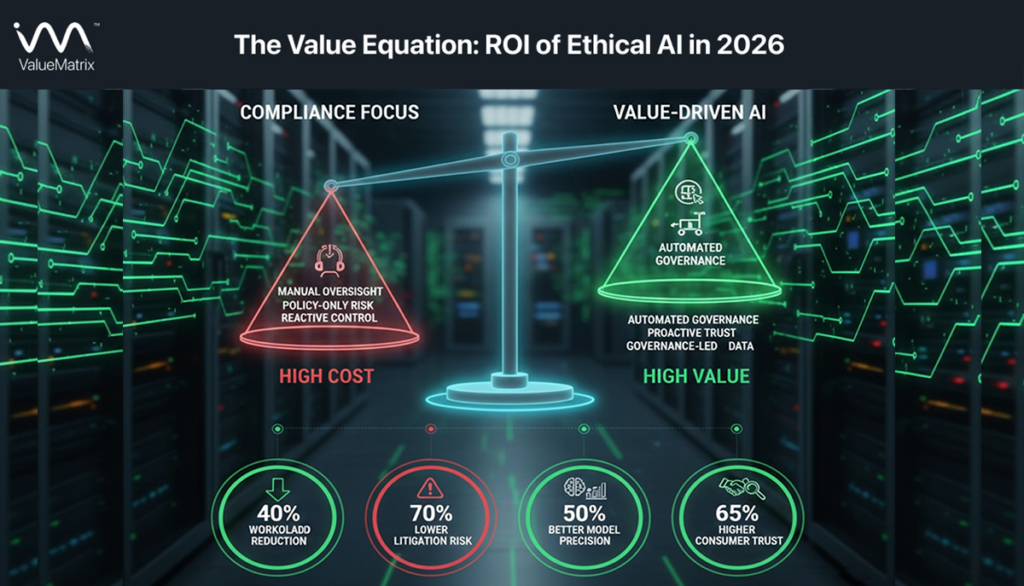
Is the investment in responsible AI worth it? The data from early 2026 suggests a resounding yes. Companies with a comprehensive, responsible approach to AI earn twice as much profit from their AI efforts compared to those that ignore governance (Source: Russell Reynolds Associates).
The ROI Shift: 2026 Benchmarks
| Metric | Verified 2026 Outcome | Source |
| Productivity | 60% of business leaders say responsible AI boosts ROI and efficiency | PwC 2025 |
| Trust/Brand | 55% of leaders report improved customer experience and innovation | PwC 2025 |
| Adoption | 50% improvement in AI adoption, business goals, and user acceptance | Gartner AI TRiSM |
| Legal Risk | Through 2027, manual compliance will expose 75% of regulated organisations to fines exceeding 5% of global revenue | Gartner 2026 |
Responsible AI extends its impact through the financial benefits that it generates. The best AI researchers and growth managers of 2026 will only accept work at companies with unblemished ethical standards. Your organization uses its responsible reputation to attract top-tier talent who belong to the elite 1% of workers.
The process involves evaluating two separate financial benefits, which include “Maintenance ROI”. Models built on responsible principles achieve 28% fewer failures, which need emergency retrofitting work after their deployment. The expense of correcting something during the initial process is lower than fixing a system that has created reputational damage after its biased operation (Source: Russell Reynolds Associates). Organizations measure their return on investment through the Customer Lifetime Value (CLV) metric.
Customers who believe their data will be treated with integrity and that AI systems will make unbiased choices will stay loyal to 3.5 times more brands while trying out new AI products from those companies. The highest-margin product that enterprises can offer in 2026 exists in trust.
9. Conclusion: Building a Culture of Trust
The future of 2027 and 2030 will see the disappearance of the boundary that divides “AI Strategy” from “Business Strategy”. All business processes will become AI-augmented operations. Your organization will establish its ethical standards as its brand identity in the future. The only method to secure your future spot at important decision-making meetings is to establish a trust-based culture. The leadership team starts this journey.
The rest of the organization will follow C-suite executives who treat responsible AI as a major business strategy instead of a minor technical matter. Organizations need to implement “Radical Transparency”, which requires sharing complete details about their AI systems with both employees and customers. Trust within an organization needs “Collaborative Governance” to develop. The responsibility exists for all departments to share between legal and IT functions while they handle their duties.
Employees must receive the authority to report possible ethical violations without risking business disruption. The ultimate objective exists as “Human Flourishing”. AI systems should function to enhance human abilities while creating environments that support diverse and efficient work. Organizations that follow this goal will experience natural growth together with increasing value.
Frequently Asked Questions (FAQs)
1. What is responsible AI, and why is it mandatory now?
The framework establishes safety guidelines while maintaining transparency requirements for AI implementation. The regulation became mandatory when global regulators from the EU and California started demanding organizations document their bias mitigation methods, together with high-risk system risk evaluation processes. 70% of consumers currently doubt that companies will act responsibly, making this framework essential for brand preservation (Source: Digital Silk).
2. What are the core responsible AI principles for a Growth Manager?
The operational framework consists of three core principles, which include Transparency (explainability), Fairness (bias control), and Accountability (human ownership). The path to expanding your AI capabilities requires you to follow these principles, which help prevent governance debt, which has already affected 43% of marketing organizations stuck in the developing stage (Source: SEO.com).
3. How to implement AI responsibly in HR without biased outcomes?
Organizations should implement “validated predictive inputs” as their primary solution. The process requires a verification skills assessment instead of a resume content analysis. The responsible AI implementation dashboard enables organizations to track protected group impacts in real-time, thus reducing both operational interruptions and litigation expenses (Source: Netguru).
4. Can small businesses afford a responsible AI implementation?
Yes. In 2026, small businesses will obtain access to multiple “Governance-as-a-Service” solutions, which enable them to implement ethical filters for their AI systems at reduced costs compared to creating personalized governance systems. 85% of executives view AI as their competitive advantage; thus, 25% of startups have made “Trust-Tech” their primary focus during system development (Source: SEO.com).
5. What is the “AI Governance Paradox” that affects enterprises in 2026?
The rapid adoption of AI technology poses branding risks for companies whose control systems exceed their capacity. 92% of C-suite executives trust AI technology to deliver its expected results, yet only 25% of them have established complete governance systems, according to Larridin. Organizations face two main challenges, which include the risk of systemic failures and increased scrutiny from regulators.
6. How does the 2026 definition of Responsible AI address Agentic AI?
The agentic era requires all autonomous actions to have “traceable human owners” who take responsibility for their execution. McKinsey reports that only one-third of organizations achieve maturity levels three and above for their agentic AI governance system (McKinsey, 2026). The current system requires all automated outputs to undergo human review, manual override, and auditing processes.
7. Why is Explainability (XAI) considered a business-critical requirement?
Explainability prevents deployment failures by eliminating “black box” problems that stop progress. 52% of data leaders have delayed or blocked agent deployments specifically because of explainability concerns (Dataiku, 2025). Organisations require XAI technology to create documentation that shows the decision-making process behind their automated systems because they will face legal risks under the EU AI Act.
8. What role does “Privacy-by-Design” play in 2026 compliance?
The procedure requires organizations to protect sensitive IP materials by implementing data reduction methods and using “Zero-Copy” network designs. The AI governance market will experience a major transformation because its value will exceed 1.42 billion dollars by 2030, according to Grand View Research. The software functions as a privacy protection system that operates as an integral component instead of adding privacy features after the design process.
9. How does Shadow AI impact an organization’s ethical policies?
Shadow AI creates a hidden governance gap where 60% of businesses using AI are not developing ethical policies (IBM Global AI Adoption Index). The company loses its ability to check security protocols and complete audit trails when workers utilize unauthorized tools, which leads to biased detection and data loss protection issues.
10. What is the verified ROI for organizations that operationalize AI trust?
The successful implementation of trust-based systems is directly linked to operational trust systems. Organizations that implement AI trust through operational transparency and security measures experience 50% better results, which include higher adoption rates and improved business outcomes and user acceptance, according to Gartner AI TRiSM. The process of ethical governance transforms into a system that organisations use to measure their financial success and operational productivity.