

Table of contents
Why is traditional IT-hiring going through a rough transformation?
There has been a bloodbath/brutal reckoning in Silicon Valley. The IT sectors have laid off over 200,000 employees since Jan 2025. With Microsoft, IBM, and TCS leading the charge. Microsoft eliminated 9,000 roles, IBM is planning to cut 24,000 employees, and TCS will sack 12,000 of its employees by the end of 2025.
It started changing around 2002. The tech sector saw a massive surge post-COVID. From e-commerce, fintech, saas to cybersecurity, every vertical experienced a massive spike in growth.
The tech companies, giddy with excitement, started hiring aggressively to meet the market demands. That era of hiring saw aggressive talent poaching, rapidly increasing the headcount, and following outdated assessments like LeetCode.
As a result, when the buzz faded in 2022, they realised they were overstaffed.
Massive cuts followed across tech industries, a trend that continues to this day.
Even today, the IT sector hasn’t got its hiring right. Many believe that these layoffs are due to the AI pivot, but you’d be surprised to know how much of this mess is due to an entirely different reason, which is a lack of relevant skills.
K Krithivasan, CEO of Tata Consultancy Services, has explicitly said that the number one reason for firings was “skill mismatches” and not AI shift.
The World Economic Forum also projects that by 2025, AI will displace 75 million jobs globally, and create 133 million new ones, resulting in a net gain of 58 million positions.
The report also states that the number one hurdle for companies will be to find a workforce with relevant skills for these emerging roles.
The field is wide open, but candidates will need to level up their play, and the companies will have to amp up their hiring game as well. What has worked in the past will not work in the future. It’s a new paradigm.
Why is IT hiring broken?
The tech industry faces its unique set of recruitment challenges:
The problem with leet-style questions
Leetcode is a popular interviewing platform that uses brain-teasing coding questions to assess candidates. Tech giants like Amazon, Meta, and Facebook have been using their services for a long time.
But their relevance has been challenged in the age of AI. Tools like ChatGPT, computer vision, and Discord calls make it very easy to cheat platforms like Leetcode.
There are AI-based websites now that can generate real-time solutions to a Leetcode problem without being detected. The software window even moves around your screen to simulate natural eye movements. So that the interview doesn’t detect that you’re reading something from your screen.
There was a famous case where a Columbia student named Roy Lee admitted to using a self-invented website to cheat in interviews for companies like Amazon, Meta, and TikTok.
The shocking part is that he got offers from all three of them.
Another reason why Leetcode style fails in the current recruitment landscape is that it lacks practical, real-world application.
The culture is shifting around riddle-style interviews. Companies want candidates to solve real-world problems, not obscure puzzles. Most startups can’t afford bad hires; their budget is tight, and they are looking for the best ROI on their candidates.
That’s why many startups now offer a 5-day contract to interviewees and pay them money to develop a feature end-to-end. This is a win-win for both parties because companies get to see candidates build real projects and candidates get compensation for their work.
If they get a good enough job, the company can actually use the features they built, and the candidates get hired. It’s hard to argue with the efficiency of the system. That is why more and more companies are jumping on the Leetcode bandwagon.
In fact, even tech behemoths like Getlab, Buffer and and Zapier have already ditched Leetcode-style interviews for practical-based assessments, and Snapchat has also announced they are dropping Leetcode from their interview funnel entirely.
Severe talent shortage
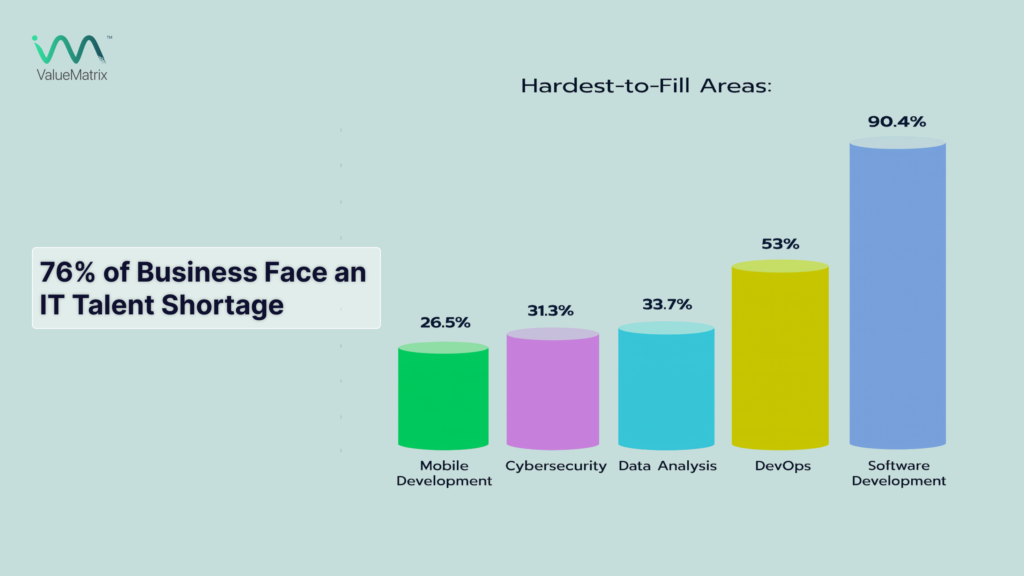
The IT sector is going through a severe talent drought. According to research by Quibit Labs, 96.4% of companies in the tech sector suffer from a skill-deficient workforce.
The problem gets even worse in the specialized roles like AI specialists, cybersecurity experts, and system architects. Even companies like Deloitte have struggled to fill their highly niche tech roles.
The IMF report shows that the tech sector will be short of 85 million workers by 2030, resulting in an annual loss of $8 trillion.
This completely blows the lid off the prevailing narrative that computer engineers will be replaced by AI. The stats tell a different picture. Companies are desperate to find a skilled workforce.
Rapidly emerging technologies
Highly specialized fields like AI/ML, cloud computing, and blockchain are changing at a breakneck pace. These sectors have not allowed the workforce to catch its breath. These fields are continuously being reinvented.
And AI has added another dimension to their challenges. For example, a DevOps engineer working in cybersecurity wasn’t worried about the threat of deepfakes five years ago. We already have voice modulation AI, where a scammer can call you pretending to be your best friend, and you wouldn’t know the difference.
Lack of specialised education and training.
Universities were caught unawares with the burgeoning demand for specialised skills in the IT sector. These technologies are changing by the minute, and no university program or course can compete with that pace.
A student will take at least 2-3 years to complete his computer science degree; by that time, the IT sector will have moved way far ahead. It’s a paradox. If you cut down the time of these courses, you compromise on the quality, and if you invest the required time in these courses, you risk turning them irrelevant.
So the universities will have to sit with industry experts to solve this conundrum. They’ll have to curate courses that can bring students’ skills up to speed with the market in record time without losing the quality, but easier said than done.
How is AI helping them navigate this talent shortage?
Here’s how AI can be a great ally to companies in this transformative period.
AI casts a wide net
AI can help you access the hidden talent market, i.e., people who are not actively applying but are restless. Companies have historically relied on HR written job descriptions on job boards to lure candidates. The downside to this approach is that it limits your possibilities, because only people who come across your job listing will notice it.
It cuts out a vast number of candidates who might be suited to your position. And this approach is very passive; you wait for people to click “apply” and submit their resume as you wait on the sidelines.
AI has taken talent scouting to a whole new level. It can scan not just the job boards but websites like LinkedIn, Github, industry-specific forums, various social platforms, and look for activities that indicate the willingness or desire for a career pivot.
These indicators may include adding new skills on professional social media platforms, uploading an updated resume, or engaging with industry-related content.
Skill-based matching
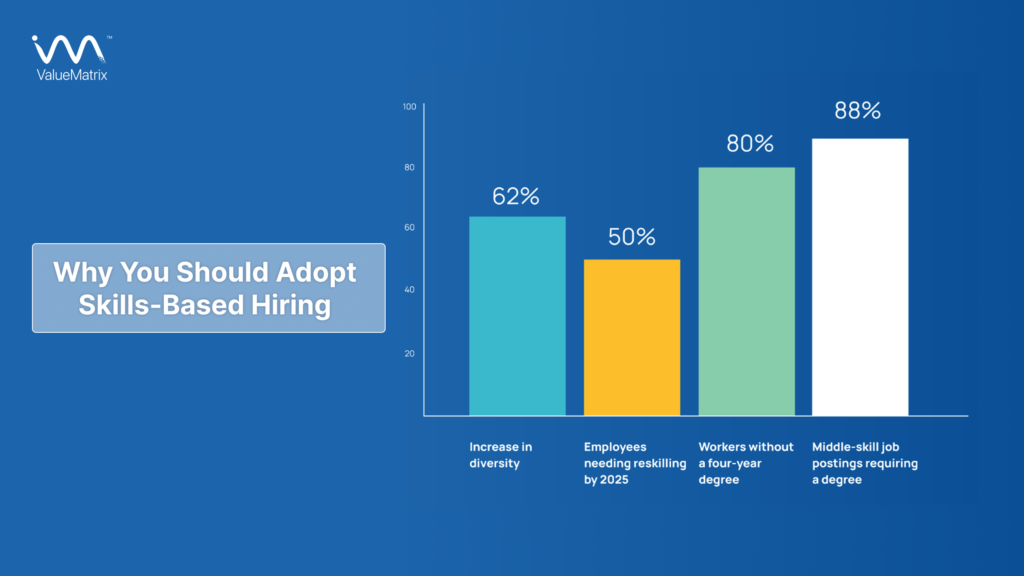
We have already discussed the acute talent shortage the tech sector is facing and how it’s going to get even worse by 2030. And the biggest reason that came out is skill mismatch.
The companies are finding it difficult to find talent whose skills are commensurate with the maddening pace of the IT sector. And the universities are also falling behind in their bid to churn out enough engineers for the new age technology.
AI can help companies bridge this talent gap. Talent intelligence systems can deploy predictive analytics and identify candidates who are closest to the desired skills based on their past projects, certifications, learning history, and real-world work, including technical contributions like code commits (which simply means the changes or updates a developer makes in their code repositories).
Predictive analytics can not only scout the talent with skills adjacent to what they require, but also suggest customised training modules or micro courses to help them upgrade their skills, so they can learn on the job and don’t have to take a sabbatical to enroll in a university.
These intelligence systems can predict the future skills that’ll be in heavy demand in the near future, assess the skill gaps of the workforce, and assign them relevant training.
This not only helps companies find skill-fit talent but also saves time and money on reskilling and upskilling.
Right behind the skill gap, high attrition rates are the biggest reason for companies facing talent issues. Runaway attrition rates mean your company will be chronically understaffed and always struggle to complete projects in time. This Forbes article reveals that US companies lose close to $1 trillion in employee turnover.
Another way predictive analytics can help companies save cost, time, and effort is by assessing the flight risk of an employee based on their interactions within teams. AI can parse a candidate’s performance, surveys, and email interactions, and gauge whether they are planning to stay or bounce.
Shorter time to hire
Another big impediment to finding talent in the tech industry is lengthy hiring pipelines. The hiring process in the tech industry can be especially multi-layered and complex. Your technical skills must blend into the existing ecosystem. So a candidate might have to face multiple rounds of live coding, product knowledge, and culture-fit assessments.
All of this takes a heavy toll on the applicants, especially if the feedback loop is slow or janky. Promising candidates might bounce due to too much delay. TALiNT Partners survey reveals that 71% of the candidates drop out if the hiring process is too complicated or bloated.
AI can be a huge helping hand to recruiters in cutting down this time drastically and streamlining the hiring process.
Automated resume screening cuts the hiring time by half and leaves ample time for the recruiters for job-appropriate coding tasks and assessments.
The feedback is instantaneous, and candidates don’t have to wait for days to hear back from HR. They get real-time feedback on their performance and mini-projects that are part of assessments.
What are leading companies doing differently?
Here’s what the future blueprint looks like.
Specialized skills hiring
Companies are moving from the post-COVID trend of bulk hiring and are hiring for specialised skills. They are still burnt from the experience of 2021; they overstocked the bench and then spent a lot of money firing those same employees.
Now the trend has shifted to specialized skill-based hiring. If you have demonstrable skills in one domain, like Cloud computing or cybersecurity, and can showcase either your past projects or talent in the said domain, you’ll be marked as a desirable hire by the companies.
Companies understand that AI is challenging the relevance of degrees. And we know it has been hard for university courses to match the pace of AI-powered advancements in the IT sector.
So they are relying more on the skills as they realise that skills are the real-world proof
of your work, whereas a degree is an untested theory, no matter how coveted.
In the words of Tesla and SpaceX founder Elon Musk:
“We don’t care where you went to school or even whether you went to school or what ‘big name’ company you worked at. Just show us your code.”
Rise in Remote hiring
Remote work is not entirely a post-COVID phenomenon, but it was relatively nominal. Only 6.5% of the workforce worked remotely. That changed post-COVID when companies were left with no other option but to adjust to the new reality.
In 2025, remote work has become a major staple in the corporate world. 81% of the workers say that remote work is just as important a factor as salary in deciding where to work.
46% say that they’ll quit their job if their option to work remotely is taken away.
These results show that employees have taken a liking to remote work, and companies don’t seem to mind because it saves them rental costs and eliminates other overheads like utilities, materials, and electricity bills.
That’s why remote work has become a part of contractual offerings. Almost every company offers either a remote or a hybrid option to its employees.
The reason is not just overheads but productivity as well. Research from Global Workplace Analytics shows that U.S. businesses lose $600 billion a year to workplace distractions. Remote setups help cut out many of those distractions, allowing people to focus better and get more done.
Remote work arrangement works for both the employees and the employer, so it’s safe to assume that it is here to stay.
Hiring for cross-functional roles
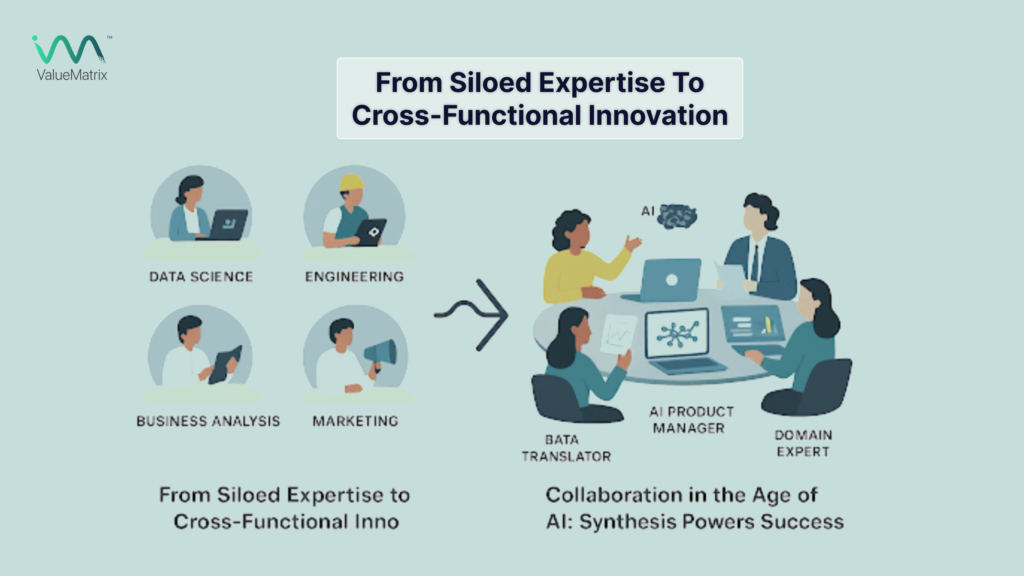
More and more IT firms are hiring for adaptability, and not fixed roles.
AI has broken down silos and pushed the work dynamic towards a more collaborative environment. Employers now prioritize professionals who can blend business, analytics, and technical insight and collaborate across different domains.
The World Economic Forum’s 2025 Future of Jobs Report forecasts over 170 million new jobs by 2030, with AI-integrated and hybrid roles leading growth globally.
What’s the reason behind this sudden cross-function hiring trend?
Innovation Happens at the Intersection.
An AI predictive model in retail, for instance, must also account for seasonality, supply chain patterns, and consumer psychology. Similarly, AI engineers in banking would need expert knowledge of domain experts in compliance, risk, and underwriting to create a truly valuable product.
Another great example is Tesla merging automotive engineering with AI-driven autonomy.
The future is cross-functional and collaborative; you need several domain experts coming together under one big umbrella to create a product.
McKinsey’s research shows cross-functional AI teams deliver 30–50% faster project rollouts and twice the ROI compared to siloed teams.
Diverse Teams
Diversity hiring is one of the positive side effects of AI. Machine learning tools have been able to mitigate human bias in hiring and allowed the underrepresented minority and ethnic groups to participate.
Equitable hiring is now more than a checkbox for companies. A Deloitte CEO survey found that 96% of CEOs confirm that diversity is a “personal strategic priority”.
Why do companies want a diverse workforce?
Diverse teams are more innovative, agile, and fast compared to homogenous teams. Forbes research found that teams that follow an inclusive process make decisions 2X faster with 1/2 the meetings.
Diverse teams widen your talent pool and are good for your market reputation. It also improves your happiness quotient and retention, which results in more profitability.
McKinsey report shows that companies that rank in diversity can be 35% more profitable than monolithic teams.
Conclusion
Hiring in IT is an evolving landscape, but it has still come a long way from where it used to be. The usual routine was to get an engineering degree and then get a job.
But things are changing, AI is threatening the standard practices of the IT sector.
As we discussed earlier, AI will create more jobs than it will displace, but it will demand an uncompromising upgrade. The future looks promising for those who are willing to reinvent themselves.
AI has broken silos of isolated work and demands collaboration. And the companies have also been quick to adapt to this dynamic landscape. For example, the IT sector was one of the last few remaining male-dominated bastions of the corporate world, and that bastion is being dismantled as diversity takes front seat in hiring strategies.
FAQs
Research shows that the ten most needed skills are software development, data analytics, DevOps, cybersecurity, mobile, web development, cloud skills (cloud services management), blockchain, AI, and full-stack.
For this purpose, any organization requires a strong employer brand, should offer competitive salaries and benefits, provide career growth opportunities, and embrace diversity and inclusion.
For a start, AI widens your selection pool; it parses the entire internet for potential hires and not just job boards. And secondly, it has been shown to mitigate bias at the screening stage so that deserving candidates who are diverse aren’t screened out due to certain keywords.
The best practice to follow during this transformative period is to keep your current workforce abreast with the latest advancements through on-the-job training modules and mini-courses.
About Us
ValueMatrix is an AI-powered talent intelligence platform that helps companies hire better, faster, and without bias. We go beyond resumes to assess skills, behavioral traits, and cultural fit using advanced AI and proven psychological frameworks. Our platform delivers data-driven insights that improve hiring accuracy, reduce time-to-hire, and elevate candidate quality.
ValueMatrix AI enables hiring teams to make confident hiring decisions and build high-performing teams at scale.