

Table of contents
- What Causes Workplace Psychological Issues?
- Major Psychological Issues That Affect Performance
- Workplace Factors Contributing To Psychological Issues
- How Workplace Mental Issues Impact Business Performance
- How HR Can Diagnose Psychological Issues Early
- What Organizations Can Do For A Healthy Work Environment
- FAQs
Mental health issues can be a silent crisis in a workplace. They drain organizations of their talented workforce, decrease productivity, and increase human resource costs. The 2024 Work in America survey by the American Psychological Association revealed that 43% of workers feel tense or stressed out during a workday. More than one in 10 (15%) workers reported experiencing a toxic workplace. If left unaddressed, psychosocial issues will have long-term repercussions on organizations. However, proactive initiatives can transform workplace culture.
What Causes Workplace Psychological Issues?
Workplace psychological issues, such as burnout, sleeplessness, and anxiety, arise among employees due to work-related stress. Stress occurs when demands/ expectations from work exceed an employee’s capacity and capability.
For instance, an employee suddenly promoted to a managerial role during their manager’s emergency leave may struggle without proper training or transition support. The situation worsens if they must maintain their original workload alongside new managerial responsibilities, as it exceeds reasonable capacity.
Psychosocial issues at work may arise due to several factors, including excessive workload, harassment, poor relations, and job insecurity.
Major Psychological Issues That Affect Performance
Identifying workplace psychological issues is the first step towards addressing them and preventing their recurrence. It’s imperative to know that mental stress due to work is not the same as clinical psychological problems. Work-related issues can be resolved by taking corrective measures within teams.
Burnout
Burnout stems from chronic, unaddressed stress. According to the World Health Organization’s (WHO) International Classification of Diseases 11th revision, burnout has “three dimensions: feelings of energy depletion or exhaustion; increased mental distance (cynicism) from one’s job; and reduced professional efficacy.” According to a report released by Boston Consulting Group (BCG) in 2024, on average, 48% of workers have experienced burnout. A survey by Censuswide for edtech company Moodle in 2025 revealed that 66% of American workers are experiencing burnout.
Disengagement
Disengagement refers to an employee’s act of distancing themselves emotionally, cognitively, and physically from work. This results in minimal effort and a lack of ownership. Gallup’s State of the Global Workplace 2025 study has shown that engagement among managers fell from 30% in 2024 to 27%, while individual employee engagement remained flat at 18%.
Workplace conflict
Differences among employees, workers, and managers, or groups, refer to workplace conflict. They arise due to opposing values, goals, and personalities. The2024 State of Conflict in the Workplace survey by Workplace Peace Institute found that 22% of the conflicts happen between a line manager and their direct reports, while 32% occur at the management level. Conflict affects performance – according to the survey, it led to 23% of employees leaving their jobs and 18% project failures.
Chronic stress and cognitive overload
Continuous work pressure, where an employee feels that their workload exceeds their physical and mental capacity, leads to chronic stress. These factors can have a long-term impact on the employees’ health and performance.
Depression and anxiety
At workplaces, depression manifests in the form of a lack of concentration, inability to make decisions, loss of interest, and fatigue. Anxiety crops from worry or nervousness related to work culture and expectations. According to WHO estimates, 12 billion working days are lost every year to depression and anxiety globally, costing $1 trillion per year in productivity.
Unlike physical stress, organizational psychology issues take time to surface; their impact is felt in the long term due to unaddressed problem areas at work.
Workplace Factors Contributing To Psychological Issues
The most common factors that adversely affect employees’ mental health are excessive work pressure, job insecurity, poor work-life balance, and a lack of control or autonomy.
Moreover, poor work relationships and social isolation in the context of remote/ hybrid setups can result in low morale, loneliness, and disengagement.
Leadership behaviors, such as a lack of empathy, harassment, micro-management, under-recognition of work, and an unhealthy work culture, can lead to severe psychosocial impact, which is one of the leading attrition risk factors.
The WHO identifies the following factors that pose a risk to mental health:
- Under-use of skills or being under-skilled for work
- Inflexible hours
- Poor physical working conditions
- Discrimination and exclusion
- Unclear job role
- Under- or over-promotion
- Inadequate pay
Addressing mental health issues isn’t just a moral obligation for HR and management—it also makes strong business sense. They result in high costs to organizations in terms of reputation and employee performance.
How Workplace Mental Issues Impact Business Performance
Research studies estimate the global economic burden of mental illness to reach $6.6 trillion by 2030. Most of it will be due to lost productivity in the form of absenteeism and presenteeism.
Decline in productivity
According to the American Psychological Association, employees who feel less psychologically safe are likely to struggle with low productivity and burnout. Stress, anxiety, and cognitive overload impair the ability to focus on work, thereby increasing the likelihood of operational inefficiencies. Reduced thinking and problem-solving abilities will have a ripple effect on team performance.
Rise in absenteeism & presenteeism
Absenteeism is regularly staying away from work, while presenteeism is being present at work but with low productivity. Fear of judgment, job insecurity, and unsupportive culture may make employees disinterested and stay away from work.
Increased attrition and talent drain
Burnout, conflict, toxic leadership, and a lack of growth are major contributing factors to attrition. Frequent hiring increases recruitment, onboarding, and training costs. Attrition results in the loss of institutional knowledge and disruption to ongoing projects. Moreover, it will have a long-term impact on the company’s brand and ability to attract talent.
Poor teamwork and culture
Stress-induced conflict and irritability lead to breakdown in communication and cooperation within a team. This lowers trust, team morale, and collective accountability.
The HR must take proactive measures to detect the underlying mental issues early and avoid a negative impact on performance.
How HR Can Diagnose Psychological Issues Early
Regular engagement surveys, pulse checks, one-on-ones, and inputs from exit interviews provide visibility into any gaps in the organization’s culture.
Engagement surveys
Properly designed engagement surveys provide a direct line of sight into the psychological state of the employees. Treat the surveys as an opportunity to bring change in work culture rather than a periodic ritual. Ask targeted questions on workload sustainability, stress levels, work-life balance, and managerial support. Keep the surveys anonymous and be transparent about data usage to get honest responses from employees.
Exit interviews
Exiting employees are more likely to talk openly than the working ones. But most organizations overlook the feedback they receive in exit interviews, considering them as an ex-employee’s bitter rantings. Although some bitterness is inevitable, the HR should realize that a majority of employees give genuine inputs, which, when acted upon, will be beneficial for the company.
Pulse checks
Typically consisting of five to ten questions, pulse surveys are conducted weekly or bi-weekly. Their frequency and brevity provide a quick insight into the employees’ mood in the backdrop of organizational changes, workload variations, and seasonal pressure.
One-on-ones
Make monthly one-on-ones of employees with the HR, team lead, or manager a part of the HR policy. These meetings should focus on the employee’s well-being rather than their performance. Make it an occasion for them to talk about themselves and share their concerns.
Data analytics
Analysis of turnover, absenteeism trends, and performance reviews enables HR to identify patterns in employees’ work behavior and productivity. This data-driven approach paves the way for a robust culture.
What Organizations Can Do For A Healthy Work Environment
The Office of the Surgeon General, US Department of Health and Human Services, recommends the following framework for mental well-being at workplaces. The framework is based on workers’ voice and equity, with five essentials to ensure workplace wellbeing.
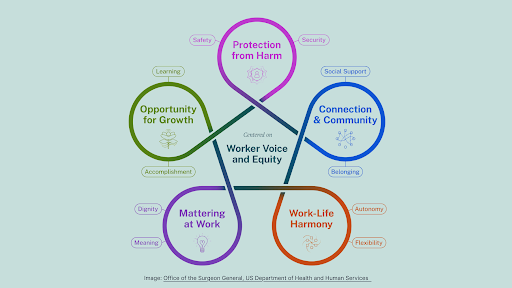
Protection from harm: Creating a healthy workplace begins with proactively removing physical and psychological hazards. Organizations must design environments and policies to make people feel safe.
- Provide ergonomic furniture, quiet zones, green areas, and proper lighting.
- Dedicate spaces for relaxation and mindfulness.
- Subsidize healthy meals.
- Implement strong policies against bullying, harassment, and discrimination.
- Create a judgment-free environment for workers to discuss their workload, stress, and challenges.
- Train managers in emotional intelligence and supportive leadership.
- Design mechanisms for anonymous feedback and grievance redressal.
2. Connection and community: Create a culture that fosters teamwork, nurtures trusted relationships, and encourages inclusion and belongingness.
- Implement a diversity, equity, and inclusion policy.
- Train employees and managers in respectful communication.
- Reward behaviors like collaboration, transparency, and respect.
- Recognize mentorship and team contribution.
3. Work-life harmony: Provide a flexible work schedule and hybrid model where possible. Allow them to use their paid leave and respect boundaries between their work and personal life.
- Monitor workload distribution and implement realistic timelines.
- Discourage after-hours messaging and calls unless critical.
- Encourage employees to take breaks and planned leaves.
- Implement micro-breaks during high-pressure cycles.
4. Mattering at work: Make the employees feel that they matter. Encourage them to share their ideas, give them freedom to work on them (ideas), and allow them to own their project.
- Include employees in decision-making.
- Make them feel valued through reward and recognition.
- Acknowledge their efforts and celebrate small wins.
5. Opportunity for growth: Advancement in career is a great motivator that mitigates psychological issues as employees witness their efforts coming to fruition.
- Provide growth opportunities to prevent stagnation and burnout.
- Offer training programs and mentoring.
- Sponsor their education and skill development programs.
- Ensure regular constructive feedback to help them improve.
- Implement job rotation to break monotony.
In addition, organizations should provide mental health support in the form of free counseling sessions and self-assessment tools. Performance and well-being monitoring should be a continuous process with regular audits and updates.
HR Checklist To Identify And Prevent Mental Health Issues at Work
| Action Area | What To Do |
| Awareness & Education | Raise awareness about the importance of mental health through engagement programs and activities. |
| Policy & Strategy | Draft a formal policy on mental health at work, applicable to all employees. |
| Leadership & Commitment | Designate a senior leader to champion mental health. |
| Culture & Inclusion | Ensure work culture supports raising issues such as stress, distress, and workload without the fear of repercussions. |
| Manager Training & Support | Provide mandatory training on recognizing warning signs (withdrawal, performance drops, behavioral changes) and conducting supportive conversations |
| Work Design & Load | Review and monitor workloads, role clarity, and work-life balance to avoid overload. |
| Physical & Psychological Safety | Create a comfortable workplace with ergonomic furniture, calm zones, and relaxation places. Implement strict policies against harassment, discrimination, and bullying. |
| Monitoring & Data-Driven Action | Detect early signs through surveys and use collected data for informed interventions. |
How HR Tech & Analytics Can Help
With the integration of technology and data analytics into HR systems, organizations can move from being reactive to proactive in addressing psychological issues at work. AI-based software like Value Matrix can help identify, monitor, and prevent problems with data-driven interventions.
- Use AI and machine learning to identify employees (and teams) at risk of burnout or turnover.
- Track mental health indicators across the organization with centralized platforms such as HRIS and wellbeing dashboards.
- Use employee pulse survey platforms for automated weekly/bi-weekly surveys.
- Provide first-line support for mental health questions and resources with 24/7 AI-powered chatbots and virtual assistants.
Case Studies: How These Organizations Addressed Work-Related Psychological Issues
| Company/ Industry | Challenge | Interventions Implemented | Result |
| A small corporate lending firm in the US | COVID-19 + imminent merger and organizational growth Return-to-office that threatened work-life balance and psychological safety | • Leadership buy-in, wherein the president took the initiative to hire a consultant for mental health • Baseline surveys on psychological safety & wellbeing • Discussions with employee focus groups to understand experiences and well-being • Strategic management of return-to-office • Targeted training for managers and leadership engagement | An environment that empowered employees to shed the fear of social stigma and seek help A ‘failing forward’ mindset that encouraged employees to take risks, experiment, and innovate A sense of loyalty that improved teamwork, commitment, and performance |
| Transport & Logistics Industry, Australia | Long hours and work pressure Ranking among the bottom-most industries in mental health | Setting up the foundation, Healthy Heads in Trucks & Sheds, by major industry companies Training forpeople working in the industry Standardizing regulationsand policies Improving the mental and physicalwell-being of workers | Substantial increase in awareness of mental well-being since the launch of the initiative in August 2021 ‘Considerable and persistent engagement’ on the foundation’s social media channels |
| On Swiss Sportswear | The need for a holistic program that focuses on body, mind, and purpose | Flexible vacation day policy to prioritize rest Launch of Kyan Health app that provides a self-care library, 12 coaching sessions, and internal wellbeing workshops and training | 11.6x ROI due to: Improvement in presenteeism-related productivity loss Reduction in voluntary attrition Reduction in HR costs to manage mental health |
The HR team should be at the forefront in drafting policies, having difficult conversations with the stressed-out employees, designing support plans, and helping workers seek professional help when needed. Preventing work-related psychological issues should be a continuous priority for HR. Undoubtedly, it’s their moral obligation toward the employees. But it’s also a financial imperative to uphold organizational productivity and performance.
FAQs
Burnout is a state of physical, emotional, and mental exhaustion at work due to constant pressure, overwork, and conflict. Disengagement is a lack of involvement, motivation, or commitment to work. Disengagement can stem from burnout, and burnout can be a result of prolonged disengagement.
Look out for signs such as absenteeism and presenteeism to act early. Address the issue respectfully and delicately while maintaining confidentiality. Listen more than talk, avoid being judgmental, and control the urge to offer instant advice.
Organizations must adhere to the labor welfare laws of the respective countries. Some of the most common ones are preventing foreseeable harm, providing a safe work environment, and not discriminating against employees with mental health conditions.
An unsupportive environment, unresponsive leadership, chronic stress, and a lack of welfare measures can make employees feel helpless. When no other avenues are available to resolve their issues, exit seems to be the only way out.
About Us
ValueMatrix is an AI-powered talent intelligence platform that helps companies hire better, faster, and without bias. We go beyond resumes to assess skills, behavioral traits, and cultural fit using advanced AI and proven psychological frameworks. Our platform delivers data-driven insights that improve hiring accuracy, reduce time-to-hire, and elevate candidate quality.
ValueMatrix AI enables hiring teams to make confident hiring decisions and build high-performing teams at scale.