

What to Find
- Predictive Analytics vs. Human Instinct: Who to Rely on in Hiring?
- Avoid Costly Hiring Mistakes with Data and Intuition
- Real Success Stories: How Analytics Transformed Talent Management
- The Secret to Smarter Hiring: Balancing Data and Human Insight
- Step-by-Step Guide to Flawless Talent Decisions
- Why ValueMatrix AI is Revolutionizing Talent Management
- The Future of HR: Data-Driven, Yet Human-Centered
Talent management is the core of every organization, yet making the right hiring decision remains a tough call. Hiring decisions are made in two ways: based on data-driven findings or human intelligence.
Data-supported decisions are made using algorithms, analytics, and data mining, whereas human intuition is about gut feeling, experience, and instinct.
Both approaches have diverse rules, challenges, and results.
A common Scenario
You hired a person who cleared every stage of the interview with flying colors and went through the intense testing processes. But after a few days, you realized that the recruit is not performing well and is struggling to cope with the work culture and pressure. Why so?
This situation is common in talent management. Even the most experienced talent acquisition manager often gets swayed by first impressions, instinct, or prejudice. In today’s competitive business space, a wrong hire is a major setback; it’s an expensive mistake that can slow down your business operation, negatively impacting your company, productivity, and bottom line.
The never-ending conflict between trusting human intuition and leveraging the power of predictive analytics is redefining companies’ talent management. While intuition is powered by speed and a personal touch, studies indicate that data-driven decisions are more accurate, better, and scalable hiring results.
In this piece of content, we’ll explore how combining predictive analysis with human intuition helps you ward off talent management disasters and why we need to evaluate the hiring process.
Predictive Analysis in Talent Management

Data-driven forecasting is about how businesses hire, train, and retain talent. For this evaluation, the process utilizes machine learning, data mining, and statistical systems to provide actionable insights to recruiters, analyzing past and present HR data.
How it works and its importance in recruitment:
- Mapping Candidate’s Journey: It digs into hiring history, performance analytics, predictive evaluation, and predictions about which candidates are going to do well in specific roles. Thus, enabling organizations to streamline hiring and avoid bias to hire the right candidates.
- Discovering Knowledge Gaps: It specifies workforce capabilities and predicts future talent needs. Given these predictions, organizations plan their training and upskilling plans. Thus, it prepares companies for future skill needs.
- Detect Future Attrition: Studying declining engagement level and productivity level, it points out members who are likely to quit without warning. One smart move by companies is to create new opportunities or offer personal counseling to help diffuse the situation.
- Improving Productivity: Using data-supported studies, the HR team can reconstruct team and work allocations for better productivity and increased engagement.
Use of predictive analytics in talent management has increased by 50% over the past three years. By 2025, nearly 80% of companies will start using data analytics for HR decisions, making it imperative for future organizations.
Case Studies of Predictive Analytics
Predictive analytics is the key performer in changing the talent management ecosystem by helping companies make better data-driven decisions. Let’s find out how businesses are succeeding using these tools:
1. Hiring: Xerox’s Solution to Employee Turnover
- Challenge: Xerox’s attrition was all-time high in its call center, which is expensive and challenging.
- Solution: In collaboration with analytics firm Evolv, Xerox collected and studied data on employee work history, preferences, personality attributes, and past performance. They found that those personality issues were the cause of quitting, not the non-performance.
- Impact: Xerox redesigned eligibility criteria, focusing on missing skills, and it reduced the attrition rate by 20% in a few months.
2. Retention: HP’s Focus Approach
- Challenge: Like several companies, HP faced employee attrition.
- Solution: HP relied on predictive models to find employees ready to quit, through engagement, performance, and personal situations.
- Impact: The company approached these employees with tailored retention strategies, lowering turnover rates, and saving talent and costs.
Astonishing Outcomes
- Graphical Effect: Using predictive tools, many companies witnessed a 25% decrease in attrition rates and a 48% acceleration in employee retention.
- Overall Benefits: This concept also redesigns recruitment, improves hires, and employee experience by elevating transparency and cutting bias.
Human Intelligence in Talent Management
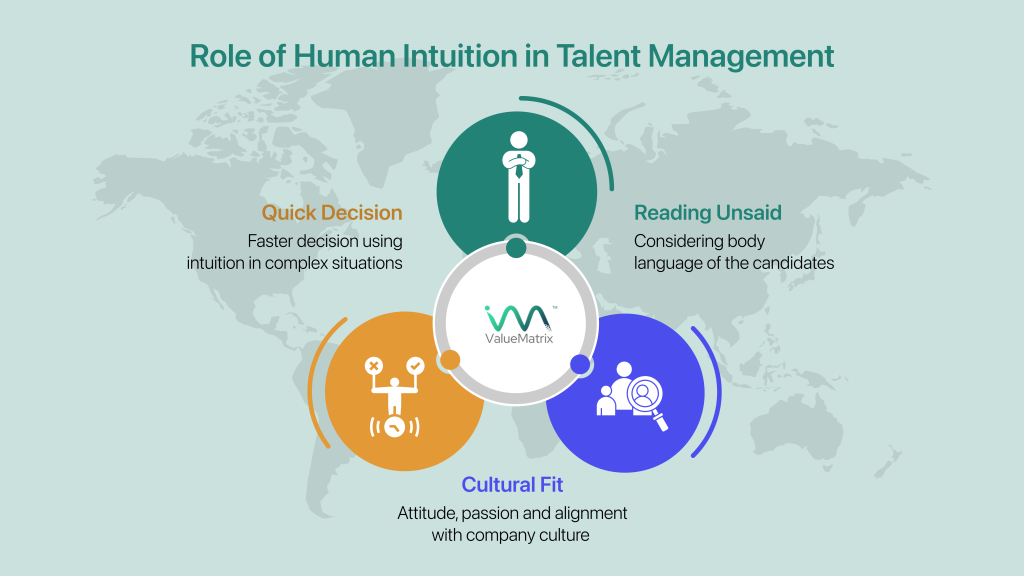
Effect of Human Instinct in Hiring
- Organizational Fit: Often, hidden attributes—approach, punctuation, and right match with company culture—can help recruiters find the ideal future employee, which is otherwise difficult to find using only AI.
- Reading Unspoken: Reading the body language, which is a great nonverbal interpreter, while hiring, is a common way of using human instinct in hiring.
- Instant Judgement: In crucial situations, the sixth sense helps HR professionals in selecting the best fit, despite having sufficient data.
Shortcomings of Intuition-Based Hiring
- Wrong Calculations: Intuition-based hiring is less effective in predicting their performance than AI analytics. In a study, the predictive system superseded recruiters’ gut feelings in most cases.
- In Common Practice Despite Shortcomings: Despite the evolving use of AI tools, about 90% of recruiters still rely on their instincts for final hiring decisions, preferring personal instincts over factual assessment.
- Unfairness and Incoherence: The inner voice is dominated by individual prejudices and preferences, often leading to wrong decisions.
- Skipping Qualified Candidates: Overtrust in human instinct results in ignoring potential aspirants. Such candidates may not instantly impress the recruiter, but might have the potential to fit the role.
So be on the right side of judgment. Considering all the above tips and adopting a hybrid talent management approach, have the best employees on board for the future success of the organization.
Predictive Analysis vs. Human Intuition: A Hybrid Approach
What is the best and smart choice for the right talent management? Is it predictive analysis? OR Human Judgement? It’s both!
A right and balanced blend of AI insights + human brain = hybrid Intelligence.
Hard information (AI) + Soft information (human intelligence) work wonders.
Integration is of the Essence
Recent research indicates that neither approach is effective when used alone.
The hard information approach, i.e., AI and predictive analytics, provides proficiency and accuracy—especially while parsing and predicting—but often skips delicate human factors. The human brain emphasizes looking out for organizational fit and reviewing interpersonal nuances, but is prone to bias and mismatch.
The besttalent intelligence policy is a blend of predictive analysis and human intelligence:
- Use predictive analytics to inform and narrow down choices.
- Put to work human instincts to include context and subtlety, especially in the last round of interviews and cultural fit evaluation.
This could be the winning approach for companies, resulting in unbiased and inclusive hiring decisions, enabling companies to build best-collaborating diverse teams while recouping retention and productivity.
How to Avoid Blunders: Actionable Steps
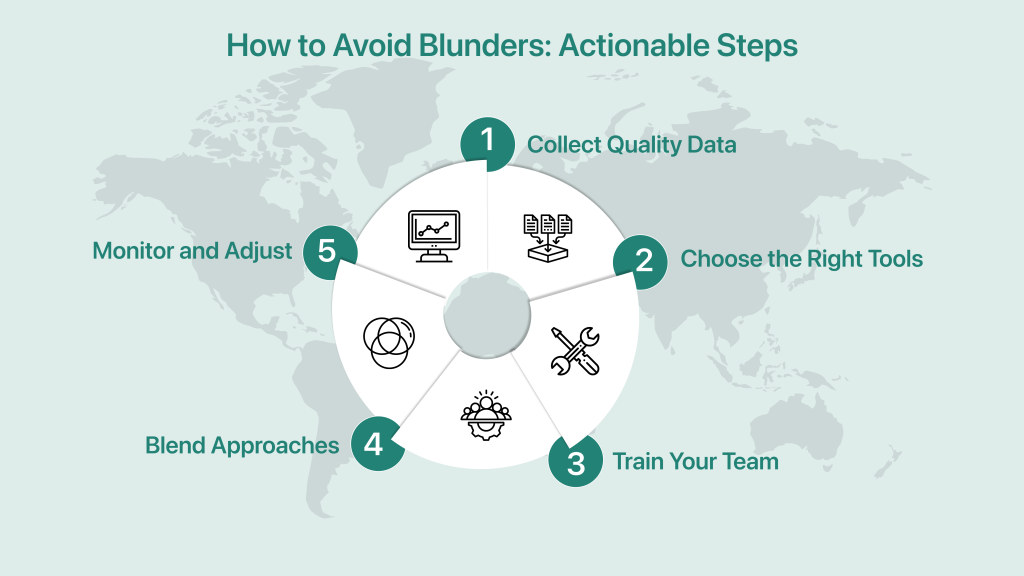
Forming the correct set of rules to avoid any pitfalls while using a data-driven approach is needed. Let’s dive into the tips you must follow to make predictive analytics work for your business and talent management:
1. Choose the Right Tools
When you use the right tool, the best result awaits. Look around and invest in advanced analytics platforms. Make sure your selected tool can process silos of related HR data and deliver actionable insights. Tools with interactive dashboards and machine learning, and those that are easy to align with your current system, can do wonders.
2. Collect Subtle Data
Ensure your metrics are accurate, whole, and solid. Inaccurate information prompts complexity. So, audit and sieve through your data sources mindfully. Garner data from multiple HR systems—like performance, recruitment, and payroll—to sort a consistent and reliable data repository.
3. Train Your Team
Form a team with HR and data analytics attributes. Train them regularly. It’ll help managers study analytics, identify their biases, and absorb data responsibly while making decisions.
4. Use the Hybrid Model
The best bet is to rely on predictive assessments for screening, predicting, and picking threats. Next, deploy human intelligence for final interviews, cultural fit studies, and subtle decisions. Such an approach drives equity and contextual intelligence.
5. Watch and Remodel
Review results. Redesign interview processes suggested by consistent review and insights. Accept required changes for successful business dynamics.
Accepting the above checklist of using predictive analysis can fix errors, offer improved HR strategies, and lubricate the predictive analytics engine of HR for the best outcome.
Why Data-Supported HR is the Future
There are many reasons to accept the shift toward data-based talent management today.
Organizations utilizing AI predictive analytics in talent management have witnessed better productivity, reduced attrition, improved retention rates, and great diverse workforce.
Using these AI-powered tools, today’s HR leaders can leap from a reactive problem-solving mode to a proactive mode. All by forecasting turnover, knowing skill gaps, and fixing recruitment processes before issues arise. There is still enough room to improvise despite this progress.
A study of 2025 suggests-42% of businesses are yet to embrace AI analytics. This will help HR leaders to gain a strategic edge in this competitive marketplace.
Today, adopting a predictive approach in talent management is not an option; it’s a necessity. A report suggests the HR analytics market will rise from $14.85 billion to $68.09 billion by 2025.
How AI Data Analytics Impacts HR Policies by 2025
Here are some staggering facts to underpin the future trend of data-based talent management:
- Worldwide Adoption: By 2022, 70% of companies were already using data analytics in HR. This is projected to surpass 80% by 2025, reflecting the growing recognition of analytics as a strategic advantage in talent management.
- Competitive Benefits: Companies using predictive analytics witness:
- Increased Productivity
- Structured Workforce Planning
- Improved Retention Graph
- Stronger Diversity Outcome
- Proactive HR Planning: Predictive analytics enables HR specialists to transition to proactive workforce planning. It includes forecasting attrition, suggesting skill gaps, and proacting before the issue arises.
- Results of Non-Adoption: Businesses, not relying on AI-driven predictive analysis, will lose credibility and edge in competition as their counterparts will outperform in retaining and managing their workforce.
- Growing Market: The AI market is growing fast and is expected to reach $244 billion by 2025, taking a leap from $14.85 billion. Ironically, 42% of companies have yet to embrace this advanced approach of AI for their HR policies, leaving space for futuristic HR leaders to step into this industry with new thoughts.
How ValueMatrix AI Helps Avoid Blunders in Talent Management
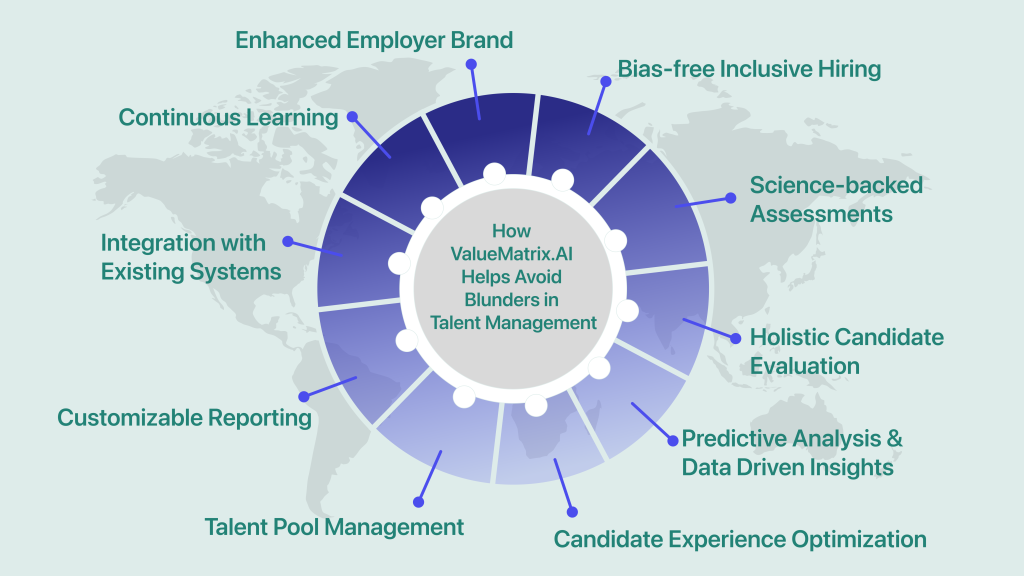
1. Science-Backed Assessments
This tool relies on proven psychological methodologies, psycholinguistics, and Computational assessment to study ‘Personality-Organization Fit’, ensuring aspirants synchronize with business culture and team cohesion.
For ValueMatrix, hiring is no longer just resume sorting and recruiting. It has crossed the old-school hiring processes. It uses gamified, non-intrusive evaluations, tests both hard and soft skills, cognitive potential, and behavioral traits, offering a complete view of each candidate.
2. Comprehensive Candidate Evaluation
For ValueMatrix, hiring is no longer just resume sorting and recruiting. It has crossed the old-school hiring processes. It utilizes gamified, non-intrusive evaluations that test both hard and soft skills, cognitive potential, and behavioral traits, providing a comprehensive view of each candidate.
3. Predictive Analysis & Data-based Insights
Using advanced algorithms, it studies historical and real-time insights to predict candidate success, retention threats, and proficiency gaps. This assists the HR team to filter the most promising candidates for long-term bonding, mitigating expensive hiring blunders.
4. Unbiased and Transparent Hiring
ValueMatrix is a specialist in an AI and machine learning based platform that terminates biased hiring and emphasizes on knowledge-driven approach. This enables the HR expert to pick the right candidates without any bias.
5. Improved Candidate Experience
Contacting the right candidate in the first place saves time and effort of the team in engaging with undeserving candidates. It’s also an inspiring journey for candidates.
6. Customized Reporting
ValueMatrix also provides user-friendly and neat reports that help HR leaders to prioritize different aspects and compare scores assigned to specific positions and segments.
7. Merging with Existing Tools
This system seamlessly integrates with current HR systems, ensuring a clean and hassle-free migration to data-based people management.
8. Ongoing Learning
The AI tools continuously learns from reviews/results, reframing their structures for simpler and better predictive accuracy and long-term relevance.
9. Talent Pool Repository
ValueMatrix also maintains a qualified database of culturally fit aspirants for future requirements, thus cutting hiring time with utmost proficiency.
10. Improved Employer Brand
A fair, open, and data-driven hiring system strengthens employer credibility, drawing and retaining the best brains.
Key Takeaways
As more and more businesses adopt HR analytics, platforms like ValueMatrix AI play a crucial role in making hiring a more diverse, effective, long-term, and high-yielding process.
This system helps companies eliminate common hiring mistakes, like bias, wrong cultural fit, and high turnover. These are speedbreakers to any company’s talent management system.
Futuristictalent management is the fusion of data-driven actionable insights and human intuition. Predictive evaluation provides insights into future workforce needs and supports employee acquisition, whereas human intelligence streamlines cultural fit and makes informed decisions. Both work towards the common goal of achieving strong talent management.
To achieve this common goal, platforms like ValueMatrix AI are the best bet. This tool is compatible with existing hiring systems, automating screening and offering measurable and actionable insights, while still leaving space for human intuition. Blending analytics with empathy delivers the best talent management. It uses data for informed decisions and human traits to add valuable context.
To sum up, organizations that acquire this balance can mitigate costly hiring mistakes and unleash the full throttle of their workforce for long-term success.
FAQs
1. What is predictive analysis talent management?
Predictive analysis is a process of utilizing stored data and algorithms to study and predict hiring success, skill gap, and attrition rate, thus allowing HR experts to make informed and data-focused hiring decisions.
2. How does predictive analysis serve as the mantra for better hiring?
It creates a recruitment roadmap by picking candidates who are likely to perform well, reducing bias, cutting time-to-hire, and elevating hiring quality.
3. Why can human instincts result in erroneous hiring?
Intuition is subjective and likely to bias and due to this, is often unable to read data patterns and future trends that predictive analytics can pick due to data data-based process.
4. Why HR intelligence should have a mix of human intuition and predictive analysis?
In complex scenarios, human intelligence adds context and empathy that robust data may lack, ensuring balanced decision-making.
5. How can businesses avoid the mistakes in talent management?
By combining human empathy and predictive analytics, confirming data quality, and training the HR team to read data accurately, organizations can reach a biasless hiring decision.
About Us
ValueMatrix helps organizations build culturally cohesive teams with AI-powered recruitment and retention strategies. We educate corporate leaders on the importance of involving and encouraging all generations to adopt enterprise values and participate actively to achieve excellence.
Our AI-powered platform transforms talent acquisition with intelligent hiring techniques backed by established psychological frameworks. We partner with HR professionals to conduct unbiased and holistic assessments for aspiring candidates.