
Table of contents
- What Is Comfort-Zone Hiring and Why Does It Feel So Right?
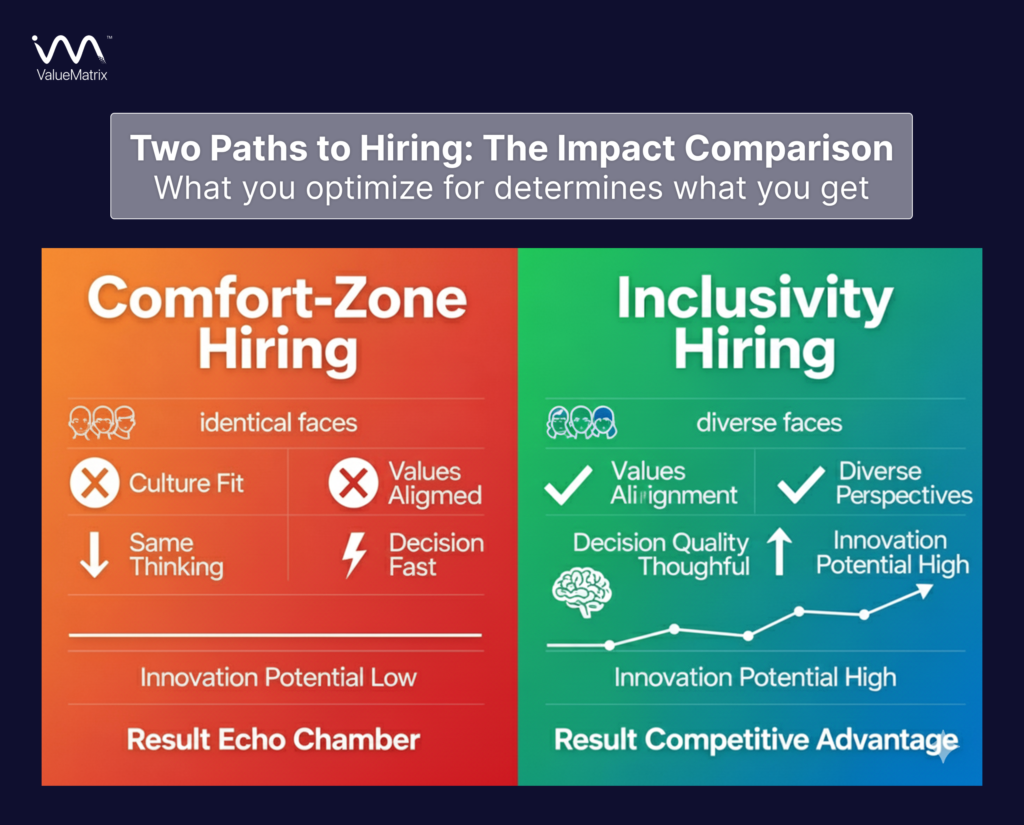
- Comfort-Zone Hiring vs. Inclusivity Hiring: A Side-by-Side Comparison
- Unpacking the Flaws of Comfort-Zone Hiring
- The Evidence Gap: Does Comfort-Zone Hiring Actually Predict Success?
- The Business Case for Inclusivity Hiring: Why It Outperforms
- Rethinking Inclusivity: Better Alternatives to Comfort-Zone Hiring
- Redefining Hiring Through Inclusivity: Data and Transparency
- In Practice: How High-Performing Organizations Are Building Inclusive Hiring
- In the End…
- FAQs
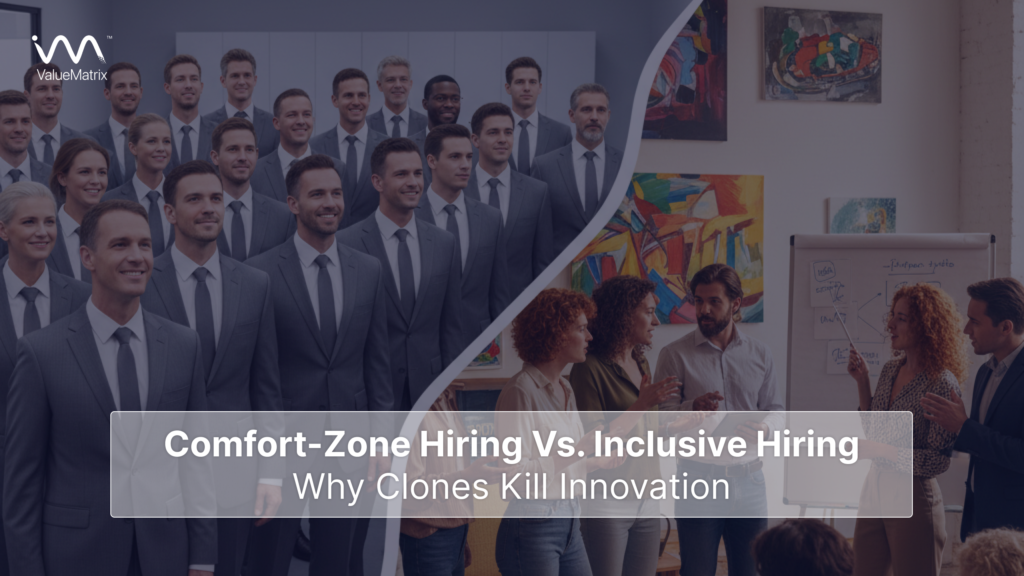
Let’s begin with this scenario: if you moved your entire top leadership to your fiercest rival tomorrow, would that change the way they operate? The sad reality is that for most companies, their top management is remarkably interchangeable. They will typically have a similar educational background, and their careers will have similar trajectories. They would often show similar patterns of decision-making, and on top of it, would communicate in a set pattern. This “sameness” is often celebrated as “culture fit.” However, it represents a fundamental business risk – a homogeneous team, one that cannot think out of the box. Simply put, herd mentality. This is the reason we need inclusive hiring. It has become the need of the hour rather than a compliance checkbox.
Comfort-zone hiring, the practice of preferring candidates who remind us of existing team members, sounds logical, promising shared values and smooth collaboration. However, the reality is a little contradictory. Comfort-zone hiring rarely focuses on values. Instead, it looks for sameness and inclines toward people who think like we do, talk the way we talk, and communicate in the same way. This sameness plateaus over time.
On the other hand, inclusivity hiring works in exactly the opposite way. It deliberately chooses people who share your company’s core values but think and act completely differently. These employees can make teams where different perspectives are shared in order to challenge the status quo and expose blind spots.
With this thought in mind, if you think your leadership team can easily move to your rival, then maybe you are a victim of comfort-zone hiring. And possibly, this is already hampering your company’s growth.
What Is Comfort-Zone Hiring and Why Does It Feel So Right?
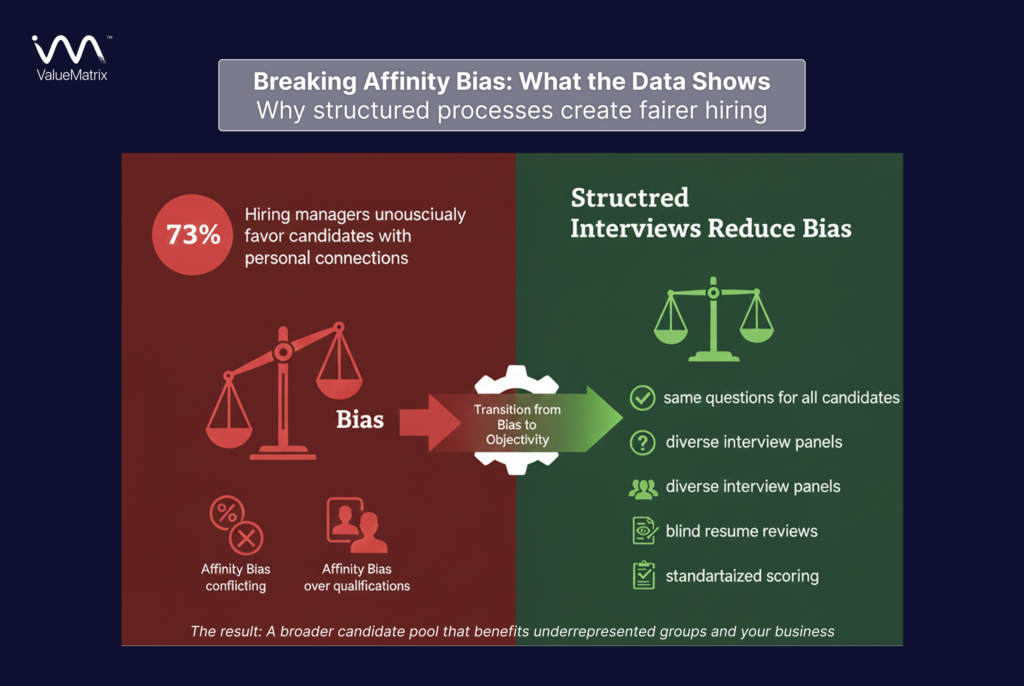
Comfort-zone hiring is when we pick candidates who feel familiar to us. They went to schools we know or worked at companies we admire. Conversations with them flow easily. This happens because of affinity bias. We unconsciously prefer people who seem similar to ourselves. Research demonstrates that 73% of hiring managers unconsciously favour candidates who share personal connections, alma maters, or even minor commonalities, with the Equality Action Centre finding that something as simple as sharing the same college creates immediate positive bias that overrides more relevant qualifications.
However, here’s where it gets tricky. The bias initially feels like a smart choice. You think you are hiring for a culture fit. But are you? Maybe you are just employing people who make you comfortable. Northwestern University research reveals that interviewers naturally exclude different perspectives by going with familiar profiles. And it’s so strong that it beats out actual qualifications and skills.
Comfort-zone hiring feels efficient and appears to build culture, but you’re actually building clones.
In a conversation with ValueMatrix :
Pratap G, a seasoned HR leader emphasizes, “Identify candidates with genuine domain loyalty who thrive on mastering specific skills (UI/UX, Figma tools) rather than title-chasers. Without clear growth paths in their expertise area, even top talent leaves within 2 years—regardless of company prestige.”
Comfort-Zone Hiring vs. Inclusivity Hiring: A Side-by-Side Comparison
| Aspect | Comfort-Zone Hiring | Inclusivity Hiring |
| Core Question | “Will this person fit in?” | “What unique perspective does this person bring?” |
| Selection Criteria | Similar backgrounds, communication style | Shared values, diverse thinking styles |
| Primary Driver | Affinity bias and comfort | Evidence-based assessment |
| Team Composition | Homogeneous thinking | Cognitively diverse perspectives |
| Interview Process | Unstructured, gut-feel-based | Structured, standardized rubrics |
| Innovation Potential | Low—predictable ideas only | High—varied perspectives |
| Decision-Making | Fast but prone to groupthink | Thoughtful and comprehensive |
| Long-Term Impact | Market vulnerabilities | Competitive advantage |
| Employee Retention | Limited growth paths | Higher retention through inclusion |
Unpacking the Flaws of Comfort-Zone Hiring
Comfort-zone hiring always feels logical. But there’s a limit to it. After a point, with such a type of hiring, you systematically don’t include people who have a different perspective. Without such employees, teams tend to have a unidirectional approach to all the problems. This leads to making the same mistakes over and over.
The Clone Problem: Echo Chambers and Blind Spots
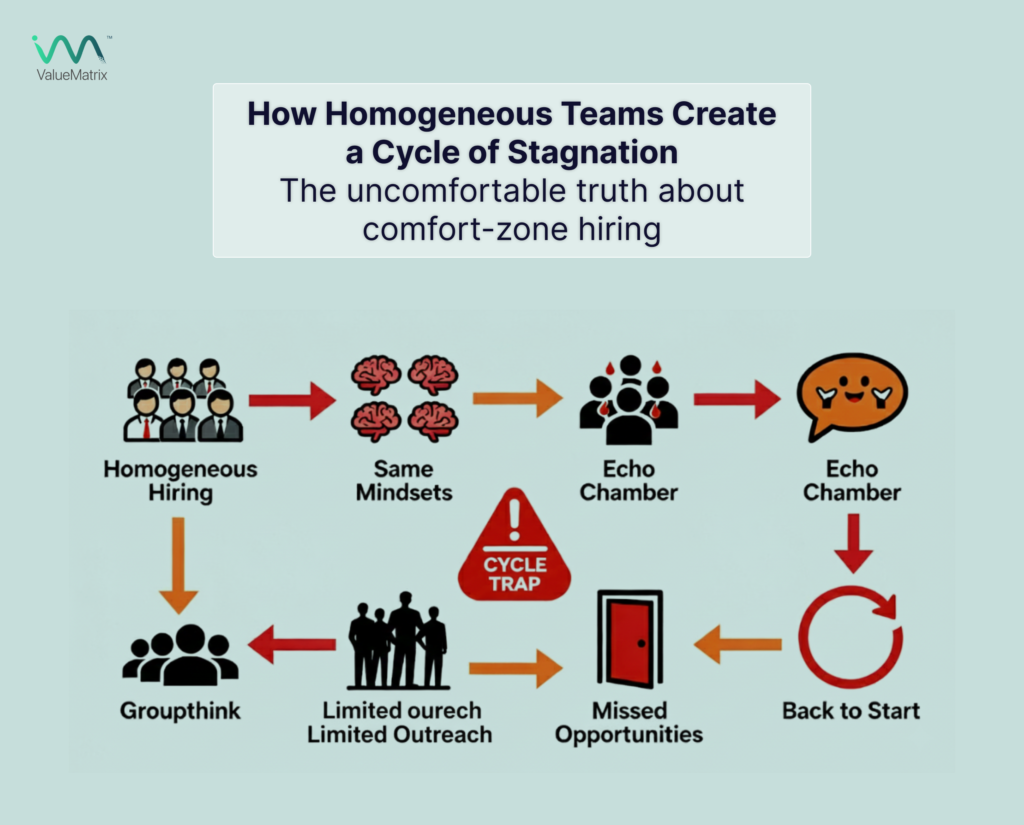
If you put together a group of people with similar mindsets and thought patterns, you are not creating a team. You are creating an echo chamber. In such a group, everyone will nod along. The daily standups will go smoothly, and decisions will be faster because no one really pushes back. On the surface, you can think, What’s the problem here?
Psychologists call such functioning groupthink. It’s when the urge to agree supersedes critical thinking. Homogeneous teams are especially vulnerable to such patterns. The need to have harmony can lead to poor decisions. And it could have all been prevented by simply having employees with different personalities and perspectives come together in the room.
Take Kodak as an example. They invented modern photography but completely missed the digital shift. Their leadership was not diverse. They thought digital cameras were a niche phenomenon (and couldn’t have been more wrong!) And by the time they realized their mistake, it was simply too late. A more diverse team might have caught this mistake early. Different voices challenge assumptions. That’s what saves companies from disasters like this one.
Innovation Suffers
A McKinsey study demonstrates that companies with strong ethnic and cultural diversity are 39% more likely to beat their competition. The reason is very clear. Team with different personalities and perspectives come up with better solutions. Similar backgrounds and experiences create a silo. It limits creativity.
Hiring diverse talent brings in fresh perspectives that spark innovation. Different viewpoints clash in productive ways. Meanwhile, homogenous workplaces see too much agreement. People nod along with each other. That comfort actually kills the creative tension needed for real breakthroughs to happen.
Your Company Becomes Blind to Its Own Blind Spots
When teams are too similar, they develop blind spots they can’t even recognize. They miss risks that sit outside their shared experience. and overlook market opportunities because their viewpoint is too limited. They build solutions that only serve people like themselves. An all-male product team might ignore what female customers actually need, a marketing group from one cultural background will struggle to reach others, and a sales team with matching backgrounds can’t connect beyond their own bubble. These aren’t just mistakes. They’re strategic weaknesses that hurt the business.
The Evidence Gap: Does Comfort-Zone Hiring Actually Predict Success?
The data becomes uncomfortable when we examine whether comfort-zone hiring actually works in predicting job performance.
What Actually Predicts Job Performance
Academic research often asks what truly predicts success. General mental ability and conscientiousness account for far more performance differences, close to 20 to 30 percent. Cultural fit explains much less. This means a person’s capacity to think, learn, and actually follow through matters more than blending into a team. Yet how many hiring managers really look for cognitive ability versus those who think, “Could I grab a beer with this person?”
The Problem of a Self-Fulfilling Prophecy
Cultural fit evaluations more often than not look like they can predict performance. But in reality, these assessments only mirror bias. They feel objective, yet they rely on personal impressions that do not measure hire quality. They are also easy to shape or manipulate. People who seem to “fit” usually get more trust. They receive better tasks and more guidance. Their work becomes visible. They earn positive reviews because managers invest in them. This creates a loop that looks like real predictive validity. It is not. The success is the result of the support they receive. It’s not a result of being a “culture fit.”
Let’s say you hire someone because they “feel like a good fit.” You give them high-visibility work and help them with mentorship. You even advocate for them during the appraisal cycle. Of course, they will succeed. But you should now be asking this question: did they succeed because they were a good fit, or because you invested more in them?
Work Engagement Is Driven by Other Factors
There is very little evidence that cultural fit shapes long-term engagement. Research shows that people feel engaged when they are paid fairly. They also stay when their work has meaning. Supportive managers matter a lot, too. Personal traits guide commitment far more than vague cultural labels. People remain when they grow and feel valued, not because they mirror a culture in their daily work lives.
The Business Case for Inclusivity Hiring: Why It Outperforms
Here’s a critical insight – inclusive hiring is not just right ethically, but also financially. Companies that integrate such inclusive hiring approaches have been seen to perform better. They also show improved innovation and retention.
Inclusivity Hiring Business Case: Key Performance Metrics
- 39% higher likelihood of outperforming competitors (McKinsey)
- 19% higher innovation revenue in diverse companies
- 2.3x higher cash flow per employee over three years
- 87% better decisions made by diverse teams
- 35% higher financial returns for gender-diverse executive teams
- 70% more likely to capture new markets
This isn’t marginal improvement—this represents transformational business performance.
Rethinking Inclusivity: Better Alternatives to Comfort-Zone Hiring
Better, more evidence-based alternatives to comfort-zone hiring exist, all starting with a fundamental shift in how you conceptualize teams.
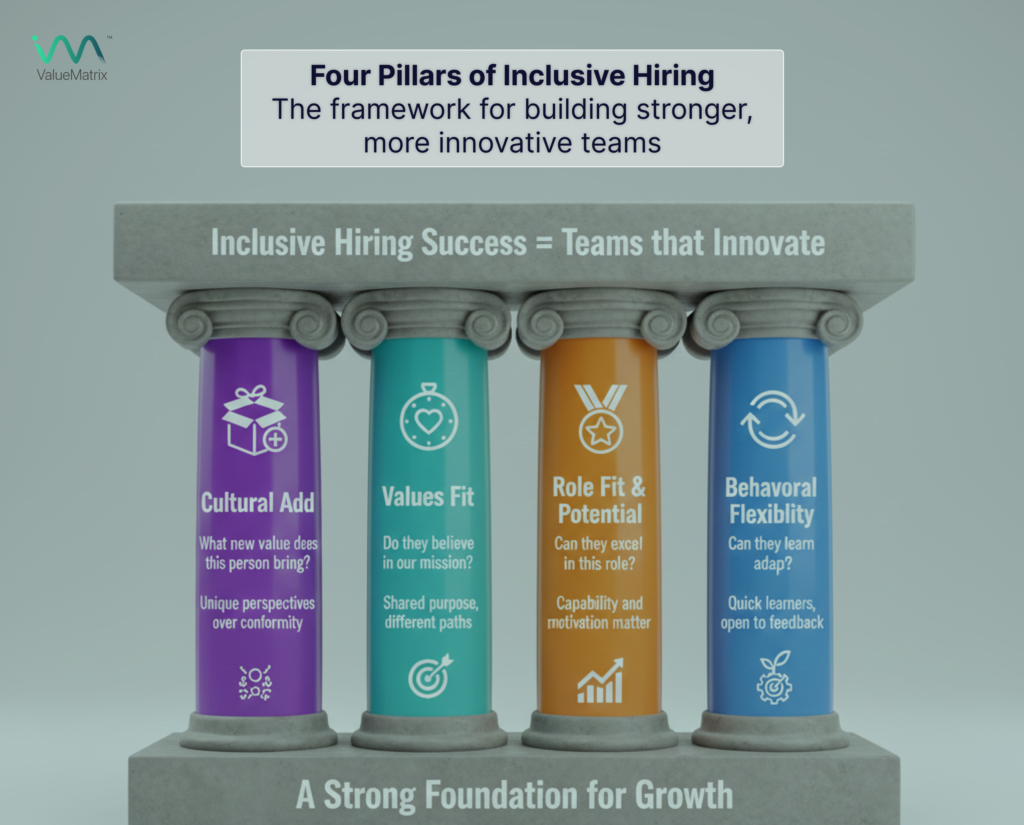
Cultural Add, Not Cultural Fit
Cultural add, shows the traditional concept by asking “What will this person add that we don’t already have?” instead of “Will this person fit in?” This approach centres on bringing people who contribute new perspectives, skills, or lived experiences, potentially meaning hiring from different industries or someone who challenges group norms. It recognizes that difference isn’t a problem but an opportunity, helping create more creative, resilient teams while preventing groupthink.
Values Fit, Not Culture Fit
Values fit gives us a smarter way to think about hiring. Yes, we need different perspectives on the team. But we also need something that brings us together. Otherwise, things fall apart.
Here’s the shift: stop looking for “culture fit” and start looking for values alignment. You want people who share your mission, not your identical backgrounds or opinions.
Ask yourself this. Does this person believe in what we’re working toward? What actually matters to them? Say your company cares deeply about sustainability. You’d want someone who genuinely values the environment, even if they have different ideas about how to achieve it. Disagreement on the details doesn’t mean they can’t contribute to the bigger goal.
To make this work, you need interview questions that dig into your core values. Train your interviewers to assess answers fairly and consistently. That’s how you build real alignment.
Role Fit and Potential
Another evidence-driven approach focuses on hiring for a role fit. It looks for the potential of the candidate to fulfil the role along with their personality. It uses structured interviews, scenario-based tests, and job-specific tasks to get tangible results and an evaluation of the applicant. Ask the hiring manager to put the candidate in a role-playing mode while evaluating for a sales job. Move away from regular and tiring “tell me about yourself” type of question. When asked about task-specific questions, the interviewer can cut through biases and properly evaluate the candidate based on capabilities.
Role fit also means assessing motivation. Why does this person want the role? How do they see themselves growing? These questions can tell you more about the potential of the candidate instead of just ticking off past experience. The interview is to find out what the candidate is able to do, while understanding who they are.
Behavioural Flexibility
Another growing focus centres on behavioural flexibility, recognizing that today’s workplaces change rapidly with evolving roles, shifting teams, and constant global challenges, requiring candidates who adapt quickly. An applicant with behavioural flexibility has the knack of taking feedback constructively. They are also able to collaborate with a wide range of colleagues across different departments. Their work is tangible with clearly defined KPIs and outcomes.
Any candidate who is able to learn quickly and handle challenges effectively will always qualify as a long-term investment rather than someone who is just a “culture fit.” When you prioritize skills and values over surface-level fit, you end up creating a broader candidate pool that benefits underrepresented groups along with your business.
Redefining Hiring Through Inclusivity: Data and Transparency
Transforming comfort-zone hiring into true inclusivity hiring requires vision and conscious effort from CHROs, demanding methods to identify core values in candidates, commitment toward diversity and innovation, and more valid testing tools. Hiring becomes more strategic and objective, teams become stronger and more adaptable, and companies grow not just in size but in depth and direction.
From Comfort to Values Alignment
One of the biggest shifts? Moving from “do they feel right?” to “do they share what matters to us?” Start by naming your actual core values. Not the polished mission statement on your website. The real principles that guide daily work. Then look for proof of these values in how candidates talk about their past choices and their approach to work. This method welcomes different personalities and communication styles. What matters is alignment with the mission. It gives hiring teams concrete insights instead of vague gut reactions.
Using Data to Identify Gaps and Opportunities
Hiring for “cultural add” means asking what someone brings to the table, not how well they disappear into the background. Look at your current team. What patterns do you see in education, experience, personality types, or how people solve problems? Then find candidates who add something different but valuable. A team of analytical thinkers might need someone more creative. A team that decides fast could grow by adding someone who asks the hard questions first.
Reducing Bias Through Structured Processes
Traditional hiring often favours people who interview well or have impressive resumes. This leaves out truly talented candidates. Structured interviews change this. When everyone answers the same questions and gets scored the same way, bias has nowhere to hide. Add diverse interview panels and blind resume reviews, and you’ve got a fairer system.
These practices help you build a more diverse team by focusing on what actually matters: capability and potential. No more getting swayed by fancy college names or surface-level charm. Just real skills and promise.
Creating Transparency and Accountability
Data-driven hiring promises to cut bias, but only when we actually check the numbers. Track who gets hired and who doesn’t. You’ll spot patterns fast. Maybe one manager always picks the loudest person in the room. Maybe women keep getting rejected at the final interview. The data shows what’s really happening.
Here’s the shift: when decisions need clear reasons instead of hunches, everyone starts asking for proof. Logic replaces gut feelings. Trust builds. Suddenly, the whole organization expects this same honesty everywhere, not just in hiring.
In Practice: How High-Performing Organizations Are Building Inclusive Hiring
Leading companies are moving past safe hiring choices. They’re building strong, diverse teams through clear values and organized processes. These organizations track both cognitive and demographic diversity. They know surface-level diversity without different thinking styles doesn’t work.
They make deliberate trade-offs. Hiring takes longer because they build diverse interview panels. They invest in training interviewers properly. The payoff in better decisions makes it worthwhile. Leadership gets coaching and support to make different choices, not punishment.
What happens? Companies using inclusive hiring see real results. Innovation goes up. Revenue grows. Top performers stay longer.
The evidence is clear. Inclusive hiring isn’t just good ethics. It’s good business.
In the End…
Hiring people just like you feels comfortable. It seems efficient at first. But here’s the thing: it quietly stifles innovation and creates hidden risks down the line. Inclusive hiring takes more effort. You need clear values, diverse thinking styles, and behavioral adaptability. It’s genuinely harder work. Yet it builds teams that think creatively and adapt quickly. The payoff? Teams that actually thrive when challenges hit.
Comfort creates clones. Inclusivity creates growth.
With Valuematrix’s data backed, inclusive insights, you can identify diverse talent profiles that help you shift from comfort-zone hiring to conscious hiring.
FAQs
We avoid this by staying clear about our values from the start. Define what your organisation stands for. Then look for candidates who genuinely share those values. Let people bring different backgrounds and thinking styles. That is what makes a team inclusive. When diversity exists without shared values, things fall apart. When both exist together, teams grow stronger.
The answer begins with data. Track your hiring patterns across different diversity indicators. Review each stage of the hiring process and check where bias shows up. Use blind resume reviews. Include varied voices on interview panels. Then look at long term results. Monitor who stays, who performs well and how diverse your final hires are. Compare this to your older methods. Change what is not working.
Not when the system is designed well. Structured steps often speed things up because they help you identify the right values and potential early. Tools like pre-hire assessments run in the background and save time. They also improve the quality of hires. The real slowdown happens when criteria are unclear and inconsistent.
Some conflict is normal. It often signals that people are bringing different insights. The key is shared values and clear communication rules. These help teams use conflict in a productive way. Inclusive teams will challenge each other. They also use those challenges to make better decisions.
Reflect on a few points. How many leaders could join a competitor and feel instantly at home? Is the thinking process same in your team members? How many risks did your organization miss that others spotted early? How many decisions felt right internally but failed outside? If these questions are hard to answer, comfort zone hiring may already be causing damage.
About Us
ValueMatrix is an AI-powered talent intelligence platform that helps companies hire better, faster, and without bias. We go beyond resumes to assess skills, behavioral traits, and cultural fit using advanced AI and proven psychological frameworks. Our platform delivers data-driven insights that improve hiring accuracy, reduce time-to-hire, and elevate candidate quality.
ValueMatrix AI enables hiring teams to make confident hiring decisions and build high-performing teams at scale.