
Table of contents
- What Is AI Candidate Assessment?
- Why Are Organizations Rethinking Candidate Assessment Data?
- How Can AI Candidate Assessment Data Be Turned Into Talent Intelligence?
- Which Hiring Decisions Can Be Improved Using Assessment Data?
- What Actually Matters in AI Candidate Assessment Platforms?
- What Are the Key Metrics to Measure Assessment Data ROI?
- How Can ValueMatrix Help in Building A Talent Intelligence Strategy?
- Summary
- Conclusion
- Frequently Asked Questions
Key Takeaways:
- 73% of talent acquisition professionals say AI will fundamentally change hiring, but most organisations have yet to unlock the full value of candidate assessment data. Instead of reusing it to improve future hiring decisions, they often treat it as information that’s only useful for a single recruitment cycle. (LinkedIn Future of Recruiting 2025, n=1,271)
- The average cost-per-hire in the U.S. is $4,700 (SHRM). Instead of starting from scratch every time they recruit, organisations can lower these costs by reusing insights from previous candidate assessments
- Recruiters who use AI save about 20% of their workweek by automating repetitive hiring tasks. That extra time can be spent making better use of candidate assessment insights to support smarter hiring decisions. (LinkedIn Future of Recruiting 2025)
- While 89% of talent acquisition professionals believe measuring quality of hire is becoming increasingly important, only 25% are confident in how well they measure it. Reusable, structured assessment data can help bridge that gap. (LinkedIn Future of Recruiting 2025)
- Companies that make the most of skills-based searches are 12% more likely to make quality hires. Reusing structured candidate assessment profiles is one of the most effective ways to build a scalable, skills-first hiring strategy. (LinkedIn Future of Recruiting 2025)
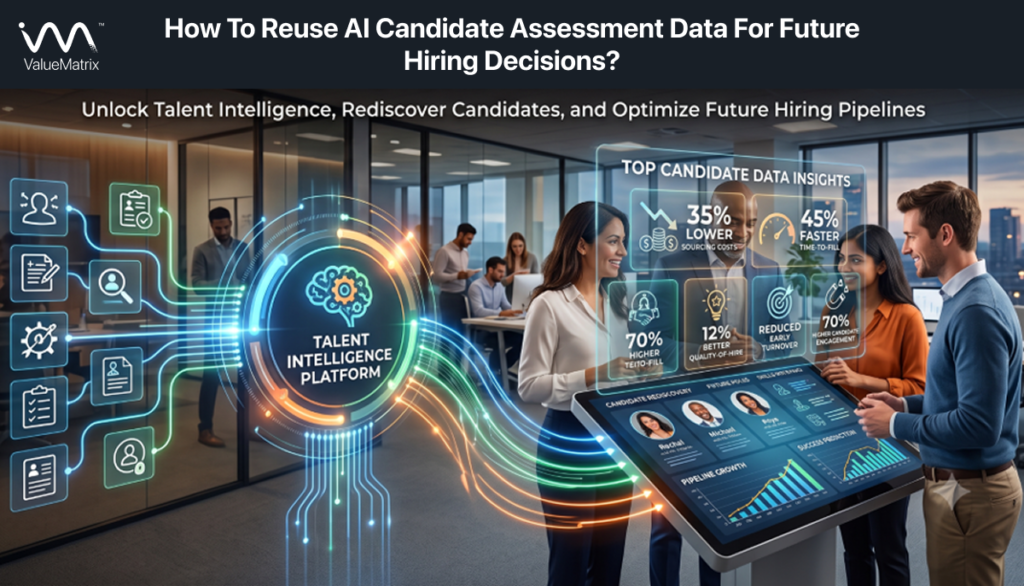
Recruitment teams invest a lot of time and resources in evaluating candidates; however, most AI-generated candidate assessment data is used only once and then archived. This approach overlooks a valuable source of hiring intelligence that could improve future recruitment decisions. According to the LinkedIn Future of Recruiting 2025, 73% of talent professionals agree that hiring is transforming with AI, requiring organizations to make better use of workforce data rather than relying solely on new sourcing efforts.
Meanwhile, the SHRM Recruiting Benchmarking Report estimates that the average cost per hire is approximately $4,700. Many positions can cost considerably more once advertising, recruiter time, and assessments are calculated. Instead of repeatedly rebuilding talent pipelines, organizations can transform AI candidate evaluation data into a reusable asset. It can support candidate rediscovery, predictive hiring analytics, as well as long-term workforce planning.
The future belongs to employers that treat candidate assessments as an ongoing source of business intelligence, not simply a one-time hiring decision.
What Is AI Candidate Assessment?
AI candidate assessment uses artificial intelligence to evaluate applicants based on technical skills, behavioural traits, cognitive abilities, and cultural fit. The resulting assessment data can be stored, searched, and reused, helping organisations make smarter hiring decisions for future roles instead of relying on one-time evaluations.
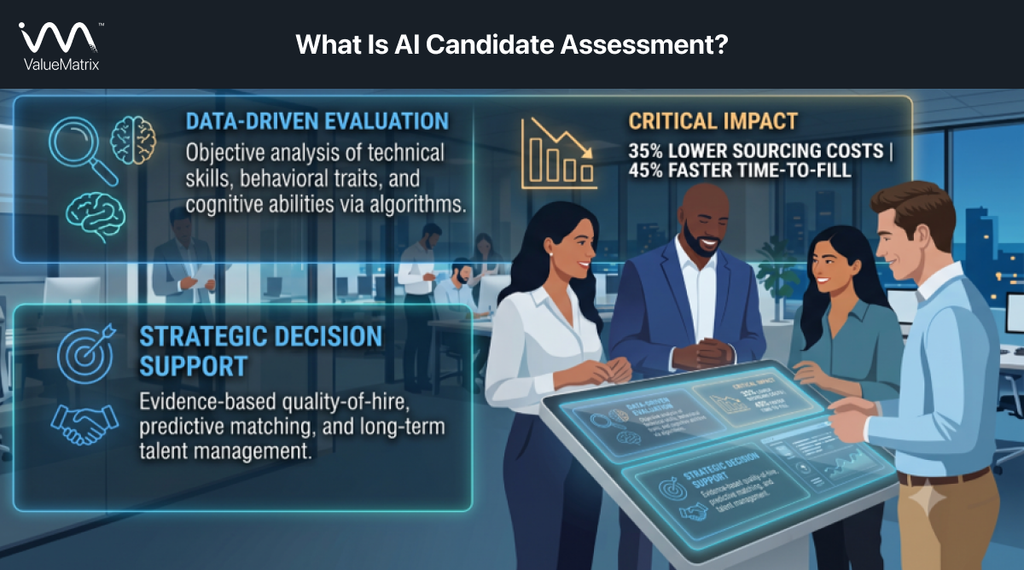
AI candidate assessment is the process of using artificial intelligence to evaluate job applicants through structured, data-driven methods rather than relying solely on resumes and interviewer judgment. Modern AI hiring assessments measure technical competencies, behavioural attributes, communication skills, cognitive abilities and cultural fit to provide a comprehensive evaluation of AI candidates. Instead of generating one-time hiring decisions, these assessments create structured hiring data that can be stored, analysed, and reused across future recruitment cycles.
The use of AI in recruitment is rapidly becoming mainstream. According to LinkedIn Future of Recruiting 2025, 73% of talent acquisition professionals agree that AI will fundamentally change how employers hire. While recruiters are already using generative AI, the LinkedIn Future of Recruiting 2025 report states that they are saving approximately 20% of their workweek by automating repetitive hiring tasks. These gains allow hiring teams to focus more on candidate evaluation and strategic decision-making rather than administrative work.
How Does AI Candidate Assessment Compare with Traditional Candidate Screening?
Traditional candidate screening heavily relies on resume reviews, recruiter opinions, and interview impressions. These can often vary between hiring managers. In contrast, AI candidate assessment produces structured assessment data based on measurable competencies as well as job-relevant skills.
Instead of supporting a single hiring decision, it creates reusable candidate intelligence that strengthens candidate rediscovery, predictive hiring analytics, and long-term hiring decision support.
What Data Can AI Candidate Assessments Capture?
Unlike resumes, AI candidate assessments gather information about numerous dimensions of candidate potential. This includes skills assessments, behavioural indicators, cognitive assessments, cultural fit assessments, interview performance, communication ability, and role-fit indicators. All these insights become reusable candidate profiles that support talent pipeline management, future hiring planning, and predictive talent matching.
The importance of structured assessment is reflected in another finding from the LinkedIn Future of Recruiting 2025 report: 89% of talent acquisition professionals say measuring quality of hire is increasingly important, yet only 25% feel confident in their ability to do so. This shift is driving organisations away from resume-centric hiring towards assessment-driven recruitment that produces richer, reusable candidate intelligence.
Why Are Organizations Rethinking Candidate Assessment Data?
Organisations are rethinking AI candidate assessment because its value goes beyond filling a single role. Assessment data, including skills scores, behavioural profiles, and cognitive insights, can be reused to rediscover candidates, reduce sourcing costs, and build stronger talent pipelines for future hiring decisions.
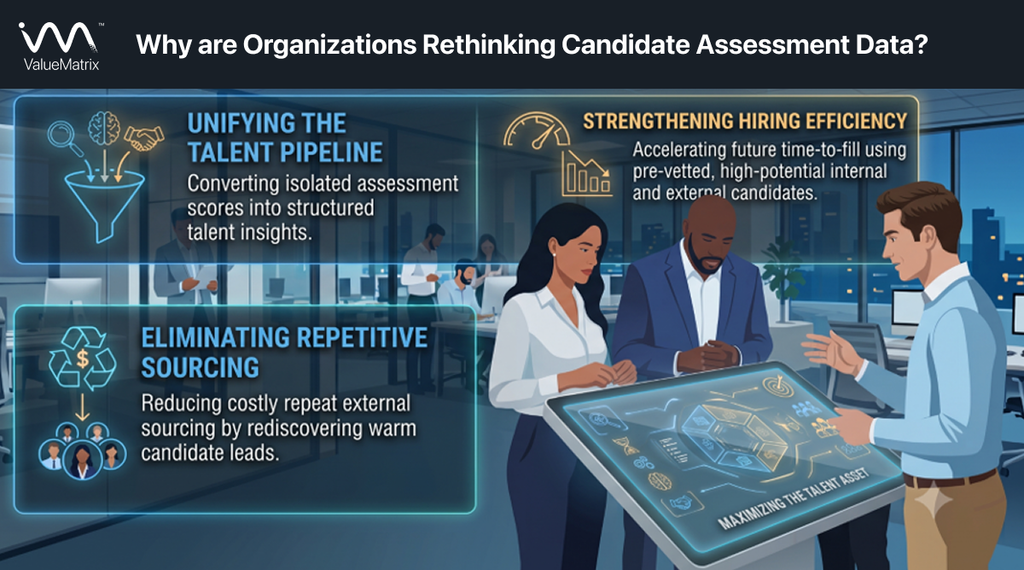
The real value of AI candidate assessment only begins after the hiring decision is made. Each assessment offers organisations the opportunity to rethink AI candidate assessment because its value extends beyond filling a single vacancy. Reusing structured assessment data improves hiring efficiency, strengthens talent pipelines, supports better hiring decisions, and reduces the need to repeatedly source and assess similar candidates.
Why Is Talent Too Expensive to Rediscover Repeatedly?
Repeated sourcing for similar roles increases recruitment costs and wastes valuable candidate intelligence. Candidates who have already completed AI hiring assessments often possess verified skills and competencies, yet their assessment data remains underutilised.
Why Is Candidate Rediscovery Becoming a Competitive Advantage?
Candidate rediscovery enables recruiters to re-engage previously assessed candidates, creating warmer talent pools and reducing time-to-hire. Rather than evaluating new applicants from scratch, recruiters can quickly identify candidates whose existing assessment data align with emerging business needs, improving both hiring speed and the candidate experience.
How Does Assessment Data Create Long-Term Hiring Intelligence?
Structured assessment data supports candidate lifecycle management, talent pool optimisation, and workforce planning by enabling the creation of searchable, reusable candidate profiles. Instead of isolated hiring records, organisations develop a growing repository of talent intelligence that becomes more valuable with every assessment.
Why Do Future Hiring Decisions Need Better Evidence?
High-quality hiring requires evidence, not assumptions. LinkedIn’s Future of Recruiting 2025 report states that companies making the correct use of skills-based searches are 12% more likely to make a hire of high-quality candidates.
This fact highlights how structured assessment data can help improve hiring decision support, predictive talent matching as well as long-term hiring quality. Here, AI can streamline the whole process by uncovering skills through resume analysis, automating skills assessment, and helping remove bias from the hiring process.
How Can AI Candidate Assessment Data Be Turned Into Talent Intelligence?
Candidate assessment data becomes valuable talent intelligence when it is captured thoroughly, stored in structured profiles, organised into a searchable database, enhanced with predictive insights, and updated over time. This five-step approach turns one-time hiring data into a long-term strategic asset.
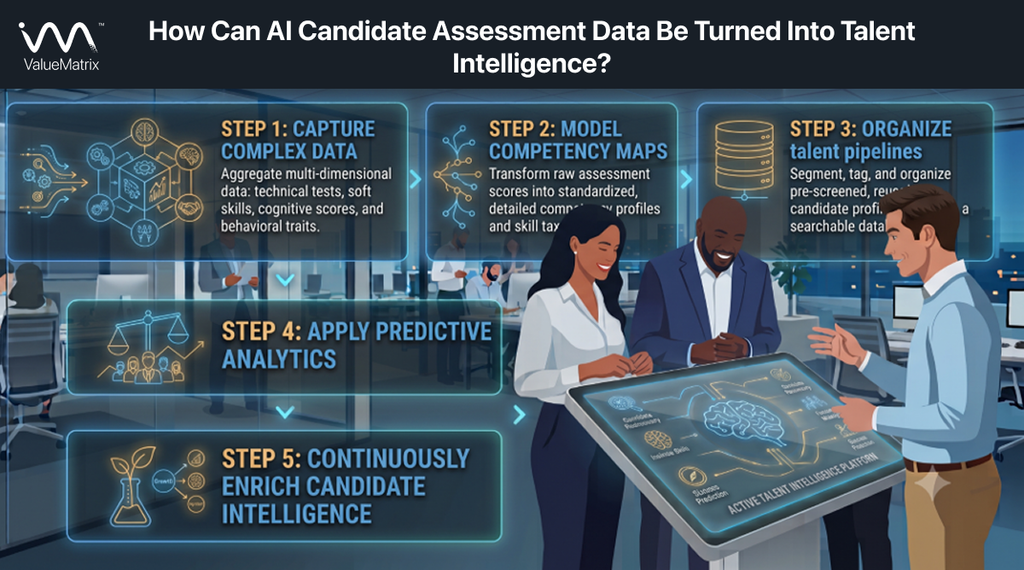
Assessment-driven hiring becomes far more powerful when candidate data is organised, searchable, and reusable. Rather than storing assessment results after a hiring decision, organisations can leverage AI candidate assessment data to build a dynamic talent intelligence system that supports candidate rediscovery, talent pipeline management, and future workforce planning.
Step 1: Capture More Than Assessment Scores
The first step is to collect comprehensive hiring data. The data will include skills data, behavioural insights, interview outcomes, and even role-fit indicators. It helps to create a holistic AI candidate evaluation.
Step 2: Build Reusable Candidate Profiles
The next step is to consolidate candidate scoring systems, skill libraries, competency mapping, and assessment history into reusable candidate profiles, as it can support multiple hiring cycles.
Step 3: Create a Searchable Talent Intelligence Database
Organise candidates using talent segmentation, role categorisation, candidate tagging, and pipeline organisation. This step helps recruiters to identify qualified talent quickly.
Step 4: Apply Predictive Hiring Analytics
The next step involves using predictive hiring analytics to improve candidate performance prediction, success forecasting, and future role matching, which is based on structured hiring data.
Step 5: Continuously Enrich Candidate Intelligence
Under this step, it is necessary to keep profiles updated by adding new assessments, updated skills, certifications, and career progression. This ensures talent intelligence remains accurate, relevant, and ready for future hiring opportunities.
Which Hiring Decisions Can Be Improved Using Assessment Data?
AI candidate assessment data improves hiring decisions across the talent lifecycle. By reusing structured candidate insights, organisations can accelerate hiring, strengthen talent pipeline management, enhance predictive talent matching, and make more strategic workforce planning decisions.
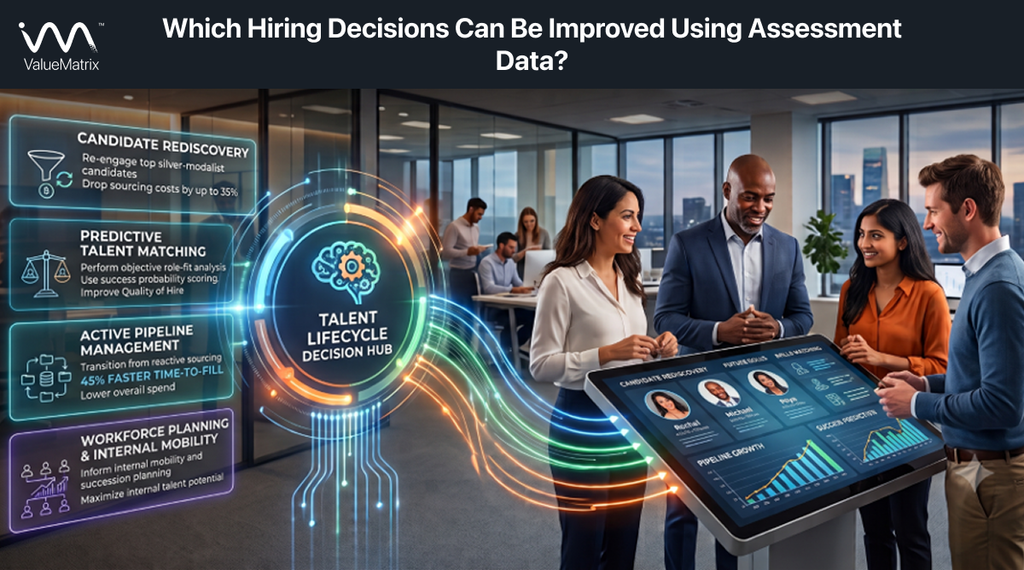
The most effective organisations use AI-powered hiring insights throughout the talent lifecycle, and not just during the screening phase. Every AI candidate assessment generates structured hiring data that can be reused to support future hiring, improve recruitment efficiency, and build a long-term talent intelligence strategy. Instead of treating assessment results as one-time records, organisations can leverage them to make faster, more accurate, and evidence-based hiring decisions.
Candidate Rediscovery for Future Openings
Candidate rediscovery helps recruiters to re-engage qualified “silver-medalist” candidates whose verified skills already match future vacancies. Instead of restarting sourcing efforts, recruiters can easily search reusable candidate profiles.
As per the TestGorilla State of Skills-Based Hiring 2024, about 81% of employers use skills-based hiring. This number highlights the growing importance of verified assessment data over traditional and outdated resumes when filling current and future roles.
Talent Pipeline Management
Structured assessment data supports robust talent pipeline management by creating searchable talent pools for future hiring planning. Candidate profiles containing competency mapping, assessment history, behavioural insights, and verified skills enable organisations to nurture high-potential candidates before vacancies arise.
This proactive approach supports talent pipeline building, recruitment data management, and hiring workflow automation while reducing dependence on continuous external sourcing.
Predictive Talent Matching
Structured hiring data also powers predictive hiring analytics. Recruiters can perform role-fit analysis, support skills-based hiring, evaluate the probability of success, and also identify candidates whose capabilities align with future business opportunities.
This improves hiring quality while enabling more accurate predictions of candidate performance and predictive talent matching across multiple roles.
Workforce Planning and Internal Mobility
Beyond recruitment, assessment data supports succession planning, internal mobility, and workforce planning. Reusable candidate profiles help organisations identify transferable skills, recommend internal opportunities, and generate workforce-planning insights to meet changing business needs.
According to the World Economic Forum, Future of Jobs Report 2025, 39% of workers’ core skills are expected to transform by the year 2030. Hence, continuously updated assessment data becomes essential for long-term talent planning as well as organisational agility.
What Actually Matters in AI Candidate Assessment Platforms?
The best AI candidate assessment platforms do more than simply automate the screening aspect. They transform assessment data into reusable talent intelligence, enabling organisations to improve hiring quality, support predictive hiring analytics, and make smarter workforce decisions over time.
Businesses must remember that not every AI hiring assessment is built for long-term talent intelligence. Many platforms generate assessment scores that are rarely revisited once a position is filled. So, leading solutions capture structured hiring data that can be organised, searched, and reused across the entire candidate lifecycle.
This allows recruiters to move beyond one-time evaluations and build a sustainable hiring strategy powered by AI candidate evaluation, reusable candidate profiles, and predictive hiring analytics.
What Features Should an AI Candidate Assessment Platform Include?
An effective AI candidate assessment platform should include predictive hiring analytics, reusable candidate profiles, talent intelligence dashboards, and comprehensive recruitment data management. Features such as competency mapping, candidate scoring systems, skills-based hiring insights, automation and AI recruitment help recruiters evaluate talent consistently while improving hiring efficiency.
What Types of Hiring Intelligence Solutions Are Available?
Modern recruitment strategies essentially combine different factors like AI hiring assessments, talent intelligence platforms, and recruitment and workforce analytics tools. Together, these technologies support candidate lifecycle management, talent pool optimisation, workforce planning insights, and data-driven recruitment. When integrated with ATS and HR systems, they create a unified hiring ecosystem that improves AI-powered decision-making across every stage of the recruitment process.
Why Is Assessment-Driven Hiring Becoming the New Standard?
Organisations are now adopting assessment-driven hiring rapidly because it produces measurable, evidence-based outcomes. Assessment data that is structured well aims to support AI-powered hiring insights, predictive talent matching, and long-term improvements in hiring quality.
The need for intelligent hiring systems is reinforced by the World Economic Forum, Future of Jobs Report 2025, which found that about 63% of employers identify skills gaps as the biggest barrier to business transformation. Platforms like ValueMatrix address this challenge by turning assessment data into reusable talent intelligence that helps organisations identify, develop, and redeploy talent more effectively.
What Are the Key Metrics to Measure Assessment Data ROI?
The success of AI candidate assessment should be measured through business outcomes, not just assessment completion rates. Tracking the right metrics like time-to-fill, quality of hire, cost per hire, talent pipeline strength and candidate rediscovery rate helps organisations evaluate hiring efficiency, talent intelligence, and the long-term value of reusable candidate data.
If candidate assessment data is being reused effectively, it should improve hiring outcomes over time. Monitoring key performance metrics enables organisations to evaluate the impact of AI candidate assessment, optimise predictive hiring analytics, and strengthen talent pipeline management while reducing recruitment costs.
| Metric | What It Measures | Why It Matters | Industry Benchmark |
| Candidate Rediscovery Rate | % of new hires sourced from previously assessed candidates | Measures how effectively assessment data is being reused, the core ROI of a talent intelligence strategy | No single industry benchmark. Aim for 15–25% of hires coming from re-engaged past candidates as a starting target |
| Time-to-Fill | Days from job post to accepted offer | Indicates efficiency gains from having warm, pre-assessed talent pipelines ready | U.S. average: 42 days (SHRM 2025 Benchmarking). Organisations with strong talent pipelines typically achieve 25–30 days. |
| Quality of Hire | Performance and retention outcomes of new hires at 6–12 months | Validates whether assessment-driven matching is producing better long-term outcomes | 89% of TA pros say this is increasingly important; only 25% can measure it confidently (LinkedIn 2025) |
| Talent Pipeline Strength | Number of pre-assessed, role-ready candidates per key job family | Supports workforce planning and reduces reactive sourcing | Aim for a minimum 3:1 ratio of qualified pre-assessed candidates to expected openings per role family |
| Candidate Conversion Rate | % of assessed candidates who progress to hire | Measures the efficiency and accuracy of the assessment-to-hire pipeline | Benchmark varies by industry; track the trend over rolling 6-month periods against your own baseline |
| Cost Per Hire | Total recruitment spend per successful hire | Shows long-term ROI of reusing assessment data vs. rebuilding pipelines | U.S. average: $4,700 (SHRM). SHRM reports that 36% of AI-using organisations see lower hiring costs (SHRM 2025 Talent Trends) |
How Can ValueMatrix Help in Building A Talent Intelligence Strategy?
ValueMatrix helps organisations turn one-time candidate assessments into reusable talent intelligence. By combining behavioural science, predictive analytics, explainable AI, and privacy-first data management, it enables recruiters to rediscover qualified candidates faster while supporting better, data-driven hiring decisions.
How Does ValueMatrix Create Reusable Candidate Profiles Enriched With the Big Five (OCEAN) Model?
ValueMatrix creates structured candidate profiles by combining assessment scores, skills, cognitive abilities, and personality insights based on the Big Five (OCEAN) model. These enriched profiles make it easier to identify candidates who are a strong fit for future roles and organisational culture.
How Does Predictive Hiring Analytics in ValueMatrix Surface the Right Past Candidates for Future Roles?
ValueMatrix uses predictive hiring analytics to match previously assessed candidates with new job openings based on skills, behavioural fit, and role requirements. This reduces sourcing effort, shortens time-to-hire, and improves hiring quality.
How Does ValueMatrix Apply Explainable AI (XAI) to Make Every Candidate Rediscovery Recommendation Transparent?
ValueMatrix uses Explainable AI (XAI) to show why candidates are recommended. Recruiters can view the key factors behind each recommendation, including skills, assessment performance, and behavioural fit, making every hiring decision more transparent and easier to validate.
How Does ValueMatrix Ensure DPDP Act 2023 and GDPR-Compliant Storage and Reuse of Candidate Assessment Data?
ValueMatrix supports secure and compliant reuse of assessment data through consent management, role-based access controls, audit trails, and data retention policies. This helps organisations meet the requirements of the DPDP Act 2023 and the GDPR while protecting candidate privacy.
Discover how ValueMatrix combines AI, behavioural science, and predictive analytics to build reusable talent intelligence that improves every hiring decision. Learn more about the science behind the platform.
Summary
The future of hiring is not only about collecting more and more candidate data. It is about extracting value from the data organizations already possess. Companies that reuse AI candidate assessment data can build stronger talent pipelines, improve hiring efficiency, and make better hiring decisions over time.
Conclusion
AI candidate assessment delivers its greatest value when organisations move beyond one-time hiring decisions and treat assessment data as a long-term and strategic asset. Reusing structured candidate insights becomes a wise move as it can significantly improve hiring quality, accelerate recruitment, strengthen talent pipeline management, and enable more accurate workforce planning.
As organisations increasingly embrace skills-based, data-driven recruitment, the ability to transform assessment results into actionable talent intelligence is set to become a key competitive advantage. ValueMatrix enables businesses to unlock this potential by converting assessment data into reusable hiring intelligence. Thus, it helps recruiters make faster, smarter, and more confident decisions to build future-ready talent pipelines.
Ready to transform assessment data into long-term hiring intelligence? Find out how ValueMatrix helps organizations unlock the full value of AI candidate assessment through predictive analytics, candidate rediscovery, and talent intelligence.
Frequently Asked Questions
What is AI candidate assessment, and how does it work?
AI candidate assessment uses artificial intelligence (AI) to evaluate candidates on the basis of skills, behavioural traits, cognitive abilities, and interview performance. It helps to procure structured hiring data that supports objective, data-driven, and reusable hiring decisions.
Why is AI candidate assessment important for modern recruitment?
AI candidate assessment improves hiring accuracy, reduces bias, accelerates candidate evaluation, and allows organisations to build reusable talent intelligence. This helps strengthen future hiring decisions and overall recruitment efficiency.
How can organizations reuse candidate assessment data for future hiring decisions?
Organisations can store assessment data in searchable candidate profiles, enabling recruiters to rediscover qualified candidates, match them with future roles, reduce sourcing efforts, and improve hiring speed.
What is candidate rediscovery, and why does it matter?
Candidate rediscovery is the process of re-engaging previously assessed candidates for new opportunities. It reduces recruitment costs, shortens hiring cycles, and maximises the value of existing candidate assessment data.
How does predictive hiring analytics improve hiring outcomes?
Predictive hiring analytics analyzes assessment data to forecast candidate success, improve role matching, enhance hiring decision support, and help recruiters identify high-potential candidates with greater confidence.
What are reusable candidate profiles in AI-driven recruitment?
Reusable candidate profiles store assessment history, verified skills, competencies, behavioural insights, and interview outcomes, allowing organisations to evaluate candidates for multiple future roles without repeating assessments.
How can AI hiring assessments strengthen talent pipeline management?
AI hiring assessments create structured candidate data that helps recruiters build qualified talent pipelines, nurture high-potential candidates, and fill future vacancies faster by leveraging previously assessed talent.
What role does a talent intelligence platform play in future hiring planning?
A talent intelligence platform centralises assessment data, skills, and candidate insights, enabling predictive talent matching, workforce planning, and data-driven recruitment for future hiring requirements.
How can assessment data support workforce planning and talent pool optimization?
Assessment data identifies verified skills, role readiness, and talent gaps, helping organisations optimise talent pools, support internal mobility, strengthen succession planning, and improve long-term workforce planning.
How does ValueMatrix transform AI candidate assessment data into long-term hiring intelligence?
ValueMatrix converts AI candidate assessment data into reusable talent intelligence through predictive analytics, candidate rediscovery, searchable candidate profiles, and AI-powered insights, enabling smarter, faster, and more strategic hiring decisions.