
Table of contents
- Introduction
- What is Skills-Based Recruitment? 💡
- How AI Transforms Skill Identification and Assessment? 🔎
- How Does AI Enhance Sourcing for Skills? 🌐
- How Can AI Reduce Bias in Skills-Based Hiring? ⚖️
- How Does AI Streamline the Candidate Journey? 👋
- What are the Benefits of AI-Driven Skills-Based Recruitment?
- Case Study: Companies Succeeding with AI and Skills 📊
- Implementing AI for Skills-Based Recruitment 🛠️
- The Future of Skills-Based Recruitment with AI 🌟
Traditional parameters of recruitment are obsolete now. The changes ushered in skill-based recruitment systems that view core abilities over formal qualifications. Skills-based recruitment defines contemporary resourcing, one that leans towards a person’s capacity rather than what they possess, such as degrees or titles from previous employment. AI is the cutting edge in technology, driving this trend. It possesses tools for identifying, evaluating, and matching talent with precision. This long blog is an exploration of how an AI-oriented approach to skill-based recruitment alters sourcing, removes unconscious bias, and creates a robust and more intelligent recruitment process. Finally, AI for skills-based hiring builds a more agile, high-performing workforce prepared for the challenges ahead.
Introduction
It seems that the recruitment sector has come to that inflection point; to put it bluntly, the reliability in résumés and even formal qualifications stops at that point in a very fast-developing economy with clear new requirements for skills. Skills-based recruiting is at the heart of this paradigm shift, thus a forward-looking methodology that essentially judges candidates based on their real capabilities and potential. These powers enable artificial intelligence to make this strategic transformation. In particular, leveraging AI, organizations can objectively analyze skills at an unprecedented scale beyond limitations posed by humans to be able to tap into a much wider and more diverse talent pool. This blog post shall act as a complete guide to driving and optimizing skills-based recruitment strategies using intelligent AI tools.
What is Skills-Based Recruitment? 💡
The first step in modernizing hiring strategy is a firm grasp of skills-based assessment for recruitment or skill-based recruitment. Recruiters often focus on the candidate’s competencies, skills, and innate abilities rather than the pedigree of their disciplines or prestigious former employers. This approach emphasizes evaluating the employees on demonstrated capabilities, evaluating the contributions they can make on a specific day, and not only hiring individuals based on credentials.
As Ajo Jose, CHRO leader, puts it:
“A resume is essentially a historical record of an applicant’s past achievements, often tailored for a specific role. It doesn’t reveal aptitude, soft skills, work style, or cultural fit—or the unique value someone can bring beyond their job titles. Relying solely on a resume is like trying to predict the weather using a forecast from two days ago.”
Beyond Degrees and Job Titles
Historically, recruiters filtered candidates using actors, such as having a university degree, holding a specific job title, etc. However, those factors do not always sit well with a person’s actual potential to do the job. The skills-based recruiting model intentionally disregards such superficial qualifications in favor of an examination of a candidate’s hard skills, specifically those relevant to software development or data analysis, as well as critical soft skills such as effective communication, critical thinking, and problem-solving. Organizations can realize significant value from it when it comes to identifying truly exceptional individuals who do not conform to the norm but are closely related to it.
Focusing on Capabilities and Potential
The new generation is keen on the flexibility and adaptability of the workforce. The once valuable skills become obsolete much faster than they ever were, so the most valuable asset is the employee who learns and adapts. This has been how the skills-based recruitment paradigm could measure this potential: measurement of the cognitive abilities of the applicants, past collaborations in adaptability courses within the delivered projects they have had, and their proven capacity for continuous learning. The predictive nature of such insight guarantees that you are hiring not just for the present needs but rather for the skills your organization will need in the future, thereby creating a much more resilient and dynamic workforce.
Benefits for Employers and Candidates
Benefits accrue to both employers and candidates with skills-based recruiting. For employers, it opens up the avenues widely beyond those of self-learners, aberrant-behavior individuals, or people who come from different industries.This was precisely the finding of a recent LinkedIn study, whereby skills-based hiring could increase retention of hires by 34 percent for employees who do not possess a four-year degree. For candidates, this method creates a more even and fair approach where the natural talent of the candidate becomes the priority above everything else. Thus, candidates will have a much higher sense of purpose and loyalty to the organization.
How AI Transforms Skill Identification and Assessment? 🔎
The AI makes skill-based recruitment scalable and efficient because it is the backbone of technology. It automates complex tasks and yields highly insightful results that are close to unattainable through manual means. AI platforms quickly analyze high volumes of data to accurately identify, extract, and verify skills. The recruitment process moves from a labor-intensive search into a strategic and data-driven function.
Intelligent Skill Extraction from Profiles
AI-enabled tools utilize deep Natural Language Processing (NLP) to read and interpret a candidate’s professional profiles, résumés, and even project portfolios. Unlike simple keyword searching, AI understands context and nuance in terms of language usage, which allows it to extract skills, capabilities, and relevant experiences. It can recognize that a candidate managed a large-scale project, which might imply proficiency in complex problem-solving, even if those exact words are not explicitly stated.
AI-Powered Skill Assessments
More than simple extraction, AI also improves objectivity and reliability in the assessment of candidates. From coding challenges and cognitive ability tests to realistic job simulations and gamified evaluations, it can administer and score a multitude of digital assessments. These instruments give objective data regarding the actual capabilities of a candidate, helping to eliminate guesswork. According to a study in the Harvard Business Review, for instance, machine learning algorithms can predict performance at work with up to 92% accuracy. Even when used for assessment, it is indeed a considerable leap from traditional methods.
Uncovering Hidden and Adjacent Skills
AI is “powerful enough” to be able to analyze big data and discover hidden or adjacent skills that may remain unnoticed by a human recruiter. It can cross-reference a candidate’s profile against millions of similar professional journeys. It is useful for uncovering transferable skills for which they may be a fantastic fit in a completely different domain. By this capability, organizations may unearth untapped talent and build even more dynamic and adaptable teams.
How Does AI Enhance Sourcing for Skills? 🌐
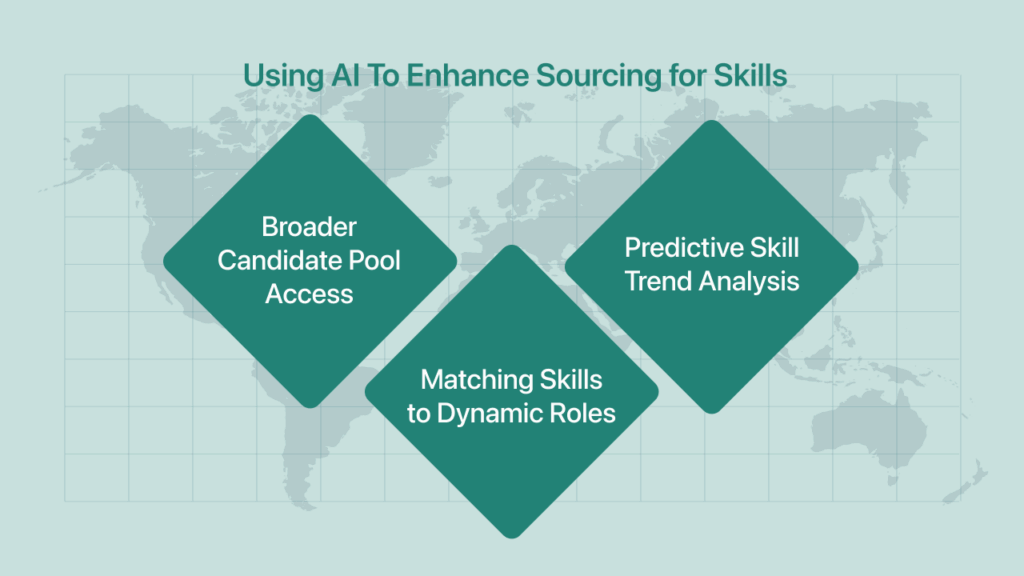
The Sourcing Function lays the groundwork for skill-based recruitment, and as such, AI has transformed it into a much more proactive and smart outreach process. With the base of skills using AI in recruiting, companies can engage with a much wider talent pool and thus identify and onboard the right people in a quicker fashion.
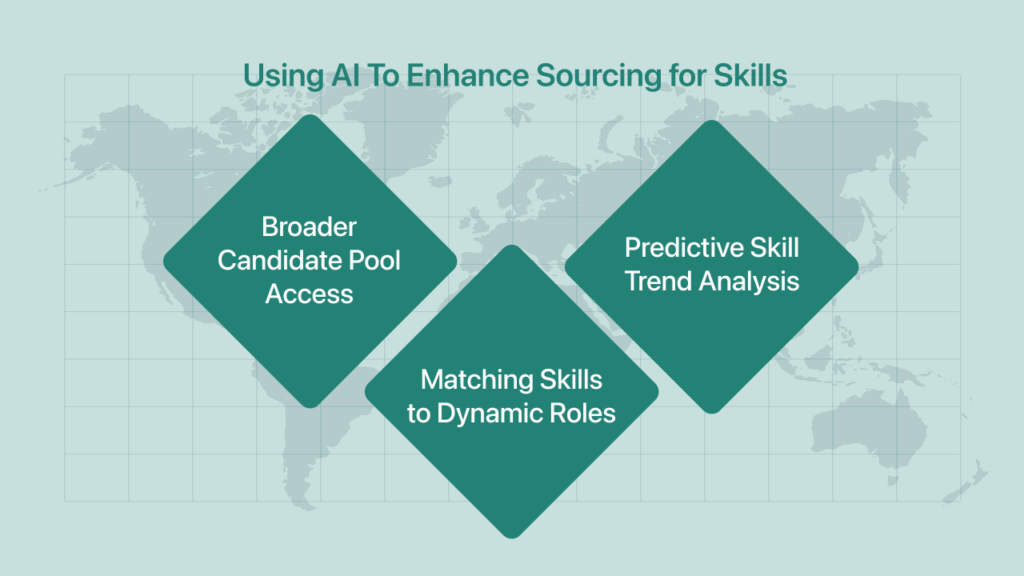
Broader Candidate Pool Access
The major plus for AI in sourcing is to blast through the narrow filters employed by the traditional sourcing approaches. With more companies eliminating four-year degree requirements, many individuals from different backgrounds may now be considered.According to McKinsey & Company, a skills-based recruitment approach can produce an increase in candidate applications by 100 percent. AI technology allows you to manage that outreach to ensure that no right candidate is overlooked.
Matching Skills to Dynamic Roles
In a fluid work environment, job descriptions are in constant evolution. AI excels at mapping the fluid dynamic skill set of an applicant to the specific and ever-evolving requirements of a given role. Rather than engage in a static search, AI platforms can continue to scan incoming talent databanks and match that information against the real-time skill demands of a project or team. You are not filling a role, but rather acquiring the exact capabilities necessary for success in that specific project.
Predictive Skill Trend Analysis
The predictive powers of AI present the stakeholders with a very high strategic advantage. By integrating hiring trends, market data, and internal workforce skills, AI could tell what skills would be in the highest demand in the future. This allows entities to secure a pipeline and pre-emptively initiate hiring campaigns for the skills they would be in need of, giving them the cutting edge to remain in front of their competitors and consistently entertained with qualified talent.
How Can AI Reduce Bias in Skills-Based Hiring? ⚖️
One of AI’s great advantages, perhaps the greatest really, is the ability to mitigate the impacts of unconscious bias systematically in recruitment. Recruitment done by humans is laden with all sorts of subjectivity, prejudice, and sometimes outlandish biases. AI provides a standardized and objective framework to assess candidates, thereby leading to fairer and more just hiring outcomes.
Objective Skill Evaluation
AI systems evaluate candidates using a common standard. Evaluation procedures rely exclusively on the match between the candidate’s skills and job specifications, excluding identifiers, such as a candidate’s name, gender, or age, that can trigger such unconscious biases. Thus, individuals are judged on merit with an inconsistency of individual biases; hence, it is a fairer procedure.
Minimizing Human Prejudices
Even the most brilliant and infamous human biases can inevitably come to bear upon decision-making, often without one’s conscious awareness. For example, the halo effect may afford a candidate from a top-tier university some leeway in being favorably looked upon by a recruiter. By conducting the initial screening and assessment of candidates using an AI-powered platform, organizations can eliminate some of the emotional and cognitive biases from their processes.AI provides blind, impartial analysis, giving human recruiters an opportunity to pay attention to higher-level engagement with candidates based on a much more objective shortlist.
Fostering Diverse Talent Pools
Of course, the elimination of bias encourages a more diverse and inclusive hiring process. By concentrating on skills and potential, companies are able to reach out to talent pools that have largely gone unnoticed. This will create a workforce with an abundance of varying perspectives and experiences.From this research, the key takeaway indicates businesses with diverse teams are 1.4 times more likely to see higher revenues, thus creating a strong business case for diverse hires.
How Does AI Streamline the Candidate Journey? 👋
It became essential to have a good candidate experience in a more competitive market. A good candidate may be lost in a long, tedious, frustrating application process. Streamlining the candidate life cycle through AI makes the candidate experience more efficient, engaging, and personalized.
Personalized Skill-Based Matching
AI tools can instantly analyze the candidate’s profile and match him with those open roles that fit his unique skills. The candidate then receives highly relevant job recommendations, thus increasing his engagement and the likelihood of applying. The personalized approach makes candidates feel seen and valued and improves impressions about your brand from the very beginning.
Efficient Interview Scheduling
These can handle the very tiresome duty of scheduling interviews and, unfortunately, think of it as yet another administrative responsibility. These two could be AI-enabled, negating the necessity for recruiting to function as the gateway into the candidates and communicating around a spammy type of discussions with real-time updates. These tools can easily be attached to a candidate despite the 24-hour schedule. Later on, they can arrange a time acceptable to all and send standardized reminders. Reducing the time taken to hire, making this a very smooth and professional experience for all candidates. It frees up the recruiters to engage in more meaningful and human interactions.
Targeted Communication for Skills
AI can assist in a better conversation between a company and its candidates. Based on a candidate’s skills, combined with interests, AI can generate targeted personalized messaging for recruiters, explaining to candidates, for example, why skill-based recruitment is relevant in this particular role. That will further exercise the compelling targeting value proposition.
What are the Benefits of AI-Driven Skills-Based Recruitment?
Concrete benefits capable of affecting a company’s bottom line and long-term success are attributable to the adoption of an AI-powered approach to skills-based recruiting. It is worthwhile to note that this is indeed a strategic investment, considering the dividends paid in terms of quality of the recent hire, efficiency, and adaptability.
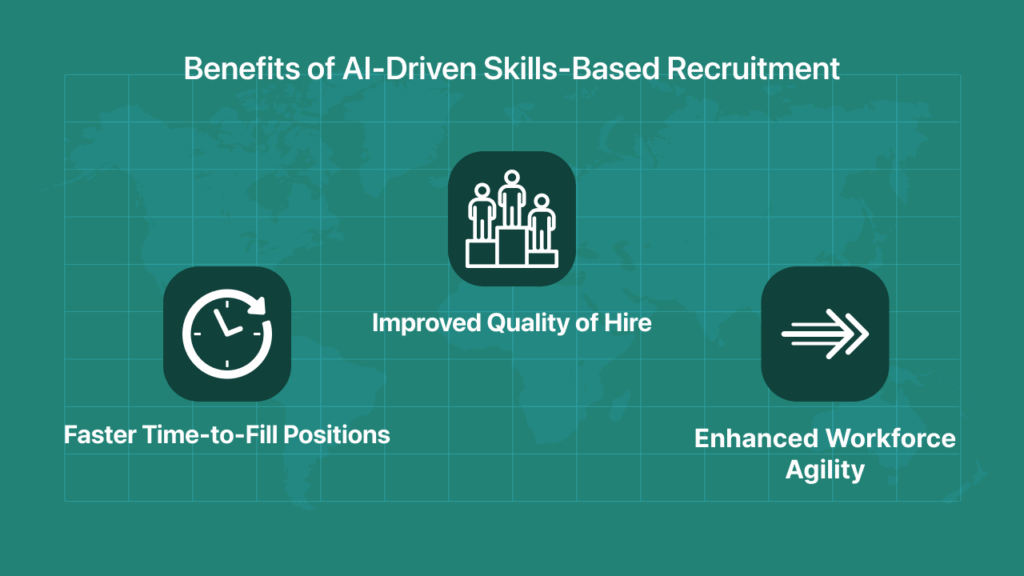
Improved Quality of Hire
Companies can now ensure that they are hiring the right person with the right skills for the job by relying on objective skill assessments. Thus, better quality of hire inversely relates to employee performance, productivity, and business growth. When a match between an employee and the organization’s needs is on, there is a strong likelihood that they will be happy in their jobs.
Faster Time-to-Fill Positions
AI automation hastens several recruitment steps, from sourcing and screening to scheduling. This accelerated filling of open positions is crucial for any competitive market. According to research from SuperAGI, AI can decrease a company’s time-to-hire by an average of 25%, enabling teams to remain fully staffed and productive.
Enhanced Workforce Agility
Typically, skills-based recruitment and talent pools tend to be more agile. When you know the entire constellation of skills in your organization, talent can move easily to new projects or respond to changing business needs without the long, complicated, and often expensive process of outside hiring. This level of overall agility enables covered organizations to better respond to sudden challenges and equally sudden opportunities.
Case Study: Companies Succeeding with AI and Skills 📊
Skills-based hiring is one of the AI-enabled vectors that has been seen to do wonders in adjustment.
Example 1: Large Tech Company’s Approach
One of the very few tech companies decided to widen its engineering talent pool and began to do so beyond the traditional academic avenues. The previous hiring process often sowed away other very skilled self-taught engineers. A skill-based hiring platform was then rolled out, using an AI portal to screen coding portfolios and give blind problem-solving tests. The AI completely stripped away any shred of personal information, focusing entirely on the code provided by the candidates and the approach applied to the problem. In doing so, the number of qualified hires from diverse and nontraditional sectors grew by leaps and bounds. Their systems eventually led to a stronger focus on skills than on former academic awards, and thereby innovative and representative engineering teams have come into being. Hiring based on skills has thus directly transformed the composition of engineering teams within the company.
Example 2: Global Consumer Goods Company’s Transformation
The finding was a gigantic task at Unilever, a consumer goods company, which had to process over 1.8 million applications each year. The conventional procedure was slow, expensive, and inefficient. As a solution, an AI-hiring platform was integrated, applying gamified assessments complemented by machine learning to assess candidates’ skills and traits for entry-level roles. The AI was uniquely able to assess candidates’ abilities, without human bias, and correlate them with job requirements. This skill-based recruitment assessment allowed Unilever to reduce its time-to-hire from months to just a few weeks. More importantly, it brought in a more diverse talent pool, demonstrating the true potential of AI to enhance speed and efficiency in hiring at scale.
Implementing AI for Skills-Based Recruitment 🛠️
Streamlining skills-based recruitment through AI actually calls for a well-planned and strategic undertaking. It is not just getting the new technology; it is a complete turnaround in your organization’s perception of talent. You do well to implement it properly.
Integrating AI Tools with ATS
The most practical first step is one where any new AI platform integrates smoothly with your Applicant Tracking System (ATS). That way, the smooth transition of data from one system to another will be achieved without disruption, and most importantly, all the talent information will be centralized. Besides, it increases the chances for the recruiters to utilize the powers of AI within the workflow they are already familiar with, leading to greater adoption as well as efficiency.
Defining Required Skills Accurately
The efficiency of an AI-led system is based entirely on the quality of information provided to it. It is thus important for companies to accurately define certain skills and competencies needed in every role. From there, vague descriptions of job qualifications will change into a meticulous breakdown of what capabilities bring success within that job period. Such specificity is imperative for the AI to conduct precise and relevant matching.
Training for Recruitment Teams
AI-supported recruitment is all about humans working with machines. Hence, recruiting teams must be trained on how they will be using the new AI tools properly. In this way, their jobs will shift from manual pre-selection to acting as strategic advisors, interpreting AI insights, and interacting with high-potential recruits to develop significant relationships. Such strategic collaboration is essential in extracting the most from the new system.
The Future of Skills-Based Recruitment with AI 🌟
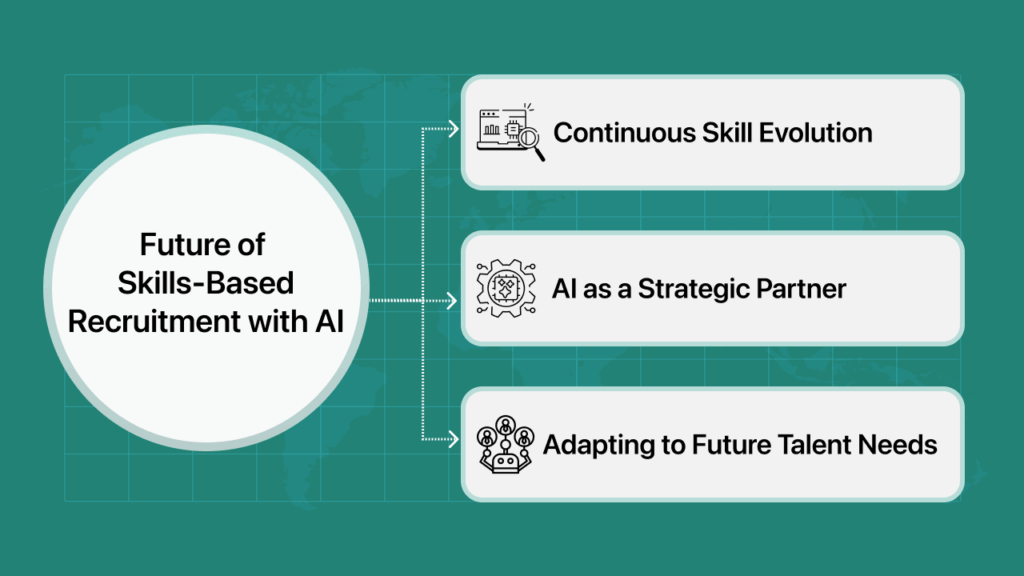
Skills-based recruitment is not a trend but the future of talent acquisition. The revolution will continue as AI evolves with better sophistication in tools and insights used in defining this field.
Continuous Skill Evolution
The global economy is changing, and so are the skills that will make a person successful in it. Artificial intelligence will assume its major role in helping companies ride on that curve. In real-time updating, AI will keep searching for new skills and trends. AI also provides organizations with data to plan their hiring and training strategies proactively. Thus, the workforce of a company is always in line with the market.
AI as a Strategic Partner
AI does not replace human recruiters; it enhances their roles as strategic partners. Automating activities such as sourcing and screening frees the recruiter to focus on the more human-centric aspects of the business. It helps in building an employer brand and fostering authentic candidate relationships. This collaboration is the new standard for productive talent acquisition.
Adapting to Future Talent Needs
Those companies that move toward skill-based recruitment through AI will be able to face the future well. They will have a clear view of the capabilities of their workforce and will be able to easily identify what forms the skill gaps of the future. Long-term competitiveness is guaranteed by this proactive approach. This drastically shapes a talent pipeline that is robust, diverse, and ready for whatever the future has in store.
Conclusion
Changing from skill-based recruitment is not an ephemeral tendency but rather a central and necessary shift in the manner in which organizations find and acquire talent. AI is the essential technology making this transition possible, for it enables hiring that is objective, efficient, and equitable. By focusing on the actual capability of a candidate and potential, a company could construct a productive workforce. One, that is not only very competent in the present but also agile and ready for challenges in the near future. Adoption of this AI-enabled approach to skills-based recruiting will go a long way in establishing a competitive edge in today’s economy.
FAQs
By standardizing the process, AI lessens bias in any selection. The candidate is assessed against predefined skills and criteria; without any personal demographic knowledge to influence the result, a fairer and equitable selection comes into the picture.
Skill-based recruitment is a process of hiring any individual based on proven skills and capacities rather than a traditional educational degree or experience. So, here a person’s ability is focused on his or her competence to perform, rather than on school or job titles.
An AI cannot replace recruiters. Rather, it is a very powerful tool that automates routine tasks such as screening and scheduling, thereby providing recruiters with the time needed for more strategic and high-value activities such as engaging with candidates and managing relationships.
AI skills-based recruitment brings in optimal recruitment, fast fill rates, diverse talent pools, and a nimble workforce by proactively predicting future skills deficits.
For organizations, the allocation of perimeter skills needed per role, embedding AI-integrated assessment into hiring processes, and training recruitment teams on how to work with the new technology could become the starting point.
About Us
ValueMatrixis an AI-powered talent intelligence platform that helps companies hire better, faster, and without bias. We go beyond resumes to assess skills, behavioral traits, and cultural fit using advanced AI and proven psychological frameworks. Our platform delivers data-driven insights that improve hiring accuracy, reduce time-to-hire, and elevate candidate quality.
ValueMatrix AI enables hiring teams to make confident hiring decisions and build high-performing teams at scale.