

The New Frontier of Authenticity in Hiring
The expansion of AI writing tools has introduced a new issue in talent acquisition: the upsurge of AI-generated resumes in recruitment. Although these technologies can assist job seekers in articulating their past experiences, they potentially jeopardise the integrity of the hiring process by erasing rightful levels of skill or by providing ordinary and unoriginal applications instead. This post elaborates on how AI-based advanced screening platforms are adapting to the niche of intercepting AI-generated resumes, and in this way, they let organisations confidently analyse authentic talent. While speaking less about the legal paraphernalia in the ways of screening AI-generated resumes for the hiring strategy. The concept of their detection by lead managers essentially necessitates the building of a level playing field as regards hiring in both equitable and efficient manners.
The Urgency of the Shift: From HR Manager to Growth Manager
Nowadays, HR management is asked to do much more than mere traditional HR management. Setting talent to grow is next to impossible now, and organisations are under tremendous pressure to keep top talent filled to the brim with thirst for development and personalised growth. It is a mandate that demands a transformation—HR managers stuck in the reactive journey are pushed to alternatively put on the mantle of the Growth Manager. The Growth Manager is a strategic union of human talent possessed by those who are looking forward to progressing simultaneously with the utilisation of advanced talent intelligence to coach, develop, and inspire from here, changing the employment prospects of teams through AI-retention.
Did this shift call purely for a different title, as stressed by our organisation, let’s say HR? It is not the semantics but our aggressive battle against high turnover costs and the urgent need to groom a workforce that will stay resilient for the future, and whose employees feel that they belong here and that they can build themselves beside us.
1. The Rise of AI-Generated Resumes in Recruitment: A Double-Edged Sword
The generation of AI-designed resumes in recruitment holds within itself opportunities and challenges. AI tools may well bring about effective resume presentation; however, in terms of evaluating whether an applicant contributes something to the job at hand, it also slaps an entirely new level of complexity into the face of the recruiter.
We all know very well that working with generative AI platforms has enabled many to create a polished-looking resume in minutes, and these activities are now increasing at a rapid pace, in 2024-2025. To that end, they are as follows:-
The Benefits
- Accessibility: Helps non-native language speakers or those challenged with writing to construct clearer resumes.
- Efficiency: The resume-writing procedure is accelerated for candidates.
- Optimisation: Job-specific resumes can be created, thereby increasing the number of keyword matches.
The Challenges
- Lack of Authenticity: Genuine identity may not be analysed, more so the candidate’s true voice.
- Generic Content: AI can create content that is too general and offers little specific meaning.
- Misrepresentation: Candidates might inflate their skills or experiences through very convincing AI narratives and then coast through the hiring process.
The rise of AI-generated resumes in recruitment, therefore, calls for more AI-powered detection processes.
2. Why Detecting AI Resumes Is Critical for Hiring Integrity
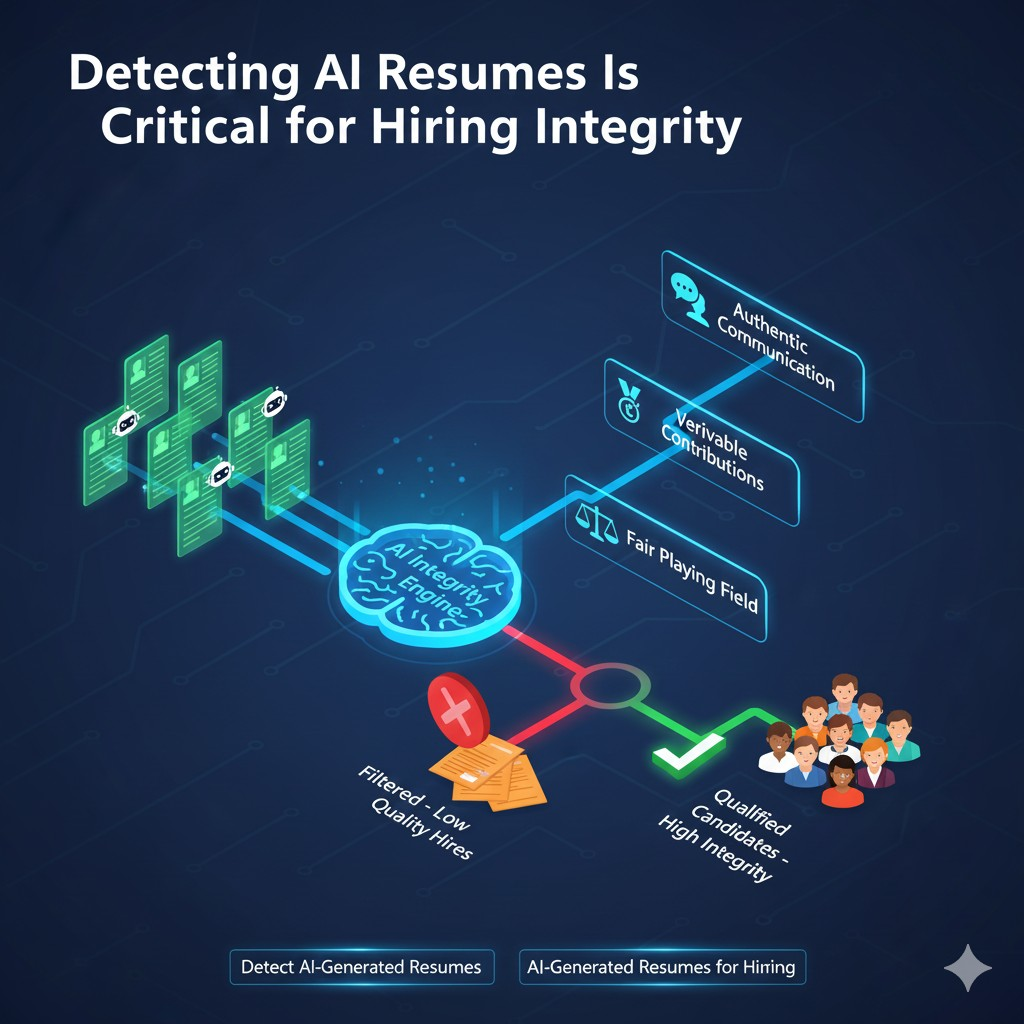
Finding AI-generated resumes in the hiring process is crucial in maintaining the integrity of the recruitment process. It is thus important for both organisations and job seekers to make sure that the evaluation is being done solely on their genuine skills and experience, not on any resume being overly crafted by AI.
This could be a curse. Hiring a highly qualified candidate who doesn’t quite fit into the company’s culture results in a serious lack of synergy!
Assessing True Communication Skills
A candidate’s ability to express his/her thoughts is the strongest indicator of his/her job performance. AI can mask these shortfalls cleverly.
Verifying Unique Contributions
Authentic resumes will tell you about actual projects and results. AI usually fails to apply genuine originality or meaning to this.
Ensuring a Fair Playing Field
Should some candidates use some AI tools to bend the fairness of the process, it causes a massive slip in that trust!
In conclusion, AI-generated resume detection is a must to create well-aligned, authentic teams of the highest performance.
3. How AI-Powered Screening Works: Beyond Keyword Matching
In contrast to traditional keyword checking, AI-generated screening for identifying AI-resumes goes a long way. Modern systems use natural language processing to analyse stylistic patterns of creativity, semantic anomalies, and consistencies, and differentiate human creativity from its own generated text.
First-generation AI was built only to work on keywords, whereas the latest one is deep into language structures and original thinking behind it.
Stylometric Analysis
Looks at common patterns in AI writing, including sentence structure, word repetition, and non-human phrases.
Semantic Cohesion
Checks whether content follows naturally and logically, or looks more like a patch-up job of optimised phrases.
Originality Scoring
Compares the document to known databases of AI-generated content or generic templates to see if there are possible matches.
In conclusion, the sophistication of AI detection now matches the sophistication of AI generation, creating a new arms race in talent acquisition.
4. Specific Technologies to Detect AI-Generated Resumes
Advanced technologies enhance the detection of AI-generated resumes by more accurate deep learning methods. Going beyond surface checks, these tools analyse writing style along with linguistic features and contextual coherence within the document.
The AI detection tool market is evolving very rapidly, with some key technologies emerging as front-runners.
Large Language Model (LLM) Fingerprinting
Detects the “fingerprint” generated by certain forms of generative AI through analyses of probabilistic word choices and stylistic markers.
Semantic Irregularity Analysis
Digs out sentence constructions that are grammatically correct but semantically odd or statements with no particular verifiable details.
Cross-Referencing Tools
These make connections to outside databases or social media profiles to cross-check assertions with inconsistencies normally produced by an AI.
Therefore, the deployment of these specialised technologies must become a priority for every organisation that believes in performing authentic hiring.
5. The Impact on AI-Generated Resumes for Hiring Decisions
Conventional recruitment and the usefulness of AI-generated resumes give us a major turning point. AI may very well polish our presentation of important statements about humanity, but totally cutting off human touch could lead to an unsound decision-making process in hires produced by only AI-based models.
Having a pre-flag for AI, at that very moment, opens up another segment to truly evaluate candidate compatibility and aptitude.
Enhanced Scrutiny
High emphasis will be placed on later stages of the recruitment process, i.e., interviews, portfolios, and work checks.
Re-evaluation of Writing Samples
Upon the formulation of such an AI-flagged resume by recruiters, they might ask for additional essays or writing samples from candidates to better evaluate them.
Emphasis on Verifiable Achievements
A further shift will, from that time on, focus more upon tangible results and specific project details that AI, in all likelihood, cannot fabricate.
In conclusion, the rise of AI-generated resumes means that every stage of the hiring process needs to be designed to probe for genuineness.
6. Building a Multi-Layered Defence: A Strategic Approach to Screening
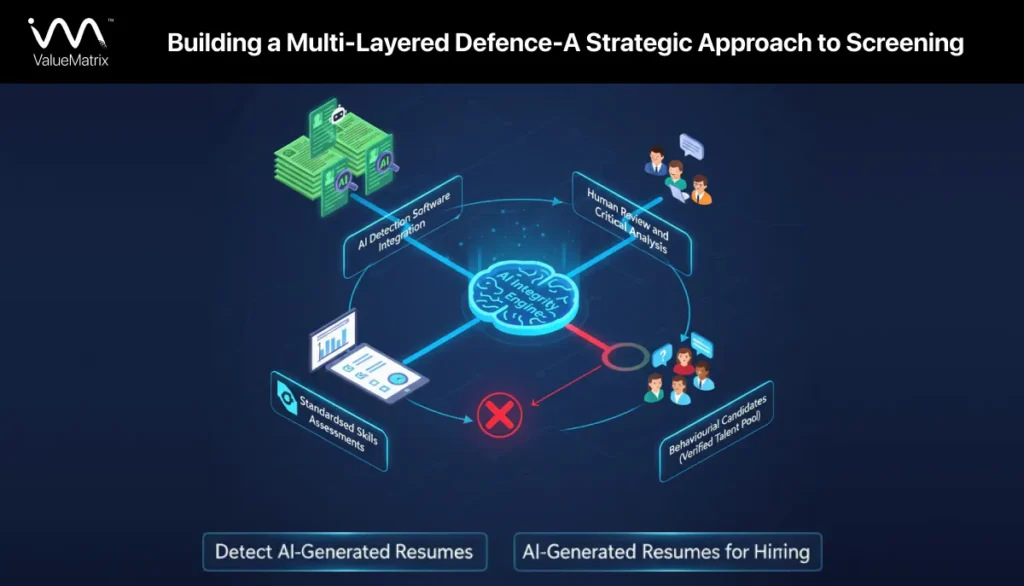
The most effective strategic approach to screening AI-generated resumes in recruitment is to apply a multi-layered defence. Such a combination sets up integration of AI detection tools, human revision, standardised testing, and sound interviewing techniques to ensure comprehensive assessment.
No single tool or method is free from errors. A more encompassing approach builds in checks at different points in the hiring process to endorse credibility.
AI Detection Software Integration
Adopting dedicated software tools to flag suspicious resumes at the primary screening level.
Human Review and Critical Analysis
Recruiters would be educated to identify several flag distributions indicating AI input, such as generic language, the absence of personal voice, and almost perfect grammar.
Standardised Skills Assessments
Skill assessments that use objective tests to measure capabilities instead of simply relying on what a resume states.
Behavioural Interview Techniques
Generating interview questions that examine particular past actions and problems thus increases the difficulty for candidates who are reliant on AI-produced content.
This means that parameters on hiring can be strengthened through a layered approach.
7. The Ethical Imperative: Balancing Innovation and Fairness
The ethics governing the use of AI-generated resumes for recruitment provide GMs with a buffer zone. While AI acts as a viable support system for the applicants, the employing parties have to stick to fairness, ensuring that their tracking mechanisms do not inadvertently punish diverse candidates or those who actually require support in writing.
This balance between being ethical in AI generation and its detection will be the call of Growth Managers.
Transparency
To make it clear to candidates that AI detection tools are in use, and to explain what is acceptable.
Avoiding Bias in Detection
The detection algorithms should not, in an unfair manner, flag resumes by foreign workers or by applicants with learning differences.
Education
Providing such candidates with information on AI tools and how they can use them appropriately while keeping to authenticity.
In conclusion, an ethical framework ensures that AI remains a tool to ensure fairness and not act as an obstacle.
8. Advantages of Proactive Detection for Talent Acquisition
On the other hand, proactively identifying AI-generated resumes in recruitment can serve as an advantage for talent acquisition, considering that it results in better hires and decreases the time spent with the wrong ones. Thereby, enhancing the employer brand trust by grounding itself firmly on transparency principles.
Detecting AI shall be deemed the long-term health of the integrity of its talent pipeline.
Higher Quality of Hire
By turning down generic or fabricated resumes, a candidate with skills and unique experiences would remain the sole focus of a recruiter.
Streamlined Recruiter Workflows
Reducing time in unauthentic application reviews would, in turn, contribute to increased engagement with really qualified candidates.
Enhanced Employer Brand
Companies that are famous for following strict and fair recruitment procedures and policies attract highly qualified professionals to work with them.
In conclusion, the proactive nature of detection will make sure that your recruitment process is evermore robust and resistant in this age of ever-changing technological trends.
9. Future Trends: The Evolution of AI in Resume Generation and Detection
The future of AI-generated resumes in recruitment and their subsequent detection practices will form a kind of technology-driven cat-and-mouse scene. As generative AI becomes more sophisticated, so too will the methods to detect the AI-generated resumes, thus pushing the boundary of authenticity in hiring processes.
Now the challenge is not static, and both sides of AI evolution will move unpredictably fast.
Emergence of “Humanisation” Tools
Artificial humanization of the generative text in future AI systems will push detection processes to be much more evolved.
Biometric and Behavioural Analysis
What is expected in future detection is the inclusion of analysis of digital footprints of the candidate or, for even further verification of authenticity, eye-tracking during online assessments.
Collaborative Detection Networks
Networking in the industry, trying to offer each other insights and strategies to detect new AI forms of content.
In conclusion, there is a need to continuously adapt with cutting-edge AI detection to remain in the lead.
Conclusion: Securing Trust in a Hyper-Automated World
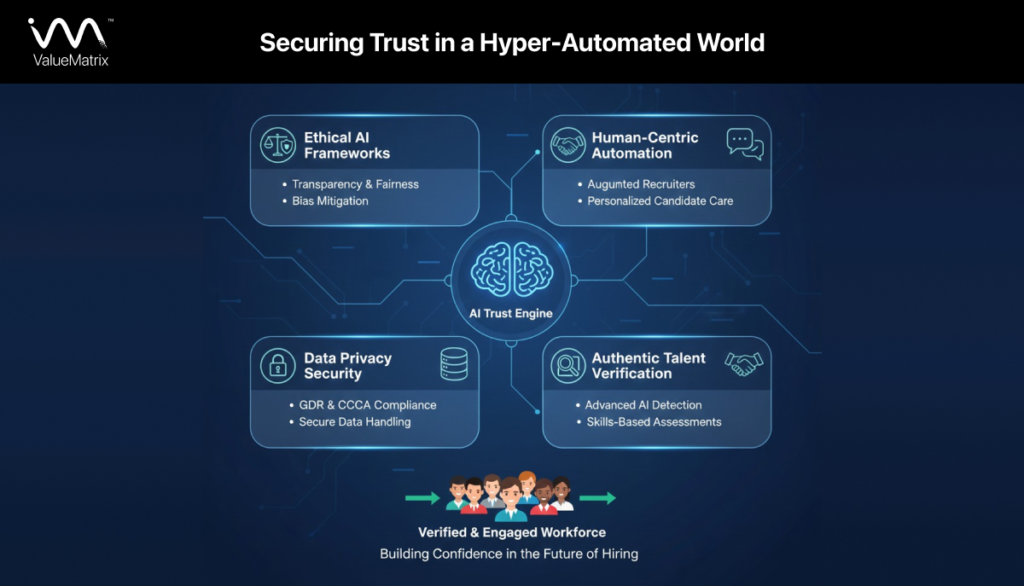
AI-generated resumes in recruitment are an eye-opening testament to the paradigm shift in talent acquisition. What once seemed to be an aloof Growth Manager concern- detecting AI-generated resumes is not a niche in a prominent place. Rather, the very foundation of integrity in hiring is dependent on putting all of AI to approval through numerous configurations and ethical checks so that AI is geared toward hiring strategies. Detecting AI-generated resumes finds organisations cultivating genuine talent, in turn, building trust, and ultimately granting a higher-quality hire by surviving amidst a world of automation.Key Takeaways and Solutions: A Summary Table
| Challenge | AI-Powered Solution | Strategic Benefit | URL Reference |
| Generic AI Resumes | Stylometric Analysis & LLM Fingerprinting | Identifies unoriginal content, highlights authentic voices. | Turnitin: AI Writing Detection |
| Misrepresentation | Semantic Irregularity & Cross-Referencing Tools | Verifies claims, detects inconsistencies beyond keywords. | Vervoe: AI Recruitment Software |
| Loss of Authenticity | Multi-Layered Defense (AI + Human + Assessments) | Ensures genuine skills are assessed, not just AI-generated prose. | HireVue: AI-Powered Assessments |
| Maintaining Fairness | Ethical Frameworks & Bias Mitigation in Detection | Protects diverse candidates and upholds the integrity of the process. | IBM: AI Ethics in HR |
Statistics: The Data Behind AI Resume Trends
| Source | Insight | Key Figure | URL Reference |
| Resume Builder 2024 | Job seekers are using AI for resume creation. | 59% of job seekers. | Resume Builder: AI Resume Survey |
| Deloitte Global 2025 | Importance of verifying candidate authenticity. | 85% of organisations. | Deloitte: Global Human Capital Trends 2025 |
| SkillSurvey/Talent Board 2024 | Impact of unauthentic applications on hiring quality. | 25% lower quality hires. | Talent Board: Candidate Experience Report |
| Forbes HR Council | Recruiter confidence in detecting AI-generated content. | Only 30% confident. | Forbes HR Council: AI in Recruiting |
FAQs
The reputed AI tools are meant to differentiate between minor grammar assistance and large-scale AI generation. They are more stylistic than simple proofreading, so they will detect AI-generated resumes quite a bit differently from typo-ridden ones.
A flagged content should be an opportunity for further examination, not an automatic “no.” It should trigger human review, ask for writing samples, or use more extensive interview questions to determine the actual skills.
With the development of generation tools by AI, detection methods are also altered. In fact, this is an endless cycle. Ultimately, the safest and best strategy for AI-generated resumes for hiring involves a multi-layered defence, i.e., AI, human review, and rigorous assessments.
It should be possible for organisations to develop clear and formal guidelines on their career pages, indicating to candidates that they could create an AI editing tool instead of letting it be a primary content generator. This addition could emphasise the importance of building their authentic voices.