

Table of contents
- The Problem with Traditional Internal Mobility
- What Makes AI a Game Changer for Internal Mobility
- How AI Personalizes Career Paths in Practice
- Strategic Outcomes — Retention, Growth & Organizational Agility
- Implementing AI-Driven Internal Mobility — A Practical Framework
- Ethical Considerations and Trust in AI
- Conclusion — Mobility as a Competitive Strategic Advantage
- FAQs
Over the past ten years, internal talent mobility has changed from an ideal HR endeavor to an important part of business strategy. It used to be that HR systems were largely data archives — storing job histories, performance records, and training completions in silos. These systems could document what employees had done, but they weren’t designed to help those employees see where they could go. That isn’t enough anymore.
In 2026, the conversation has changed. Employees desire career growth that feels real and personal, not merely programs that check off boxes. They want to know what’s coming up, get individualized advice on what skills are vital, and comprehend how their efforts to study can lead to real chances. This is hard for traditional methods to do since they depend on static job descriptions and manual reviews.
This is where intelligent systems are making a measurable difference. Research shows that solutions enabling personalized career pathing — tailored to an individual’s skills and aspirations — can boost employee retention by around 20%. These aren’t vague projections; they reflect a growing body of data showing the value of aligning career development with real pathways inside organizations. At the same time, internal mobility platforms that leverage data and analytics can reduce attrition by up to 35%, giving companies a powerful lever to retain talent that might otherwise walk out the door.
What’s driving this shift isn’t buzz or buzzwords — it’s measurable impact. As workforce volatility rises and the pace of skills change accelerates, organizations that treat internal mobility as a strategic capability rather than an administrative task are beginning to see the difference in retention, engagement, and long-term performance outcomes. Strategic workforce planning isn’t just a phrase anymore — it’s a necessity.
The Problem with Traditional Internal Mobility
For many organizations, internal mobility hasn’t lived up to its reputation as a retention and engagement driver — not because the idea is flawed, but because the approach has been stuck in the past.
Traditional internal mobility tends to lean heavily on subjective signals: manager recall, static job listings, and the occasional suggestion on a quarterly review. In that model, if you’re not on a manager’s radar, you can easily be overlooked — even if you have the skills and drive for new roles. This kind of mobility relies on memory instead of insight, and it’s a big reason why so many talent-management efforts stall before they deliver real impact.
Another challenge is that legacy mobility systems often miss the real gaps in skills and readiness. Job descriptions focus on titles or years of experience rather than the actual capabilities that matter for success in a new role. Employees are left with nebulous growth plans that don’t relate to the work they are enthusiastic about when there is a lack of clarity on skills, both present and future. Because of this, skilled people start to feel stuck, and many hunt for employment outside of their current ones, where they may grow further.
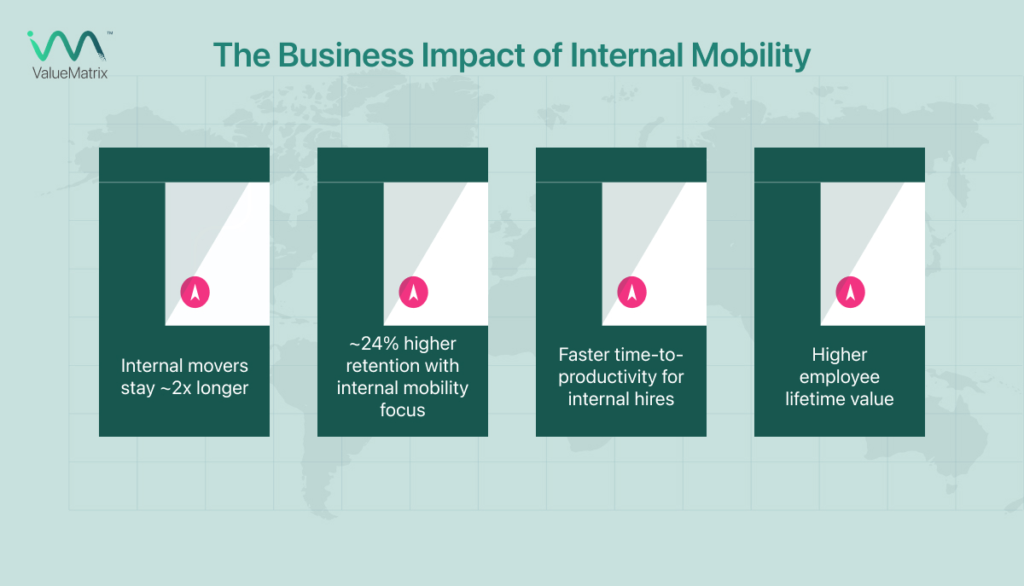
Internal hires stay for an average of 3.2 years, outsider hires only stay for 1.7 years. This shows that when done right, mobility can lead to more engagement and longer retention. Firms that put a lot of value on internal mobility also tend to keep their employees longer than firms that don’t, often by approximately 24%.
Think about these possible benefits in light of the real problems that come with relying too heavily on hiring from other countries. These challenges include greater hiring costs, longer time-to-fill, and cultural adjustment issues that slow down output. People who work today also have greater standards. They want visibility into career paths and clarity around how their skills translate to opportunity. When organizations fail to deliver that, talent quickly discovers greener pastures — not because they don’t like their current company, but because the path forward feels invisible.
We can build more strategic career experiences, but it requires moving beyond old-school mobility to systems that understand people, skills, and opportunity in much deeper and more dynamic ways. This shift in thinking — toward people + data synergy — is foundational to modern talent strategies like those we explore in Driving Talent Management with ValueMatrix.AI.
| Traditional Mobility | AI-Driven Mobility |
| Job titles & resumes | Skills graphs & signals |
| Manager recall | Data-driven recommendations |
| Annual reviews | Continuous insights |
| Reactive backfilling | Predictive redeployment |
| Hidden opportunities | Transparent internal markets |
What Makes AI a Game Changer for Internal Mobility
The limitations of traditional internal mobility aren’t rooted in a lack of intent — most organizations want to create better growth opportunities for their people. The issue is that legacy systems simply don’t have the depth, speed, or intelligence to support mobility at scale. This is the point at which AI significantly alters the situation. It transforms the understanding and relationship between talent, skills, and opportunity rather than merely automating current procedures.
From Static Records to Dynamic Skill Intelligence
In most organizations, employee data is frozen in time — job titles, past roles, performance ratings, and training completions. AI provides a dynamic, changing picture of each person’s abilities in place of this static image. It figures out someone’s skills not just from their formal qualifications or resumes, but also from their daily work, like the projects they work on, the problems they solve, the tools they use, and the education they want.
This helps us get a much clearer and fuller picture of what people can genuinely do and become throughout time. Companies might inquire, “What skills does this person have, and how are they changing?” instead of “What role does this person play?” That shift is minor yet important. It turns internal mobility into a skills-driven system rather than a title-driven one.
Personalized Career Pathing at Scale
Mobility is more than merely connecting people with open opportunities once their skills are clear. AI can tell workers not only where they are currently, but also what they might do next based on their existing profile. This means that career planning is not a reactive process that starts when people leave or when yearly reviews happen. Instead, it is a proactive process that sees change coming and helps people improve before problems happen.
Crucially, this also makes early intervention possible. Leaders can take action before employees quietly leave since AI technologies can identify disengaged or at-risk employees up to 30% faster than previous methods.
Talent Matching That Doesn’t Rely on Manual Bias
Fairness is probably the best thing about AI-driven mobility that people don’t talk about enough. People make decisions based on things like unconscious bias, intimacy, and familiarity. When AI is made right, it thinks about what is important instead of just who is there. It shows off skills that might not be noticed otherwise—people whose skills fit a job even if their title doesn’t.
This is why simple keyword matching systems are no longer enough. Matching “data analyst” to “data analyst” only reinforces existing structures. Skill graphs, by contrast, reveal deeper connections between roles, capabilities, and potential. They show that a marketing analyst might thrive in product operations, or that a customer success manager has the foundation for a strategy role.
That is the real transformation: internal mobility becomes not just easier, but smarter — grounded in real capability, real potential, and real opportunity.
How AI Personalizes Career Paths in Practice
It’s one thing to talk about personalization in theory. It’s another to understand what it actually looks like inside a real organization. AI-driven career personalization isn’t about flashy dashboards or abstract recommendations — it’s about quietly connecting signals that already exist and turning them into something useful for both employees and leaders.
Intelligent Skills Inference
Understanding people’s true abilities, not just what their job title indicates, is the cornerstone of personalization.
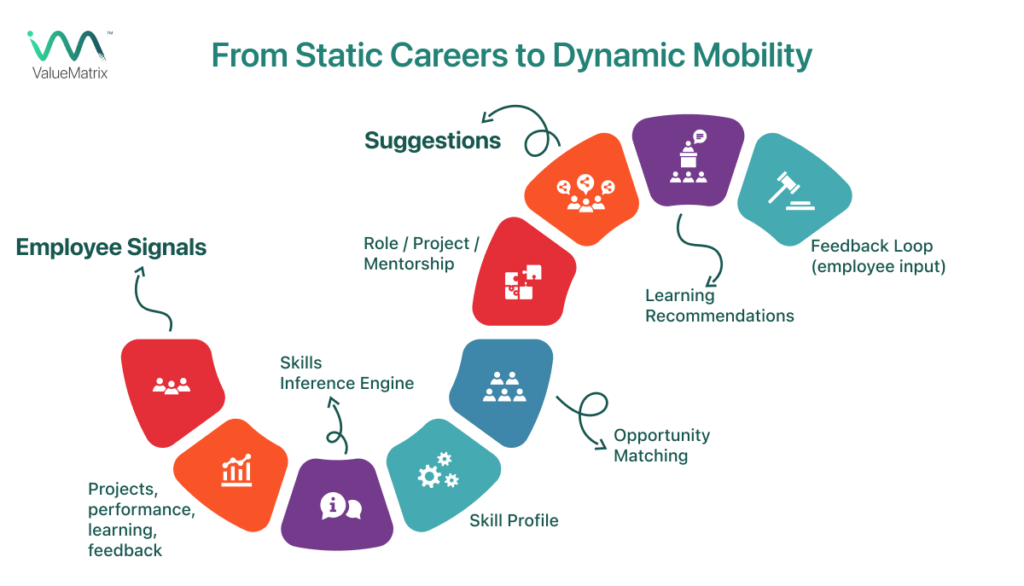
AI learns this over time by looking at a lot of different things, such as the projects a person works on, how well they do in different situations, the feedback they get from their boss and coworkers, and the learning resources they use. None of these things is enough by itself. They all work together to create a picture of a person’s talents, interests, and growth path that changes all the time.
This is a living “career dossier” that shows the truth, not a CV or a static HR profile. Profiles of workers are updated to reflect their new difficulties, skill development, or areas of focus. This means that workers can always get better at their jobs, not just once a year when they get their performance assessments.
Opportunity Matching and Career Recommendations
Once skills are visible, AI can begin to connect people to opportunities in a much more meaningful way.
The system can present roles, internal initiatives, stretch assignments, and even mentorship opportunities that fit with where someone is and where they could feasibly go next, rather than just showing available roles. These are ideas based on the situation, not universal ones. They consider not only availability but also readiness, proximity, and interest.
This kind of guidance is becoming an expectation rather than a bonus. Research suggests that up to 80% of employees will expect AI-driven career development plans by 2025, reflecting how strongly personalization is shaping employee experience expectations. In that environment, offering visibility into potential growth paths is no longer a differentiator — it’s table stakes.
Just as importantly, these recommendations help organizations use their internal talent more effectively. Instead of searching externally for every need, leaders can discover capable people who are already inside the company — people who might not have applied for a role simply because they didn’t realize it was a good fit.
Learning and Development Alignment
Personalization also changes how learning works.
Rather than assigning employees to broad training categories, AI can recommend specific learning experiences tied directly to future opportunities. If someone is close to being ready for a role, learning becomes targeted and purposeful. “Take this course because it’s in your area of expertise,” not “This skill is what’s standing between you and your next step.”
This agreement helps workers understand why they are spending their time and makes learning feel more real instead of abstract.
At its core, this isn’t a search with smarter filters. It’s a rethinking of how careers are designed inside organizations — moving from static ladders to adaptive pathways shaped by real-time signals, real capabilities, and real ambition.
Strategic Outcomes — Retention, Growth & Organizational Agility
AI-powered internal mobility has benefits that go beyond just seeming more modern and personalized. The most important results for leadership teams are how long workers stay, how quickly they become productive, and how well the organization adapts when priorities change.
Retention and Employee Lifetime Value (ELV)
When employees can see the future of their company, they are considerably more likely to put money into it. Personalized career paths send a strong message: you are noticed, you are respected, and there is room for you to flourish here. A lot of companies don’t realize how crucial it is to have a sense of direction.
Retention and internal mobility indices are usually very closely linked. Employees who transfer within the company usually stay far longer than those who are hired from outside. In fact, internal movers usually stay almost twice as long. The difference gets worse over time. Longer tenure leads to stronger relationships with clients and coworkers, lower hiring costs, less disruption, and a deeper understanding of the organization. Higher employee lifetime value is a direct result of all of those factors.
Mobility also alters people’s perceptions of their employers. Employees feel invested rather than controlled or moved around. Although it is hard to measure, that emotional shift is one of the most powerful motivators for loyalty and engagement.
Faster Time-to-Productivity
External hiring is costly due to ramp-up time as well as recruitment fees. It takes time for even the most skilled external hire to become familiar with the internal procedures, clients, systems, and culture of the company.
Internal hires already have that context. They know how decisions are made, how work moves from one team to another, and what “good” looks like in the company. When people move into new responsibilities at work, they normally become more productive more quickly and with less trouble. Speed is important, particularly in settings where priorities change frequently, and execution delays can be expensive.
Workforce Agility
Agility is probably the most important strategic outcome.
Organizations today work in a world that is always changing. New technology, changing client needs, and new skill requirements are all examples of this. AI-driven internal mobility lets employees be moved and retrained in response to these changes, instead of waiting until the gaps grow too big.
Leaders may plan ahead instead of putting out fires by recognizing what skills are already in the workforce and how to improve them. This is where internal mobility becomes inseparable from strategy, a point explored further in [Strategic Workforce Planning with AI]. Predictive insights and tailored mobility make a workforce that is not only stable but also flexible.
Also, in 2026, you need to be flexible.
Implementing AI-Driven Internal Mobility — A Practical Framework
Moving to AI-driven internal mobility doesn’t require a massive, risky transformation. It needs to be clear, organized, and able to see mobility as a system rather than a bunch of discrete tools. Most successful businesses start off small, build strong foundations, and then grow steadily.
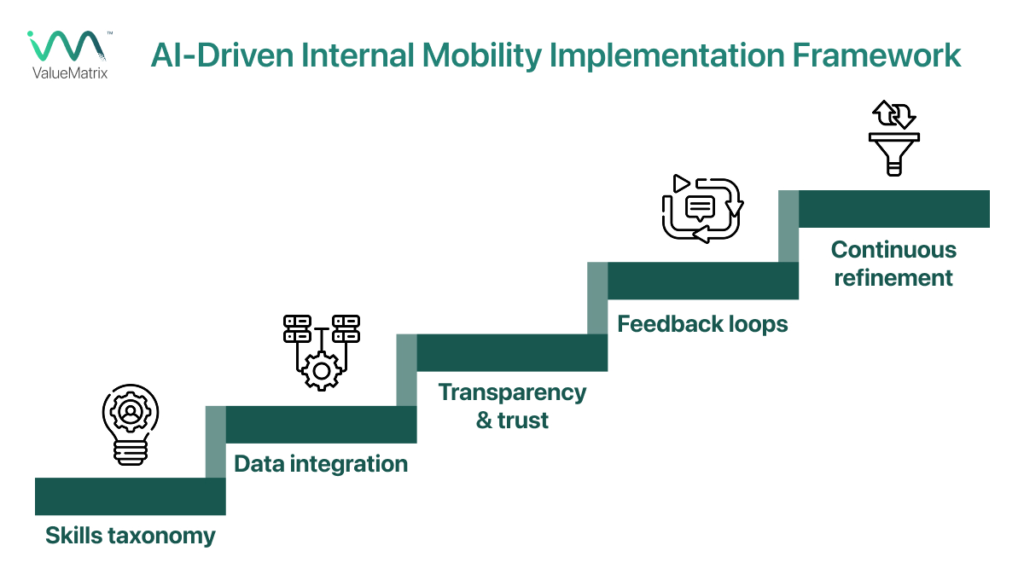
Start with a Skills Taxonomy
The first step is shifting the organization’s language from roles to skills.
Job titles are blunt instruments — they vary across teams, geographies, and managers, and they rarely reflect what someone actually does. On the other side, a skills taxonomy gives the whole firm a common language for its skills. It doesn’t have to be perfect right away. The important thing is that it may alter and expand.
Begin with the most crucial skills for your plan, such as leadership, technical, and domain expertise. You can make things better over time when you see patterns. This becomes the backbone of career pathing, opportunity matching, and workforce planning.
Centralize Real-Time Data
Personalization depends on signals, and signals only matter if they’re connected.
Performance data, learning activities, project participation, and HR records frequently reside in distinct systems. AI can only do as well as the information it has access to. Putting these sources together shows patterns, such as who is getting bigger, where skills are gathering, and where gaps are appearing.
This doesn’t entail starting from scratch and developing a huge new system. In a lot of cases, it means linking up what is already there and making sure that data moves safely and consistently between platforms.
Prioritize Transparency and Trust
If people don’t trust a system, it won’t work, no matter how accurate it is.
Both employees and managers need to know, at a high level, how suggestions are made and how their data is used. This doesn’t mean showing people how algorithms work, but it does mean being clear about your goals and limits. When people can talk to each other clearly, they feel more confident that the system is meant to help them progress, not keep an eye on their behavior.
Studies have consistently shown that AI projects are more successful when HR is part of AI centers of excellence rather than just a user. When HR is involved in the strategic design, adoption goes up and results are more in line with business goals.
Build Iterative Feedback Loops
AI systems improve with feedback.
Encourage employees to respond to recommendations, update interests, and signal when suggestions are helpful or irrelevant. This feedback makes the system better over time and makes customisation more accurate.
This also makes people feel like they are working together: employees don’t just get career guidance; they help shape it.
Technology Infrastructure: Choose Connection Over Complexity
Not all platforms are built for this kind of ecosystem thinking. Tools that only optimize a single function — learning, hiring, or performance — rarely create meaningful mobility on their own.
What matters is choosing solutions that connect learning, talent data, and internal opportunities into a coherent experience. That connective tissue is what turns isolated insights into real career movement.
The goal isn’t to automate mobility. It’s to make growth clear, easy to find, and possible for both people and the organization.
Ethical Considerations and Trust in AI
People have to trust an AI system for it to work, no matter how advanced it is. Trust is not only a “nice to have” when it comes to internal mobility and professional growth; it is the basis for adoption. Employees are being pushed to let systems change something very personal: their jobs. People will overlook such influence if it doesn’t feel fair, open, and helpful.
Bias Mitigation and Fairness
AI systems learn from past data, and history is almost never neutral. If earlier decisions favored certain jobs, teams, or profiles, those patterns might accidentally become stronger unless they are deliberately dealt with. This means that bias mitigation is an ongoing task, not just a one-time setup.
Companies need to check their results on a frequent basis: Who is being suggested for chances to grow? Who isn’t? Are some groups consistently over- or under-represented in internal moves? These inquiries aren’t meant to blame the technology; they’re meant to make sure it fits with the organization’s beliefs and aims.
Transparency in Recommendations
People don’t need to see the math behind every suggestion, but they do need to know why it makes sense. Employees should be able to see why a system offers a role, a learning route, or a project. They should be able to see what skills are needed, what gaps exist, and how that suggestion fits into the bigger picture.
Transparency turns AI from a mystery into a helpful tool. Instead of giving orders, it converts suggestions into conversations.
Employee Consent and Participation
Agency is another thing that affects trust. Employees should be able to choose how their data is utilized and how much AI suggestions affect their growth. The best systems let people participate by letting them say what they want, turn down recommendations, and choose their own routes.
This participation doesn’t hurt the system; it makes it stronger by offering context that data alone can’t show.
Continuous Evaluation and Governance
Ethical AI is not something you “finish.” As companies change and data changes, it needs to be constantly evaluated, governed, and adjusted. This means going back over your assumptions, looking for unexpected effects, and being aware of how systems change behavior over time.
AI can definitely make work experiences better, fairer, and more exciting. But even the best technology could become useless if it isn’t open and designed with people in mind. Ultimately, trust is not a technical characteristic; it is a relational dynamic. And like any other connection, it needs to be formed, kept up, and valued.
Conclusion — Mobility as a Competitive Strategic Advantage
By 2026, internal mobility will no longer be a support function sitting quietly inside HR. It is a strategic capability that shapes how organizations grow, adapt, and retain their most valuable asset — their people.
AI is central to that shift. Not as an extra layer on top of what is already there, but as the smartness that keeps those processes running in a world that is always changing. It links abilities to chances, learning to being ready, and personal progress to the goals of the company. It does this by improving retention, increasing the lifetime value of employees, and giving leaders the information they need to plan forward instead of reacting in a crisis.
When companies have clear talent signals and real-time information on their workers, they don’t have to guess what will happen next. They can identify where new talent is coming from, where there are gaps, and where their money will have the biggest impact. That visibility is what keeps talent pipelines strong for the future. Not by making strict plans, but by establishing mechanisms that can change as the business does.
But the most crucial change might be cultural. Instead of being a series of transactions (like a promotion here and a lateral shift there), internal mobility becomes a living ecosystem of growth. People who work for you don’t have to wait for opportunities to come up. They may see them, get ready for them, and move toward them on purpose.
This is what internal mobility looks like these days. Not a program. Not a policy. But a strategic advantage grounded in data, powered by intelligence, and centered on people.
FAQs
AI-driven internal mobility means using smart technologies to match people with jobs, projects, and learning opportunities based on their changing abilities, performance, and interests, not just their job titles or what their managers say. It makes internal mobility a process that is based on data, open, and tailored to each person.
Most of the time, traditional career planning is done on a regular basis, by hand, and based on roles. AI-driven mobility is always happening, based on skills, and flexible. It changes as people mature, showing them realistic next steps and getting them ready for future jobs instead of reacting after possibilities are missed.
No. AI helps humans make better choices by giving them information and making things clear, but people still make the final choices. Managers, HR executives, and employees are still the most important people in career conversations. AI just makes sure that those interactions are based on facts instead of guesses.
Employees are more inclined to stay with a company if they can see obvious ways to advance and feel like they are being supported in their development. AI makes career growth visible, tailored, and proactive. This helps companies deal with disengagement early and give workers meaningful possibilities before they start looking for work elsewhere.
It can be, but only if it is done right. Fair systems need to keep an eye on bias, be open about their reasoning, let employees have a say, and be checked on often. AI doesn’t automatically get rid of bias; it needs rules and people to make sure it promotes justice instead of repeating old patterns.
Most companies start by developing a skills framework, linking up their current data systems, and testing mobility in one area of the business. Building trust and making sure the system matures in a way that suits the organization’s culture and goals is easier when you start small, are open about things, and get feedback early.